
I still remember the phone call. Tuesday morning, maybe 7 AM my time. A skincare brand founder on the other end, panicking. She’d launched her essential oil serum line six months earlier in what she called “nice clear bottles.” Looked great on her website. Photographed beautifully. Customers loved the aesthetic.
Then the complaints started trickling in. Bottles warping on bathroom shelves. A yellowish tint creeping into the plastic. Weird chemical smell that definitely wasn’t there when she filled them. One customer posted a photo on Instagram of a bottle that had basically caved in on itself. Tagged the brand. That post got shared a lot.
What happened? She’d put an essential oil formulation into PET plastic. PET handles water and soda like a champ. But certain essential oils and high-concentration botanical extracts? They eat right through it. Slowly, invisibly at first, then very visibly.
She didn’t know there were fundamentally different types of plastic bottles because, honestly, who teaches you that? They all look like plastic. They all feel like plastic when you squeeze them at the store. But the chemistry hiding inside that smooth surface determines whether your product stays perfect for two years or turns into a customer service nightmare in two months.
I’ve spent years sourcing packaging from factories in Guangdong and Zhejiang. Walked through blow molding facilities where bottles pop out of machines like popcorn. Argued with engineers about wall thickness tolerances. Watched entire production runs get rejected because someone specified the wrong resin grade. And I keep seeing the same mistakes from brands who don’t understand what these seven little numbers on the bottom of bottles actually mean for their products.
Let me save you from learning this the expensive way.
Table of Contents
| # | Section |
| 1 | Why the Plastic Type on Your Bottle Matters More Than You Think |
| 2 | Understanding Resin Identification Codes |
| 3 | 7 Common Types of Plastic Bottles Explained |
| 4 | Comparison Table: All 7 Plastic Types Side by Side |
| 5 | How to Choose the Right Plastic Bottle for Your Product |
| 6 | Sourcing Plastic Bottles for Your Brand |
| 7 | FAQ |
Those Triangle Numbers Aren’t What You Think They Are
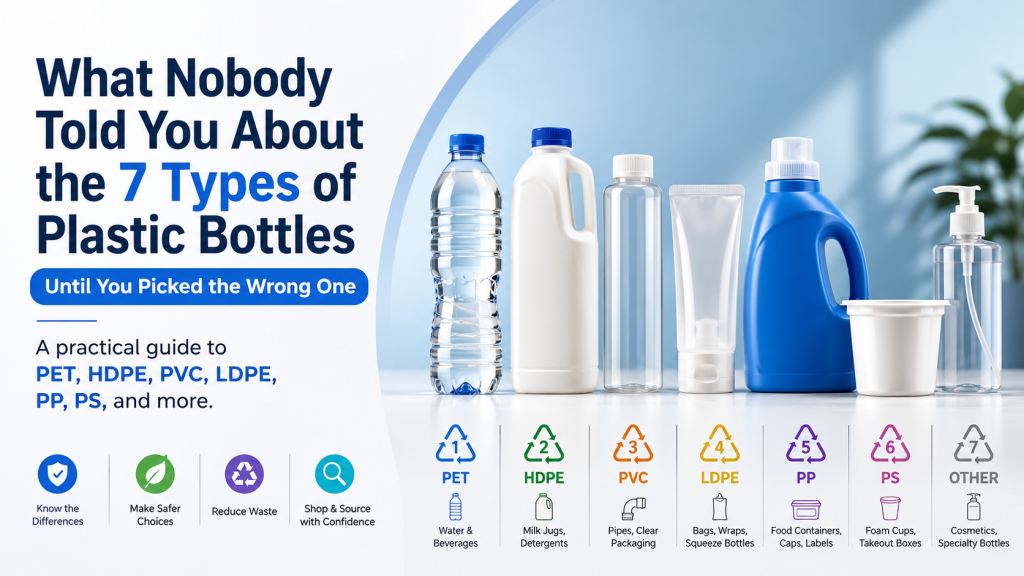
Quick thing before we dive into the seven types. You know that little triangle with a number inside, stamped on the bottom of every plastic container? Most people think that’s a recycling symbol. It’s not. Never was.
It’s a Resin Identification Code. Created back in 1988 so recycling facilities could sort different plastics apart from each other. The triangle shape with arrows was, in hindsight, a terrible design choice because everyone assumes it means “this is recyclable.” Some of these plastics get recycled regularly. Others technically could be recycled but nobody actually does it because the infrastructure doesn’t exist. And a couple of them contaminate recycling streams so badly that facilities would rather you threw them in the trash than put them in the blue bin.
I’ll be straight about recycling reality for each type below. No sugarcoating.
7 Common Types of Plastic Bottles: What’s Actually Inside That Smooth Surface
1: PET, The One You’re Probably Holding Right Now
Polyethylene Terephthalate. Grab any water bottle off your desk. Any soda from the fridge. Flip it over. There’s your #1.
PET took over the beverage world for reasons that make total sense once you understand them. It’s clear. Not sort-of-clear or milky-clear. Crystal clear, like glass, but weighing a fraction of what glass weighs. It keeps carbonation locked inside (try keeping a Coke fizzy in a different plastic and good luck with that). And it’s cheap to produce at insane volumes. I’ve watched blow molding lines in Zhejiang pump out 20,000 bottles per hour from those little test-tube-shaped preforms. Twenty thousand. Per hour. Per machine. And some factories run dozens of machines.
Where PET falls on its face: heat and aggressive chemicals. Fill a PET bottle with liquid above about 70°C and watch it wilt like a flower in August. Put essential oils in it and wait. Put strong alcohol-based products in it and wait. The waiting is the dangerous part because it looks fine for weeks before the degradation becomes visible.
Where you’ll find it: Water bottles, soda bottles, juice containers, salad dressing, peanut butter jars, mouthwash.
What it does well: Gorgeous clarity that shows off whatever’s inside. Lightweight enough that shipping costs stay reasonable. Keeps oxygen out and CO2 in. FDA says it’s safe for food. Recycling facilities actually want it. PET has the highest recycling rate of any plastic, and recycled PET goes back into new bottles, polyester clothing, even carpet fiber.
Where it struggles: Can’t handle heat. Scratches up if you reuse it repeatedly. Certain chemicals degrade it from inside (learned that one from my skincare client). Not great for long-term storage of anything aggressive. Gets brittle in extreme cold.
Recycling truth: This one’s real. PET actually gets recycled at meaningful rates. Your curbside bin accepts it. Facilities process it. It becomes new stuff. One of the few plastics where “recyclable” isn’t just a feel-good label.
2: HDPE, The Tough One Nobody Thinks About
High-Density Polyethylene. The milk jug. The laundry detergent bottle. That big container of bleach under your sink. HDPE doesn’t get Instagram posts or design awards. It just works, year after year, holding chemicals that would destroy fancier plastics.
I think of HDPE as the pickup truck of the plastic world. Not pretty. Not trying to be pretty. But you can throw anything in the back and it handles it without complaining. Bleach? Fine. Motor oil? No problem. Industrial cleaners that would melt PET from the inside? HDPE doesn’t even flinch.
The tradeoff is appearance. HDPE is opaque. You can’t see through it. For products where visual appeal matters, where customers want to see the color of their juice or the shimmer in their body wash, HDPE won’t work. But for products where toughness and chemical resistance matter more than looking pretty on a shelf? Nothing beats it at the price point.
Where you’ll find it: Milk jugs, detergent bottles, shampoo containers, bleach bottles, motor oil, pharmaceutical bottles, some juice containers.
What it does well: Laughs at chemicals that destroy other plastics. Survives being dropped on concrete (I’ve watched factory QC guys hurl filled HDPE bottles at floors during drop testing and they bounce). Handles freezing temperatures without cracking. Handles moderate heat without warping. Doesn’t leach anything concerning into contents under normal use. Recycling infrastructure exists and functions.
Where it struggles: Opaque appearance limits premium positioning. Can absorb strong fragrances over time (ever notice how a detergent bottle still smells like detergent even after you rinse it out?). Won’t hold carbonation. Looks utilitarian, which is fine for cleaning products but tough for luxury brands.
Recycling truth: Second-most recycled plastic globally. Your curbside program takes it. Recycled HDPE becomes plastic lumber, drainage pipes, playground equipment, new bottles. Legitimate second life.
3: PVC, The Controversial One
Polyvinyl Chloride. This is where things get complicated and, honestly, a bit political.
PVC makes a perfectly functional bottle. Good clarity. Decent chemical resistance. Affordable. But it carries baggage that’s driven most consumer-facing brands away from it over the past decade. The chlorine in its molecular structure and the plasticizers (often phthalates) needed to make it flexible enough for bottles have raised enough health and environmental red flags that major retailers have quietly stopped stocking PVC-packaged products.
I still see PVC in some cooking oil bottles, certain industrial chemical containers, and pharmaceutical blister packs. But the trend line is clear. Brands are moving away. Retailers are pushing back. Regulations are tightening. If you’re launching a new product today, I’d steer you away from PVC for anything consumer-facing unless you have a very specific technical reason that no other plastic satisfies.
Where you’ll find it: Some cooking oil bottles, certain pharmaceutical packaging, industrial chemical containers, some cosmetic packaging (declining).
What it does well: Clear. Chemically resistant. Durable. Cheap raw material. Versatile and can be made rigid or flexible depending on formulation.
Where it struggles: Health concerns that won’t go away regardless of industry reassurances. Recycling is essentially impossible in practice because PVC contaminates PET recycling streams (they look similar but behave completely differently during reprocessing). Burns releasing toxic dioxins. Increasingly restricted by regulation. Negative consumer perception growing every year.
Recycling truth: Forget it. Most facilities actively reject PVC. Even a small amount mixed into a PET batch ruins the entire run. If sustainability is anywhere in your brand vocabulary, PVC is a non-starter.
4: LDPE, The Squeezable One
Low-Density Polyethylene. Same polyethylene family as HDPE but with a different molecular arrangement that makes it flexible instead of rigid. Pick up a squeeze bottle of honey or ketchup. That soft, giving plastic that bounces back after you squeeze it? LDPE.
The user experience with LDPE is fundamentally different from rigid bottles. You interact with it physically. Squeeze, dispense, release. It’s tactile in a way that other bottles aren’t. For thick products that need to be pushed out rather than poured, things like honey, condiments, thick lotions, and hair products, LDPE makes the experience intuitive.
Where you’ll find it: Honey bears, ketchup and mustard squeeze bottles, some lotion containers, condiment bottles, laboratory wash bottles.
What it does well: Flexible without cracking. Returns to shape after squeezing (memory). Good chemical resistance for most food and personal care products. Safe for food contact. Lightweight. Won’t shatter if dropped.
Where it struggles: Not rigid enough for heavy contents (a full liter of liquid would make an LDPE bottle sag and flop). Poor oxygen barrier (not suitable for products that oxidize). Translucent rather than clear. Recycling infrastructure is spotty. Can feel cheap in hand compared to rigid alternatives.
Recycling truth: Hit or miss depending on where you live. Some curbside programs take it. Many don’t. Grocery store plastic bag drop-offs sometimes accept LDPE containers. Recycling rates are significantly lower than PET or HDPE. Don’t build your sustainability story around LDPE recyclability.
5: PP, The Heat-Resistant One
Polypropylene. Here’s a fun fact that most people don’t realize: almost every bottle cap in your house, regardless of what the bottle itself is made from, is PP. That cap on your PET water bottle? PP. The cap on your HDPE shampoo? PP. The flip-top on your condiment bottle? PP.
Why? Because PP handles heat, handles repeated flexing without cracking (called fatigue resistance), and maintains a tight seal. But PP also makes entire bottles, particularly for products that need hot-fill processing. When a manufacturer fills bottles with hot liquid to sterilize the contents and extend shelf life, they need a plastic that won’t wilt at those temperatures. PP handles it where PET would collapse.
Where you’ll find it: Medicine bottles (those amber prescription containers), syrup bottles, some ketchup bottles, yogurt containers, virtually all bottle caps, hot-fill beverage bottles, automotive fluid containers.
What it does well: Handles heat that would destroy PET (fills above 100°C, no problem). Caps and hinges flex thousands of times without cracking. Good chemical resistance. Lightweight. Rigid without being brittle. FDA approved for food contact. Microwave safe.
Where it struggles: UV light degrades it over time (needs stabilizers if stored outdoors or in sunny windows). Not as crystal-clear as PET (slight haze). Gets brittle in very cold temperatures (I’ve seen PP containers crack in unheated winter warehouses in northern China). Costs a bit more than HDPE for equivalent applications.
Recycling truth: Getting better every year. More curbside programs accept PP now than five years ago. The infrastructure is growing. Not yet at PET/HDPE levels but trending in the right direction. Recycled PP becomes automotive parts, garden furniture, storage bins.
6: PS, The One Everyone’s Turning Against
Polystyrene. You know it better as Styrofoam in its expanded form, though rigid PS also exists in bottles and containers. Rigid PS shows up in some vitamin bottles, supplement containers, and cosmetic jars. It’s clear, it’s cheap, and it’s increasingly unwelcome.
Multiple cities and states have banned PS food packaging outright. While those bans typically target foam takeout containers rather than rigid bottles specifically, the regulatory momentum tells you where this is heading. Brands using PS packaging face growing consumer backlash and potential future restrictions.
From a performance standpoint, PS is brittle. Drop a PS container on a hard floor and it cracks or shatters rather than bouncing like HDPE or flexing like LDPE. It dissolves in contact with many common solvents. And the styrene monomer that can leach from it has been classified as a possible human carcinogen, which isn’t exactly a selling point for health-conscious consumers.
Where you’ll find it: Some vitamin and supplement bottles, certain cosmetic jars, disposable cups, laboratory containers.
What it does well: Cheap. Clear. Easy to mold into complex shapes. Fine for dry products that don’t interact chemically with the plastic.
Where it struggles: Brittle. Potential health concerns from styrene leaching. Dissolves in contact with many chemicals. Rarely recycled in practice. Increasingly banned or restricted. Terrible public perception. Not suitable for liquids under any pressure.
Recycling truth: Almost never recycled despite the #6 code on the bottom. Very few facilities accept it. Most PS goes straight to landfill where it persists essentially forever. If you’re choosing PS for new packaging in 2025, you’re swimming against a very strong current.
7: Other, The Wild Card Category
Everything that doesn’t fit codes 1 through 6 gets lumped into #7. Which means this single number covers polycarbonate, bioplastics like PLA, nylon, acrylic, multi-layer barrier plastics, and experimental materials that didn’t exist when the coding system was created in 1988.
For bottles specifically, the #7 plastics you’ll encounter most are polycarbonate (those big 5-gallon water cooler jugs, some reusable sport bottles) and PLA bioplastics (showing up in eco-conscious brands trying to differentiate on sustainability).
Polycarbonate got hammered in the press over BPA concerns starting around 2008. The resulting consumer panic pushed most manufacturers toward BPA-free alternatives. Whether the actual health risk justified the panic is still debated in scientific circles, but consumer perception shifted permanently. If your bottle says #7 and it’s polycarbonate, you’ll spend more time answering safety questions than selling product.
PLA bioplastics are the new darling of sustainability marketing. Made from corn starch or sugarcane. Technically compostable. The catch? They require industrial composting facilities running at specific temperatures for specific durations. Your backyard compost pile won’t break them down. And those industrial facilities? They barely exist in most regions. So “compostable” often means “goes to landfill just like regular plastic but costs three times as much and makes the brand feel virtuous.”
Where you’ll find it: Water cooler jugs, some reusable bottles, bioplastic bottles, specialty barrier containers.
Recycling truth: Effectively zero. Recycling facilities can’t identify or sort #7 plastics consistently because the category contains completely different materials. It all goes to landfill. Every time. Building a sustainability claim on #7 plastic is building on sand.
Quick Comparison: All Seven Side by Side
| #1 | PET | Yes, beautifully | Moderate | No (warps at 70°C) | Yes, widely | Low |
| #2 | HDPE | No, opaque | Excellent | Moderate (120°C) | Yes, widely | Low |
| #3 | PVC | Yes | Excellent | Moderate | No, never | Low |
| #4 | LDPE | Sort of, translucent | Good | No (80°C) | Sometimes | Low |
| #5 | PP | Slight haze | Good | Yes (130°C+) | Growing | Medium |
| #6 | PS | Yes | Poor | No (70°C) | No, almost never | Very low |
| #7 | Other | Depends | Depends | Depends | No | Varies wildly |
Picking the Right Plastic for What You’re Actually Selling
I’ve watched too many brands overthink this decision and too many others not think about it at all. Here’s how I walk clients through it when they’re developing custom packaging.
Selling a beverage? PET unless you need hot-fill. If you’re filling above 85°C for shelf stability, switch to PP or invest in heat-set PET (costs more but maintains clarity). Carbonated drinks need PET specifically for the CO2 barrier.
Selling cleaning products or anything chemically aggressive? HDPE. Don’t even consider alternatives. The chemical resistance isn’t optional for these products. It’s the entire point. Bleach in PET would be a disaster. Bleach in HDPE sits happily for years.
Selling personal care? Depends on your positioning. Premium brands wanting to show off product color and texture go PET for clarity. Mass-market shampoos and conditioners go HDPE for durability and cost. Thick products needing squeeze dispensing go LDPE. Flip-top caps are PP regardless.
Selling supplements or pharmaceuticals? HDPE for standard pill bottles (amber HDPE blocks UV that degrades medications). PP for child-resistant caps. PET for liquid medications where patients need to see fill level.
Selling food products? PET for anything where visual appeal matters (sauces, dressings, honey in clear containers). HDPE for products needing chemical resistance. PP for hot-fill items (syrups, certain sauces processed at high temperatures). LDPE for squeeze dispensing.
Building a sustainability-focused brand? PET or HDPE. Full stop. These are your only honest options because they’re the only plastics with functioning recycling infrastructure at meaningful scale. Using recycled PET (rPET) in your bottles demonstrates genuine commitment. Slapping a #7 bioplastic label on your bottle and calling yourself sustainable? That’s marketing theater, not environmental action.
Getting Bottles Made: What I Tell Every Client
Knowing which plastic you need is half the battle. Getting bottles manufactured correctly at the right quality and price is where sourcing expertise earns its keep.
China produces billions of plastic bottles every year. Billions. The manufacturing clusters in Guangdong, Zhejiang, and Jiangsu provinces range from small family operations with a handful of blow molding machines to enormous facilities running 24/7 for global household names.
When you write your product specification, be painfully specific. Resin type AND grade (not just “PET” but which PET grade). Exact capacity in milliliters. Wall thickness with tolerances. Neck finish dimensions (the threading that connects bottle to cap, and getting this wrong means nothing seals properly). Color with Pantone reference. Surface treatment for labeling. And regulatory compliance for your target market ( FDA for the US, EU food contact regulations for Europe, and so on).
The mistake I see most often? Brands ordering bottles from one factory and caps from another without testing them together first. On paper, both meet the same neck finish specification. In reality, minor tolerance differences between two factories mean the cap doesn’t seal properly. Product leaks during shipping. Customer opens a box with product all over everything. Brand reputation takes a hit that no amount of marketing budget fixes.
Order bottles and caps together. Or at minimum, get samples from both suppliers and test the seal under real conditions before committing to production volumes. This one step prevents more sourcing disasters than any other single piece of advice I give.
Custom molds typically run $2,000-15,000 depending on bottle size and design complexity. Minimum orders start around 10,000-50,000 units for custom work. Those numbers sound intimidating but per-unit costs at volume make custom bottles surprisingly affordable. A custom PET bottle at 100,000 units might cost $0.08-0.15 each depending on size and complexity. The mold cost amortizes to almost nothing per bottle at that volume.
Seven numbers. Seven completely different materials hiding behind identical-looking smooth plastic surfaces. The difference between them determines whether your product stays stable on shelves for two years or falls apart in two months. Whether your packaging gets recycled or sits in a landfill for centuries. Whether your brand builds trust or generates complaint emails.
Pick the right number. Test it with your actual product. Verify it with your actual caps. Then scale with confidence.
Need help sourcing plastic bottles from verified manufacturers? eSourcingSolution works with bottle factories across China’s packaging production regions. From custom mold development to final quality inspection, we manage the process so your bottles protect what’s inside them. Start your packaging project here.
FAQ
Q: Which plastic bottle is safest for drinking water?
PET (#1) and HDPE (#2) are both considered safe for water under normal conditions. PET is what virtually every bottled water brand on earth uses. HDPE shows up in reusable water jugs and cooler bottles. Both carry FDA approval for food contact. My practical advice: don’t reuse single-use PET bottles dozens of times. Not because the plastic becomes dangerous (that’s mostly myth under normal temperatures) but because scratches harbor bacteria that you can’t wash out effectively. If you want a reusable bottle, buy something designed for reuse.
Which plastic bottles actually get recycled in the real world?
PET (#1) and HDPE (#2). That’s the honest answer. PP (#5) is getting there as more facilities accept it every year. Everything else? Theoretically recyclable, practically landfilled. If you’re choosing packaging and recyclability matters to your brand story, limit yourself to PET or HDPE. Anything else and you’re making promises your local recycling infrastructure can’t keep.
Can I put hot liquid in any plastic bottle?
PP (#5) handles hot-fill temperatures above 100°C without warping. Everything else has problems with heat. PET warps around 70°C. HDPE handles moderate warmth but not true hot-fill temperatures. LDPE softens with heat. PS and PVC aren’t suitable either. If your manufacturing process involves filling bottles with hot liquid for sterilization, specify PP or specially engineered heat-set PET in your sourcing requirements. Regular PET will collapse and you’ll have a factory floor covered in product.
HDPE vs LDPE, when do I use which?
Think of it this way. HDPE is the rigid bottle that stands on a shelf holding heavy liquid without sagging. LDPE is the squeeze bottle you physically compress to push product out. Same plastic family, different personality. Laundry detergent goes in HDPE because it’s heavy and needs a sturdy container. Honey goes in LDPE because you squeeze it out. Shampoo could go in either depending on whether you want a pump-top rigid bottle (HDPE) or a squeeze-and-flip bottle (LDPE).
Is BPA still a concern with plastic bottles?
BPA was specifically a polycarbonate (#7) and epoxy lining issue. PET, HDPE, LDPE, and PP never contained BPA in the first place. If your bottle is #1, #2, #4, or #5, the “BPA-free” label is technically accurate but also meaningless, like labeling water “gluten-free.” For polycarbonate containers (large water cooler jugs, some reusable bottles), BPA-free versions using alternative materials have largely replaced traditional formulations. Whether the actual health risk justified the panic is still debated, but from a practical standpoint, most consumer-facing brands have moved on regardless of where the science ultimately lands.
Glass vs plastic, how do I decide?
Glass wins on: chemical inertness (won’t react with anything), premium perception (customers associate glass with quality), infinite recyclability (glass recycles forever without degrading), and zero leaching concerns. Plastic wins on: shipping cost (dramatically lighter), breakage resistance (bathrooms, outdoor use, kids), unit cost (cheaper per container), and design flexibility (more shapes possible). My rule of thumb for clients: if your product retails above $30 and sits on a shelf looking pretty, consider glass. If it ships in boxes, gets used in wet environments, or needs to hit a mass-market price point, plastic makes more practical sense. Essential oils and aggressive formulations should always go in glass regardless of price positioning.