
Brazil is an export-oriented economy, with exports accounting for 14% of its GDP, estimated at $22 billion per month.
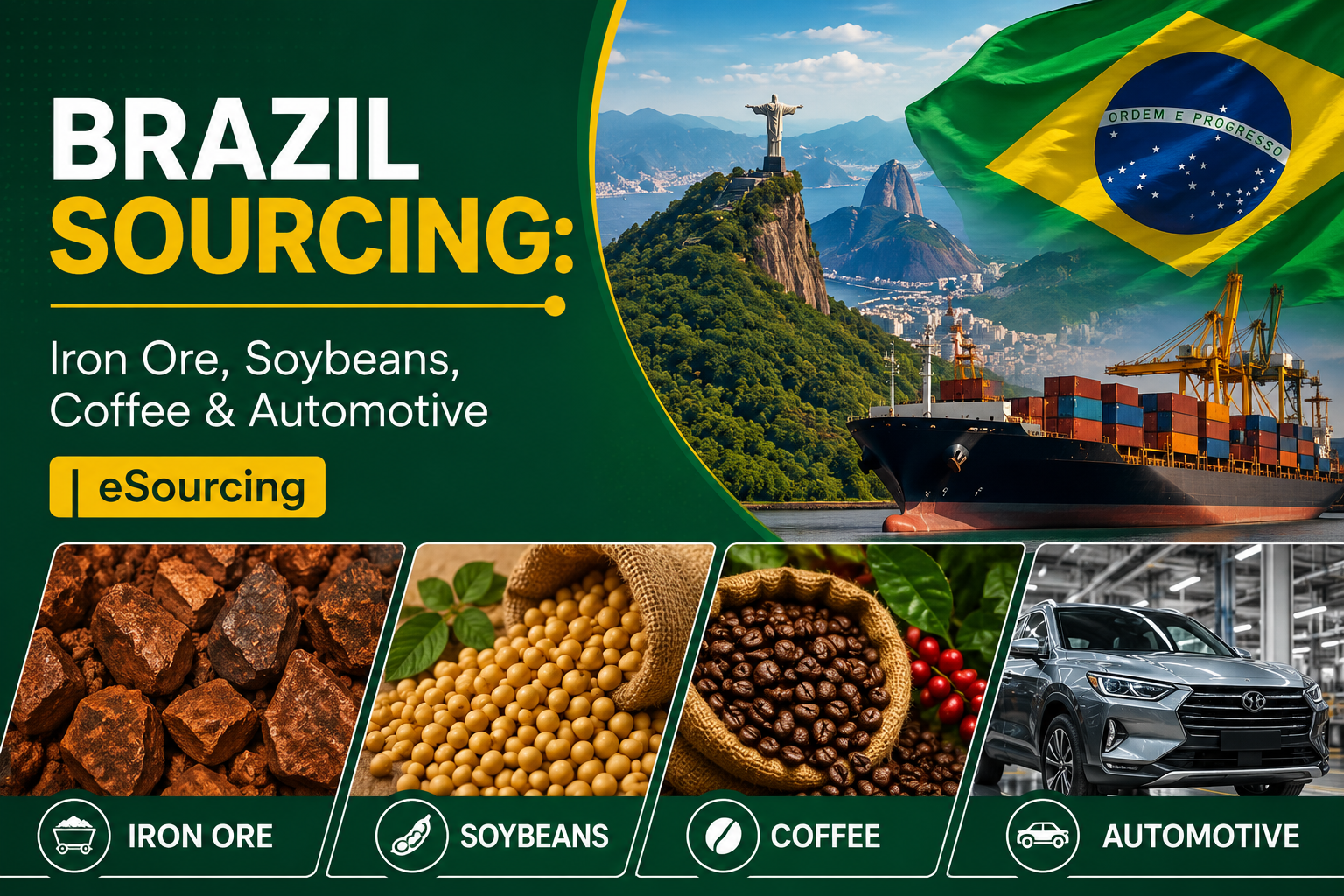
Brazil does not do anything small. Fifth-largest country by area. Seventh-largest economy globally. The world’s biggest producer of coffee, sugar, orange juice, and soybeans. The largest iron ore exporter on the planet. Monthly exports of USD 22 billion flow from mines in Minas Gerais, soybean farms in Mato Grosso, factories in Sao Paulo, and offshore oil platforms in the Santos Basin. Over 60% of those exports are manufactured or semi-manufactured goods, which surprises people who still think of Brazil as purely a commodity economy. Brazil sourcing gives procurement teams access to a continental-scale industrial base that produces everything from Embraer regional jets to Havaianas flip-flops, from turbine components to instant coffee, all within a single country spanning three time zones.
Brazil Sourcing: Market Overview & Industrial Scale
Brazil sourcing operates at a scale that dwarfs every other Latin American market combined. The country’s GDP exceeds USD 2 trillion. Its industrial sector employs over 20 million workers. Sao Paulo state alone has a larger economy than Argentina, Colombia, or Chile. When global manufacturers need a Latin American production base with genuine depth, Brazil is not one option among many. It is the only option that delivers volume, diversity, and infrastructure simultaneously.
The MERCOSUR trade bloc (Brazil, Argentina, Paraguay, Uruguay) provides preferential access across South America. The EU-MERCOSUR agreement, once ratified, will create one of the world’s largest free trade zones. China has become Brazil’s largest single trading partner, absorbing massive quantities of iron ore, soybeans, and crude oil. The European Union, United States, Argentina, and increasingly Southeast Asian nations round out the export destinations.
Brazil’s manufacturing sector matured over decades of import substitution policies that forced domestic production of goods other developing nations simply imported. The result is unusual industrial breadth. Brazil builds commercial aircraft (Embraer, world’s third-largest manufacturer), manufactures buses exported to 100 countries (Marcopolo), produces compressors found in refrigerators worldwide (Embraco/Nidec), and assembles vehicles for every major global automaker. That depth means Brazil sourcing can satisfy requirements across categories that would normally require sourcing from multiple countries.
Products to Source from Brazil
Iron Ore and Minerals. Vale is the world’s largest iron ore producer. Brazil exports over 350 million tonnes annually, primarily to China, Japan, and European steelmakers. Manganese, bauxite, niobium (Brazil controls 90% of global supply), and rare earth elements add to the mineral portfolio.
Soybeans and Agricultural Commodities. World’s largest soybean exporter, second-largest corn exporter, and dominant in sugar, orange juice concentrate, and tobacco. Mato Grosso, Goias, and Parana states produce at scales that influence global commodity prices.
Coffee. Brazil produces roughly one-third of the world’s coffee. Arabica from Minas Gerais and Sao Paulo. Robusta from Espirito Santo. Green beans, roasted coffee, instant coffee, and specialty single-origin lots. No serious coffee sourcing strategy ignores Brazil.
Steel and Metallurgical Products. Gerdau, CSN, and Usiminas produce flat steel, long steel, and specialty alloys. Brazil is Latin America’s largest steel producer with annual output exceeding 30 million tonnes.
Transport Equipment. Embraer regional jets and executive aircraft. Marcopolo and Comil bus bodies exported globally. Agricultural machinery from AGCO and CNH. Brazil’s transport equipment sector generates over USD 10 billion in annual exports.
Automotive Parts. Over 40 vehicle assembly plants (Volkswagen, GM, Fiat/Stellantis, Toyota, Hyundai, Mercedes-Benz) create demand for a massive parts supply chain. Engines, transmissions, stampings, castings, electronics, and rubber components. Sao Paulo’s ABC industrial region remains the automotive heartland.
Footwear. Brazil is the world’s fourth-largest shoe producer. The Vale dos Sinos region in Rio Grande do Sul hosts over 3,000 footwear companies producing leather shoes, athletic footwear, and sandals. Havaianas alone sells over 200 million pairs annually.
Pulp and Paper. Suzano (world’s largest eucalyptus pulp producer) and Klabin lead a sector that exports over USD 10 billion annually. Fast-growing eucalyptus plantations give Brazil a cost advantage in cellulose production that Nordic producers cannot match.
Poultry and Meat. World’s largest chicken exporter and second-largest beef exporter. JBS (world’s largest meat company), BRF, and Marfrig supply processed and frozen meat to over 150 countries.
Chemicals and Petrochemicals. Braskem (largest petrochemical company in the Americas) produces polyethylene, polypropylene, and PVC. Agrochemicals, industrial chemicals, and biofuels (ethanol from sugarcane) complete the sector.
Challenges in Brazil Sourcing and Our Approach
Brazil sourcing comes with a reputation for complexity that is entirely earned. The tax system is among the world’s most convoluted, with federal, state, and municipal taxes layering on top of each other in ways that confuse even Brazilian accountants. Import duties on raw materials inflate manufacturing costs (the “Brazil cost” that local industrialists constantly complain about). Bureaucracy moves at its own pace. Infrastructure outside the Sao Paulo-Rio corridor deteriorates quickly. Port congestion at Santos (Latin America’s busiest port) adds days during peak agricultural export seasons. And the Real currency fluctuates enough to turn a profitable contract into a loss within months.
Our team navigates Brazilian complexity through established relationships and local knowledge. We work with export-oriented manufacturers who understand international pricing expectations and delivery standards. We structure contracts accounting for ICMS tax variations between states. We plan logistics around Santos congestion by routing through alternative ports (Paranagua, Rio Grande, Itajai) where appropriate. We monitor Real movements and advise on timing for large purchases. And we conduct thorough factory audits because Brazilian manufacturing quality spans from world-class (Embraer-tier) to unreliable within the same industrial district.
How We Support Your Brazil Sourcing
eSourcingSolution provides comprehensive Brazil sourcing services for businesses seeking commodities, manufactured goods, and agricultural products from Latin America’s industrial giant. Our procurement intelligence delivers commodity market analysis, supplier capability assessments, and landed-cost calculations that account for Brazil’s complex tax structure. Quality control inspections verify production standards across manufacturing and agricultural sectors.
The Brazilian Trade and Investment Promotion Agency (ApexBrasil) actively promotes Brazilian exports and facilitates international buyer connections across all sectors. The Brazilian National Confederation of Industry (CNI) represents over 700,000 industrial companies and provides sector-specific market intelligence.
We handle supplier identification, factory and farm audits, commodity sourcing, logistics coordination from Brazilian ports, and ongoing supply chain management. Whether you need iron ore from Minas Gerais, soybeans from Mato Grosso, automotive parts from Sao Paulo, or pulp from Bahia, our network covers Brazil’s vast industrial and agricultural geography.
Ready to explore Brazil sourcing for your supply chain? Contact us for a free market assessment and supplier shortlist matched to your volume requirements and quality specifications.
Brazil’s current growth brings strong export opportunities but navigating its cultural and administrative complexities is vital.
Before doing business with Brazilian suppliers, it’s essential to conduct thorough background checks and clearly align quality requirements. Also, English is not widely spoken — proficiency in Portuguese is highly recommended, especially outside major cities.
To discuss your sourcing or procurement intelligence needs from Brazil, please contact us.

Below are answers to common questions about eSourcingSolution, our services, and how we work. If you need more details, feel free to reach out — our team is ready to help!
We can source a wide range of goods and services — from raw materials and commodities to custom-engineered products and specialized services. Visit our Category Expertise page to explore what we cover.
We work with startups, SMEs, and global enterprises that want to source more competitively from emerging and developed markets, strengthen supply chains, and access reliable procurement support.
Yes. We maintain strong partnerships with a global network of vetted, reliable suppliers across multiple industries, ensuring quality, compliance, and long-term value.
Our proven qualification process, supported by local teams and digital audits, can fully onboard a new supplier in as little as 4–8 weeks, depending on category and compliance needs.
Using real-time market data, cost analysis, and sourcing intelligence, we can quickly evaluate potential savings, benchmark costs, and highlight key opportunities — typically within a few weeks.
It’s easy to begin — just reach out through our Contact page. We’ll arrange a quick discovery call, understand your goals, and design a customized sourcing plan to help you unlock better value.