
Egypt’s economy has traditionally relied heavily on oil exports, with annual export values reaching around $25 billion before recent periods of political uncertainty.
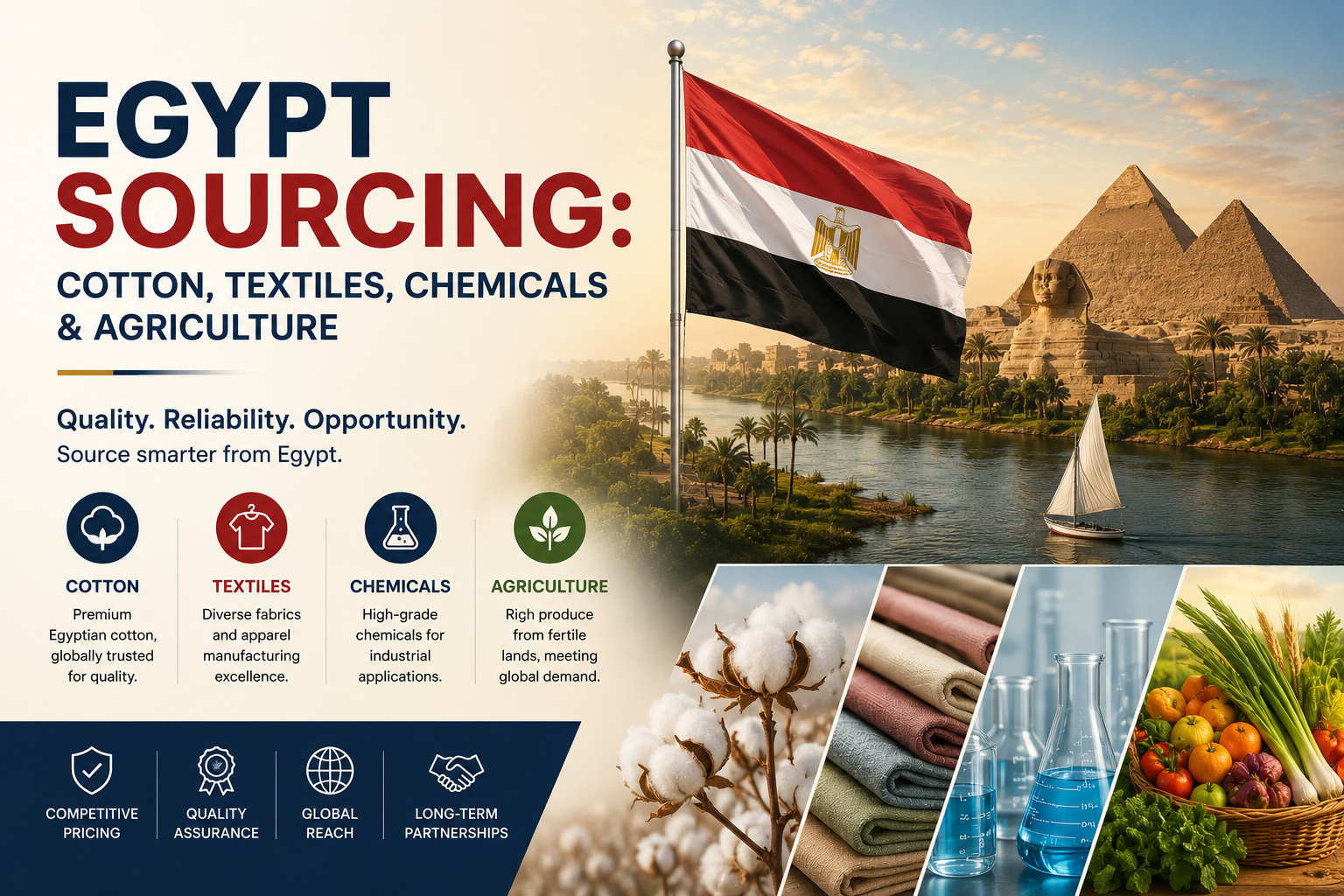
Egypt sits where three continents meet. Africa below, Asia to the east, Europe across the Mediterranean. That geographic position is not just trivia for a sourcing professional. It means Egyptian factories can ship to Southern Europe in three days, reach Gulf states overnight, and access African markets that most Asian suppliers cannot serve efficiently. With annual exports around USD 25 billion and a population of 105 million providing deep labour availability, Egypt sourcing offers something genuinely different from the typical Asian manufacturing playbook. Lower shipping costs to Europe and the Middle East. Duty-free access to African markets. And product categories where Egypt has centuries of accumulated expertise that no competitor can replicate overnight.
Egypt Sourcing: Market Overview & Export Capabilities
Egypt sourcing has operated in the shadow of political headlines for over a decade. That is understandable but increasingly outdated. Since 2016, the Egyptian government has devalued the currency, reformed investment laws, and poured billions into industrial zones along the Suez Canal corridor. New factories are opening. Foreign investment is returning. And the products coming out of Egyptian plants are reaching quality levels that surprise buyers who last looked at this market five years ago.
The country exports primarily to the United States, Italy, China, and the United Kingdom. Free trade agreements with the EU (Association Agreement), African Continental Free Trade Area (AfCFTA), and multiple Arab states create preferential access to markets covering over two billion consumers. For buyers selling into Europe, the Middle East, or Africa, Egypt sourcing eliminates tariff barriers that would apply to goods manufactured in Asia.
Labour costs sit among the lowest in the Mediterranean region. A factory worker in Egypt earns roughly 60-70% less than equivalent roles in Turkey and 50% less than Morocco. Combined with the devalued Egyptian Pound, pricing from Egyptian manufacturers has become genuinely competitive against South Asian alternatives for many product categories.
Products to Source from Egypt
Cotton and Textiles. Egyptian cotton needs no introduction. Long-staple and extra-long-staple varieties remain the global benchmark for premium bed linens, towels, and shirting fabric. Beyond luxury cotton, Egypt produces workwear, knitted garments, denim, and home textiles at commercial scale. The textile sector employs over one million workers concentrated in the Nile Delta region.
Chemicals and Fertilizers. Nitrogen fertilizers, phosphates, petrochemicals, and industrial chemicals. Egypt’s natural gas reserves feed large-scale chemical production. Abu Qir Fertilizers and Egyptian Chemical Industries are major producers serving African and Asian agricultural markets.
Petroleum and Natural Gas. Crude oil, refined petroleum products, LNG, and petrochemical derivatives. The Zohr gas field discovery in 2015 transformed Egypt from a net importer to a growing gas exporter.
Agricultural Products. Citrus fruits (oranges, lemons), potatoes, onions, grapes, strawberries, and herbs. Egypt is the world’s largest orange exporter, shipping primarily to European and Russian markets. Fresh produce benefits from year-round growing seasons and proximity to European consumers.
Metals and Steel. Rebar, flat steel, aluminium products, and fabricated metal components. Egypt Aluminium (Egyptalum) operates one of Africa’s largest aluminium smelters in Nag Hammadi.
Ceramics and Building Materials. Floor tiles, wall tiles, sanitary ware, and cement. Egypt ranks among the world’s top ten ceramic tile producers, with modern factories meeting European design standards.
Marble and Natural Stone. Egyptian marble, granite, and limestone. Quarries in the Eastern Desert and Sinai produce distinctive stone varieties exported for construction and decoration globally.
Furniture. Wooden furniture, upholstered seating, and office systems. Damietta is Egypt’s furniture capital, hosting thousands of workshops and factories ranging from artisan to industrial scale.
Challenges in Egypt Sourcing and Our Approach
Egypt sourcing requires honest acknowledgment of real obstacles. Bureaucracy moves slowly. Customs procedures can be unpredictable. Infrastructure outside Cairo and Alexandria varies in quality. Power supply interruptions affect some industrial zones. And political risk, while reduced, has not disappeared entirely from the calculation.
Our team navigates these challenges through local experience. We work with factories in established industrial zones where infrastructure is reliable: 10th of Ramadan City, 6th of October City, Sadat City, and the new Suez Canal Economic Zone. We handle documentation requirements that would frustrate buyers attempting direct procurement. We verify factory capabilities through physical audits rather than relying on certificates alone. And we build realistic timelines that account for Egyptian business rhythms rather than imposing Western expectations that lead to frustration.
How We Support Your Egypt Sourcing
eSourcingSolution provides structured Egypt sourcing services for businesses targeting European, Middle Eastern, and African markets. Our procurement intelligence delivers sector-specific pricing data and supplier capability assessments. Quality control inspections verify production standards before shipment from Egyptian ports.
The General Authority for Investment and Free Zones (GAFI) supports foreign companies establishing procurement relationships in Egypt. The Egyptian Commercial Service facilitates trade connections and provides export data across product categories.
We manage supplier identification, factory audits, sample coordination, production monitoring, and logistics from Alexandria and Port Said to your destination. Whether you need premium cotton textiles from the Delta, chemicals from the Suez corridor, or fresh produce from Upper Egypt, our network covers Egypt’s key production regions.
Ready to explore Egypt sourcing for your supply chain? Contact us for a free supplier assessment and market briefing tailored to your product requirements and target markets.

Below are answers to common questions about eSourcingSolution, our services, and how we work. If you need more details, feel free to reach out — our team is ready to help!
We can source a wide range of goods and services — from raw materials and commodities to custom-engineered products and specialized services. Visit our Category Expertise page to explore what we cover.
We work with startups, SMEs, and global enterprises that want to source more competitively from emerging and developed markets, strengthen supply chains, and access reliable procurement support.
Yes. We maintain strong partnerships with a global network of vetted, reliable suppliers across multiple industries, ensuring quality, compliance, and long-term value.
Our proven qualification process, supported by local teams and digital audits, can fully onboard a new supplier in as little as 4–8 weeks, depending on category and compliance needs.
Using real-time market data, cost analysis, and sourcing intelligence, we can quickly evaluate potential savings, benchmark costs, and highlight key opportunities — typically within a few weeks.
It’s easy to begin — just reach out through our Contact page. We’ll arrange a quick discovery call, understand your goals, and design a customized sourcing plan to help you unlock better value.