
Morocco’s annual exports total approximately $14 billion, driven by diverse sectors.
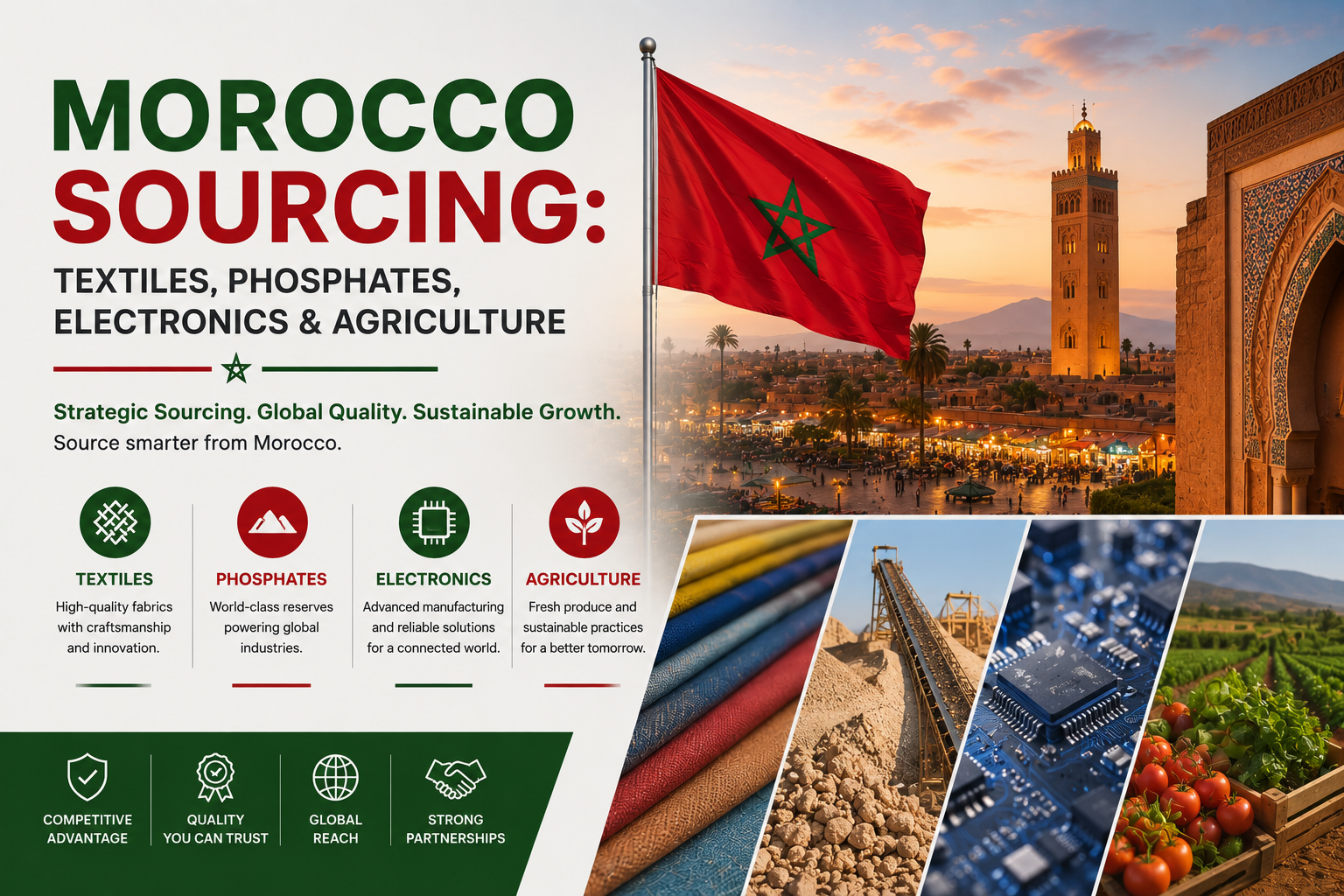
Look at a map. Morocco sits 14 kilometres from Spain across the Strait of Gibraltar. A truck leaving Tangier reaches Madrid in one day, Paris in two, and anywhere in Western Europe within 72 hours. No ocean freight. No three-week container voyages. No customs delays at EU borders thanks to a deep free trade agreement signed in 2000. For European buyers tired of six-week lead times from Asia and unpredictable shipping costs, Morocco sourcing offers something radical: nearshore manufacturing at developing-world prices with next-door delivery times. Annual exports of USD 14 billion and growing confirm that European brands have already figured this out.
Morocco Sourcing: Market Overview & Strategic Position
Morocco sourcing has accelerated dramatically over the past decade because the Moroccan government made a deliberate bet on industrial development. They built Tanger Med port, now the largest container port in Africa and the Mediterranean. They constructed free trade zones with tax holidays and streamlined customs. They invested in motorways connecting industrial cities to ports. And they signed trade agreements with the EU, US, Turkey, and dozens of African nations. The result is a manufacturing platform purpose-built to serve European supply chains at a fraction of European cost.
Labour costs run 60-70% below Spain and France, and roughly 30% below Turkey. The workforce is young, with a median age of 29, and French-speaking, which eliminates language barriers for the largest European buyer markets. Morocco also benefits from political stability rare in the region. The monarchy provides continuity that investors value, and the country has avoided the upheaval that disrupted neighbouring nations during the Arab Spring and after.
Spain, France, and Italy absorb the majority of Moroccan exports. The EU Association Agreement provides duty-free access for most manufactured goods. For American buyers, a bilateral free trade agreement (signed 2006) eliminates tariffs on qualifying Moroccan products entering the US market.
Products to Source from Morocco
Textiles and Garments. Fast fashion, denim, knitwear, workwear, and luxury garment finishing. Zara, Mango, and dozens of French brands manufacture in Morocco for speed-to-market reasons. A design approved in Paris can be on store shelves within two weeks using Moroccan production. That turnaround is impossible from Asia.
Automotive Components. Renault and Stellantis (Peugeot/Citroen) operate major assembly plants in Tangier and Kenitra. The automotive supply chain produces wiring harnesses, seating, interior trim, metal stampings, and plastic components. Morocco now exports more cars than South Africa.
Phosphates and Chemicals. OCP Group (Office Cherifien des Phosphates) controls 70% of global phosphate reserves. Phosphate rock, phosphoric acid, and fertilizers represent Morocco’s largest single export category. Industrial chemicals, including inorganic compounds, serve agricultural and manufacturing markets worldwide.
Electronics and Electrical Components. Transistors, capacitors, wiring harnesses, and electronic sub-assemblies. The Casablanca and Kenitra free zones host electronics manufacturers serving European automotive and consumer markets.
Aerospace Components. Bombardier, Boeing suppliers, Safran, and Stelia Aerospace operate in Morocco. The Nouaceur aerospace cluster near Casablanca produces aircraft wiring, composite parts, and structural components. Morocco’s aerospace exports have grown 20% annually for the past decade.
Citrus Fruits and Vegetables. Oranges, clementines, tomatoes, peppers, green beans, and strawberries. The Souss-Massa region produces year-round for European supermarkets. Proximity means Moroccan produce reaches European shelves fresher than competing origins.
Seafood. Sardines (Morocco is the world’s largest sardine exporter), octopus, shrimp, and canned fish. Atlantic coast fishing ports from Agadir to Dakhla supply European and Japanese markets.
Leather Goods. Bags, belts, shoes, and small leather accessories. Fez and Casablanca host both traditional artisan workshops and modern manufacturing facilities. Morocco offers handcrafted quality for premium brands alongside industrial production for volume orders.
Challenges in Morocco Sourcing and Our Approach
Morocco sourcing is not without friction. Quality consistency varies significantly between factories. The best Moroccan manufacturers match European standards perfectly. The worst deliver work that requires renegotiation and rework. The gap between top and bottom is wider than in more mature markets like Turkey or Poland. Skilled worker availability tightens during peak garment seasons. And while infrastructure in northern Morocco (Tangier, Kenitra, Casablanca) is excellent, southern regions remain less developed.
Our team eliminates the quality lottery through rigorous factory selection. We audit facilities before recommending them, verifying equipment, workforce skill, and management capability. We implement in-line inspections rather than relying on final checks alone. We match product complexity to factory capability, steering complex orders toward proven manufacturers and simpler products toward developing facilities. And we focus recommendations on the Tangier-Casablanca industrial corridor where infrastructure supports reliable delivery.
How We Support Your Morocco Sourcing
eSourcingSolution provides structured Morocco sourcing services for European and American businesses seeking nearshore manufacturing alternatives. Our procurement intelligence delivers factory-level pricing benchmarked against Turkish, Tunisian, and Asian alternatives. Quality control inspections verify production standards throughout manufacturing runs.
The Moroccan Investment and Export Development Agency (AMDIE) supports foreign companies establishing procurement relationships and provides sector-specific market data. The Moroccan Chamber of Commerce facilitates business connections across manufacturing and agricultural sectors.
We handle supplier identification, factory audits, sample development, production monitoring, and logistics coordination. Whether you need garments from Casablanca, automotive parts from Tangier, or aerospace components from Nouaceur, our network covers Morocco’s key industrial zones.
Ready to explore Morocco sourcing for your European supply chain? Contact us for a free supplier assessment and lead-time comparison against your current Asian sources.

Below are answers to common questions about eSourcingSolution, our services, and how we work. If you need more details, feel free to reach out — our team is ready to help!
We can source a wide range of goods and services — from raw materials and commodities to custom-engineered products and specialized services. Visit our Category Expertise page to explore what we cover.
We work with startups, SMEs, and global enterprises that want to source more competitively from emerging and developed markets, strengthen supply chains, and access reliable procurement support.
Yes. We maintain strong partnerships with a global network of vetted, reliable suppliers across multiple industries, ensuring quality, compliance, and long-term value.
Our proven qualification process, supported by local teams and digital audits, can fully onboard a new supplier in as little as 4–8 weeks, depending on category and compliance needs.
Using real-time market data, cost analysis, and sourcing intelligence, we can quickly evaluate potential savings, benchmark costs, and highlight key opportunities — typically within a few weeks.
It’s easy to begin — just reach out through our Contact page. We’ll arrange a quick discovery call, understand your goals, and design a customized sourcing plan to help you unlock better value.