
So my sister rings me up last Tuesday night. She’s panicking. Just microwaved leftover pasta in one of those black takeout containers for about four minutes. Thing warped on one side. Got soft and bendy. And now she’s standing in her kitchen wondering if she just served her kids a plate of chemicals with their spaghetti.
Told her to chuck the food. Not because I enjoy being dramatic about these things. Because that container was polystyrene. Number 6 on the bottom. The kind of plastic that’s built to hold your food for a twenty minute car ride home from the restaurant. Not built to survive the inside of a microwave where temperatures climb past 200 degrees and start pulling chemicals out of the plastic walls like a sponge releasing water.
She got lucky. Nothing melted into a puddle. Nobody got sick. But it got me thinking about how many people do this exact thing every single day without a second thought.
Here’s what bugs me about the whole “can you put plastic in the microwave” question. There’s no clean yes or no. Some plastics handle microwave heat like a champ. Others start falling apart at the molecular level the second they get warm. And a scary number of containers that people nuke daily were never tested, never approved, and never meant to go anywhere near that kind of heat.
I’ve been working in product sourcing for years now. Visited factories that make microwave-safe containers. Also visited factories making containers that should never see the inside of a microwave. From the outside? They look almost identical sitting on a store shelf. But what happens when you heat them up? Completely different story.
Let me walk through all of it. Which plastics you can trust. Which ones you can’t. How to spot the difference without a chemistry degree. And what’s really going on inside your microwave when you put the wrong container in there.
Table of Contents
- The Short Answer About Plastic in the Microwave
- Plastic Types by Recycling Number
- Which Plastics Are Actually Microwave Safe?
- Plastics That Should Never Touch Your Microwave
- Finding the Microwave Safe Symbol
- What Happens Inside Unsafe Plastic When You Nuke It
- BPA and Phthalates: The Chemicals Nobody Wants in Their Dinner
- Stuff People Microwave Every Day That They Shouldn’t
- Better Options Than Plastic for Microwave Use
- The Home Test for Microwave Safety
- Questions People Always Ask Me About This
1. The Short Answer About Plastic in the Microwave
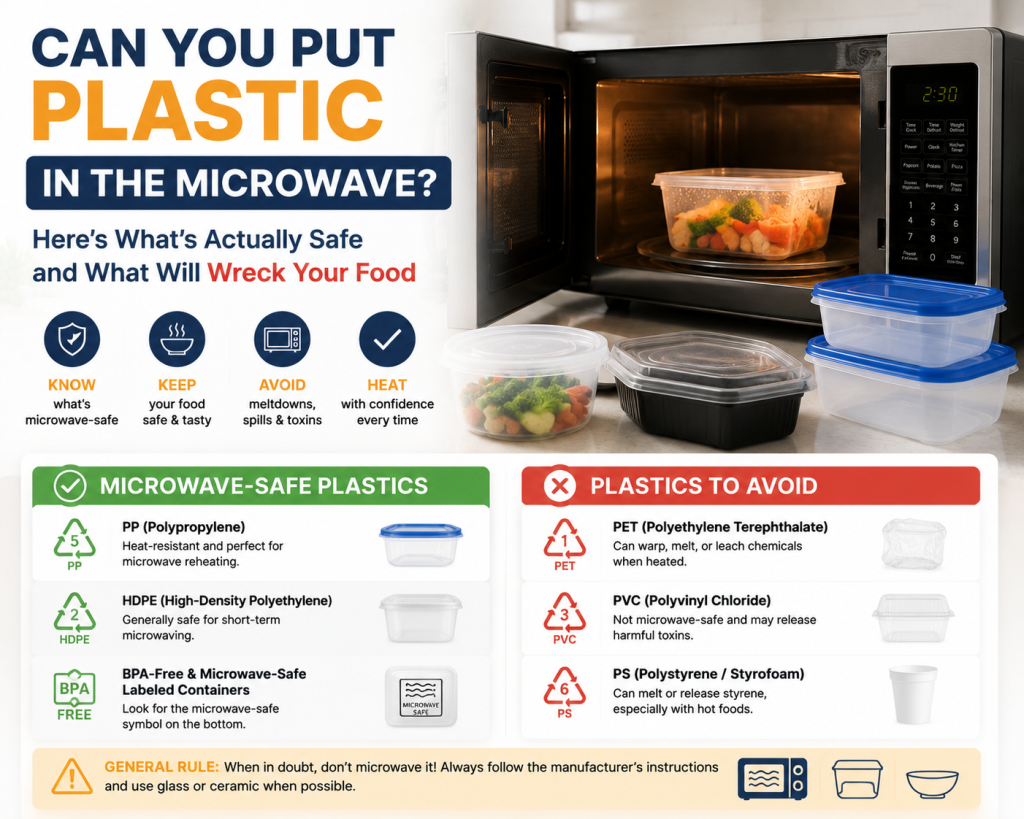
Yeah, you can microwave plastic. But only certain kinds. Only the ones that somebody actually tested and confirmed won’t fall apart or leak weird stuff into your Tuesday night leftovers.
The FDA runs tests on plastics meant for microwave use. They heat them up, measure what comes out, and decide whether the levels are acceptable for human consumption. Containers that pass get the microwave-safe symbol stamped on the bottom. That symbol means something. It means a lab somewhere confirmed this specific container won’t poison you under normal reheating conditions.
No symbol on your container? Don’t guess. Don’t assume. Don’t figure “it’s probably fine because it looks sturdy.” That assumption has been quietly dosing people with endocrine-disrupting chemicals for decades. Nobody notices because the amounts are tiny each time. But tiny amounts add up when you’re doing it three times a week for fifteen years.
2. Plastic Types by Recycling Number
Flip any plastic container over. See that little number inside the triangle of arrows? That number tells you what kind of plastic resin you’re holding. And that resin type basically determines whether your container belongs in a microwave or belongs in the recycling bin.
Seven categories exist. I’ll go through each one because they all behave differently when heat gets involved.
Number 1: PET (Polyethylene Terephthalate)
Your water bottles. Soda bottles. Those clear containers holding strawberries at the grocery store. Peanut butter jars. Salad dressing bottles. Lightweight, clear, cheap to make.
Can you microwave it? Nope. PET was designed for room temperature. Maybe slightly cold. It starts getting soft around 70 degrees Celsius, which is about 158 Fahrenheit. Your microwave blows past that temperature in under a minute. When PET gets hot, antimony and other compounds start migrating into whatever food or liquid is touching the plastic. Don’t microwave it. Don’t pour boiling water into it either. And that water bottle you left on your dashboard all summer? Probably shouldn’t drink from that anymore.
Number 2: HDPE (High-Density Polyethylene)
Milk jugs. Detergent bottles. Some yogurt containers. Opaque plastic with a slightly waxy feel when you run your finger across it. Tougher than PET. Handles heat better.
Can you microwave it? Usually no. Unless the specific container says otherwise on the label. HDPE tolerates moderate warmth but wasn’t engineered for sustained microwave temperatures. Some HDPE containers do carry microwave-safe ratings. Most don’t. Check before you assume.
Number 3: PVC (Polyvinyl Chloride)
Cling wrap. Some food packaging. Plumbing pipes. This is one of the worst plastics for food contact at any temperature. Heated? Even worse.
Can you microwave it? Absolutely not. Not even a little bit. Not even for thirty seconds. PVC contains phthalates as plasticizers. Heat makes those phthalates jump ship from the plastic and land directly in your food. Never microwave PVC cling wrap on food. If you see number 3 on anything in your kitchen, keep it away from heat sources entirely.
Number 4: LDPE (Low-Density Polyethylene)
Squeeze bottles. Bread bags. Frozen food bags. Some flexible lids. Softer and bendier than HDPE.
Can you microwave it? Not recommended unless the label specifically says so. LDPE handles heat okay for brief periods but can warp and potentially release stuff at sustained microwave temperatures. Some LDPE products carry ratings for quick reheating. Not for actual cooking though.
Number 5: PP (Polypropylene)
This is the one you want. The good one. Yogurt containers, deli containers, Tupperware-style storage containers, bottle caps, and basically every container specifically marketed as microwave safe.
Can you microwave it? Yes. Polypropylene melts somewhere between 130 and 170 degrees Celsius. Way above what a microwave produces during normal food reheating. It stays stable. Doesn’t break down. Doesn’t leach at concerning levels. When you see “microwave safe” on a plastic container, nine times out of ten it’s made from this stuff.
Number 6: PS (Polystyrene)
Styrofoam cups. Takeout containers. Disposable plates. Egg cartons. Cheap, lightweight, and absolutely terrible for microwaving.
Can you microwave it? Never. Not once. Not briefly. Polystyrene breaks down at relatively low temperatures and releases styrene. The International Agency for Research on Cancer calls styrene a “possible human carcinogen.” That takeout box from last night? Move the food to a real plate before you reheat it. Every single time. No exceptions.
Number 7: Other (Mixed Plastics)
The junk drawer category. Includes polycarbonate, bioplastics, nylon, and various blended materials. Some contain BPA. Some are perfectly fine. The number alone tells you nothing useful.
Can you microwave it? Depends entirely on the specific product. Some Type 7 containers are designed and tested for microwave use. Others contain BPA or other chemicals you definitely don’t want migrating into your lunch. With this category, you need the microwave-safe symbol or explicit confirmation from the manufacturer. The recycling number is useless for making safety decisions.
3. Which Plastics Are Actually Microwave Safe?
Let me simplify this because I know the list above is a lot to remember.
Green light (when properly labeled):
Type 5 polypropylene. This is your go-to. High heat tolerance. Chemically stable under microwave conditions. Most food storage brands build their microwave-safe lines from PP.
Certain Type 2 and Type 4 containers that specifically carry microwave-safe labels. These work for brief reheating. Not extended cooking. Quick warm-ups only.
Some Type 7 containers designed explicitly for microwave use. Only when labeled. Never assume with Type 7.
Red light (never, regardless of circumstances):
Type 1 PET. Type 3 PVC. Type 6 Polystyrene. These three don’t belong in your microwave under any conditions. Any duration. Any power level. Just don’t.
The rule that matters most: Even with “safe” plastic types, always look for the microwave-safe symbol or text. A container being made from polypropylene doesn’t automatically mean it was manufactured to microwave-safe standards. The resin gives you a starting point. The label gives you the actual answer.
4. Plastics That Should Never Touch Your Microwave
I want to hammer this section because these are the materials that genuinely pose health risks when heated. Not theoretical maybe-someday risks. Documented, studied, published-in-journals risks.
Polystyrene (Type 6) and styrene release. Styrene is classified as a possible carcinogen. When you microwave a styrofoam container, you’re basically slow-cooking your food in a chemical bath. The container might look totally fine afterward. Might not visibly melt or change shape at all. But at the molecular level, styrene is migrating into your food. Can’t see it. Can’t smell it. Can’t taste it. It’s happening anyway.
PVC (Type 3) and phthalate release. Phthalates mess with your hormones. They’re endocrine disruptors that interfere with how your body produces and regulates hormones. Particularly concerning for kids, pregnant women, and developing babies. When PVC cling wrap touches hot food in a microwave, phthalate migration spikes hard. This isn’t controversial or debated. It’s well-documented across dozens of peer-reviewed studies.
PET (Type 1) and antimony release. Antimony levels increase with temperature and time. A water bottle sitting in a hot car already shows elevated antimony. Put that same plastic type in a microwave and you’re accelerating the whole process dramatically.
Anything without a microwave-safe label. Even if the base resin is technically heat-resistant, a container that wasn’t manufactured and tested for microwave use might contain additives, colorants, or processing chemicals that become problematic when heated. The resin might be fine. The other stuff mixed in during manufacturing? Maybe not.
5. Finding the Microwave Safe Symbol
The symbol you’re looking for resembles a small microwave oven with wavy lines inside. Sometimes it’s three wavy lines representing heat or radiation. Sometimes it’s a little dish with wavy lines rising above it. Different manufacturers draw it slightly differently but they all mean the same thing: this container passed testing for microwave use.
Check the bottom of the container first. Sometimes it’s on the lid instead. Occasionally it’s printed on the outer packaging rather than molded into the plastic itself.
No symbol anywhere? Don’t microwave it. Period. The absence of a symbol doesn’t necessarily mean the container is dangerous. Might just mean the manufacturer never bothered getting it tested. But from where you’re standing in your kitchen at 7pm trying to reheat dinner, “never tested” and “unsafe” should be treated the same way. You don’t have enough information to make a safe choice, so make the cautious one instead.
Some containers carry text instead of symbols. “Microwave Safe.” “Suitable for Microwave Use.” “Microwave Reheating Only.” Pay attention to the exact wording. “Reheating Only” means brief warming. Not cooking raw chicken for eight minutes. There’s a meaningful difference between 90 seconds of reheating and extended cooking at full power. The container might handle one scenario but fail the other.
For businesses sourcing food containers or kitchenware, make sure your supplier provides actual documentation confirming microwave-safe testing. Not a verbal promise over email. Actual test reports from accredited labs. This is standard quality control practice for food-contact products. Protects your customers and protects your business from liability claims down the road.
6. What Happens Inside Unsafe Plastic When You Nuke It
People ask me this constantly. “Is it really that bad? Or is this one of those overblown health scares?”
Let me explain what’s actually occurring at the material level so you can decide for yourself.
Microwaves generate electromagnetic radiation at a frequency that makes water molecules vibrate. Those vibrating water molecules create heat. That heat spreads through your food and into anything touching your food. Including the container walls.
When unsafe plastic reaches temperatures beyond what it was designed to handle, the polymer chains making up the plastic structure start weakening. Not dramatically. Not in a way you’d notice by looking. But at a molecular level, bonds loosen and small molecules break free from the plastic matrix. Those freed molecules migrate into whatever food or liquid is sitting against the plastic surface.
How much migration happens depends on a few things. Temperature is the big one. Higher heat means more migration. Duration matters too. Longer heating means more time for chemicals to escape. Fat content of the food plays a role because fatty foods absorb plastic chemicals more readily than dry foods. Acidity accelerates the process as well. Tomato sauce, citrus-based dishes, vinegar-heavy foods all pull more chemicals from plastic than neutral foods.
So picture this scenario. You’re reheating leftover tikka masala in a non-microwave-safe container. Tomato-based sauce. Oily. Acidic. Full surface contact with the plastic walls. High heat for three or four minutes. You’ve basically created the perfect storm for maximum chemical migration. Every factor working against you simultaneously.
The chemicals that escape include BPA, phthalates, styrene, antimony, and various plasticizers depending on the specific plastic type. None of these belong in your body. Even at low levels, repeated exposure builds up over months and years of daily microwaving.
7. BPA and Phthalates: The Chemicals Nobody Wants in Their Dinner
You’ve seen “BPA Free” stamped on water bottles and food containers everywhere. But what is BPA actually? And why did manufacturers start removing it?
BPA (Bisphenol A) gets used in making certain plastics, particularly polycarbonate (some Type 7 plastics) and the epoxy resins lining the inside of food cans. The problem? BPA mimics estrogen in your body. It latches onto estrogen receptors and disrupts normal hormonal function.
Research connects BPA exposure to reproductive problems, heart disease, type 2 diabetes, and developmental issues in children. The FDA banned it from baby bottles and sippy cups back in 2012. But it’s still floating around in plenty of adult food containers, can linings, and even thermal receipt paper.
Microwave a container with BPA in it and the heat dramatically accelerates leaching. One study measured BPA migration increasing by 55 times when containers were heated compared to room temperature storage. Fifty-five times. That’s not a marginal increase. That’s an explosion of chemical transfer.
Phthalates are plasticizers. They make rigid plastics bendable and flexible. Common in PVC (Type 3) and scattered across various food packaging materials. Like BPA, phthalates are endocrine disruptors. They interfere with testosterone production. Research links them to reproductive issues, particularly in males.
Now here’s the part that really frustrates me about “BPA Free” labels. Many manufacturers pulled BPA out of their products and replaced it with BPS (Bisphenol S) or BPF (Bisphenol F). Then they slapped “BPA Free” on the packaging and called it a day. Early research suggests these replacement chemicals might have similar endocrine-disrupting properties to the original BPA. So “BPA Free” doesn’t necessarily mean “free from all bisphenols.” It means they swapped one potentially harmful chemical for another potentially harmful chemical with a different name.
Safest approach? Stick with Type 5 polypropylene containers that carry explicit microwave-safe labeling. PP manufacturing doesn’t require BPA or phthalates. The material is inherently stable at high temperatures. And when it carries that microwave-safe label, somebody actually tested it and confirmed minimal chemical migration under heating conditions.
8. Stuff People Microwave Every Day That They Shouldn’t
Let me run through the items I see people nuking constantly without thinking twice. Guarantee at least one of these is sitting in your kitchen right now.
Takeout containers. Those black plastic trays from Chinese food, Indian food, Thai food, whatever. Almost always polystyrene or PET. Built to hold hot food for a short car ride. Not built to be reheated. Move your leftovers to a proper dish before microwaving. Takes ten seconds. Saves you from eating styrene with your kung pao chicken.
Yogurt cups and cottage cheese tubs. Usually made from Type 5 polypropylene, which sounds promising. But here’s the catch. They’re manufactured as single-use containers for refrigerated storage. Nobody tested them for microwave conditions. The walls are thin. They can warp. And the manufacturing process for cheap single-use containers may include additives that aren’t present in containers specifically engineered for repeated microwave heating.
Butter and margarine tubs. Same story as yogurt cups. Right resin type, wrong application. People reuse these as leftover containers all the time. Fine for cold storage in the fridge. Not fine for microwaving. The plastic wasn’t made thick enough or tested rigorously enough for that use.
Plastic wrap laid directly on food. Regular cling wrap is often PVC-based. Should never make direct contact with food during microwaving. Want to cover something to prevent splatter? Use microwave-safe wrap specifically labeled for that purpose. Or leave a gap between the wrap and the food surface. Or just lay a paper towel over the dish. Or flip a microwave-safe plate upside down on top. All better options than PVC touching your hot food.
Deli containers from the grocery store. Those clear clamshell containers holding rotisserie chicken or prepared salads? Usually PET or polystyrene. Not microwave safe. Pop the food onto a real plate before reheating.
Old beat-up containers. Even containers that started life as microwave safe can become unsafe over time. Scratches, stains, warping, cloudiness. All signs the plastic is degrading. Degraded plastic leaches chemicals more readily than intact plastic because the polymer structure is already compromised. If a container looks tired and worn out, retire it from microwave duty. Doesn’t matter what it was rated for originally.
9. Better Options Than Plastic for Microwave Use
If everything above is making you nervous about plastic in general, here are materials that don’t carry the same baggage.
Glass. Probably the safest thing you can put in a microwave. Glass is chemically inert. Doesn’t react with food. Doesn’t leach anything regardless of temperature. Brands like Pyrex make glass containers with snap-on lids designed specifically for microwave use. Heavier than plastic. Breakable if you drop them. But from a “am I eating chemicals” perspective? Unbeatable.
Ceramic. Your regular plates, bowls, and coffee mugs are generally microwave safe. Avoid anything with metallic trim, gold or silver paint, or sketchy glazes that might contain lead. Most commercial dinnerware sold in the US, Europe, or Australia is fine. But check the bottom for a microwave-safe marking if you’re unsure. Handmade or imported ceramics from unregulated markets deserve more scrutiny.
Paper. Plain white paper plates and paper towels work for brief microwave use. Avoid printed paper products, wax-coated paper, and brown paper bags. Brown bags can contain recycled materials with unknown chemical content. They can also catch fire. Neither outcome is great.
Silicone. Food-grade silicone handles high heat without breaking down or leaching. Silicone microwave covers, steamers, and containers are getting more popular as people move away from plastic. Make sure you’re buying actual food-grade silicone though. Cheap knockoffs sometimes contain fillers that defeat the whole purpose.
If you’re in the business of sourcing kitchenware or food storage products, offering glass and silicone alternatives alongside traditional plastic gives customers options. The market for non-plastic food storage has grown steadily as awareness about plastic chemicals has spread. Smart product lines include both options and let the customer choose based on their priorities.
10. The Home Test for Microwave Safety
Got a container with no label and you’re curious? Here’s a quick test you can run in your own kitchen. Not a replacement for proper lab testing. But it gives you a reasonable first indication.
Fill the mystery container with room temperature water. Grab a separate mug and fill that with water too. Put both in the microwave. The separate mug is there to absorb microwave energy in case the mystery container doesn’t absorb any. Run the microwave on high for sixty seconds.
After one minute, carefully touch the container walls. If the container feels cool or barely warm while the water inside is warm, that’s a good sign. The container isn’t absorbing microwave energy directly. It’s letting the energy pass through to the water.
If the container walls feel hot but the water inside is barely warm? Bad sign. The container itself is absorbing microwave radiation and heating up independently of the food. That means the material is interacting with microwave energy in ways that could cause chemical breakdown. Don’t use it for food.
If the container warped, softened, or changed shape in any visible way? Throw it out. Clearly not designed for microwave temperatures. Don’t test it again. Don’t give it a second chance. It failed.
One important caveat. This test tells you about heat absorption. It doesn’t tell you about chemical migration. A container could stay cool (pass this test) but still leach chemicals at elevated temperatures over longer heating periods. For absolute certainty, you need manufacturer certification. But this test eliminates the obvious failures quickly and easily.
11. Practical Habits for Safer Microwave Use
Let me give you some things you can start doing today that reduce your chemical exposure without requiring you to overhaul your entire kitchen.
Move food before reheating. Build the habit of transferring leftovers from storage containers to a glass or ceramic dish before microwaving. Takes seconds. Eliminates the entire question of whether your container is safe or not.
Keep fatty foods away from plastic. Even microwave-safe plastic shows higher chemical migration with fatty foods. Cheese, butter, meat with visible fat, oily sauces. These foods pull more chemicals from plastic surfaces than dry or water-based foods. Reheating something greasy? Use glass.
Turn down the power. Lower power settings mean lower temperatures inside the container. Lower temperatures mean less chemical migration. Microwave at 50 to 70 percent power for slightly longer instead of blasting everything at full power. Your food heats more evenly too. Win-win.
Replace containers that look worn. Plastic breaks down over time. Dishwasher cycles, repeated heating, sunlight exposure, physical scratches. All of it weakens the polymer structure. Swap out your microwave-safe containers every 6 to 12 months if you use them frequently. Anything cloudy, scratched, stained, or warped should go immediately.
Don’t seal containers in the microwave. Steam buildup increases internal temperature and pressure. Both accelerate chemical migration. Leave a corner of the lid open. Or use a loose cover instead of a sealed one.
Keep plastic wrap off your food. If you’re using wrap as a splatter guard, make sure it hovers above the food with airspace between them. Or skip the wrap entirely and use a microwave-safe plate flipped upside down as a cover. Works just as well. Zero chemical concerns.
12. Cheap Imports and Fake “Microwave Safe” Labels
This is something I need to address because it comes up constantly in our sourcing work. Not every “microwave safe” label on the market carries equal weight.
Containers from reputable brands manufactured in regulated markets go through legitimate testing. The FDA has specific protocols. European regulations set migration limits. Japanese standards are even stricter. These testing frameworks mean something real.
But containers from unregulated manufacturers, particularly ultra-cheap imports sold through marketplace platforms with no brand recognition? That microwave-safe symbol might be completely meaningless. I’ve seen this with my own eyes at factories. A buyer requests the symbol. The factory adds it to the mold. Nobody runs a single test. Nobody verifies anything. The symbol exists because someone asked for it, not because someone earned it.
If you’re buying food containers from unknown brands at prices that seem too good to be true, be skeptical of every safety claim on the packaging. Look for established brands with traceable supply chains. Or if you’re building your own brand and sourcing containers from overseas, insist on migration testing reports from accredited laboratories before you sell a single unit. This is basic product compliance that protects your customers and keeps your business out of legal trouble.
The cost difference between a properly tested container and an untested one with a fake symbol? Maybe fifteen to thirty cents per unit at factory level. That’s nothing compared to what happens if a customer gets sick, reports your product, and suddenly you’re dealing with a recall or a lawsuit.
Questions People Always Ask Me About This
Can you microwave Tupperware?
Depends which Tupperware product you’re talking about. Their polypropylene containers with the microwave-safe symbol? Totally fine for reheating. But not every Tupperware product carries that rating. Older product lines and some specialty items aren’t approved for microwave use. Check the bottom of each specific container. Don’t assume the brand name alone makes everything safe.
Are Ziploc bags microwave safe?
Ziploc says their bags are safe for reheating and defrosting. They’re polyethylene, which has reasonable heat stability for brief warming. Key word: brief. Don’t cook raw food in them. Don’t run them at full power for ten minutes. Quick reheat, low to medium power, and don’t let the bag touch the microwave walls or turntable directly. It can melt against hot surfaces.
I accidentally microwaved unsafe plastic once. Am I in trouble?
Probably not from a single incident. Chemical migration happens at low levels. Health effects come from cumulative exposure over months and years, not one oops moment. If the container didn’t visibly melt or smell weird, the food was likely fine that one time. Just don’t make it a regular thing. And if the container did melt, warp, or give off a chemical smell? Toss the food. Not worth the gamble.
What about plastic plates for kids?
Only microwave them if they’re explicitly labeled for it. Many children’s plates are melamine, which should never be microwaved. Melamine releases formaldehyde when heated. Other kids’ plates made from polypropylene with microwave-safe ratings are perfectly fine. Material matters more than what the plate looks like or who it’s marketed toward.
Can you tell if chemicals leached into your food?
Usually not. Chemical migration at harmful levels is invisible, odorless, and tasteless in most cases. If you can see warping, discoloration, or smell something chemical, that means severe degradation is happening and migration is definitely occurring at high levels. But absence of visible signs doesn’t mean absence of migration. Prevention beats detection every time.
Is BPA-free plastic safe to microwave?
Safer than plastic containing BPA. But “BPA-free” doesn’t automatically mean “chemical-free.” Replacement chemicals like BPS and BPF may carry similar risks based on early research. Your safest bet remains Type 5 polypropylene with explicit microwave-safe labeling. It doesn’t need bisphenols during manufacturing and has proven heat stability.
Wrapping This Up
Can you put plastic in the microwave? Yeah. But only the right plastic. Type 5 polypropylene with a microwave-safe symbol is your safest bet for everyday use. Everything else needs specific verification or should stay out of the microwave entirely.
The plastics to absolutely avoid microwaving: Type 1 PET, Type 3 PVC, and Type 6 Polystyrene. These release harmful chemicals when heated. No exceptions. No “just this once because I’m lazy.” Transfer food to a safe container before reheating. Takes ten seconds of your life.
Want to eliminate the worry completely? Switch to glass or ceramic for microwave use. They don’t leach. They don’t degrade. They don’t require you to memorize recycling numbers or squint at tiny symbols on container bottoms.
Your health isn’t worth the convenience of skipping one simple step. Move the food to a proper dish. Reheat it safely. Eat without wondering what else you’re consuming alongside your dinner.
For businesses sourcing food containers, packaging, or kitchenware, material safety isn’t something you can cut corners on. It’s a legal requirement and a brand trust issue that can make or break your reputation. If you need help verifying supplier claims, testing material safety, or finding manufacturers who genuinely meet food-contact regulations, get in touch with our team or schedule a conversation. We deal with food-contact sourcing regularly and can help you avoid the pitfalls that trip up first-time buyers.