
So here’s a story that still makes me shake my head. A hotel purchasing manager rang me up last winter in a panic. She’d ordered 3,000 blankets from a supplier who promised “premium microfiber, cashmere-feel.” Sounded great on paper. What showed up at her warehouse? Blankets that felt like sleeping under cling wrap.
Technically microfiber? Sure. Soft to a quick touch in the showroom? Absolutely. But ten minutes under one of those things and you’re swimming in your own sweat, static electricity zapping you every time you shift position. Guests were kicking them off by midnight.
That’s the thing about blanket materials nobody tells you. The label on the tag? It’s barely half the story. I’ve spent years sourcing textiles from mills across China, touching thousands of fabric samples, arguing with factory managers about GSM weights and fiber deniers. And I can tell you that two blankets with the exact same material label can feel like they came from different planets.
Table of Contents
| 1 | Why Blanket Material Is the Only Decision That Matters |
| 2 | 12 Blanket Materials with Honest Pros and Cons |
| 3 | How to Choose the Right Blanket Material |
| 4 | Sourcing Blanket Materials for Your Brand |
| 5 | FAQ |
Let me walk you through what I actually know about each material. No marketing fluff. Just what happens when you’re under these fabrics at 2 AM.
12 Blanket Materials: What Each One Actually Delivers
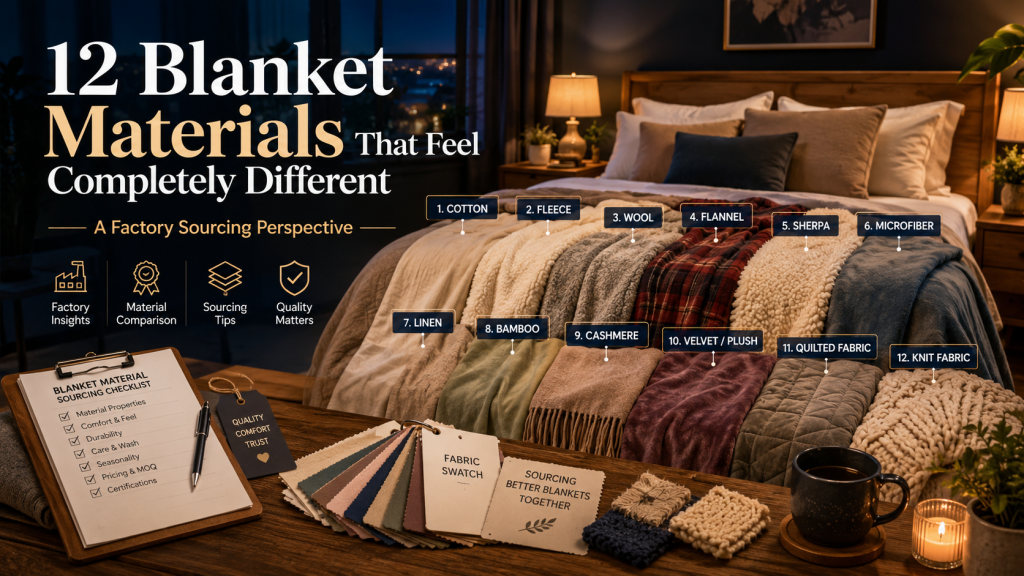
1. Wool
I’ll start with the granddaddy. Wool does something no synthetic has ever truly replicated. It pulls moisture off your skin, holds up to 30% of its weight in water vapor without feeling damp, then slowly releases it. You stay warm without that suffocating feeling.
But here’s what drives me crazy about wool marketing. “Wool” is not one thing. Coarse wool from hardy sheep breeds? That’s the scratchy military blanket your grandfather complained about. Fine merino under 20 microns? That’s a completely different experience against bare skin. When someone tells me they hate wool blankets, I always ask what micron count they tried. Nine times out of ten, they have no idea. They just got a scratchy one once and wrote off the entire material.
Good wool blankets last decades. My grandmother still uses one from the 1970s. It’s been washed hundreds of times and still performs. Try that with a polyester fleece. Woolmark certification exists for a reason. It tells you the fiber is genuine and meets quality benchmarks.
The downsides are real though. Moths will find your wool blanket. Washing it wrong will felt it into a stiff board. And quality merino wool costs serious money. You’re looking at $80-200 for a blanket that’s actually soft enough to use without a duvet cover.
2. Cashmere
I handle cashmere sourcing disputes more than any other textile. The fraud in this market is staggering. I’ve tested “100% cashmere” blankets that came back from the lab as 60% wool, 35% viscose, and maybe 5% actual cashmere. The supplier shrugged when confronted. “Close enough,” he said. It wasn’t close enough.
Real cashmere though? There’s a reason people pay what they pay. The undercoat fiber from cashmere goats weighs almost nothing and traps warmth like it’s defying physics. A genuine cashmere throw weighs half what an equivalent-warmth wool blanket weighs. You pick it up and think something’s missing.
The softness is immediate and obvious. Even people who know nothing about textiles touch cashmere and their eyebrows go up. That reaction is why it commands $200-1000+ for a single blanket.
Fragility is the tradeoff. Cashmere pills where friction happens. It needs hand washing or professional cleaning. Moths target it even more aggressively than regular wool. And unless you’re getting lab-verified fiber content, you might be paying cashmere prices for something that’s mostly viscose.
3. Mink Fur
Let me be upfront. Most “mink blankets” you see online for $40-80 aren’t mink anything. They’re heavy polyester with a dense pile that vaguely resembles fur texture. The name stuck as a marketing term decades ago and nobody corrected it.
Genuine mink fur blankets exist but they’re rare, expensive, and carry obvious ethical baggage that I won’t pretend doesn’t matter.
The synthetic versions? They’re warm. Undeniably warm. Dense pile traps body heat effectively. But they weigh a ton (some hit 7-8 pounds), they don’t breathe at all, and they generate enough static electricity to make your hair stand up when you pull them back in the morning. Hot sleepers will hate these within a week.
4. Rabbit Fur
Similar story to mink. Genuine Rex rabbit fur creates an almost impossibly soft blanket. I’ve touched authentic ones at trade shows and the sensation is hard to describe. Softer than cashmere. Lighter than you’d expect.
But genuine rabbit fur blankets shed. They require professional cleaning. They’re expensive. And the ethical questions are the same as mink.
Synthetic “rabbit fur” blankets are really just another polyester pile construction with a different marketing name. They share all of polyester’s breathability problems. If you’re buying one under $100, you’re buying polyester. Full stop.
5. Feathers (Down)
Down isn’t technically a blanket fabric. It’s a fill material trapped between two layers of shell fabric. But down-filled throws and lightweight comforters function as blankets for millions of people, so it belongs on this list.
Nothing matches down’s warmth-to-weight ratio. Nothing. A quality goose down throw with 800+ fill power weighs almost nothing in your hands yet keeps you warm through January nights. It compresses flat for storage and lofts back up when you shake it out.
The catch? Down needs a shell fabric, so you’re never touching the down itself. It loses all insulating ability when wet. It requires careful washing (or professional cleaning). Some people are allergic. And ethical sourcing matters here. Live-plucking still happens in parts of the supply chain, and responsible brands pay more to avoid it.
6. Cotton
The blanket material nobody gets excited about but everybody owns. Cotton just works. It washes in a machine without drama. It doesn’t trigger allergies. It breathes well enough for summer and, in heavier weaves like flannel, provides decent winter warmth.
What I love about cotton blankets is the variety within the material. A cotton thermal weave (that open honeycomb pattern) is a summer blanket. Cotton flannel (brushed for softness) is a winter blanket. Same fiber, completely different performance based on construction.
Cotton gets softer with every wash. It’s affordable. Organic options with GOTS certification exist for brands that care about sustainability credentials. It’s not glamorous, but it’s honest.
The downsides? Cotton isn’t the warmest. It wrinkles. It absorbs water and takes forever to dry. And it’s heavier than wool or down for the same warmth level. But for a $30-60 blanket that lasts years and goes in the washing machine weekly? Hard to beat.
7. Flax (Linen)
Linen blankets are for people who run hot at night. Flax fiber conducts heat away from your body faster than any other natural textile. Sleeping under linen in summer feels noticeably cooler than sleeping under cotton.
Here’s what nobody warns you about though. New linen feels stiff. Almost crunchy. People buy a linen blanket, use it once, and think they wasted their money. Give it ten washes. Twenty washes. It transforms into something buttery and drapey that you’ll never want to replace.
Linen also outlasts everything else on this list except maybe wool. I’ve seen linen textiles from the 1940s still in regular use. The fiber actually gets stronger with washing. It’s the opposite of synthetic materials that degrade over time.
Expensive though. And it wrinkles like nothing else. If rumpled bedding bothers you, linen will drive you insane.
8. Bamboo Fiber
I have complicated feelings about bamboo textiles. The marketing says “natural, sustainable, eco-friendly.” The reality is that most bamboo fabric goes through a viscose/rayon chemical process that’s about as natural as a polyester factory. The FTC in the US actually requires labeling it “rayon from bamboo” rather than just “bamboo” because the processing transforms it so completely.
That said? The finished fabric genuinely feels good. Soft. Breathable. Moisture-wicking. Temperature-regulating in a way that polyester never manages. If you judge the material by performance rather than marketing claims, bamboo fiber blankets deliver real comfort.
They’re not the most durable option. They can pill. They cost more than cotton. But for people who want something softer than cotton without jumping to cashmere prices, bamboo hits a nice middle ground.
9. Polyester Fiber
The material that dominates the blanket market by sheer volume. Polyester fleece. Polyester sherpa. Polyester plush. Polyester microplush. Different names, different textures, same base fiber processed different ways.
I won’t pretend polyester is terrible. A well-made polyester fleece blanket for $25 provides warmth, washes easily, dries in an hour, and lasts for years without falling apart. For kids’ blankets, guest room blankets, and camping blankets, polyester makes perfect sense.
But it doesn’t breathe. Period. Your body heat builds up underneath, moisture has nowhere to go, and you wake up sweaty. Hot sleepers and polyester blankets are a miserable combination. Static electricity is constant in dry weather. And every wash sends microplastic fibers into the water system. These are real tradeoffs that the $19.99 price tag makes easy to ignore.
10. Acrylic Fiber
Acrylic exists to look like wool on a budget. Knitted acrylic throw blankets mimic wool’s appearance and provide decent warmth at a fraction of wool’s price. Moths won’t touch it. You can machine wash it without worry.
The problems show up over time. Acrylic pills aggressively. After six months of regular use, most acrylic blankets look worn and fuzzy in all the wrong ways. They share polyester’s breathability issues. They generate static. And they lack wool’s natural temperature regulation entirely.
For a decorative throw that sits on a couch and gets used occasionally? Acrylic is fine. For a primary sleeping blanket used nightly? You’ll be disappointed within a year.
11. Microfiber
Ultra-fine polyester fibers (under 1 denier per filament) woven or knitted into a dense, soft fabric. The “cashmere-feel” marketing material that tripped up my hotel client.
Quality microfiber genuinely feels plush. The ultra-fine fibers create a surface density that mimics expensive materials surprisingly well for a quick touch. The problem reveals itself over hours of use. Same breathability issues as regular polyester. Same moisture trapping. Same static.
The quality range within microfiber is enormous. Cheap microfiber (the $15 blanket at the discount store) feels thin and plasticky. Premium microfiber (200+ GSM with proper brushing) feels genuinely luxurious. Same material name, completely different product. This is why spec sheets matter when sourcing. “Microfiber” alone tells a factory nothing about what you actually want.
12. Viscose Fiber
Regenerated cellulose from wood pulp. Viscose shows up in blankets mostly as a blending fiber rather than standing alone. Mixed with cotton, it adds drape and softness. Mixed with polyester, it adds breathability and moisture absorption that pure polyester lacks.
On its own, viscose is soft and drapey with decent breathability. Better than polyester for sleeping comfort. Worse than cotton for durability. It wrinkles, it can shrink when wet, and it wears out faster than most alternatives.
Where viscose shines is in blends. A 60% cotton / 40% viscose blanket often feels softer and drapes better than 100% cotton while maintaining most of cotton’s durability. Smart blending is where viscose earns its place in the blanket world.
How to Choose the Right Blanket Material
Forget brand names for a minute. Forget what looks good on Instagram. Answer these three questions and your material choice becomes obvious.
Question one: do you sleep hot or cold?
Hot sleepers need materials that conduct heat away. Linen first. Cotton second. Bamboo third. Stay away from polyester, acrylic, microfiber, and synthetic mink. They’ll turn your bed into a sauna.
Cold sleepers need materials that trap warmth. Wool and cashmere are king here. Down if you want warmth without weight. Synthetic mink or heavy fleece work on a budget but expect moisture issues.
Question two: how much maintenance will you actually do?
Be honest with yourself. If you’re going to throw your blanket in the washing machine weekly (and you should), pick cotton, polyester, microfiber, or acrylic. They handle it without complaint.
If you’ll hand wash occasionally or dry clean seasonally, wool, cashmere, and down reward that care with decades of performance.
If you won’t do any special maintenance at all, don’t buy cashmere. You’ll ruin it and resent the money you spent.
Question three: what’s your real budget?
Under $50: Cotton, polyester fleece, microfiber, or acrylic. All functional at this price.
$50-150: Quality cotton (organic, waffle weave), bamboo, wool blends. The comfort sweet spot.
Over $150: Merino wool, cashmere, quality down. Materials that justify their cost over years of nightly use.
Sourcing Blanket Materials for Your Brand
Building a blanket product line? Material sourcing is where your margins and customer satisfaction get determined before a single unit ships.
China dominates blanket manufacturing. Polyester and microfiber production concentrates in Zhejiang province (Shaoxing and Tongxiang specifically). Cotton blankets come from multiple regions. Wool processing happens in Inner Mongolia and Hebei.
For custom blanket production, your spec sheet needs to nail down: exact fiber content with percentages, fabric weight in GSM, finished dimensions, edge finishing method, Pantone color references, and care label requirements for your target market.
Here’s my strongest advice: always request physical samples before committing to bulk orders. Sleep under the sample for a week. Wash it three times. Check for pilling, shrinkage, and color fading. A blanket that looks perfect in a factory showroom can disappoint completely after real-world use. Catch problems at the sample stage, not after 5,000 units land at your warehouse.
The right blanket material makes every night better. The wrong one sits in your closet collecting dust regardless of what you paid. Match the material to how you actually sleep, how you’ll actually care for it, and what you can actually afford. Everything else is marketing noise.
Need help sourcing blankets from verified textile mills? eSourcingSolution works with blanket manufacturers across China’s textile production regions. From material sourcing to final quality inspection, we handle the supply chain so you don’t have to. Get started here.
FAQ
What is the warmest blanket material?
Goose down with 800+ fill power gives you the most warmth for the least weight. If you want a solid fabric rather than a filled product, wool wins. Merino wool and cashmere both trap heat exceptionally well. Among synthetics, heavy polyester sherpa or synthetic mink provide serious warmth but you’ll sacrifice breathability for it.
What blanket material works best for sensitive skin?
Organic cotton, bamboo fiber, and fine silk are your safest bets. All three are hypoallergenic and smooth against skin. Avoid coarse wool (anything over 25 microns), cheap acrylic (friction and static irritate skin), and heavily treated synthetics where chemical finishes haven’t been washed out. Merino wool under 18.5 microns works for most people with mild wool sensitivity, though not for true wool allergies.
Which blanket material lasts the longest?
Linen outlasts everything. It actually gets stronger with washing, which is the opposite of how most textiles behave. Wool comes second with decades of performance when stored properly away from moths. Cotton is moderately durable but thins and fades over years. Synthetics hold their shape but degrade visually (pilling, static buildup, surface wear) within 2-5 years of regular use.
What’s the best blanket material for summer?
Linen. Nothing else comes close for hot weather sleeping. The fiber conducts heat away from your body actively. Lightweight cotton in a thermal or percale weave is your second choice. Bamboo fiber offers good breathability with extra softness. Avoid polyester, acrylic, microfiber, and anything heavy. They’ll trap heat against you and make summer nights miserable.
How do I know if a cashmere blanket is real?
Three quick checks. First, weight: genuine cashmere blankets feel surprisingly light for their warmth. If it’s heavy, it’s probably not cashmere. Second, touch: real cashmere is soft without being slippery. Viscose fakes feel slick. Third, price: a genuine cashmere throw under $150 retail should make you suspicious. For absolute certainty when sourcing at scale, send samples to an independent lab for fiber content analysis. It costs $50-100 per test and saves you from paying cashmere prices for blended products.