
I watched a guy at a tackle shop last spring spend forty minutes comparing two rods that looked nearly identical. Same length. Same action rating. Same power. One cost $89. The other cost $340.
“What’s the difference?” he asked the shop employee.
“The expensive one is better graphite,” the employee said. Which told him absolutely nothing useful.
The real answer involves modulus ratings, resin systems, guide insert materials, handle construction, and about fifteen other factors that separate a rod you’ll curse at from a rod you’ll fish with for a decade. But nobody in that shop could explain it because most people in fishing retail understand fish behavior far better than they understand fishing rod materials.
I come at this from the other direction. I’ve been sourcing fishing tackle from manufacturers in Weihai, China (the fishing rod manufacturing capital of the world, producing roughly 70% of all rods sold globally) for years. I’ve walked through blank rolling facilities watching carbon fiber sheets get wrapped around mandrels. Argued with engineers about resin-to-fiber ratios. Watched guide frames get welded and handle cork get graded.
Here’s everything I know about what fishing rods are actually made from, component by component, material by material, with the manufacturing context that explains why things cost what they cost and perform how they perform.
Table of Contents
| # | Section |
| 1 | Why Fishing Rod Materials Define Your Experience on the Water |
| 2 | What Are Fishing Rods Made of? (6 Parts Included) |
| 3 | Six Materials and Comparison of Rod Blanks |
| 4 | What is the Best Material for a Fishing Rod? |
| 5 | Materials of Fishing Rod Handle |
| 6 | Materials of Fishing Rod Tip |
| 7 | Materials of Fishing Reel Seat |
| 8 | Materials of Hook Keeper |
| 9 | Materials of Rod Guides |
| 10 | Are Expensive Rods Really the Best? |
| 11 | How to Choose a Fishing Rod for Beginners |
| 12 | Future Trends in Fishing Rod Materials |
| 13 | FAQ |
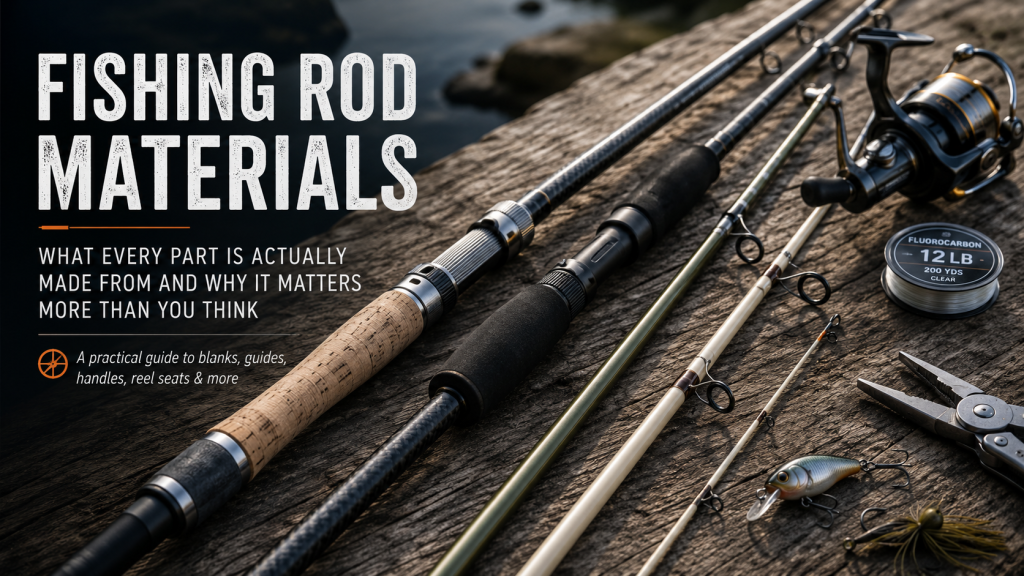
What Are Fishing Rods Made of? (6 Parts Included)
A fishing rod isn’t one material. It’s a system of six distinct components, each made from different materials chosen for different performance characteristics. Understanding all six gives you the complete picture that most guides skip.
Part 1: The Blank
The main shaft of the rod. The tube that bends, loads, and transfers energy. This is what people usually mean when they discuss “fishing rod materials.” The blank determines the rod’s action (where it bends), power (how much force it takes to bend), sensitivity (how much vibration transmits to your hand), and weight.
Part 2: The Handle (Grip)
Where you hold the rod. Needs to be comfortable for hours, provide grip when wet, insulate your hand from cold blank material in winter, and transmit vibration from the blank to your palm for sensitivity.
Part 3: The Tip Top
The guide at the very end of the rod. Takes the most abuse from line friction and fish pressure. Often a different material or construction than the other guides because of the stress concentration at this point.
Part 4: The Reel Seat
The mechanism that holds your reel to the rod. Needs to be secure (a reel falling off mid-fight is catastrophic), lightweight, corrosion-resistant (especially in saltwater), and comfortable where it contacts your hand.
Part 5: The Hook Keeper
Small ring or clip near the handle where you secure your hook when not fishing. Seems trivial but a poorly designed hook keeper damages line, scratches the blank, or doesn’t hold the hook securely during transport.
Part 6: The Guides
The rings along the blank that direct your fishing line from reel to tip. Guide frame material, insert material, and guide placement all affect casting distance, line wear, sensitivity, and rod weight.
Each component has its own material science. Let’s go deep on each one.
Six Materials and Comparison of Rod Blanks
The blank is the heart of the rod. Six materials dominate modern rod blank construction, and understanding the differences between them is the single most important piece of knowledge for choosing a rod.
1. Graphite (Carbon Fiber)
The dominant material in modern fishing rods. Carbon fiber sheets (called prepreg because they’re pre-impregnated with resin) get wrapped around a tapered steel mandrel, heated in an oven to cure the resin, then the mandrel gets pulled out leaving a hollow tube.
Graphite rods are described by modulus rating. Modulus measures stiffness of the carbon fiber itself (not the finished rod). Higher modulus means stiffer fiber, which means less material needed for the same stiffness, which means lighter rods. But higher modulus also means more brittle.
Standard modulus (33-36 million PSI): Durable, forgiving, affordable. What most mid-range rods use. Good all-around performance.
Intermediate modulus (36-42 million PSI): Lighter and more sensitive than standard. The sweet spot for serious recreational anglers. Noticeable improvement over standard without extreme fragility.
High modulus (42-65 million PSI): Tournament-grade sensitivity and lightness. Expensive. More fragile. Requires careful handling. What professional anglers use when every vibration matters.
Ultra-high modulus (65+ million PSI): Exotic. Extremely light and sensitive. Extremely expensive and fragile. Niche applications. Toray produces some of the highest-grade carbon fiber used in premium rod blanks.
Pros: Lightest blank material. Most sensitive (transmits vibration best). Stiffest for its weight. Allows precise action design. Dominant technology for good reason.
Cons: Brittle (can shatter on impact rather than bending). More expensive than fiberglass. Higher modulus = more fragile. Can break if stepped on, slammed in car doors, or high-sticked during a fight. Requires more careful handling than fiberglass.
2. Fiberglass
The original modern rod material. Glass fibers embedded in resin, wrapped around a mandrel similar to graphite construction. Dominated the market from the 1950s through the 1980s before graphite took over.
Fiberglass blanks are heavier and less sensitive than graphite but far more durable and forgiving. They bend deeply without breaking. They absorb shock rather than transmitting it. They survive abuse that would shatter a graphite rod.
Two types exist: S-glass (stronger, lighter, more expensive) and E-glass (standard, heavier, cheaper). Most fiberglass rods use E-glass. Premium fiberglass rods use S-glass.
Pros: Extremely durable (nearly indestructible with normal use). Forgiving (deep flex absorbs mistakes). Affordable. Great for beginners (survives learning-curve abuse). Smooth, parabolic action. Excellent for crankbaits and treble-hook lures where a soft rod prevents hook pulls.
Cons: Heavy. Less sensitive than graphite (dampens vibration rather than transmitting it). Slower action (not ideal for techniques requiring fast tip response). Feels sluggish compared to graphite for experienced anglers. Fatiguing over long days due to weight.
3. Composite (Graphite/Fiberglass Blend)
A blank that combines both graphite and fiberglass in its construction. Not a compromise but a deliberate engineering choice to get specific performance characteristics that neither material achieves alone.
Construction methods vary. Some composites layer graphite over a fiberglass core. Some alternate graphite and fiberglass layers. Some use graphite in the tip section and fiberglass in the butt section. The ratio and arrangement determine the final performance.
Pros: Balances sensitivity with durability. Lighter than pure fiberglass, tougher than pure graphite. Versatile performance. Can be tuned for specific applications. Often the best value proposition (performance per dollar).
Cons: Jack of all trades, master of none (doesn’t match pure graphite sensitivity or pure fiberglass durability). Heavier than equivalent pure graphite. Performance varies enormously depending on the specific blend ratio and construction method. Harder to evaluate quality without fishing it.
4. Bamboo (Split Cane)
The traditional rod material. Strips of Tonkin bamboo (specifically Arundinaria amabilis from China’s Guangdong province) split, planed to precise triangular cross-sections, and glued together to form hexagonal blanks.
Bamboo rod making is craftsmanship, not manufacturing. Each rod takes days to weeks of hand labor. The material has natural taper, natural flex characteristics, and a warmth that synthetic materials can’t replicate.
Pros: Beautiful aesthetics. Smooth, progressive action. Natural vibration dampening that feels pleasant in hand. Heirloom quality (lasts generations with care). Appreciates in value. Connection to fishing tradition and history.
Cons: Extremely expensive ($500-5000+ for quality rods). Heavy. Requires maintenance (varnish upkeep, straightening). Limited to lighter applications (trout, panfish). Not suitable for heavy-duty fishing. Affected by moisture (can warp). Fragile compared to modern materials. Slow to produce.
5. Boron
Boron fibers are stiffer and stronger than carbon fiber but significantly more expensive to produce. Boron rods were briefly popular in the 1980s and 1990s as the “next big thing” before advanced carbon fiber caught up in performance at lower cost.
Today, pure boron rods are rare. Some manufacturers use boron as a supplementary material, adding boron fiber layers to graphite blanks for specific stiffness enhancement in critical sections.
Pros: Stiffer than graphite (more sensitivity per diameter). Stronger than graphite. Excellent vibration transmission.
Cons: Extremely expensive. Difficult to manufacture. Largely obsolete as advanced carbon fiber achieves similar performance at lower cost. Limited availability. Mostly a historical curiosity now.
6. Nano-Resin Technology
Not a fiber material but a resin system advancement that deserves its own category because it fundamentally changes blank performance. Traditional blanks use standard epoxy resin to bind carbon fibers together. Nano-resin technology uses resin infused with nano-scale particles (silica, carbon nanotubes, or graphene) that fill microscopic gaps between fibers.
The result: less resin needed for the same structural integrity, which means lighter blanks with thinner walls that maintain or exceed the strength of conventional construction.
Pros: Lighter blanks without sacrificing strength. Thinner wall construction. Improved impact resistance compared to standard graphite. Better hoop strength (resistance to crushing). Represents the current cutting edge of blank technology.
Cons: Expensive (nano-materials and processing add cost). Marketing claims often exceed measurable real-world differences. Difficult for consumers to verify claims. Still relatively new technology with limited long-term durability data.
Material Comparison Table
| Graphite (Standard) | Light | High | Moderate | All-around fishing |
| Graphite (High Mod) | Very Light | Very High | Low | Tournament, finesse |
| Fiberglass | Heavy | Low | Very High | Beginners, crankbaits |
| Composite | Medium | Medium-High | High | Versatile applications |
| Bamboo | Heavy | Medium | Moderate | Fly fishing, tradition |
| Nano-Resin Graphite | Very Light | Very High | High | Premium performance |
What is the Best Material for a Fishing Rod?
This question has no single answer because “best” depends entirely on how you fish. But I can give you the framework that makes the decision obvious.
For sensitivity (detecting bites): High-modulus graphite wins. Period. If feeling every pebble on the bottom and every tentative nibble matters to your technique (bass fishing with soft plastics, walleye jigging, finesse presentations), graphite is the answer. Higher modulus = more sensitivity, with the tradeoff being increased fragility.
For durability (surviving abuse): Fiberglass wins. If you’re fishing around heavy cover, handing the rod to kids, throwing it in truck beds, or fishing in conditions where rods get banged around, fiberglass survives what graphite won’t. Composite is the middle ground.
For weight (all-day comfort): High-modulus graphite or nano-resin graphite wins. When you’re making 500+ casts per day, every gram matters. Arm fatigue from a heavy rod ruins your last two hours of fishing. Light rods let you fish effectively all day.
For value (performance per dollar): Composite or standard-modulus graphite wins. You get 80% of premium performance at 40% of premium price. The diminishing returns curve in rod materials is steep. The jump from a $100 rod to a $200 rod is noticeable. The jump from $200 to $400 is subtle. The jump from $400 to $800 requires expert hands to detect.
For beginners specifically: Composite or fiberglass. Forgiving, durable, affordable. Learn technique first. Upgrade materials once you know what performance characteristics matter to your specific fishing style.
Materials of Fishing Rod Handle
The handle is your physical connection to the rod for hours at a time. Material choice affects comfort, sensitivity transmission, durability, weight, and aesthetics.
Cork
The traditional premium handle material. Harvested from cork oak bark (Quercus suber) without killing the tree. Graded by density and surface quality from super-grade AAA (fewest pits and imperfections) down to lower grades with visible holes and filler.
Pros: Warm to touch in cold weather (natural insulator). Lightweight. Comfortable grip even when wet. Transmits blank vibration well (good sensitivity). Traditional aesthetic. Molds to your hand shape over time. Natural and sustainable material.
Cons: Degrades over time (crumbles, chips, develops holes). Quality varies enormously between grades. Lower-grade cork looks terrible within a year. Absorbs water and dirt (stains). Requires maintenance. More expensive than EVA foam. Increasingly difficult to source in top grades.
Quality indicator: Look at the cork surface. Fewer and smaller pits = higher grade. If you see large holes filled with putty or cork dust filler, it’s lower grade cork that will deteriorate faster.
EVA Foam
Ethylene-vinyl acetate closed-cell foam. The modern alternative to cork. Available in various densities and surface textures.
Pros: Durable (doesn’t degrade like cork). Comfortable. Lightweight. Affordable. Consistent quality batch to batch. Available in any color. Easy to clean. Doesn’t absorb water. Maintains appearance over years.
Cons: Less sensitive than cork (dampens vibration slightly more). Can feel “cheap” to anglers who associate cork with quality. Gets slippery when combined with sunscreen or fish slime (textured versions solve this). Doesn’t develop character over time (stays the same forever, which is either pro or con depending on perspective).
Carbon Fiber Handle
Exposed carbon fiber or carbon fiber wrapped over foam core. The modern premium option appearing on high-end rods.
Pros: Extremely lightweight. Maximum sensitivity (carbon transmits vibration directly). Durable. Distinctive appearance. Doesn’t degrade. Easy to clean.
Cons: Cold to touch in winter (conducts temperature). Hard surface can cause blisters during long days without gloves. Expensive. Can be slippery when wet. Less comfortable than cork or foam for extended use.
Hypalon (Synthetic Rubber)
Dense synthetic rubber grip material. Common on saltwater rods and heavy-duty applications.
Pros: Extremely durable. Excellent wet grip. Chemical resistant (handles sunscreen, bug spray, fish slime). Easy to clean. Doesn’t degrade in UV or saltwater.
Cons: Heavy. Minimal sensitivity transmission. Firm feel that some find uncomfortable over long sessions. Limited to utilitarian aesthetics. Not suitable for finesse applications where sensitivity matters.
Split Grip vs Full Grip Design
Beyond material, handle design matters. Full grip covers the entire handle section with material. Split grip exposes bare blank between the fore grip and rear grip.
Split grip saves weight and increases sensitivity (your hand contacts the blank directly in the exposed section). Full grip provides more comfort and a traditional look. Most modern bass rods use split grip. Most traditional and saltwater rods use full grip.
Materials of Fishing Rod Tip
The tip top is the final guide at the rod’s end. It takes concentrated stress from line angle changes and fish pressure. Material choice here affects durability and line wear.
Stainless Steel Frame with Ceramic Insert
The standard tip top construction. Stainless frame provides corrosion resistance and strength. Ceramic insert (usually aluminum oxide or silicon carbide) provides a smooth, hard surface for line to pass over without friction damage.
Titanium Frame
Lighter than stainless steel. More flexible (returns to shape if bent rather than staying bent). Corrosion-proof. Premium option found on high-end rods. The flexibility means a bent tip top from transport damage can often be straightened rather than replaced.
Zirconia Insert
Harder than standard aluminum oxide ceramic. Smoother surface. Better heat dissipation during fast line retrieval. Found on mid-range to premium rods. Good balance of performance and cost.
Silicon Carbide (SiC) Insert
The premium insert material. Extremely hard. Extremely smooth. Excellent heat dissipation. Allows braided line use without grooving. The standard on high-end rods. Manufactured primarily by Fuji, the dominant rod component manufacturer globally.
Materials of Fishing Reel Seat
The reel seat locks your reel to the rod. It needs to be secure, lightweight, corrosion-resistant, and comfortable where it contacts your hand during the cast and retrieve.
Graphite Reel Seat
Molded graphite composite. The most common reel seat material on freshwater rods.
Pros: Lightweight. Affordable. Adequate strength for freshwater applications. Doesn’t conduct cold (comfortable in winter). Available in many designs.
Cons: Can crack under extreme force. Less durable than metal options. Can loosen over time with heavy use. Not ideal for saltwater (corrosion concerns at metal contact points).
Aluminum Reel Seat
Machined or cast aluminum, usually anodized for corrosion resistance and color.
Pros: Strong. Durable. Precise machining allows tight reel fit. Premium feel. Good for saltwater when properly anodized.
Cons: Heavier than graphite. Conducts cold (uncomfortable in winter without a handle covering it). More expensive. Can corrode if anodizing is damaged in saltwater environments.
Carbon Fiber Reel Seat
Carbon fiber composite construction. The premium lightweight option.
Pros: Extremely lightweight. Strong. Excellent sensitivity (doesn’t dampen vibration between blank and hand). Premium appearance.
Cons: Expensive. Can crack on impact. Less forgiving than metal if over-tightened.
Titanium Reel Seat
Found on ultra-premium rods. Titanium frame with precision machining.
Pros: Lightest metal option. Corrosion-proof (ideal for saltwater). Extremely strong. Will not corrode regardless of environment.
Cons: Very expensive. Adds significant cost to the rod. Overkill for freshwater applications. Limited availability.
Materials of Hook Keeper
A small component but one that varies in material and design more than you’d expect.
Wire Hook Keeper
Simple bent wire (stainless steel or titanium) attached to the blank. The traditional design.
Pros: Lightweight. Simple. Functional. Cheap to produce. Doesn’t add bulk.
Cons: Can scratch the blank if poorly installed. Wire can bend out of position. Doesn’t hold all hook sizes securely. Can snag line during casting if positioned poorly.
Folding Hook Keeper
Hinged design that folds flat against the blank when not in use.
Pros: Doesn’t interfere with casting. Cleaner appearance when not holding a hook. More secure hook retention.
Cons: More complex. Slightly heavier. More expensive. Moving parts can wear over time.
Rubber Ring Hook Keeper
Simple rubber O-ring around the blank that hooks tuck under.
Pros: Lightest option. No hardware. Doesn’t scratch blank. Cheap. Simple.
Cons: Rubber degrades with UV exposure over time. Can slide on the blank. Doesn’t hold hooks as securely as wire or folding designs. Looks less refined.
Materials of Rod Guides
Guides are the unsung heroes of rod performance. The frame material, insert material, and design all affect casting distance, line durability, sensitivity, and rod weight.
Guide Frame Materials
Stainless Steel: The standard. Strong, corrosion-resistant, affordable. Heavier than alternatives. Found on most mid-range rods.
Titanium: Premium frame material. 43% lighter than stainless steel. Memory metal (returns to shape if bent). Corrosion-proof. Found on high-end rods. Significantly more expensive.
Aluminum: Lightweight but less durable than stainless or titanium. Can bend permanently. Used on some ultralight applications where weight savings justify the fragility tradeoff.
Guide Insert Materials
The insert is the ring inside the guide frame that your line actually contacts. This material determines line wear, heat buildup during retrieval, and casting friction.
Aluminum Oxide (Al₂O₃): The standard ceramic insert. Hard, smooth, affordable. Adequate for monofilament and fluorocarbon line. Can groove over time with heavy braided line use.
Silicon Carbide (SiC): Premium insert material. Harder than aluminum oxide. Better heat dissipation (important during long fights with fast runs). Handles braided line without grooving. The standard on quality rods. Fuji’s SiC guides are the industry benchmark.
Titanium Carbide: Between aluminum oxide and SiC in performance. Good heat dissipation. Durable. Mid-premium pricing.
Zirconia: Hard ceramic with good smoothness. Better than aluminum oxide, slightly below SiC in most performance metrics. Good value option.
Torzite (Fuji proprietary): Ring-shaped guide insert (vs traditional disc shape). Lighter than SiC with equivalent or better performance. The current pinnacle of guide insert technology. Extremely expensive. Found only on premium rods.
Alconite (Fuji proprietary): Fuji’s mid-range insert material. Better than aluminum oxide, more affordable than SiC. Good balance for rods in the $100-250 range.
Guide Design Considerations
Beyond materials, guide design affects performance. Micro guides (smaller diameter) reduce weight and improve sensitivity but can ice up in cold weather and create more friction with thick lines. Standard guides are more versatile. The number of guides and their spacing (called the guide train) affects how the rod loads, how line flows during casting, and how evenly stress distributes along the blank.
Are Expensive Rods Really the Best?
I get asked this constantly by clients looking to source fishing rods for their brands. Here’s the honest answer from someone who’s seen rods at every price point come off the same factory floors.
The $50-100 range: You get functional rods with standard-modulus graphite or composite blanks, aluminum oxide guide inserts, stainless steel guide frames, EVA foam or lower-grade cork handles, and graphite reel seats. These rods fish perfectly well. They catch fish. They last years with reasonable care. For 80% of recreational anglers, this range delivers everything they need.
The $100-250 range: Noticeable improvements. Better carbon fiber (intermediate modulus). SiC or Alconite guide inserts. Better cork grades or premium EVA. More refined actions. Lighter weight. Better sensitivity. This is where serious recreational anglers find their sweet spot. The performance jump from $50 to $150 is significant and tangible.
The $250-500 range: Diminishing returns begin. High-modulus graphite. Titanium guide frames. SiC inserts throughout. Premium cork. Carbon fiber reel seats. These rods are genuinely better but the improvement over the $150-250 range is subtle. You’re paying for refinement, not revolution. Tournament anglers and dedicated enthusiasts appreciate the differences. Casual anglers often can’t detect them.
The $500+ range: You’re paying for the last 5% of performance. Ultra-high modulus blanks. Torzite guides. Titanium everything. Hand-finished cosmetics. Custom components. These rods are objectively the best performing tools available. But the performance gap between a $500 rod and a $250 rod is smaller than the gap between a $250 rod and a $100 rod.
The factory truth: Many rods across different brands and price points come from the same factories in Weihai, China. The same facility might produce a $79 rod for Brand A and a $349 rod for Brand B. The difference is real (different carbon fiber grade, different components, different quality control standards) but the manufacturing expertise is identical. You’re not paying for a “better factory.” You’re paying for better materials and tighter tolerances within the same factory.
When sourcing rods for a brand, your product specification determines what you get. Specify the carbon fiber grade, the guide brand and model, the cork grade, the reel seat type. Don’t just say “high quality rod.” That means nothing to a factory. Specific material specs mean everything.
And always get pre-production samples tested on the water before approving bulk production. A rod that looks perfect in a factory can have action problems, dead spots, or balance issues that only reveal themselves during actual fishing. Physical testing catches what visual inspection cannot.
How to Choose a Fishing Rod for Beginners
If you’re new to fishing and this article has overwhelmed you with material science, here’s the simplified decision path.
Step 1: Determine your primary fishing type.
Freshwater bass fishing? You want a medium-power, fast-action graphite or composite rod, 6’6″ to 7′ length. This covers 80% of bass techniques.
Trout and panfish? A light-power, moderate-action rod, 5’6″ to 6’6″. Fiberglass or composite works great here and forgives beginner mistakes.
Saltwater inshore? Medium-heavy power, fast action, 7′ length. Composite or graphite with corrosion-resistant components (titanium or coated stainless guides, graphite reel seat).
Catfish or heavy freshwater? Medium-heavy to heavy power fiberglass or composite. Durability matters more than sensitivity for this application.
Step 2: Set your budget realistically.
$50-80 gets you a perfectly functional rod that will catch fish and last years. Don’t let anyone tell you that you need to spend $200+ to start fishing. You don’t. Spend that money on time on the water instead.
$100-150 gets you a noticeable upgrade in sensitivity and weight that makes fishing more enjoyable if you’re committed to the hobby.
Over $150 as a beginner is usually wasted money. You don’t yet know what performance characteristics matter to your specific style. Buy mid-range, fish for a season, then upgrade with informed preferences.
Step 3: Prioritize durability over sensitivity.
As a beginner, you will bang your rod on things. You will high-stick fish. You will slam it in car doors. You will lean it against things that fall over. A composite or fiberglass rod survives these learning moments. A high-modulus graphite rod shatters during them. Save the fragile, sensitive rods for when your handling habits have matured.
Step 4: Don’t obsess over components at this stage.
Aluminum oxide guides are fine for a beginner rod. EVA foam handles are fine. Graphite reel seats are fine. These components all work. They all catch fish. The premium upgrades (SiC guides, AAA cork, carbon reel seats) matter when you’re fishing 100+ days per year and can feel the difference. At 20 days per year as a beginner, you won’t notice what you’re missing.
Step 5: Buy from a reputable brand with warranty support.
A $75 rod from a brand with good warranty service beats a $75 rod from an unknown brand with no support. Rods break. It happens to everyone. A brand that replaces or repairs broken rods at reasonable cost provides long-term value that the initial purchase price doesn’t reflect.
The one thing beginners should spend on: A rod and reel combo that’s balanced. A heavy rod with a light reel (or vice versa) creates an uncomfortable, fatiguing setup regardless of material quality. Hold the combo at the reel seat with one finger. If it balances roughly level, the pairing works. If it tips dramatically forward or backward, the combo is mismatched.
Future Trends in Fishing Rod Materials
The fishing rod industry continues evolving. Here’s where materials technology is heading based on what I’m seeing in factory R&D departments and trade shows.
Graphene-Enhanced Blanks
Graphene (single-atom-thick carbon sheets) is being incorporated into resin systems to create blanks that are stronger and lighter than conventional carbon fiber construction. Several manufacturers have released graphene-enhanced rods in the past few years. The technology is real but still early. Current graphene rods show modest improvements over premium conventional graphite. As graphene production scales and costs decrease, expect this to become standard in mid-range rods within 5-10 years.
Bio-Based Resins
Traditional rod blanks use petroleum-based epoxy resin to bind carbon fibers. Environmental pressure is pushing manufacturers toward bio-based resin alternatives derived from plant sources. Several Japanese manufacturers are experimenting with partially bio-based resin systems. Performance is approaching parity with petroleum epoxy. Full adoption is likely within a decade as sustainability becomes a purchasing factor for younger anglers.
Recycled Carbon Fiber
Virgin carbon fiber production is energy-intensive and expensive. Recycled carbon fiber (reclaimed from aerospace, automotive, and industrial waste) is entering the fishing rod supply chain. Current recycled carbon fiber performs below virgin fiber but above fiberglass. As recycling technology improves, expect recycled carbon to become viable for mid-range rod blanks, reducing both cost and environmental impact.
Advanced Nano-Materials
Beyond current nano-resin technology, research into carbon nanotube reinforcement and nano-ceramic coatings promises blanks that are simultaneously lighter, stronger, and more impact-resistant than anything currently available. This technology is 5-15 years from mainstream rod production but represents the likely next major leap in blank performance.
Smart Rod Technology
Sensors embedded in rod blanks that measure cast distance, retrieve speed, hook-set force, and fish fight dynamics. Several prototypes exist. The materials challenge is integrating electronics without adding weight or compromising blank performance. Expect commercial smart rods within 3-5 years, initially at premium price points.
3D-Printed Components
Reel seats, guide frames, and handle components produced via additive manufacturing. Allows custom geometries impossible with traditional machining or molding. Titanium 3D-printed reel seats already exist in limited production. As printing technology improves and costs decrease, expect more custom and small-batch components produced this way.
Sustainability Certification
Similar to how textiles have OEKO-TEX and organic certifications, expect fishing tackle to develop standardized sustainability certifications covering material sourcing, manufacturing processes, and end-of-life recyclability. Brands that adopt early will have competitive advantage as environmentally conscious purchasing grows in the fishing market.
Sourcing Fishing Rods for Your Brand
If you’re building a fishing rod brand or product line, understanding fishing rod materials at this level isn’t optional. It’s the difference between creating products that earn loyal customers and creating products that break on the third trip and generate returns.
Weihai, China produces the majority of the world’s fishing rods across all price points. The same city houses factories making $15 rods for big-box retailers and $500 rods for premium Japanese brands. The infrastructure, expertise, and supply chain exist to produce virtually any rod specification you can design.
Your product spec sheet for rod sourcing needs to include: carbon fiber grade and source (Toray, Mitsubishi, domestic Chinese), modulus rating, resin system, blank wall thickness, guide brand and model (Fuji, SeaGuide, generic), guide insert material, reel seat brand and model, handle material and grade, hardware finish, action and power ratings, and ASTM testing standards compliance.
Work with a sourcing agent who understands fishing tackle specifically. Generic sourcing agents often can’t evaluate rod quality because they don’t fish and don’t understand what makes a blank feel “right” versus “dead.” A specialized agent can flex a blank sample and tell you whether the action matches your specification before you commit to thousands of units.
Pre-production inspection should include: blank straightness verification, spine alignment check, guide alignment inspection, epoxy finish quality, component security testing (pull-test guides, torque-test reel seats), and ideally on-water casting and fish-fighting tests with the actual production sample.
Fishing rod materials determine everything about how a rod performs, how long it lasts, and how much it costs. The blank material gets all the attention, but handles, guides, reel seats, and tips all contribute to the total fishing experience. Understanding all six components and their material options gives you the knowledge to evaluate any rod intelligently, whether you’re buying one for yourself or sourcing thousands for a brand.
The best rod isn’t the most expensive rod. It’s the rod whose materials match your fishing style, your handling habits, and your expectations. A $100 composite rod that’s perfect for your application outfishes a $400 graphite rod that’s wrong for it every single time.
Know your materials. Fish your conditions. Let the rod do what it was built to do.
Need help sourcing fishing rods from verified manufacturers? eSourcingSolution works with rod factories across Weihai and China’s fishing tackle production hubs. From custom rod development to final quality inspection, we manage the production process. Start your rod line.
FAQ
What are most fishing rods made of today?
The majority of fishing rods sold today use graphite (carbon fiber) blanks with standard modulus carbon fiber, stainless steel guide frames with aluminum oxide or SiC inserts, EVA foam or cork handles, and graphite reel seats. This combination provides the best balance of performance, durability, and cost for recreational fishing. Budget rods may use fiberglass or composite blanks. Premium rods upgrade to high-modulus carbon, titanium guide frames, and SiC or Torzite guide inserts.
Is graphite or fiberglass better for fishing rods?
Neither is universally better. Graphite is lighter and more sensitive, making it superior for techniques where detecting subtle bites matters (bass fishing with soft plastics, walleye jigging, finesse presentations). Fiberglass is more durable and forgiving, making it superior for applications where shock absorption matters (crankbait fishing, trolling, beginner use, situations where rods take physical abuse). Composite blends offer middle-ground performance. Choose based on your specific fishing application, not on which material sounds more premium.
What is the most durable fishing rod material?
Fiberglass is the most durable rod blank material. It flexes deeply without breaking, absorbs impact without shattering, and tolerates abuse that would destroy graphite rods. For components, titanium guide frames are the most durable guide option (corrosion-proof, memory metal that returns to shape if bent). EVA foam handles outlast cork in terms of maintaining appearance and structural integrity over years of use.
Why are some fishing rods so expensive?
Premium rod pricing reflects: higher-grade carbon fiber (high-modulus Toray or Mitsubishi fiber costs significantly more than standard Chinese carbon), premium components (Fuji Torzite guides cost 10x more than generic aluminum oxide guides), tighter manufacturing tolerances (more blanks rejected during quality control), hand-finishing of cosmetics, and brand positioning. The materials genuinely cost more. Whether the performance improvement justifies the price increase depends on your skill level and how many days per year you fish.
What is rod modulus and why does it matter?
Modulus measures the stiffness of carbon fiber material (measured in millions of PSI). Higher modulus fiber is stiffer per unit of material, meaning less material is needed to achieve the same rod stiffness. This translates to lighter, thinner blanks that transmit more vibration (sensitivity). The tradeoff is that higher modulus fiber is more brittle and less impact-resistant. Standard modulus (33-36M) is durable and forgiving. High modulus (42-65M) is light and sensitive but fragile. Choose based on how carefully you handle your equipment and how much sensitivity your technique demands.
How can I tell what material a fishing rod is made from?
Check the rod specifications (usually printed near the handle or on the manufacturer’s website). Look for terms like “IM6,” “IM7,” “IM8” (indicating graphite modulus grades), “carbon,” “graphite,” “fiberglass,” or “composite.” For guides, look for markings on the guide frame (Fuji stamps their logo on guide feet). For handles, cork is visually obvious (natural tan color with visible pores). EVA foam is smooth, uniform, and usually black or gray. If specifications aren’t available, weight is a rough indicator: very light rods are likely graphite, heavier rods may be fiberglass or composite.
Do fishing rod materials affect casting distance?
Yes, but less than most people think. Rod materials affect casting primarily through weight (lighter rods generate faster tip speed with less effort) and recovery speed (how quickly the blank stops vibrating after the casting stroke, which affects line release timing). High-modulus graphite rods with fast recovery cast slightly farther than equivalent fiberglass rods in skilled hands. However, casting technique, line choice, lure weight matching, and guide quality all affect distance more than blank material alone. A skilled caster with a fiberglass rod outcasts a beginner with premium graphite every time.
What fishing rod material is best for saltwater?
Graphite or composite blanks work well in saltwater (the blank itself isn’t affected by salt). The critical factor is component corrosion resistance. Saltwater rods need: titanium or heavily coated stainless steel guide frames, SiC or ceramic guide inserts (won’t corrode), graphite or anodized aluminum reel seats (avoid bare metal), and EVA foam or Hypalon handles (cork degrades faster in salt environments). Rinse all rods with fresh water after saltwater use regardless of materials.