
A guy named Marcus emailed me in January. He’d found what looked like the perfect supplier on Alibaba for custom phone cases. Good reviews. Gold Supplier badge. Verified company. Responsive salesperson who spoke decent English and answered questions within hours. Everything checked out on the surface.
Marcus placed a $4,200 order. Paid through Alibaba’s system. Got a tracking number two weeks later. Watched the shipment move across the Pacific. Felt good about the whole thing.
Then the boxes arrived at his apartment in Texas. He opened the first one and his stomach dropped. The phone cases inside looked nothing like the samples he’d approved. Wrong material. Wrong color shade. Print quality so bad that the designs were visibly blurry. He opened the second box. Same thing. Third box. Same. All 2,000 units were garbage he couldn’t sell.
Is Alibaba safe? That’s what Marcus typed into Google at 11 PM that night, sitting on his living room floor surrounded by boxes of worthless inventory.
Here’s my honest answer after years of sourcing products from Chinese suppliers for clients: Alibaba is a tool. Like any tool, it can work well or it can hurt you badly depending on how you use it and how much you understand about what you’re actually dealing with. A chainsaw is perfectly safe in trained hands. Hand one to someone who’s never held one before and tell them to figure it out? Someone’s going to the hospital.
The problem isn’t that Alibaba is a scam. It’s not. It’s a legitimate marketplace where real factories and real trading companies sell real products to buyers worldwide. Millions of successful transactions happen there every single day. But the platform also attracts fraudsters, and its protections have gaps that beginners don’t discover until money has already changed hands.
Let me walk you through the eight risks I’ve personally watched beginners stumble into. Not theoretical risks from some article written by someone who’s never placed an order. Real situations I’ve seen play out with real money lost.
Table of Contents
| 1 | The Honest Answer About Alibaba Safety |
| 2 | How Alibaba Actually Works (What Most Guides Skip) |
| 3 | Risk #1: The Supplier Who Doesn’t Exist |
| 4 | Risk #2: Bait and Switch on Product Quality |
| 5 | Risk #3: Trade Assurance Doesn’t Cover What You Think |
| 6 | Risk #4: The Trading Company Pretending to Be a Factory |
| 7 | Risk #5: Intellectual Property Theft |
| 8 | Risk #6: Payment Scams Outside the Platform |
| 9 | Risk #7: Quality Fade After Your First Order |
| 10 | Risk #8: Shipping and Customs Nightmares |
| 11 | When Alibaba Makes Sense and When It Doesn’t |
| 12 | How to Actually Protect Yourself |
| 13 | FAQ |
How Alibaba Actually Works (The Part Most Guides Skip Over)
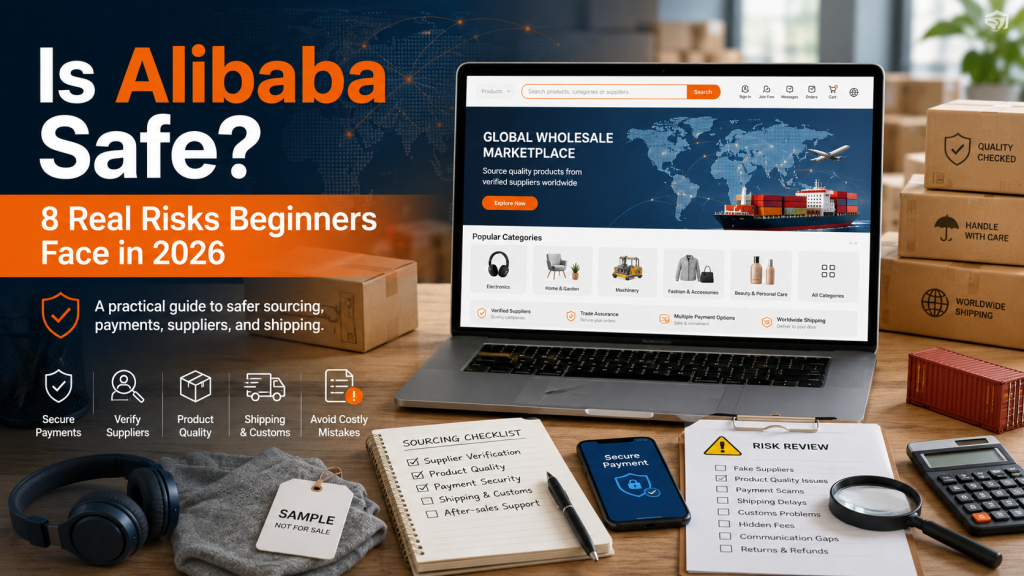
Before we get into risks, you need to understand what Alibaba actually is. Because most beginners misunderstand it fundamentally, and that misunderstanding is where the danger starts.
Alibaba is not a retailer. It’s not Amazon. When you buy something on Amazon, Amazon handles fulfillment, guarantees delivery, processes returns easily, and refunds you quickly if something goes wrong. Amazon is the seller in most practical senses.
Alibaba is a directory. A matchmaking platform. It connects buyers with suppliers, takes a cut, and offers some protections. But the transaction is fundamentally between you and the supplier. Alibaba is the middleman, not the seller. This distinction matters enormously when things go wrong because your recourse is limited in ways that Amazon buyers never experience.
Suppliers pay Alibaba for listings. They pay for Gold Supplier status. They pay for verified badges. These paid features signal some level of legitimacy (a scammer operating for two weeks probably won’t invest $5,000+ in annual membership fees), but they don’t guarantee quality, honesty, or reliability. I’ve dealt with Gold Suppliers who delivered excellent products and Gold Suppliers who lied about their factory capabilities. The badge tells you they paid money to Alibaba. That’s all it definitively tells you.
Understanding this framing changes how you approach every interaction on the platform. You’re not shopping at a store with a return policy. You’re negotiating with a foreign business entity operating under a different legal system, different business culture, and different set of assumptions about buyer-seller relationships.
Risk #1: The Supplier Who Doesn’t Actually Exist
This is the most basic scam and it still catches people in 2026. A “supplier” creates a professional-looking Alibaba storefront. Product photos stolen from legitimate manufacturers. Competitive pricing. Responsive communication. Everything looks real.
You place an order. You pay. And then… nothing. The supplier stops responding. The storefront disappears. Your money is gone.
I watched this happen to a client’s friend who ordered $6,800 worth of yoga mats. The supplier had been on Alibaba for “3 years” according to the profile. Had product photos that looked professional. Had a few reviews (which, we later figured out, were likely fake or purchased). The friend paid via bank transfer outside of Alibaba’s system because the supplier offered a 7% discount for “direct payment.” That discount cost him $6,800.
How this scam works mechanically: Fraudsters create multiple storefronts. They invest enough in each one to look credible for a few months. They collect payments from several buyers simultaneously. Then they vanish and start over with new company names and new storefronts. The cycle repeats.
Red flags I’ve learned to spot:
Company has been on Alibaba less than 2 years but claims 10+ years of manufacturing experience. Their transaction history is thin relative to their claimed production capacity. They push aggressively for payment outside Alibaba’s platform. Their product range is impossibly broad (a “factory” that makes electronics AND furniture AND clothing is almost certainly a scam or a trading company misrepresenting itself). Their factory address, when you check it on Baidu Maps or Google Maps satellite view, shows a residential building or empty lot.
Your protection: Never pay outside Alibaba’s system for your first order with any supplier. Period. Use Trade Assurance. Yes, it has limitations (I’ll cover those in Risk #3). But it’s infinitely better than a wire transfer to a stranger’s bank account. And before any significant order, invest in procurement intelligence to verify the supplier actually exists as a real business entity.
Risk #2: Bait and Switch on Product Quality
This is what happened to Marcus. And honestly, it’s the most common problem I see. More common than outright scams. The supplier is real. The factory exists. They do make products. But what they ship you doesn’t match what they showed you.
The sample they send (or the photos they share) represents their best possible work. Maybe it’s a sample they made specifically to win your order, using better materials and more careful assembly than their normal production line produces. Maybe the photos are from a different factory entirely and they’re planning to subcontract your order to a cheaper facility.
Either way, you approve based on one thing and receive something different.
I’ve seen this play out dozens of times across different product categories. A client ordered custom printed tote bags. Sample was beautiful. Crisp printing, sturdy canvas, clean stitching. Production run arrived with thinner canvas, slightly blurry printing, and loose threads everywhere. Technically it was “the same product.” Practically it was unsellable at the quality level her brand promised customers.
Why this happens so frequently: Chinese manufacturing culture has a different relationship with specifications than Western buyers expect. If you order “cotton tote bags” without specifying exact fabric weight, thread count, print resolution in DPI, stitching density, and acceptable defect rates, the factory has room to interpret. And their interpretation will lean toward whatever saves them money.
This isn’t necessarily malicious. It’s a communication gap combined with economic incentive. The factory quoted you a price. If they can deliver something that technically matches the description while using cheaper materials, their margin improves. Without a detailed product specification sheet that locks down every variable, you’re leaving quality decisions in the hands of someone whose financial incentive runs opposite to yours.
Your protection: Get physical samples before any production order. Not photos. Physical samples shipped to your hands. Then create a spec sheet so detailed that there’s no room for interpretation. Fabric weight in GSM. Color in Pantone codes. Dimensions with tolerances in millimeters. Print resolution minimums. Acceptable defect rate percentages. And then hire third-party quality inspection before shipment leaves the factory. An inspector visits the factory, pulls random samples from your finished production run, and checks them against your approved sample and spec sheet. This single step prevents more quality disasters than everything else combined.
Risk #3: Trade Assurance Doesn’t Cover What You Think It Covers
Alibaba’s Trade Assurance program is their headline buyer protection feature. And beginners treat it like a guarantee. “I used Trade Assurance, so I’m protected.” I’ve heard this dozens of times. And every time, I have to explain what Trade Assurance actually does and, more importantly, what it doesn’t do.
What Trade Assurance actually covers: If the supplier doesn’t ship your order at all, or ships it significantly late beyond the agreed delivery date, you can file a dispute and potentially get a refund. If the product quality is provably different from what was contractually agreed upon, you can file a dispute.
What Trade Assurance doesn’t effectively cover: Subjective quality differences. If you think the blue is slightly wrong but the supplier argues it’s within acceptable range, good luck winning that dispute. Minor defects that don’t make the product “unusable.” Situations where you didn’t specify something clearly enough in the original order contract. Products that technically match the description but don’t match your expectations.
The dispute process reality: Filing a Trade Assurance claim isn’t like clicking “return” on Amazon. It’s a mediation process. You submit evidence. The supplier submits their counter-evidence. Alibaba’s team reviews both sides. This takes weeks, sometimes months. During that time, your money is tied up, your inventory timeline is destroyed, and your business plans are on hold.
I helped a client navigate a Trade Assurance dispute last year. She’d ordered 5,000 silicone kitchen utensils. About 30% had visible defects (air bubbles in the silicone, uneven coloring). She filed a claim with photos and inspection reports. The supplier argued the defects were “within industry standard tolerance.” The dispute took 11 weeks to resolve. She eventually got a partial refund covering roughly 60% of the defective units’ value. Not the full order value. Not even the full value of the defective portion. Sixty percent of the defective portion.
Trade Assurance is better than nothing. Significantly better. But treating it as a safety net that catches everything is dangerous. It’s more like a seatbelt. Helps in a crash. Doesn’t prevent the crash. And doesn’t guarantee you walk away without injuries.
Risk #4: The Trading Company Pretending to Be a Factory
This one isn’t technically a scam. Trading companies are legitimate businesses. But when a trading company presents itself as a factory on Alibaba, you’re being misled about what you’re actually buying and from whom.
Why this matters practically:
Price: A trading company adds their margin (typically 10-30%) on top of the factory’s price. You’re paying more than you would dealing with the factory directly.
Quality control: The trading company may not have direct oversight of production. They place your order with whatever factory offers them the best margin, which might not be the factory that made your sample.
Communication: You’re playing telephone. Your specifications go through the trading company to the factory. Nuances get lost. Changes take longer. Problems take longer to identify and fix.
Accountability: If something goes wrong, the trading company blames the factory. The factory says they followed the trading company’s instructions. You’re stuck in the middle with no direct relationship to the people who actually made your product.
How to detect trading companies posing as factories:
Ask for factory photos showing your specific product being made (not generic factory floor shots). Request a video call where they walk through the production area. Check if their product range is suspiciously broad (real factories specialize; trading companies sell everything). Ask technical manufacturing questions about your product. A real factory engineer answers confidently and specifically. A trading company salesperson gives vague answers or says “let me check with our production team.”
When I do supplier verification for clients, I cross-reference the company’s business license (which states their registered business type) with what they claim on Alibaba. About 40% of “factories” I’ve investigated turned out to be trading companies. Forty percent. That’s not a small number.
When trading companies are actually fine: If you’re ordering small quantities and don’t want to meet factory minimums. If you need multiple product types from different factories and want one point of contact managing everything. If the trading company adds genuine value through quality control, logistics coordination, or design services. Trading companies aren’t evil. But you should know what you’re dealing with and pay accordingly.
Risk #5: Intellectual Property Theft
This risk doesn’t get enough attention in most “is Alibaba safe” articles. But for anyone developing custom or proprietary products, it’s potentially the most expensive risk on this list.
Here’s what happens: You share your product designs, molds, packaging artwork, or proprietary specifications with a supplier on Alibaba. They manufacture your product. And then they also manufacture that same product (or something very similar) for other buyers. Or they list it on their own Alibaba storefront. Or they sell it on Amazon themselves, competing directly with you using your own design.
I’ve seen this happen with custom electronics accessories, unique kitchen gadgets, proprietary cosmetic formulations, and branded packaging designs. One client spent $15,000 developing a custom product mold. Six months after his first production run, he found nearly identical products from three other sellers on Amazon, all sourced from the same factory region. His factory had either sold his mold design to competitors or used it to produce units they sold through other channels.
Why this is hard to prevent: Chinese IP law exists and has improved significantly over the past decade. But enforcement across international borders remains difficult, expensive, and slow. Filing a lawsuit in Chinese court from the United States costs $20,000-50,000+ and takes years. For most small businesses, that’s not economically viable even if you’d win.
Practical protections:
Register your trademark and patents in China before sharing designs with any supplier. Chinese IP law is “first to file,” not “first to use.” If you don’t register in China, someone else can register your own brand name there and you’ll have no legal standing.
Use NNN agreements (Non-Disclosure, Non-Use, Non-Circumvention) written in Chinese, governed by Chinese law, with a Chinese jurisdiction clause. English-language NDAs are essentially unenforceable in Chinese courts.
Never share more information than necessary for production. If the factory doesn’t need your full design file to make your product, don’t send it. Send only what’s required for their specific manufacturing step.
Split production across multiple suppliers so no single factory has your complete product knowledge. One factory makes the housing. Another makes the internal components. A third does assembly. No single supplier can replicate your full product independently.
Risk #6: Payment Scams That Pull You Off-Platform
The supplier says something like: “We can give you 5% discount if you pay by wire transfer directly to our company account instead of through Alibaba.” Or: “Trade Assurance adds fees that increase your cost. Pay us directly and we’ll pass those savings to you.” Or: “For returning customers, we prefer direct bank transfer. It’s faster for both of us.”
Every single one of these is a red flag the size of a billboard.
The moment your money leaves Alibaba’s system, you lose every protection the platform offers. Trade Assurance? Gone. Dispute resolution? Gone. Transaction records that prove what was agreed? Gone. You’re now in a direct financial relationship with a foreign entity, and your only recourse if something goes wrong is international litigation. Which, for a $5,000-20,000 order, costs more than the order itself.
Wire transfers (T/T) to Chinese bank accounts are essentially irreversible once processed. Unlike credit card chargebacks or PayPal disputes, a completed wire transfer cannot be recalled by your bank after the receiving bank has processed it. Your money is gone the moment it clears.
The Western Union and MoneyGram variant: Some scammers push for payment through money transfer services. These are completely untraceable and irreversible. No legitimate manufacturer asks for Western Union payment. None. If someone on Alibaba asks for Western Union, block them immediately and report the account.
PayPal variant: Some suppliers accept PayPal, which does offer buyer protection. But PayPal’s protection has limits on business transactions, time windows for disputes, and the supplier knows this. Sophisticated scammers will delay and stall until your PayPal dispute window expires.
Your protection: Keep all payments within Alibaba’s system for at least your first 3-5 orders with any supplier. Once you’ve established a genuine relationship with verified quality over multiple orders, some buyers transition to direct payment for cost savings. But that’s a calculated risk taken with a known, proven partner. Not something you do with a stranger on your first transaction.
Risk #7: Quality Fade After Your First Order
This is the sneaky one. Your first order arrives and it’s great. Matches the sample. Good quality. You’re happy. You reorder. Second order is… fine. Maybe slightly lower quality but nothing dramatic. Third order? Noticeably worse. Fourth order? You’re getting complaints from customers.
Quality fade is a deliberate strategy some suppliers use. They deliver excellent quality initially to win your business and positive reviews. Then they gradually substitute cheaper materials, reduce quality control attention, or shift your production to a lower-cost subcontractor. Each individual step is small enough that you might not catch it immediately. But over 6-12 months, the cumulative decline is significant.
Why suppliers do this: Margin pressure. Raw material costs fluctuate. Labor costs rise. Your locked-in price doesn’t change. So the factory finds savings elsewhere. Thinner fabric. Cheaper components. Less inspection time. Faster (sloppier) production speeds. Each substitution saves them a fraction of a percent on margin. Multiply that across thousands of units and it adds up.
How I’ve seen this play out: A client selling premium leather wallets on Amazon. First two orders were genuine full-grain leather, beautiful quality, five-star reviews rolling in. Third order, the leather felt slightly different. Still good, but different. By the fifth order, the “leather” was bonded leather (leather scraps glued together with polyurethane). Customer reviews tanked. Amazon listing dropped in ranking. Six months of brand building destroyed.
Your protection: Inspect every single order. Not just your first one. Every one. Third-party quality inspection before shipment should be a permanent line item in your cost structure, not a one-time precaution. Keep approved production samples from each order and compare them against new shipments. Document material specifications so precisely in your product spec sheet that any substitution is contractually measurable. And maintain relationships with backup suppliers so you have leverage. A factory that knows you can walk away treats you differently than one that knows you’re dependent on them.
Risk #8: Shipping and Customs Nightmares
Your product is made. Quality is good. You’ve paid. Now it needs to cross an ocean and clear customs in your country. This is where a whole new category of problems emerges that has nothing to do with the supplier’s honesty or product quality.
Incorrect HS codes: Every product has a Harmonized System code that determines its import duty rate. If your supplier declares the wrong HS code on shipping documents (intentionally to reduce duties, or accidentally because they don’t know your country’s classification system), your shipment gets flagged at customs. Best case: delays and additional paperwork. Worst case: seizure, fines, and forced re-export at your expense.
Missing or incorrect documentation: Commercial invoices, packing lists, certificates of origin, compliance certificates, material safety data sheets. Different products require different documentation. If anything is missing or incorrect, customs holds your shipment. Storage fees at port accumulate daily. I’ve seen storage charges exceed $2,000 for shipments held just three weeks.
Compliance failures: Your product might be perfectly legal to manufacture in China but illegal to import into your country without specific certifications. Electronics need FCC certification in the US. Children’s products need CPSIA testing. Food-contact items need FDA compliance. Cosmetics have their own regulatory framework. If your product arrives without required certifications, customs won’t release it. Period.
The supplier’s role in shipping problems: Many Alibaba suppliers offer FOB (Free On Board) pricing, meaning they handle getting the goods onto a ship but you’re responsible for everything after that. If you don’t have a freight forwarder, customs broker, or experience with international logistics, you’re navigating a complex system blind.
Your protection: Work with a freight forwarder who specializes in imports from China. They handle documentation, customs clearance, and compliance verification. Cost is typically $150-500 per shipment depending on complexity. That’s cheap insurance against $2,000+ in port storage fees or a seized shipment. And verify compliance requirements for your specific product category BEFORE you order, not after goods are floating across the Pacific. A sourcing agent who handles end-to-end logistics eliminates most of these headaches entirely.
When Alibaba Makes Sense (And When It Absolutely Doesn’t)
After everything I’ve just described, you might think I’m saying “never use Alibaba.” I’m not. I use Alibaba regularly as a research and initial contact tool. Many of my clients’ best supplier relationships started with an Alibaba search. The platform has genuine value when used correctly.
Alibaba makes sense when:
You’re researching what’s available and at what approximate price points. You’re making initial contact with suppliers you’ll later verify independently. You’re ordering standard, commodity products where quality variation is limited (basic packaging materials, simple hardware, standard textiles). You have experience with international sourcing and understand the risks. You’re using Trade Assurance and keeping all transactions on-platform. Your order value is small enough that losing it wouldn’t devastate your business.
Alibaba is risky when:
You’re a complete beginner with no sourcing experience. You’re ordering custom or proprietary products with complex specifications. Your order represents a significant portion of your available capital. You can’t afford professional quality inspection. You need guaranteed delivery timelines for time-sensitive launches. You’re in a product category with strict regulatory compliance requirements. You don’t have backup suppliers identified.
The alternative approach: For beginners or anyone ordering custom products above $5,000, working with a sourcing agent or procurement service dramatically reduces risk. A sourcing agent physically visits factories, verifies capabilities, negotiates pricing (often achieving better rates than you’d get directly because of volume relationships and local market knowledge), manages quality control, and handles logistics. Their fee (typically 5-10% of order value) is insurance against the risks described above.
Is that fee worth it? Consider Marcus and his $4,200 in worthless phone cases. Consider my client’s friend and his $6,800 wire transfer to a ghost. Consider the leather wallet seller whose brand got destroyed by quality fade. The sourcing agent’s fee is a fraction of what these people lost.
How to Actually Protect Yourself on Alibaba
If you’re going to use Alibaba directly (and many people do, successfully), here’s the protection framework I recommend:
Before you contact any supplier:
Define your product specifications in writing. Every detail. Materials, dimensions, colors, tolerances, packaging, labeling. Leave nothing to interpretation. Use a proper spec sheet template so you don’t miss critical details.
Research your product’s import compliance requirements. What certifications does it need? What testing is required? What documentation must accompany the shipment? Know this before you order, not after.
Set a budget that includes inspection costs, shipping costs, duties, and a contingency for problems. Your product cost from the supplier is maybe 40-60% of your total landed cost. Beginners consistently underestimate total costs.
During supplier selection:
Contact at least 5-10 suppliers for the same product. Compare pricing, communication quality, willingness to answer technical questions, and sample availability. Suppliers who rush you toward payment without answering questions thoroughly are waving red flags.
Verify the supplier independently. Check their business license. Look up their registered address on satellite maps. Ask for references from other international buyers. Request a live video call showing their factory floor with your product being made.
Order samples from your top 2-3 candidates. Physical samples shipped to you. Compare them side by side. This costs $50-200 per supplier including shipping. Cheap investment relative to a $5,000+ production order.
During ordering:
Keep payment on Alibaba’s platform using Trade Assurance. No exceptions for first orders. Specify everything in the order contract: quantity, specifications, quality standards, delivery date, inspection rights, and what happens if quality doesn’t match the approved sample.
Before shipment:
Hire third-party inspection. An inspector visits the factory when production is 80-100% complete, pulls random samples, and checks against your specifications and approved sample. Cost is typically $200-400 per inspection. If they find problems, you negotiate with the supplier before goods ship. Infinitely easier than negotiating after goods arrive at your warehouse 6,000 miles away.
After delivery:
Document everything. Keep samples from each order for comparison against future orders. Track quality metrics over time. Watch for gradual decline. Maintain relationships with backup suppliers so you’re never dependent on a single source.
This framework doesn’t eliminate risk entirely. Nothing does when you’re buying from overseas suppliers. But it reduces your exposure from “gambling” to “calculated business risk with reasonable protections in place.”
Is Alibaba safe? It’s as safe as you make it. Beginners who treat it like Amazon get burned. Experienced buyers who understand the risks, implement protections, and verify before trusting build successful sourcing relationships through the platform every day.
The eight risks above aren’t reasons to avoid Alibaba entirely. They’re reasons to approach it with eyes open, protections in place, and realistic expectations about what the platform does and doesn’t guarantee.
If you’d rather skip the learning curve and the risk exposure entirely, that’s a legitimate choice too. Book a consultation with someone who’s already made the mistakes and learned the lessons. Or reach out directly to discuss your specific sourcing needs. Either way, don’t become another Marcus sitting on his living room floor surrounded by boxes of products he can’t sell.
FAQ
Is Alibaba safe for small orders under $500?
Relatively safer, yes. At that order size, you’re typically buying existing stock rather than custom production, which eliminates the bait-and-switch risk on manufacturing quality. Trade Assurance covers the transaction. And if the worst happens and you lose $500, it hurts but it doesn’t destroy your business. Many experienced sourcing professionals actually recommend beginners start with small test orders specifically to learn the process without catastrophic downside. Order a small batch. Evaluate quality. Evaluate communication. Evaluate shipping timelines. Then scale up gradually with suppliers who prove themselves reliable across multiple small transactions before you commit serious capital.
Does Gold Supplier status mean the supplier is trustworthy?
No. Gold Supplier is a paid membership tier. The supplier pays Alibaba an annual fee (roughly $4,000-6,000 depending on the category and region) to get that badge. It means they invested money in their Alibaba presence, which suggests they’re not a fly-by-night operation that’ll disappear tomorrow. But it tells you nothing about their product quality, their honesty, or their reliability as a manufacturing partner. I’ve worked with Gold Suppliers who were outstanding and Gold Suppliers who delivered garbage. The badge is one data point among many. Not a trust guarantee. Treat it as a minimum threshold (you probably shouldn’t work with non-Gold suppliers as a beginner) but never as sufficient proof of reliability on its own.
What happens if I get scammed on Alibaba? Can I get my money back?
Depends entirely on how you paid. If you used Trade Assurance and kept everything on-platform, you can file a dispute through Alibaba’s resolution center. You’ll need evidence: photos of defective products, communication records showing what was agreed, inspection reports if you have them, shipping documents. Alibaba mediates between you and the supplier. Resolution takes anywhere from 2-12 weeks depending on complexity. Refunds are possible but not guaranteed, and partial refunds are more common than full refunds for quality disputes. If you paid by wire transfer outside the platform, your options are essentially: ask the supplier nicely (unlikely to work), hire a Chinese lawyer (expensive, slow, uncertain outcome). The US Commercial Service can sometimes assist with trade disputes but their resources are limited. Bottom line: your payment method determines your recovery options. Keep money on-platform.
How do I tell the difference between a real factory and a trading company on Alibaba?
Ask specific manufacturing questions that only a factory would know. What machines do you use for this process? What’s your daily production capacity for this specific product? Can you show me a video of my product being made on your line right now? A real factory answers these confidently and specifically. A trading company gives vague responses or delays while they check with their actual supplier. Also look at product range. A factory that makes silicone kitchen tools doesn’t also make leather bags and electronic accessories. That breadth screams trading company. Check their business license type if you can access it. Chinese business licenses specify whether the entity is a manufacturing company or a trading/commerce company. A sourcing agent can verify this for you by checking Chinese business registration databases that aren’t accessible to overseas buyers.
Is Alibaba safer than sourcing directly from China through other methods?
Alibaba offers more built-in protections than finding suppliers through random Google searches, WeChat groups, or Canton Fair contacts with no platform oversight. Trade Assurance, transaction records, supplier ratings, and dispute resolution are genuine safety features that don’t exist when you wire money to a factory you found through a WhatsApp referral. However, Alibaba is generally less safe than working through a verified sourcing agent who physically visits factories, has established relationships, and stakes their professional reputation on supplier quality. It’s also less safe than attending trade fairs in person where you can see products, meet factory owners face-to-face, and tour facilities yourself. Alibaba sits in the middle of the safety spectrum. Better than going completely solo with no platform protections. Not as secure as having boots on the ground in China verifying everything firsthand.
What’s the safest payment method on Alibaba?
Trade Assurance through Alibaba’s platform using a credit card. This gives you two layers of protection: Alibaba’s dispute resolution system AND your credit card company’s chargeback rights. If Alibaba’s dispute process fails you, you can still initiate a chargeback through your card issuer (though this should be a last resort, not a first move). PayPal offers some protection but has time limits on disputes and caps on business transaction coverage. Wire transfer (T/T) offers zero protection once funds clear. Western Union and MoneyGram offer zero protection and zero traceability. For orders above $10,000, some buyers use letters of credit through their bank, which hold payment in escrow until shipping documents prove delivery. This is more complex to set up but provides strong protection for large orders.
How much should I budget for protecting myself when buying from Alibaba?
Plan for these costs on top of your product cost: Samples from 2-3 suppliers ($100-600 total including shipping). Third-party quality inspection ($200-400 per inspection, every order). Freight forwarding and customs brokerage ($150-500 per shipment). Product compliance testing if required for your category ($500-3,000 depending on product type and certifications needed). Contingency fund of 10-15% of order value for unexpected problems. So if your product order is $5,000, budget an additional $1,000-2,000 for protection measures. That sounds like a lot until you compare it to losing the entire $5,000 to a quality failure or scam. These costs are the price of doing international business responsibly. Brands that skip them to save money usually end up spending far more fixing problems that proper precautions would have prevented.
Has Alibaba gotten safer or more dangerous over the past few years?
Both, honestly. The platform has improved its verification processes, expanded Trade Assurance coverage, and gotten better at removing obvious scam accounts. Dispute resolution has improved compared to five years ago. So the platform itself is safer. But scammers have also gotten more sophisticated. Fake reviews are harder to spot. Fraudulent suppliers invest more in looking legitimate. Quality fade tactics are more gradual and harder to detect. AI-generated product images make it easier to create convincing fake listings. And new scam variants emerge constantly as old ones get shut down. The net result is that a cautious, informed buyer is safer on Alibaba today than five years ago. But a naive beginner faces more convincing, harder-to-detect threats than ever before. Education and proper precautions matter more now, not less. If you’re sourcing products from China for Amazon FBA or any other sales channel, invest time in understanding these risks before you invest money in inventory.