
A guy in one of my sourcing groups posted last month asking for help. He’d ordered 2,000 tents from a factory in Zhejiang for his outdoor gear brand. “4-season expedition tents” according to the listing. What arrived were basically 3-season dome tents with slightly thicker fabric. Same pole structure. Same ventilation design. Same everything except the product description.
His customers found out the hard way. In snow. In wind. In conditions those tents were never built to handle.
He didn’t understand types of tents well enough to know what he was actually ordering versus what the factory was actually making. The spec sheet said “4-season.” The construction said otherwise. And nobody caught it because nobody on his team could look at a tent and identify whether the pole architecture, fabric weight, and ventilation design actually matched the claimed category.
I’ve been sourcing outdoor gear from Chinese manufacturers for years. Tents are one of those products where the gap between what’s advertised and what’s delivered can be enormous if you don’t understand the fundamentals. Whether you’re buying a tent for personal camping or sourcing thousands for a brand, knowing the parts, the types, and the selection criteria protects you from expensive mistakes.
Table of Contents
| 1 | Why Knowing Tent Types Actually Matters |
| 2 | Tent Parts You Should Know Before Choosing |
| 3 | 6 Factors to Consider When Choosing a Tent |
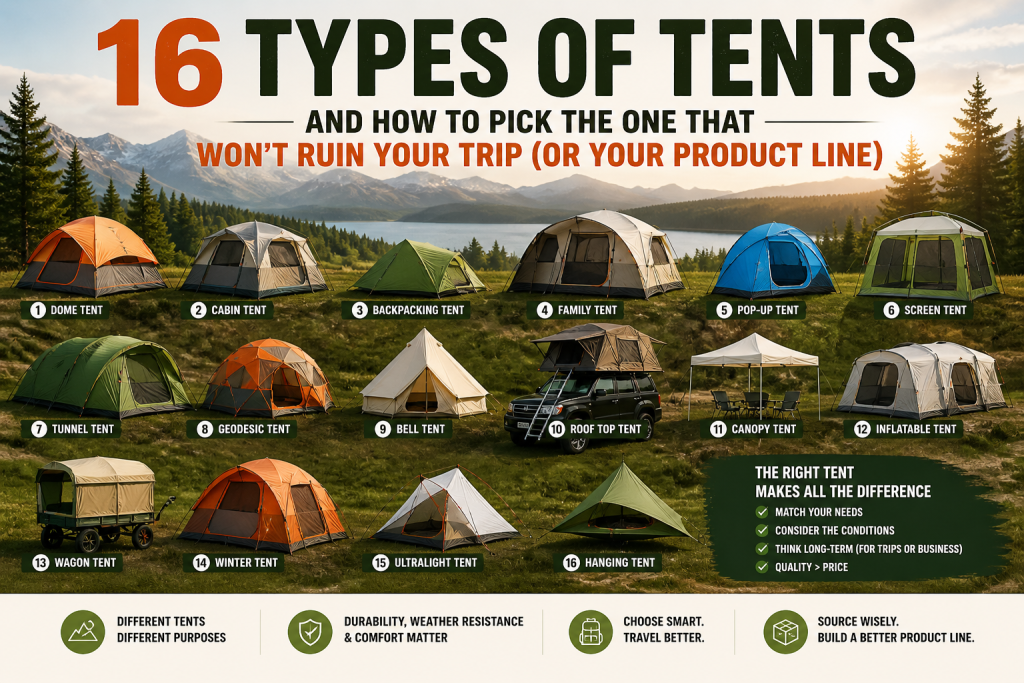
| 4 | 16 Types of Tents Explained |
| 5 | How to Source Tents for Your Business |
| 6 | FAQ |
Tent Parts You Should Know Before Choosing
Before we talk about types of tents, you need to understand what you’re looking at. A tent isn’t just “fabric on poles.” Each component serves a specific function and the quality of each part determines whether the tent performs or fails.
Tent Body (Inner Tent). The main living structure. Usually made from breathable nylon or polyester mesh panels combined with solid fabric panels. The mesh allows ventilation and prevents condensation buildup inside. The solid panels provide privacy and wind protection. The ratio of mesh to solid fabric tells you a lot about what climate the tent is designed for. All mesh? Summer tent. Mostly solid with minimal mesh? Cold weather tent.
Rainfly. The waterproof outer shell that goes over the tent body. Made from nylon or polyester with waterproof coating (usually polyurethane or silicone). The fly is what keeps rain out. A full-coverage fly extends to the ground and provides maximum weather protection. A partial fly covers just the top and leaves the lower mesh exposed. Waterproof rating is measured in millimeters (mm HH). 1500mm handles light rain. 3000mm+ handles heavy downpours. 5000mm+ handles sustained storms.
Poles. The skeleton. Aluminum poles (usually 7001-T6 or DAC brand) are the standard for quality tents. Lightweight, strong, flexible. Fiberglass poles are cheaper but heavier, less durable, and can shatter in cold weather rather than bending. Carbon fiber poles exist at the ultralight premium end. The pole architecture (how many poles, how they cross, where they connect) determines the tent’s shape, stability, and wind resistance.
Stakes (Pegs). Anchor the tent to the ground. Aluminum Y-stakes or V-stakes for most conditions. Steel stakes for hard ground. Titanium for ultralight applications. Cheap tents come with wire stakes that bend on the first use. Good stakes matter more than people realize until they’re chasing their tent across a field at 2 AM.
Guylines. Cord attachments that extend from the fly to stakes in the ground, adding wind stability. Reflective guylines prevent tripping at night. Tensioners allow quick adjustment. A tent without proper guyline attachment points will flap and potentially collapse in moderate wind.
Vestibule. The covered area between the tent body door and the rainfly edge. Gear storage space. Keeps boots and packs dry without bringing them inside the sleeping area. Some tents have no vestibule. Some have two (one on each side). Vestibule size varies from barely-fits-your-boots to practically-another-room.
Floor. The bottom of the tent body. Needs to be waterproof since it sits directly on wet ground. Usually a heavier denier fabric with higher waterproof coating than the fly (since it handles ground moisture and the pressure of bodies lying on it). Bathtub floor design curves up several inches at the edges to prevent ground water from seeping in at the seams.
Seam Sealing. Every stitch hole in waterproof fabric is a potential leak point. Factory-sealed seams have waterproof tape applied over every stitch line. Some budget tents ship unsealed and include a tube of seam sealer for DIY application. If you’re sourcing tents for a brand, specify factory seam sealing in your product spec sheet. Customers should never have to seal their own seams on a finished product.
Zippers. YKK or equivalent quality zippers on doors and vestibules. Cheap zippers fail in cold weather, jam when dirty, and separate under stress. Two-way zippers allow ventilation adjustment from top or bottom. Zipper quality is one of the first things that fails on budget tents.
6 Factors to Consider When Choosing a Tent
Before picking from the 16 types of tents below, run your decision through these six filters.
1. Capacity (How Many People)
Tent capacity ratings are optimistic. A “2-person tent” fits two people lying shoulder to shoulder with zero extra space. No gear inside. No room to sit up comfortably in most cases. Real-world rule: add one person to your actual group size. Two people camping? Get a 3-person tent. Family of four? Get a 6-person.
2. Seasonality
3-season tents handle spring, summer, and fall. More mesh, lighter weight, adequate rain protection, moderate wind resistance. This covers 90% of recreational camping.
4-season tents handle winter conditions. Stronger pole architecture, less mesh, heavier fabrics, designed to shed snow load and resist sustained high winds. Heavier and more expensive. Overkill for summer camping.
3+ season (extended season) tents sit between. Handle light snow and stronger winds than pure 3-season but aren’t true mountaineering shelters.
3. Weight
Matters enormously for backpacking. Irrelevant for car camping. Ultralight tents (under 2 lbs per person) sacrifice durability and space for weight savings. Car camping tents can weigh 20+ lbs because you’re carrying them 50 feet from your trunk, not 10 miles up a mountain.
4. Weather Resistance
Consider your typical conditions. Desert camping? Ventilation matters more than waterproofing. Pacific Northwest? Waterproofing and full-coverage fly are essential. Mountain ridgelines? Wind resistance and pole strength are priority. Match the tent’s design strengths to your actual environment.
5. Setup Complexity
Some tents take 45 minutes and an engineering degree. Others pop up in 30 seconds. For family camping with kids running around, fast setup matters. For a base camp you’ll occupy for a week, setup time is less critical. Freestanding tents (don’t require stakes to stand up) offer more flexibility on hard surfaces.
6. Packed Size and Portability
A tent that packs to the size of a sleeping bag works for backpacking. A tent that fills half your car trunk works for car camping. Consider how you’re transporting it and what space constraints exist.
16 Types of Tents Explained
Now the main event. Every major tent type, what it’s built for, and who should actually buy it.
1. Dome Tent
The most common recreational tent shape. Two poles cross in an X pattern over the top creating a rounded dome. Freestanding (stands without stakes, though stakes add stability).
Best for: General camping, beginners, car camping, festivals.
Capacity: Usually 2-6 person.
Pros: Simple setup. Affordable. Stable in moderate wind. Widely available.
Cons: Limited headroom at edges. Not ideal for tall people. Wind resistance drops in larger sizes.
2. Cabin Tent
Vertical or near-vertical walls creating a box-like interior. Maximum interior volume for the footprint. The “room” feeling.
Best for: Family car camping, extended stays, campground camping.
Capacity: Usually 4-12 person.
Pros: Stand-up headroom. Room dividers available. Feels like a room, not a tent. Maximum livable space.
Cons: Heavy. Bulky packed. Poor wind resistance (tall flat walls catch wind). Complex setup. Not portable.
3. Tunnel Tent
Multiple parallel hoops creating a tube shape. Not freestanding (requires stakes to maintain shape). Popular in European camping and expedition use.
Best for: Base camps, windy conditions (when oriented correctly), groups needing length.
Capacity: 2-8 person.
Pros: Excellent space-to-weight ratio. Good headroom throughout length. Strong in wind when staked properly with narrow end facing wind.
Cons: Must be staked (won’t stand alone). Orientation matters for wind. Can be complex to pitch.
4. Geodesic Tent
Multiple poles crossing at numerous points creating a sphere-like structure with many triangular panels. The strongest tent architecture.
Best for: Mountaineering, expedition camping, extreme weather, high altitude.
Capacity: Usually 2-4 person.
Pros: Extremely wind-resistant. Handles snow load. Self-supporting. Strongest structure available.
Cons: Expensive. Heavy. Complex setup. Overkill for casual camping. Limited interior space relative to weight.
5. A-Frame Tent (Ridge Tent)
The classic tent shape. Single horizontal ridge pole with fabric sloping down to the ground on both sides. The tent your grandfather used.
Best for: Nostalgia, ultralight versions for backpacking, scout camps.
Capacity: Usually 1-3 person.
Pros: Simple design. Can be very lightweight. Easy to understand. Cheap to manufacture.
Cons: Poor interior space (sloping walls everywhere). Limited headroom except at center. Mostly obsolete for serious use.
6. Pop-Up Tent (Instant Tent)
Pre-assembled frame that springs into shape when released from its circular carrying case. Setup time: seconds.
Best for: Festivals, beach shade, casual day camping, kids.
Capacity: Usually 1-4 person.
Pros: Instant setup. No assembly required. Great for non-campers. Fun for kids.
Cons: Bulky packed (large flat circle). Difficult to fold back up (the learning curve is real). Flimsy in wind. Not waterproof enough for serious rain. Limited lifespan.
7. Backpacking Tent
Lightweight, compact, designed to be carried miles on your back. Every gram is considered.
Best for: Hiking, thru-hiking, backcountry camping, bikepacking.
Capacity: Usually 1-3 person.
Pros: Light (1-4 lbs total). Packs small. Designed for portability above all else.
Cons: Tight interior. Less durable fabrics (thinner to save weight). Expensive for quality versions. Comfort sacrificed for weight savings.
8. Rooftop Tent
Mounts on vehicle roof rack. Unfolds or pops up from a hard or soft shell case on top of your car.
Best for: Overlanding, road trips, vehicle-based adventure travel.
Capacity: Usually 2-4 person.
Pros: Off-ground sleeping (away from animals, water, uneven terrain). Quick setup. Built-in mattress. No ground preparation needed.
Cons: Expensive ($1000-4000+). Heavy (affects vehicle fuel economy and handling). Must return to vehicle to sleep. Requires robust roof rack.
9. Teepee/Tipi Tent
Single center pole with fabric radiating outward to the ground in a cone shape. Modern versions use lightweight materials with traditional silhouette.
Best for: Glamping, group camping, winter camping with stove (some have stove jack openings).
Capacity: 4-12 person.
Pros: Huge interior volume. Single pole simplicity. Can accommodate wood stove. Dramatic aesthetic.
Cons: Center pole obstructs interior. Not freestanding. Requires many stakes. Heavy in larger sizes.
10. Bell Tent
Vertical side walls with a conical roof from a center pole. The glamping icon. Canvas or polycotton construction typically.
Best for: Glamping, semi-permanent camps, events, rental businesses.
Capacity: 4-10 person.
Pros: Beautiful aesthetic. Stand-up room throughout. Breathable canvas. Can fit furniture inside. Feels like a room.
Cons: Extremely heavy (50-100+ lbs). Expensive. Not portable. Requires dry-out time after rain to prevent mold. Canvas needs maintenance.
11. Hammock Tent
Suspended sleeping system with integrated bug net and rainfly. No ground contact.
Best for: Solo backpacking in forested areas, warm weather camping, anyone who hates sleeping on the ground.
Capacity: 1 person (usually).
Pros: Comfortable sleep (no ground pressure points). Light. Works on uneven or wet terrain. No ground preparation.
Cons: Requires trees. Cold underneath without underquilt. Not for groups. Learning curve for comfortable sleep position. Difficult in treeless environments.
12. Bivy Sack (Bivouac)
Minimal waterproof shell that fits over a sleeping bag. Barely a tent. Maximum minimalism.
Best for: Ultralight backpacking, emergency shelter, mountaineering, military use.
Capacity: 1 person.
Pros: Lightest possible shelter (8-32 oz). Tiny packed size. Fast deployment. Works anywhere.
Cons: Claustrophobic. No sitting up. Condensation issues. No gear storage. No comfort whatsoever. Purely functional survival shelter.
13. Inflatable Tent
Air beams replace traditional poles. Pump up instead of threading poles through sleeves.
Best for: Family camping, people who hate pole assembly, car camping.
Capacity: 4-8 person.
Pros: Fast setup (pump and done). No pole breakage risk. Comfortable to lean against (flexible beams).
Cons: Requires pump. Puncture risk (though modern ones are durable). Heavier than pole equivalents. More expensive. Repair is more complex than splinting a broken pole.
14. Screen House/Screen Tent
Mesh walls with a solid roof. Not a sleeping tent. A communal shelter for bug-free outdoor living.
Best for: Campsite dining area, bug protection, shade structure, event shelter.
Capacity: 8-15 person standing/sitting.
Pros: Bug-free outdoor space. Ventilation. Shade. Social gathering point.
Cons: Not waterproof (mesh walls). Not a sleeping shelter. Bulky. Requires calm conditions (no wind resistance).
15. Tarp Tent/Tarp Shelter
A shaped tarp with strategic attachment points that pitches into various shelter configurations using trekking poles or trees.
Best for: Ultralight backpacking, experienced campers, thru-hikers.
Capacity: 1-2 person.
Pros: Extremely light. Versatile pitch configurations. Good ventilation. Affordable.
Cons: No floor (bugs, ground moisture). No full enclosure. Requires skill to pitch well. Limited weather protection compared to full tents. Not for beginners.
16. Multi-Room Tent
Large family tent with internal dividers creating separate “rooms.” Essentially a fabric house.
Best for: Large families, extended car camping trips, group camping.
Capacity: 8-16 person.
Pros: Privacy within a shared shelter. Separate sleeping and living areas. Stand-up height. Feels like home.
Cons: Extremely heavy and bulky. Complex setup (30-60 minutes). Expensive. Poor wind resistance. Requires large flat campsite.
How to Source Tents for Your Business
If you’re reading this as someone who wants to sell tents rather than just buy one for personal use, here’s what matters from the sourcing side.
China’s tent manufacturing concentrates in Zhejiang province (Ningbo and Yongkang areas) and parts of Guangdong. These factories produce for major global brands and also handle OEM/ODM orders for smaller brands.
The critical specs for your product spec sheet: fabric type and denier, waterproof rating (mm HH), pole material and diameter, seam sealing method, zipper brand, total weight, packed dimensions, and compliance with ISO 5912 tent safety standards.
Get pre-production samples tested in actual conditions before approving bulk production. Set up the tent. Pour water on it. Stress the poles. Yank the stakes. Zip and unzip 50 times. A tent that looks good on a factory floor might fail in a rainstorm. Physical testing catches what visual inspection misses.
Material certifications matter for retail. Bluesign certification for sustainable textile production. CPAI-84 flame resistance for the US market. Specify these upfront or you’ll discover compliance gaps when your retailer asks for documentation you don’t have.
Understanding types of tents at this level separates informed buyers from people who get surprised by what shows up. Whether you’re choosing one tent for your next camping trip or specifying thousands for a product line, the knowledge is the same. Know the parts. Know the types. Know what questions to ask.
Then go sleep outside. That’s the whole point.
Need help sourcing tents from verified manufacturers? eSourcingSolution works with tent factories across China’s outdoor gear manufacturing hubs. From custom tent development to final quality inspection, we handle the production side. Start your project.
FAQ
What type of tent is best for beginners?
A dome tent in the 3-4 person size range. Simple two-pole setup, freestanding (forgiving if you pick a bad spot), affordable, and stable enough for three-season conditions. Don’t overcomplicate your first tent purchase.
What is the strongest type of tent for wind?
Geodesic tents with multiple crossing poles offer the highest wind resistance due to their spherical geometry and numerous intersection points. For non-expedition use, low-profile dome tents and properly staked tunnel tents (narrow end facing wind) handle strong winds well.
How long should a quality tent last?
A well-made tent with aluminum poles and quality fabric should last 5-10 years of regular use (20-50 nights per year). Ultraviolet exposure degrades waterproof coatings over time regardless of use. Store dry, avoid prolonged sun exposure when not in use, and re-waterproof every 2-3 years. Budget tents with fiberglass poles typically last 2-4 years. REI’s tent care guide covers maintenance basics.
What’s the difference between 3-season and 4-season tents?
3-season tents prioritize ventilation (more mesh), lighter weight, and rain protection. They handle spring through fall conditions. 4-season tents prioritize structural strength (more poles, more crossing points), snow load shedding, wind resistance, and heat retention (less mesh, more solid fabric). They handle winter and extreme conditions but are heavier, hotter in summer, and more expensive.
Can I use a 4-season tent in summer?
You can, but you’ll be uncomfortable. Less mesh means less ventilation, which means more heat and condensation buildup inside. A 4-season tent in July feels like sleeping in a sauna. Use a 3-season tent for warm weather and save the 4-season for conditions that actually demand it.