
Hungary is a rapidly developing nation in Central Europe, strategically positioned within the EU single market, offering businesses reliable access to high-quality sourcing opportunities.
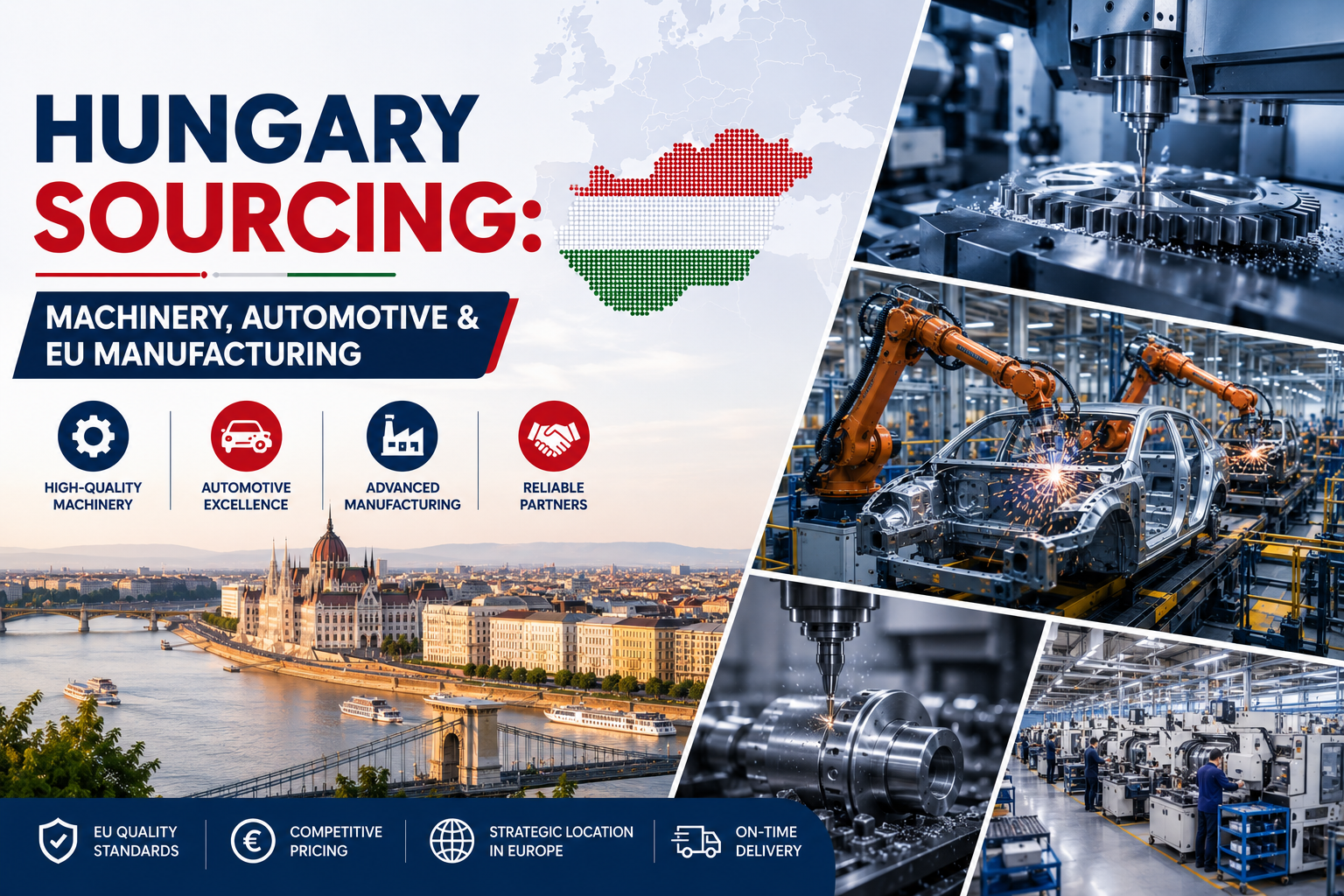
Hungary does not get the attention it deserves in sourcing conversations. While procurement teams debate China versus Vietnam or Poland versus Romania, Hungary quietly hosts Audi’s largest engine factory in the world, Mercedes-Benz’s newest European assembly plant, and a BMW gigafactory under construction. Annual exports exceed USD 112 billion from a country of just 10 million people. That ratio of output to population tells you something important: Hungarian manufacturing is not a side project. It is the backbone of the economy, refined over decades of German and Austrian industrial partnership. For buyers seeking EU-compliant manufacturing at Central European pricing, Hungary sourcing deserves serious consideration.
Hungary Sourcing: Market Overview & Strategic Advantages
Hungary sourcing works because geography and economics align perfectly. The country sits at the crossroads of Central Europe, bordering Austria, Slovakia, Romania, Serbia, Croatia, Slovenia, and Ukraine. A truck leaving Budapest reaches Vienna in two hours, Munich in five, and any EU capital within a day. Over 70% of Hungarian exports stay within the EU, meaning factories here are built to satisfy European regulatory requirements, quality expectations, and just-in-time delivery schedules as standard practice.
Germany dominates as Hungary’s largest trade partner, absorbing roughly 27% of all exports. Austria, Italy, France, Romania, and Poland round out the top destinations. This German orientation is not coincidental. German multinationals invested heavily in Hungary starting in the 1990s, transferring manufacturing know-how, quality systems, and supply chain discipline. The result is a manufacturing culture that thinks in German precision but operates at Hungarian cost levels.
Labour costs sit approximately 35-45% below Germany and 20-25% below the Czech Republic for equivalent skill levels. Hungary also offers generous government incentives for manufacturing investment, including tax credits, training subsidies, and fast-track permitting through Special Economic Zones.
Products to Source from Hungary
Automotive and Vehicle Components. Audi produces two million engines annually in Gyor. Mercedes assembles vehicles in Kecskemet. Suzuki manufactures in Esztergom. The Tier 1 and Tier 2 supply chain surrounding these OEMs produces transmissions, electronics, seating, stampings, castings, and plastic interior components at scale.
Industrial Machinery and Equipment. Food processing machinery, packaging systems, agricultural equipment, and precision tools. Hungarian engineering firms serve both domestic agriculture and international industrial clients.
Electronics and Electrical Components. Samsung, Bosch, and Continental operate major electronics plants. Wiring harnesses, sensors, control units, and consumer electronics assembly.
Chemicals and Pharmaceuticals. Richter Gedeon is Hungary’s flagship pharma company, but the sector extends to industrial chemicals, plastics, rubber compounds, and agrochemicals. The chemical corridor along the Danube hosts significant production capacity.
Food and Agricultural Products. Processed meats (Hungarian salami is world-famous for a reason), wines, canned vegetables, sunflower oil, grain products, and dairy. Hungary’s agricultural sector combines traditional quality with modern food safety certification.
Textiles and Apparel. Mid-range garments, workwear, uniforms, and technical textiles. Not competing on volume with Asia, but strong for small-to-medium EU-compliant production runs with fast turnaround.
Iron, Steel, and Metal Products. Structural steel, precision tubes, sheet metal fabrication, and machined components. Dunaujvaros hosts Hungary’s primary steel production complex.
Furniture and Wood Products. Office furniture, contract seating, kitchen cabinetry, and solid wood furniture. Clean Scandinavian-influenced design combined with competitive Central European pricing.
Challenges in Hungary Sourcing and Our Approach
Hungary sourcing has limitations buyers should understand. The domestic market is small, so factory capacity can be tight in high-demand sectors like automotive. The Hungarian Forint fluctuates more than the Euro, creating currency risk on longer contracts. Skilled worker availability is tightening as unemployment sits near historic lows. And English proficiency, while improving among younger professionals, remains inconsistent at factory-floor level.
Our team manages these factors from experience. We identify factories with genuine available capacity rather than plants already running three shifts for German OEMs. We structure contracts with currency adjustment clauses where appropriate. We verify workforce stability during factory audits. And our local contacts handle Hungarian-language communication during technical discussions and quality reviews.
How We Support Your Hungary Sourcing
eSourcingSolution delivers structured Hungary sourcing services for businesses building or diversifying European supply chains. Our procurement intelligence provides sector-specific cost benchmarking against Czech, Polish, and Slovak alternatives. Quality control inspections confirm EU-standard compliance before shipment.
The Hungarian Investment Promotion Agency (HIPA) supports foreign companies establishing procurement relationships and provides sector-specific market data. The Hungarian Chamber of Commerce and Industry facilitates business connections across manufacturing sectors.
We handle supplier identification, factory capability assessments, sample coordination, production monitoring, and logistics planning. Whether you need automotive components from Gyor, electronics from the Budapest corridor, or food products from the Great Plain region, our network covers Hungary’s industrial landscape.
Ready to explore Hungary sourcing for your European procurement needs? Contact us for a free supplier assessment and cost comparison against your current sources.

Below are answers to common questions about eSourcingSolution, our services, and how we work. If you need more details, feel free to reach out — our team is ready to help!
We can source a wide range of goods and services — from raw materials and commodities to custom-engineered products and specialized services. Visit our Category Expertise page to explore what we cover.
We work with startups, SMEs, and global enterprises that want to source more competitively from emerging and developed markets, strengthen supply chains, and access reliable procurement support.
Yes. We maintain strong partnerships with a global network of vetted, reliable suppliers across multiple industries, ensuring quality, compliance, and long-term value.
Our proven qualification process, supported by local teams and digital audits, can fully onboard a new supplier in as little as 4–8 weeks, depending on category and compliance needs.
Using real-time market data, cost analysis, and sourcing intelligence, we can quickly evaluate potential savings, benchmark costs, and highlight key opportunities — typically within a few weeks.
It’s easy to begin — just reach out through our Contact page. We’ll arrange a quick discovery call, understand your goals, and design a customized sourcing plan to help you unlock better value.