
Turkey’s economy has flourished since 1995 through strengthened ties with the European Union, including a free-trade agreement that has boosted access to the EU market.
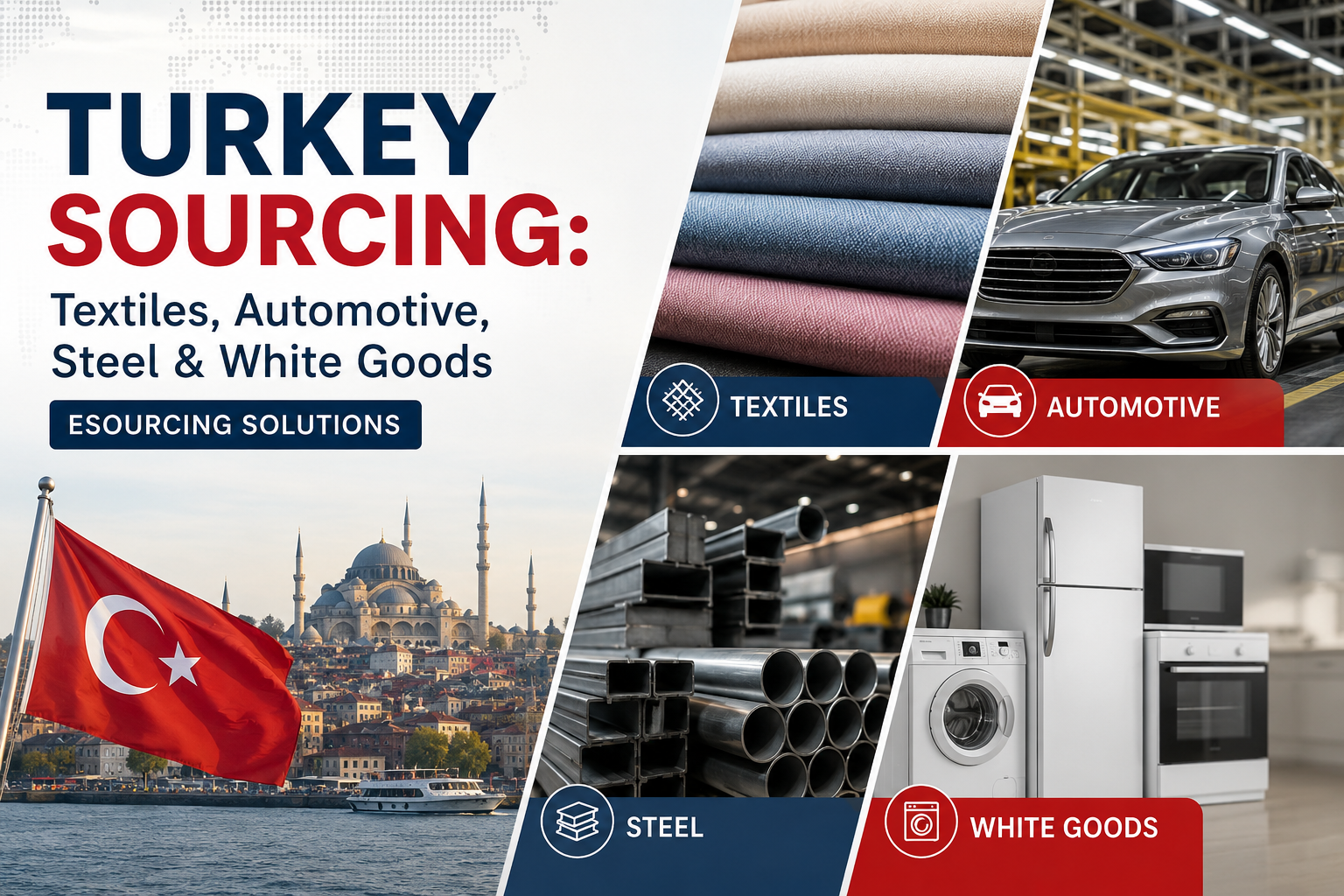
Turkey is the manufacturing giant that procurement teams either love or underestimate. Monthly exports of USD 11 billion put it among the world’s top 15 exporting nations. The country produces everything from fast fashion to warships, from refrigerators to reinforcing steel, from automotive components to surgical instruments. And it does all of this within a customs union with the European Union that has been operational since 1996. That means Turkish manufactured goods enter the EU market with zero tariffs and minimal border friction. For buyers who need serious manufacturing scale, European-adjacent quality, and delivery times measured in days rather than weeks, Turkey sourcing is not an alternative to China. It is a different category entirely.
Turkey Sourcing: Market Overview & Manufacturing Power
Turkey sourcing works because the country occupies a unique position that no competitor can replicate. Geographically, Istanbul straddles Europe and Asia. Economically, Turkey combines a massive domestic market of 85 million consumers with export infrastructure built to serve Europe, the Middle East, North Africa, and Central Asia simultaneously. A container leaving Istanbul reaches any Mediterranean port within days. A truck crosses into Bulgaria and reaches Western Europe faster than shipments from Poland.
The EU Customs Union (operational since 1996) eliminates tariffs on industrial goods moving between Turkey and EU member states. This is not a standard free trade agreement. It is deeper integration that aligns Turkish industrial standards with European norms. Turkish factories producing for European markets already comply with CE marking, REACH regulations, and sector-specific EU directives as standard practice.
Labour costs sit approximately 40-50% below Western Europe but 30-40% above Asian competitors like Vietnam or Bangladesh. Turkey does not compete on cheapest price. It competes on speed, flexibility, quality, and the ability to handle complex manufacturing that Asian factories struggle with. Small batch runs, rapid prototyping, custom specifications, and fast turnaround are where Turkish manufacturers excel.
Primary export destinations are the European Union (particularly Germany, UK, Italy, France, and Spain), the United States, and Russia. Turkey also serves as a gateway to Middle Eastern and Central Asian markets for companies seeking regional distribution.
Products to Source from Turkey
Textiles and Garments. Turkey is Europe’s largest garment supplier and the world’s fifth-largest textile exporter. Denim (Turkey produces more denim than any European country), knitwear, woven garments, home textiles, towels, and technical fabrics. Istanbul, Bursa, Denizli, and Gaziantep are primary textile centres. Brands from Zara to Hugo Boss manufacture in Turkey for speed-to-market.
Automotive and Auto Parts. Ford, Toyota, Hyundai, Fiat (Stellantis), and Mercedes-Benz all operate assembly plants. Turkey produces over 1.5 million vehicles annually. The supply chain delivers engines, transmissions, axles, seating, glass, and electronics. Bursa and Kocaeli are the automotive heartland.
Iron, Steel, and Metals. Turkey is the world’s eighth-largest steel producer. Rebar, flat steel, structural sections, stainless steel, and aluminium products. Iskenderun and Izmir host major steel complexes. Turkish steel reaches construction sites across the Middle East, Africa, and Europe.
White Goods and Home Appliances. Arcelik (Beko, Grundig brands), Vestel, and BSH all manufacture in Turkey. Washing machines, refrigerators, dishwashers, ovens, and televisions. Turkey is Europe’s largest white goods producer, exporting to over 140 countries.
Chemicals and Pharmaceuticals. Industrial chemicals, plastics, paints, cleaning products, cosmetics, and generic pharmaceuticals. Kocaeli and Istanbul’s industrial zones host major chemical production.
Ships and Yachts. Turkey ranks among the world’s top five superyacht builders. Commercial vessels, tankers, and naval ships are constructed in Tuzla (Istanbul) and Yalova shipyards. A sector most buyers do not associate with Turkey until they see the order books.
Furniture. Modern furniture, hotel and restaurant fit-outs, kitchen systems, and office furniture. Inegol (near Bursa) and Kayseri are Turkey’s furniture manufacturing capitals. Quality ranges from budget to luxury contract work.
Ceramics and Natural Stone. Floor tiles, wall tiles, marble, travertine, and granite. Turkey is the world’s largest marble exporter and a top-five ceramic tile producer. Afyon and Bilecik supply distinctive stone varieties globally.
Fresh and Processed Food. Hazelnuts (Turkey produces 70% of global supply), dried fruits, olive oil, canned goods, confectionery, and frozen vegetables. The Aegean and Mediterranean coasts produce for European food brands.
Challenges in Turkey Sourcing and Our Approach
Turkey sourcing requires navigating economic volatility that would unsettle less experienced buyers. The Turkish Lira has lost over 80% of its value against the Dollar since 2018. That devaluation makes Turkish goods cheaper for foreign buyers but creates chaos for Turkish manufacturers managing imported raw material costs. Inflation has exceeded 60% in recent years, forcing constant price renegotiation. Political tensions with EU members occasionally disrupt trade sentiment. And while top-tier Turkish factories match European quality perfectly, the market also contains thousands of smaller operations where consistency requires active management.
Our team turns Turkish volatility into buyer advantage. We lock pricing in hard currency where possible. We identify manufacturers with strong balance sheets who can absorb Lira fluctuations without cutting corners on quality. We renegotiate pricing quarterly rather than annually to reflect market reality. We audit factories rigorously because the quality spread between Turkey’s best and worst is enormous. And we maintain relationships across multiple suppliers in each category so capacity constraints at one factory never become your problem.
How We Support Your Turkey Sourcing
eSourcingSolution provides comprehensive Turkey sourcing services for businesses seeking European-adjacent manufacturing at competitive pricing. Our procurement intelligence delivers sector-specific cost data benchmarked against Chinese, Eastern European, and North African alternatives. Quality control inspections verify production standards throughout manufacturing runs.
The Investment Office of the Presidency of the Republic of Turkey provides sector-specific investment data and facilitates international business partnerships. The Turkish Exporters Assembly (TIM) publishes detailed export statistics and connects international buyers with verified Turkish manufacturers across all sectors.
We handle supplier identification, factory audits, sample development, production monitoring, and logistics coordination from Turkish ports and overland routes. Whether you need textiles from Bursa, automotive parts from Kocaeli, steel from Iskenderun, or marble from Afyon, our network covers Turkey’s industrial geography.
Ready to explore Turkey sourcing for your supply chain? Contact us for a free supplier assessment and cost-speed comparison against your current manufacturing sources.

Below are answers to common questions about eSourcingSolution, our services, and how we work. If you need more details, feel free to reach out — our team is ready to help!
We can source a wide range of goods and services — from raw materials and commodities to custom-engineered products and specialized services. Visit our Category Expertise page to explore what we cover.
We work with startups, SMEs, and global enterprises that want to source more competitively from emerging and developed markets, strengthen supply chains, and access reliable procurement support.
Yes. We maintain strong partnerships with a global network of vetted, reliable suppliers across multiple industries, ensuring quality, compliance, and long-term value.
Our proven qualification process, supported by local teams and digital audits, can fully onboard a new supplier in as little as 4–8 weeks, depending on category and compliance needs.
Using real-time market data, cost analysis, and sourcing intelligence, we can quickly evaluate potential savings, benchmark costs, and highlight key opportunities — typically within a few weeks.
It’s easy to begin — just reach out through our Contact page. We’ll arrange a quick discovery call, understand your goals, and design a customized sourcing plan to help you unlock better value.