
A client came to me last spring wanting to launch a men’s chino line. He had the brand name picked out. Logo designed. Shopify store built. Instagram content planned. Marketing budget allocated. Everything was ready except one thing: he had no idea what fabric to use for his pants.
“Just use whatever Bonobos uses,” he told me.
That’s not how this works. Bonobos uses a proprietary fabric blend developed over years of testing with specific mills. You can’t call a factory in Guangzhou and say “make me the Bonobos fabric.” You need to specify exactly what you want: fiber content, weave structure, weight in GSM, stretch percentage, finish type, color fastness rating, shrinkage tolerance, and pilling resistance grade. Without those specifications, a factory will use whatever fabric for pants they have sitting in their warehouse. And whatever they have sitting around is probably not what your brand needs.
Choosing the right fabric for pants is the single most consequential decision you’ll make in your product development process. It determines how your pants feel on the body. How they drape. How they hold their shape after fifty washes. How they breathe in summer heat. How they photograph for your product listings. How much they cost to manufacture. How much they weigh to ship. And ultimately, whether customers reorder or leave one-star reviews about quality.
I’ve spent years sourcing textiles from mills across China, Vietnam, India, and Turkey. I’ve held thousands of fabric swatches. Rejected hundreds that looked good on paper but felt wrong in hand. Watched brands succeed because they nailed their fabric choice and watched brands fail because they cheaped out on material quality thinking nobody would notice. Customers always notice.
Here are the ten fabric types that matter for pants production in 2026, explained from the perspective of someone who actually buys these textiles at mill level for production runs.
Table of Contents
| 1 | Why Fabric Choice Makes or Breaks Your Pants Brand |
| 2 | How to Read Fabric Specifications Like a Pro |
| 3 | #1 Cotton Twill — The Workhorse |
| 4 | #2 Denim — Beyond Blue Jeans |
| 5 | #3 Polyester Blends — Performance Without the Price Tag |
| 6 | #4 Wool and Wool Blends — The Dress Pant Standard |
| 7 | #5 Linen — Summer’s Favorite (With Caveats) |
| 8 | #6 Corduroy — Texture That Sells Itself |
| 9 | #7 Nylon and Nylon Blends — Technical Pants Territory |
| 10 | #8 Rayon and Viscose — The Drape Fabric |
| 11 | #9 Spandex Blends — Stretch That Changed Everything |
| 12 | #10 Hemp — The Sustainability Play |
| 13 | Fabric Comparison Chart |
| 14 | Common Mistakes When Choosing Fabric for Pants Production |
| 15 | FAQ |
How to Read Fabric Specifications (Before We Get Into Specific Fabrics)
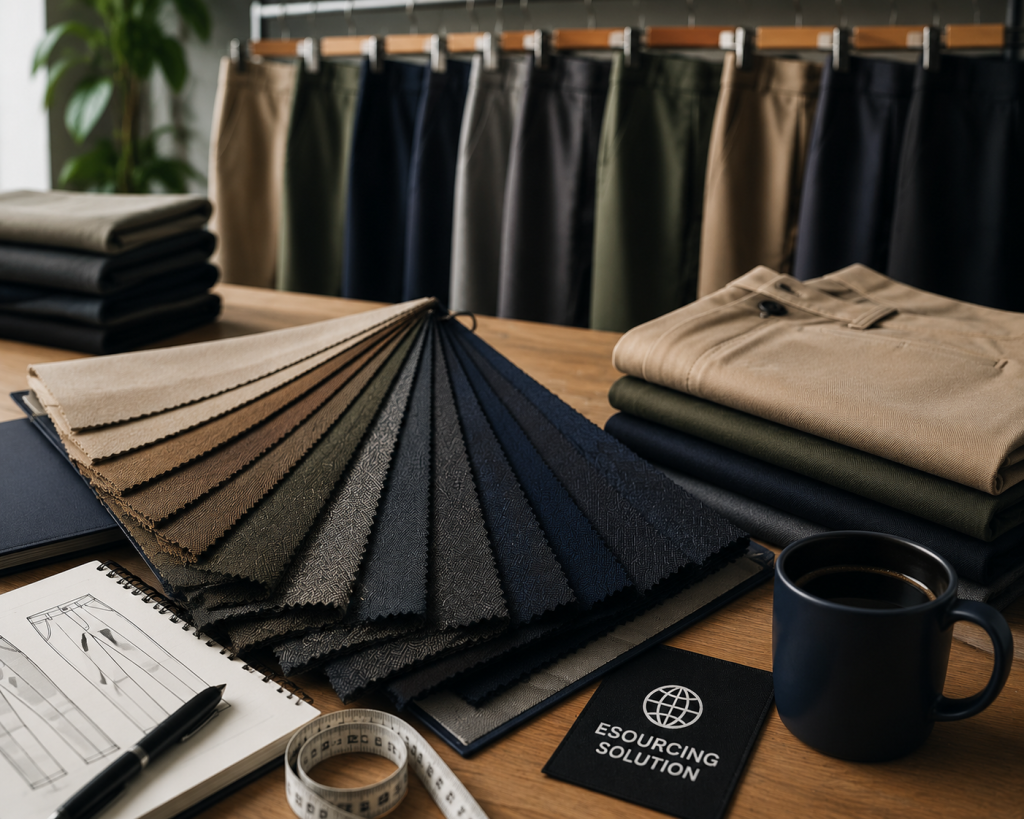
Every fabric has a technical identity defined by measurable specifications. Understanding these numbers lets you communicate precisely with mills and factories instead of using vague language that gets misinterpreted.
GSM (Grams per Square Meter): This measures fabric weight. Higher GSM means heavier, thicker fabric. Lightweight summer pants might use 150-200 GSM fabric. Mid-weight chinos sit around 220-280 GSM. Heavy winter trousers or workwear use 300-400+ GSM. When you specify GSM in your product spec sheet, the factory knows exactly what weight range to source.
Thread count: Number of threads per square inch. Higher thread count generally means smoother, more refined fabric. Relevant primarily for woven fabrics like cotton shirting and dress pant materials.
Stretch percentage: How much the fabric extends before returning to shape. A fabric with 2% stretch has minimal give. A fabric with 15% stretch moves significantly with the body. Stretch comes from elastane (spandex/Lycra) content or from the weave structure itself.
Shrinkage rate: How much the fabric contracts after washing. Cotton shrinks 3-5% if not pre-shrunk. Polyester barely shrinks at all. This matters for pattern grading. If your fabric shrinks 4% and you don’t account for it in your patterns, every pair of pants comes out a size smaller after the customer’s first wash.
Color fastness: Rated on a 1-5 scale (5 being best). Measures how well the dye holds during washing, rubbing, and light exposure. Cheap dyes fade quickly. Quality dyes maintain color through dozens of washes. For pants that get washed frequently, you want color fastness ratings of 4 or higher.
Pilling resistance: Also rated 1-5. Measures how much the fabric develops those annoying little balls of fiber on the surface with wear and washing. Synthetic blends are more prone to pilling than natural fibers. A pilling resistance of 3 or below means visible pilling within 10-20 washes. Not acceptable for any brand positioning above budget tier.
These specifications should appear in every fabric order you place and every quality control inspection you conduct. Without them, you’re hoping for the best instead of specifying what you need.
Cotton Twill — The Workhorse Nobody Outgrows
Cotton twill is the foundation fabric for chinos, khakis, and casual trousers worldwide. The diagonal weave pattern (visible as subtle diagonal lines on the fabric surface) gives it durability and a clean drape that straight weaves can’t match.
Why it dominates the pants market: Cotton twill balances comfort, durability, appearance, and cost better than any other single fabric. It breathes reasonably well in warm weather. It holds structure without feeling stiff. It takes dye beautifully across the full color spectrum. It softens with washing without falling apart. And it’s available from virtually every textile mill on the planet, meaning supply is never a problem.
Specifications for production:
Typical weight range: 200-320 GSM depending on season and style. Summer chinos lean toward 200-240 GSM. Year-round chinos sit at 240-280 GSM. Workwear and heavy-duty pants push 280-320 GSM.
Common compositions: 100% cotton, 98% cotton / 2% elastane (for stretch), 97% cotton / 3% spandex. The small elastane addition transforms the wearing experience without changing the fabric’s visual character.
Shrinkage: 3-5% for non-pre-shrunk cotton twill. Most mills offer pre-shrunk (sanforized) options that reduce shrinkage to under 1%. Always specify sanforized fabric unless you’re intentionally designing for shrink-to-fit.
Wholesale cost range (2026): $3.50-8.00 per yard depending on quality grade, organic certification, and order volume. Basic conventional cotton twill from Chinese mills starts around $3.50/yard at 1,000+ yard minimums. Premium long-staple cotton twill with peach finish from Turkish mills runs $6.00-8.00/yard.
Best sourced from: China (Guangdong, Zhejiang provinces) for volume and value. Turkey (Denizli, Bursa) for premium quality. India (Tamil Nadu, Gujarat) for organic cotton options. Pakistan (Faisalabad) for competitive pricing on mid-range quality.
Denim — Beyond Blue Jeans
Denim is cotton twill’s heavier, more characterful cousin. The distinctive look comes from dyeing only the warp threads (typically with indigo) while leaving weft threads undyed (white or natural). This creates the fading patterns that denim enthusiasts obsess over.
What most brands get wrong about denim: They treat it as one fabric when it’s actually a spectrum. Lightweight chambray-style denim (4-8 oz) works for summer pants and shirts. Mid-weight denim (9-12 oz) covers most jeans applications. Heavyweight selvedge denim (13-16+ oz) serves the premium raw denim market. Specifying “denim” without weight is like ordering “food” at a restaurant.
Specifications for production:
Denim weight is traditionally measured in ounces per square yard (not GSM, though conversion is possible). Standard jeans use 11-13 oz denim. Lightweight jeans and warm-weather styles use 8-10 oz. Premium selvedge uses 13-16 oz.
Stretch denim (containing 1-3% elastane) now outsells rigid denim in most markets. The comfort factor drives consumer preference overwhelmingly toward stretch, especially in women’s jeans.
Shrinkage varies dramatically. Raw (unwashed) denim can shrink 5-10% on first wash. Pre-washed or sanforized denim shrinks under 2%. Your pattern grading must account for whichever you choose.
Wholesale cost range (2026): $4.00-15.00+ per yard. Basic stretch denim from Chinese mills (Foshan, Zhongshan) starts around $4.00-5.00/yard. Japanese selvedge denim from heritage mills (Kurashiki, Ibara) runs $12.00-15.00+/yard. The price range in denim is wider than almost any other fabric category because quality variation is enormous.
Production consideration: Denim requires specialized sewing equipment. The thickness demands industrial machines with walking feet and heavy-duty needles. Not every garment factory handles denim well. When sourcing denim pants production, verify the factory has denim-specific experience and equipment before placing orders.
Polyester Blends — Performance Without the Price Tag
Pure polyester pants feel cheap and trap heat. But polyester blended with cotton, rayon, or wool creates fabrics that perform remarkably well at price points natural fibers can’t match alone.
Why polyester blends matter commercially: They resist wrinkles (huge selling point for travel pants and office wear). They hold color longer than pure cotton. They dry faster. They cost less per yard. They pill less than pure synthetics when blended properly. And they maintain shape through hundreds of wash cycles without the gradual breakdown that pure cotton experiences.
Common blend ratios for pants:
65% polyester / 35% cotton: The classic “easy care” trouser fabric. Wrinkle-resistant, durable, affordable. Dominates the corporate uniform and budget dress pant market.
60% polyester / 35% rayon / 5% spandex: Soft hand feel with excellent drape and stretch. Popular for women’s dress pants and modern slim-fit men’s trousers.
55% polyester / 45% wool: Combines wool’s natural drape and breathability with polyester’s wrinkle resistance and durability. The standard for mid-range suit trousers and dress pants.
Specifications for production:
Weight range: 180-280 GSM for most pant applications. Lighter weights for summer dress pants. Heavier weights for structured trousers.
Pilling resistance is critical with polyester blends. Insist on grade 4 or higher. Low-quality polyester blends pill visibly within weeks of wear, destroying the garment’s appearance and your brand’s reputation.
Color fastness: Polyester takes dye differently than natural fibers. Sublimation printing works beautifully on high-polyester-content fabrics but not on cotton-dominant blends. Specify your coloring method when ordering fabric.
Wholesale cost range (2026): $2.50-6.00 per yard. Polyester blends are among the most affordable fabric options for pants production. Basic poly/cotton twill from Chinese mills starts under $3.00/yard. Higher-end poly/wool blends with mechanical stretch run $5.00-6.00/yard.
Sustainability note: Polyester is plastic. It sheds microfibers during washing. Consumers increasingly care about this. If your brand has sustainability positioning, pure polyester or high-polyester blends create messaging conflicts. Consider recycled polyester (rPET) options, which cost 10-20% more but support sustainability claims with certifiable standards.
Wool and Wool Blends — The Dress Pant Standard
Nothing drapes like wool. Nothing breathes like wool. Nothing recovers from wrinkles like wool. For dress pants, suit trousers, and premium casual pants, wool remains the gold standard fabric that synthetics imitate but never quite replicate.
The grades that matter for pants:
Super 100s-120s: Fine worsted wool suitable for year-round dress pants. Smooth, refined, professional appearance. This is what most quality suit trousers use.
Super 130s-150s: Ultra-fine wool for luxury dress pants. Beautiful hand feel and drape but more delicate. Wears faster than coarser grades. Reserved for premium price points where customers understand the care requirements.
Merino wool blends: Merino’s finer fibers create softer, less itchy fabric than standard wool. Blended with synthetic fibers for durability and stretch, merino blends work for both dress and casual pants.
Tropical wool: Lightweight (180-220 GSM) open-weave wool designed for warm climates. Breathes exceptionally well while maintaining wool’s natural drape and wrinkle recovery.
Specifications for production:
Weight: 220-300 GSM for standard dress pants. 180-220 GSM for tropical/summer weight. 300-380 GSM for heavy winter trousers.
Wool content: 100% wool for premium positioning. 55-70% wool blended with polyester for durability and cost reduction. Wool/elastane blends (97/3 or 95/5) for stretch dress pants.
Shrinkage: Wool shrinks and felts when washed incorrectly (hot water, agitation). Most wool pants are dry-clean or cold-wash only. Specify care instructions clearly in your product labeling.
Wholesale cost range (2026): $8.00-25.00+ per yard. Wool is expensive. Basic poly/wool suiting from Chinese mills starts around $8.00/yard. Italian-milled Super 120s wool runs $15.00-25.00/yard. The fabric cost alone on premium wool trousers can exceed $30 per pair before any manufacturing happens.
Sourcing reality: Quality wool fabric comes primarily from Italy (Biella region), UK (Yorkshire), and Australia/New Zealand (raw fiber). Chinese mills produce acceptable wool blends for mid-market positioning but can’t match Italian mills for premium grades. Your price point and brand positioning determine which origin makes sense.
Linen — Summer’s Favorite (With Honest Caveats)
Linen is the ultimate warm-weather fabric for pants. Nothing breathes better. Nothing feels cooler against skin in 95-degree heat. The natural texture and slight irregularity of linen fabric communicates relaxed sophistication that cotton and synthetics can’t replicate.
But linen has real drawbacks that you need to understand before building a product line around it.
The good: Exceptional breathability and moisture-wicking. Gets softer with every wash (unlike cotton which eventually breaks down). Naturally antibacterial. Biodegradable and sustainable. Strong fiber despite lightweight feel. Unique textured appearance that photographs beautifully for product listings.
The honest caveats: Wrinkles aggressively. Within 30 minutes of wearing linen pants, they look like you slept in them. Some customers love this “lived-in” character. Others return the product complaining about wrinkles. Know your customer. Also, pure linen has zero stretch. It’s stiff when new (softens over time but the first few wears feel rigid). And it’s more expensive than cotton at comparable quality levels.
Specifications for production:
Weight: 150-250 GSM for pants. Lightweight summer pants use 150-180 GSM. Structured linen trousers use 200-250 GSM.
Common compositions: 100% linen for purists. 55% linen / 45% cotton for reduced wrinkling and lower cost. 95% linen / 5% elastane for stretch (increasingly popular). Linen/rayon blends for softer drape.
Shrinkage: 5-8% for unwashed linen. Always specify pre-washed (enzyme-washed or stone-washed) linen for production to minimize customer shrinkage issues.
Wholesale cost range (2026): $6.00-14.00 per yard. Chinese-produced linen (from flax grown in France/Belgium but woven in China) runs $6.00-9.00/yard. European-woven linen (Ireland, Lithuania, Italy) runs $10.00-14.00/yard. The flax fiber itself mostly comes from France, Belgium, and the Netherlands regardless of where the fabric is woven.
Corduroy — Texture That Sells Itself
Corduroy is cotton fabric with raised parallel ridges (called “wales”) that create a distinctive texture visible from across a room. It’s a seasonal fabric that peaks in fall/winter collections but maintains year-round appeal in lighter weights.
Why corduroy works for brands: It’s visually distinctive in product photography. The texture creates visual interest that flat fabrics lack. It signals quality and intentionality. Customers perceive corduroy pants as more premium than plain cotton pants at the same price point, even though production costs are similar.
Wale count matters: Wale count (ridges per inch) determines the fabric’s character. Wide wale (6-8 wales per inch) creates bold, chunky texture. Standard wale (11-14 per inch) is the classic corduroy look. Pinwale (16-21 per inch) creates subtle, refined texture that works for dressier applications. Specify wale count in your orders. “Corduroy” without wale specification leaves the decision to the factory.
Specifications for production:
Weight: 220-350 GSM. Lighter weights for spring/summer corduroy (yes, it exists). Heavier weights for traditional fall/winter pants.
Composition: 98-100% cotton for traditional corduroy. 97% cotton / 3% elastane for stretch corduroy (increasingly standard). Some mills offer organic cotton corduroy at 15-25% premium.
Wholesale cost range (2026): $4.50-9.00 per yard. Standard cotton corduroy from Chinese mills (Shaoxing is the textile capital for this) runs $4.50-6.00/yard. Premium stretch corduroy with peach-skin finish runs $7.00-9.00/yard.
Nylon and Nylon Blends — Technical Pants Territory
Nylon dominates the technical and outdoor pants market. Hiking pants, climbing pants, travel pants, and performance workwear all rely on nylon’s exceptional strength-to-weight ratio and abrasion resistance.
What nylon offers that other fabrics can’t: Pound for pound, nylon is stronger than any natural fiber. It resists abrasion better than polyester. It dries faster than cotton. And it’s lighter than comparable-strength alternatives. For pants that need to survive rough use (outdoor activities, physical labor, military applications), nylon is the engineering choice.
Common nylon fabrics for pants:
Ripstop nylon: Reinforced grid pattern prevents small tears from spreading. Standard for hiking and tactical pants. Lightweight (70-160 GSM) but remarkably tough.
Nylon/spandex blends: 88% nylon / 12% spandex is a common ratio for athletic and climbing pants. Excellent stretch recovery and freedom of movement.
Nylon/cotton blends: 65% nylon / 35% cotton combines nylon’s durability with cotton’s breathability and natural hand feel. Popular for premium workwear and casual technical pants.
Specifications for production:
Weight: 100-250 GSM depending on application. Ultralight hiking pants use 100-130 GSM. Standard outdoor pants use 150-200 GSM. Heavy-duty work pants use 200-250 GSM.
DWR (Durable Water Repellent) finish: Most technical nylon pants include a DWR coating that causes water to bead and roll off. Specify whether you need DWR and what rating (measured in mm of water column resistance).
UPF rating: Nylon naturally blocks some UV radiation. For outdoor pants marketed with sun protection claims, specify and test UPF rating (UPF 50+ blocks 98% of UV).
Wholesale cost range (2026): $5.00-12.00 per yard. Basic ripstop nylon from Asian mills starts around $5.00/yard. Premium 4-way stretch nylon with DWR finish runs $9.00-12.00/yard. Technical fabrics generally cost more than basic natural fiber options because the engineering and finishing processes are more complex.
Rayon and Viscose — The Drape Fabric
Rayon (also called viscose) is a semi-synthetic fiber made from wood pulp. It drapes like silk, breathes like cotton, and costs less than both. For women’s pants, flowy trousers, and relaxed-fit styles where drape matters more than structure, rayon delivers a look that stiffer fabrics simply cannot achieve.
Why designers love rayon for pants: The fluid drape creates elegant silhouettes. It takes dye vibrantly (colors appear richer and deeper than on cotton). It feels cool against skin. And it’s affordable enough for mid-market positioning without sacrificing visual quality.
The downsides you must plan for: Rayon wrinkles easily (though less aggressively than linen). It’s weaker when wet, meaning aggressive washing damages it. It shrinks significantly if not pre-treated. And it pills more readily than cotton. These characteristics mean rayon pants require careful care instructions and pre-shrinking during production.
Specifications for production:
Weight: 130-220 GSM for pants. Lightweight flowy pants use 130-160 GSM. Structured rayon trousers use 180-220 GSM.
Composition: 100% rayon for maximum drape. 70% rayon / 25% nylon / 5% spandex for durability and stretch. Rayon/linen blends for textured summer pants.
Shrinkage: 5-8% for untreated rayon. ALWAYS specify pre-shrunk fabric. Rayon that hasn’t been pre-shrunk will devastate your return rate when customers wash their pants and they come out two sizes smaller.
Wholesale cost range (2026): $3.00-7.00 per yard. Basic rayon twill from Chinese mills (Shaoxing, Keqiao) starts around $3.00-4.00/yard. Premium Tencel/Lyocell (a more sustainable form of rayon with closed-loop production) runs $5.50-7.00/yard.
Sustainability angle: Standard viscose production uses harsh chemicals and contributes to deforestation. OEKO-TEX and FSC certifications verify responsible production. Tencel (made by Lenzing) and other branded lyocell fibers offer the same drape properties with significantly lower environmental impact. If sustainability matters to your brand positioning, specify Tencel or certified viscose rather than generic rayon.
Spandex Blends — Stretch That Changed the Pants Industry
Spandex (also called elastane or Lycra) isn’t a pants fabric by itself. Nobody makes 100% spandex pants outside of athletic compression wear. But adding 2-8% spandex to virtually any other fabric transforms the wearing experience so dramatically that stretch has become the default expectation for modern pants.
What 2-5% spandex actually does: It allows fabric to stretch 15-25% and recover to its original shape. This means pants move with the body during sitting, walking, bending, and climbing stairs without bagging at the knees or losing shape. Once consumers experience stretch pants, they rarely go back to rigid fabrics willingly.
The mechanical stretch alternative: Some fabrics achieve stretch through weave structure rather than elastane content. Mechanical stretch uses specific weaving techniques that allow the fabric itself to flex without any synthetic stretch fiber. This appeals to brands avoiding synthetic content for sustainability reasons. However, mechanical stretch typically provides less recovery than elastane-based stretch, meaning the fabric may bag slightly over time.
How spandex content affects production:
Cutting: Stretch fabrics require different cutting techniques. The fabric must be laid flat without tension during cutting or pieces come out undersized.
Sewing: Stretch fabrics need specific stitch types (overlock, coverstitch) that stretch with the fabric. Standard lockstitch on stretch fabric creates seams that pop when the fabric extends.
Pressing: Excessive heat damages elastane fibers, reducing stretch recovery permanently. Factories must control pressing temperatures carefully.
These production requirements mean not every factory handles stretch fabrics well. Verify your manufacturer’s experience with stretch textiles before committing to production. A quality inspection should specifically test stretch recovery on finished garments.
Cost impact: Adding spandex increases fabric cost by $0.50-1.50 per yard compared to the same fabric without stretch. The manufacturing complexity adds another $0.30-0.80 per garment in production cost. Total impact on a pair of pants: roughly $1.00-2.50 additional cost for stretch versus non-stretch. Consumers willingly pay $10-20 more for stretch pants, making the ROI on elastane addition extremely favorable.
Hemp — The Sustainability Play With Real Performance
Hemp fabric has shed its counterculture associations and entered mainstream fashion as a legitimate performance textile with genuine sustainability credentials. For brands building around environmental responsibility, hemp offers a story that resonates with conscious consumers while delivering functional performance that justifies the price premium.
What hemp actually offers for pants: Exceptional durability (hemp fiber is stronger than cotton). Natural UV resistance. Antimicrobial properties that reduce odor. Gets softer with every wash without losing strength. Breathes well in warm weather. Biodegradable at end of life. Requires minimal pesticides and water to grow compared to conventional cotton.
The realistic challenges: Hemp fabric feels rougher than cotton when new (though it softens significantly over 5-10 washes). It wrinkles moderately. Color options are more limited because hemp doesn’t take all dyes equally well. And it costs more than cotton at every quality level. Supply is also more constrained. Fewer mills produce hemp fabric compared to cotton, meaning lead times are longer and minimum order quantities are often higher.
Specifications for production:
Weight: 200-350 GSM for pants. Lightweight hemp/cotton blend summer pants use 200-240 GSM. Sturdy hemp workwear pants use 300-350 GSM.
Common compositions: 55% hemp / 45% cotton (the most popular blend, balancing hemp’s durability with cotton’s softness). 100% hemp for maximum sustainability claims. 70% hemp /27% cotton / 3% spandex for stretch hemp pants.
Certifications: GOTS (Global Organic Textile Standard) certifies organic hemp production. OEKO-TEX Standard 100 verifies the finished fabric is free from harmful chemicals. These certifications matter for brands making sustainability claims because consumers and regulators increasingly demand proof behind marketing language.
Wholesale cost range (2026): $7.00-14.00 per yard. Hemp/cotton blends from Chinese mills (Heilongjiang province grows most of China’s hemp) start around $7.00-9.00/yard. European-processed hemp fabric (Romania, Netherlands) runs $10.00-14.00/yard. Pure hemp is consistently 40-80% more expensive than comparable cotton fabric. The price premium is real but defensible if your brand positioning and price point support it.
Sourcing reality: Hemp textile production is growing but still represents a tiny fraction of global fabric output. Lead times are longer (8-12 weeks versus 4-6 weeks for cotton). Minimum order quantities are often higher (3,000+ yards versus 1,000 yards for cotton). Plan further ahead when building hemp into your product line. A sourcing partner with textile mill relationships can identify reliable hemp fabric suppliers and negotiate MOQs that work for emerging brands.
Fabric Comparison Chart
| Cotton Twill | 200-320 | Low-Med | Good | High | $3.50-8.00 | Chinos, khakis, casual pants |
| Denim | 220-450 | None-Med | Moderate | Very High | $4.00-15.00 | Jeans, workwear, casual |
| Polyester Blend | 180-280 | Low-Med | Moderate | Very High | $2.50-6.00 | Dress pants, uniforms, travel |
| Wool/Wool Blend | 180-380 | Low | Excellent | Moderate | $8.00-25.00 | Dress trousers, suiting |
| Linen | 150-250 | None | Excellent | Moderate | $6.00-14.00 | Summer pants, resort wear |
| Corduroy | 220-350 | Low-Med | Good | High | $4.50-9.00 | Fall/winter casual pants |
| Nylon Blend | 100-250 | Med-High | Low-Mod | Very High | $5.00-12.00 | Outdoor, technical, athletic |
| Rayon/Viscose | 130-220 | Low | Good | Low-Mod | $3.00-7.00 | Flowy trousers, women’s pants |
| Spandex Blend | Varies | High | Varies | Moderate | +$0.50-1.50 | Any pant needing stretch |
| Hemp | 200-350 | None-Low | Good | Very High | $7.00-14.00 | Sustainable brands, workwear |
Common Mistakes When Choosing Fabric for Pants Production
I’ve watched brands make these errors repeatedly. Each one costs money, time, or reputation. Sometimes all three.
Mistake #1: Choosing fabric based on how it looks, not how it performs.
A fabric swatch looks beautiful pinned to your mood board. But how does it perform after 30 wash cycles? Does it pill? Does it fade? Does it lose shape at the knees? Does it shrink unevenly? Request wash testing data from your mill before committing to production. If they can’t provide it, order a few yards and wash-test it yourself before placing a bulk order. A fabric that looks premium on day one but deteriorates by week four generates returns and kills repeat purchases.
Mistake #2: Not accounting for fabric weight in shipping cost calculations.
Fabric weight directly affects your shipping cost per unit. A pair of pants made from 350 GSM fabric weighs significantly more than the same pattern in 200 GSM fabric. When you’re shipping 5,000 units from China, that weight difference translates to hundreds or thousands of dollars in additional freight cost. Factor fabric weight into your landed cost calculation during product development, not after production is complete.
Mistake #3: Specifying fabric by name instead of by technical specifications.
“Cotton twill” describes thousands of different fabrics. Telling a factory you want “cotton twill pants” gives them permission to use whatever cotton twill they have available, which might be a rough 320 GSM workwear fabric when you wanted a soft 240 GSM chino fabric. Specify GSM, fiber content, weave type, finish, stretch percentage, and color fastness requirements. Leave nothing to interpretation. Your product spec sheet should define fabric with enough precision that any mill in the world would produce the same material from your specifications.
Mistake #4: Ignoring minimum order quantities at the fabric level.
You might find the perfect fabric, but if the mill requires a 5,000-yard minimum and your production run only needs 800 yards, that fabric isn’t accessible to you at that scale. Ask about MOQs before falling in love with a specific textile. Many mills have stock fabrics available in smaller quantities (500-1,000 yards) but custom colors or custom compositions require larger commitments. Plan your fabric strategy around what’s actually available at your order volume.
Mistake #5: Skipping the sample yardage step.
Never commit to bulk fabric purchase without first ordering sample yardage (typically 5-20 yards), making sample garments, wearing them, washing them repeatedly, and evaluating real-world performance. The cost of sample yardage ($50-200) is negligible compared to the cost of discovering your fabric choice was wrong after you’ve manufactured 3,000 pairs of pants. This testing phase is where you catch problems with shrinkage, pilling, color bleeding, hand feel after washing, and drape on actual bodies rather than on flat tables.
Mistake #6: Choosing the cheapest option without understanding why it’s cheapest.
A mill offering cotton twill at $2.50/yard when everyone else quotes $4.00-5.00/yard isn’t giving you a deal. They’re giving you inferior fiber (short-staple cotton that pills and breaks down faster), cheaper dyes (that fade after 10 washes), or lower thread count (that feels rougher and wears through sooner). In textiles, you genuinely get what you pay for. The cheapest fabric produces the cheapest-feeling product, which generates the most returns and the worst reviews. Supplier negotiation should focus on getting fair pricing for quality fabric, not on finding the absolute lowest price regardless of quality.
Mistake #7: Not considering your end customer’s washing behavior.
Your fabric needs to survive how your customer actually treats their clothes. If you’re selling to busy professionals who throw everything in the washer on hot and tumble dry on high, your fabric needs to handle that abuse without shrinking, fading, or falling apart. If you’re selling to fashion-conscious consumers who follow care labels carefully, you have more flexibility with delicate fabrics. Design your fabric choice around real customer behavior, not ideal care conditions.
Fabric selection isn’t a decision you make once and forget. As your brand evolves, as seasons change, as customer feedback accumulates, your fabric choices should evolve too. The brands that build loyal followings are the ones that obsess over textile quality the way their customers obsess over fit and style. Your customers might not know the difference between 240 GSM and 280 GSM cotton twill by name. But they absolutely feel the difference when they put your pants on. They feel it when they sit down and the fabric moves with them or fights against them. They feel it after the tenth wash when the color still looks rich or has faded to a shadow of what they bought.
Get the fabric right and everything else about your pants brand becomes easier. Marketing is easier because the product speaks for itself. Customer retention is easier because quality builds loyalty. Pricing is easier because customers pay premium prices for premium materials without resistance.
Get it wrong and no amount of marketing, branding, or Instagram content saves you from one-star reviews about quality.
If you’re developing a pants line and need help navigating fabric sourcing, mill selection, or production planning,schedule a conversation or reach out here. The right fabric decision made early saves thousands in avoided mistakes later.
FAQ
What is the best all-around fabric for pants if I can only choose one?
Cotton twill with 2-3% elastane. It covers the widest range of pant styles (chinos, casual trousers, smart-casual pants), works across three seasons (spring, summer, fall in lighter weights), appeals to both men and women, and sits at a price point that supports mid-market to premium positioning. The stretch component makes it comfortable enough for all-day wear without the performance-fabric look of nylon or polyester. If you’re launching a pants brand and need one fabric to start with, 250 GSM cotton twill with 2% elastane in a peach-skin or brushed finish gives you maximum versatility while you learn what your specific customers respond to.
How do I request fabric samples from mills in China?
Contact mills directly through Alibaba, 1688.com, or through a sourcing agent who has existing mill relationships. Request a “swatch card” or “hanger sample” of specific fabric compositions you’re interested in. Most mills send swatch cards free of charge or for a nominal shipping fee ($20-40 via DHL/FedEx). For larger sample cuts (1-5 yards for making test garments), expect to pay the per-yard fabric cost plus shipping. Specify exactly what you want: fiber content, weight range, finish type, and color. Vague requests like “send me your cotton fabrics” result in receiving 50 random swatches that waste everyone’s time. Be specific and mills respond with relevant options quickly.
Does fabric weight affect how pants fit?
Significantly. Heavier fabrics (280+ GSM) hold structure and create cleaner lines but feel stiffer and restrict movement more. Lighter fabrics (180-220 GSM) drape closer to the body and move more freely but can look limp or cheap if the pattern isn’t designed for that weight. Your pattern must be developed FOR the specific fabric weight you’re using. A pattern designed for 280 GSM cotton twill will look completely different (and usually wrong) when sewn in 180 GSM rayon. This is why sample garments in your actual production fabric are non-negotiable before bulk manufacturing. Never approve a pattern based on a sample made in a different fabric weight than your production fabric.
What fabric certifications should I look for when sourcing pants fabric?
OEKO-TEX Standard 100 verifies the fabric is free from harmful chemicals and safe for skin contact. This is the minimum certification any reputable brand should require. GOTS (Global Organic Textile Standard) certifies organic fiber content and environmentally responsible processing. Required if you’re making organic claims. BCI (Better Cotton Initiative) certifies responsibly sourced cotton that meets environmental and social standards. GRS (Global Recycled Standard) certifies recycled content in fabrics using recycled polyester or other recycled fibers. Which certifications you need depends on your brand claims and target market. European markets increasingly require OEKO-TEX as a baseline. US markets are moving in the same direction but more slowly.
How much fabric do I need per pair of pants?
Typically 1.5-2.0 yards of 58-60 inch wide fabric per pair of pants, depending on the style and size range. Slim-fit pants with no pleats use less fabric (closer to 1.5 yards). Wide-leg pants, cargo pants, or styles with large pockets use more (up to 2.0+ yards). Your factory calculates exact fabric consumption during pattern making and provides a “consumption chart” showing yards needed per size. For budgeting purposes before patterns exist, estimate 1.7 yards per pair as a reasonable average. Multiply by your order quantity to determine total fabric yardage needed, then add 5-8% for cutting waste and defect replacement. So a 2,000-pair order needs approximately 3,400 yards of fabric plus 200-270 yards buffer, totaling roughly 3,600-3,670 yards minimum order from your mill.
Can I mix fabric types within one pants collection?
Absolutely, and most successful brands do exactly this. A single collection might include cotton twill chinos, stretch denim jeans, wool-blend dress trousers, and nylon technical pants. Each serves a different customer need and occasion. However, mixing fabrics increases sourcing complexity. Each fabric type may come from a different mill with different MOQs, lead times, and pricing structures. Your production factory needs capability across all fabric types (not every factory handles both denim and lightweight rayon well). Plan your collection around what your manufacturing partner can actually produce competently rather than designing in isolation and hoping a factory can execute everything.