
A jewelry brand owner contacted me last March in a panic. She’d launched a stainless steel ring collection six months earlier. Marketed them as “tarnish-free forever.” Charged premium prices based on that promise. And now, six months in, customer complaints were flooding her inbox. Rings turning dark around the edges. Greenish discoloration on some pieces. Dull spots appearing where the metal contacted skin regularly.
Her supplier in Yiwu had told her the rings were “316L surgical stainless steel.” She’d trusted that claim. Never verified it. Never tested the material independently. Never specified testing requirements in her purchase order. And now she had 4,000 units in inventory that were tarnishing on her customers’ fingers and a brand reputation dissolving faster than her profit margins.
Does stainless steel tarnish? The answer she needed six months earlier was: genuine high-grade stainless steel resists tarnish extremely well under normal conditions. But the cheap substitute her factory actually used? That tarnishes readily. And without material testing in your quality control process, you’ll never know which one you received until your customers tell you with one-star reviews.
This question matters enormously for anyone sourcing stainless steel products from overseas factories. The gap between what stainless steel should do and what it actually does in your products comes down to material grade, surface treatment, manufacturing quality, and whether anyone verified the material before it shipped to your warehouse.
Let me explain what’s actually happening at the material science level, which grades resist tarnish and which don’t, and how to protect your brand from the exact situation that nearly destroyed my client’s business.
Table of Contents
| # | Section |
| 1 | The Short Answer: Yes, But It Depends on Everything |
| 2 | What “Tarnish” Actually Means on Stainless Steel |
| 3 | Why Stainless Steel Resists Tarnish (The Chromium Shield) |
| 4 | The Conditions That Break Through the Shield |
| 5 | Stainless Steel Grades and Their Tarnish Resistance |
| 6 | Does Stainless Steel Tarnish in Jewelry? |
| 7 | Does Stainless Steel Tarnish in Kitchenware and Cookware? |
| 8 | Does Stainless Steel Tarnish in Outdoor and Marine Environments? |
| 9 | How Factories Cut Corners (And How It Causes Tarnish Problems) |
| 10 | How to Specify Tarnish-Resistant Stainless Steel for Your Products |
| 11 | Testing Methods That Catch Tarnish Problems Before They Reach Customers |
| 12 | How to Remove Tarnish From Stainless Steel Products |
| 13 | FAQ |
What “Tarnish” Actually Means on Stainless Steel
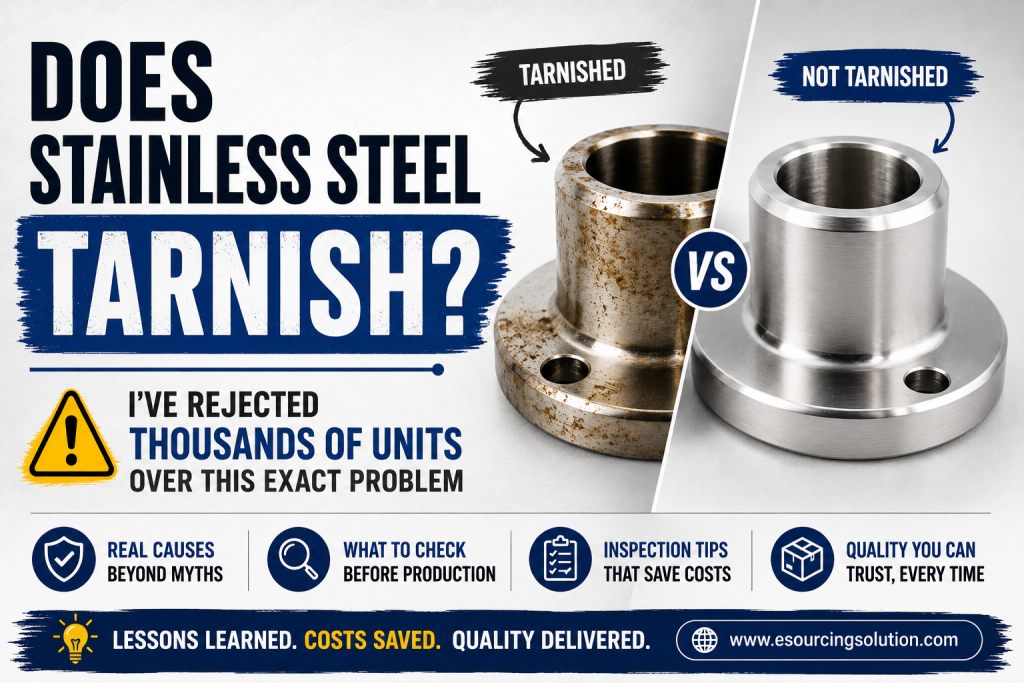
People use “tarnish” loosely to describe any discoloration or degradation on metal surfaces. But tarnish, rust, and corrosion are different processes with different causes and different solutions. Understanding the distinction helps you diagnose problems accurately and specify materials correctly.
Tarnish is a thin layer of discoloration that forms on a metal surface through chemical reaction with substances in the environment. On stainless steel, tarnish typically appears as a yellowish, brownish, or rainbow-colored film. It affects appearance but doesn’t eat into the metal structure. Think of it as a surface stain rather than structural damage.
Rust is iron oxide formation. It’s a specific type of corrosion where iron in the metal reacts with oxygen and moisture to form reddish-brown iron oxide. Stainless steel contains iron (it’s an iron alloy), so rust IS possible under certain conditions, despite the “stainless” name.
Corrosion is the broader category. Any chemical or electrochemical degradation of the metal. Pitting corrosion creates small holes. Crevice corrosion attacks gaps between surfaces. Stress corrosion cracking causes structural failure. These are more severe than tarnish and indicate serious material or environmental problems.
For consumer products (jewelry, kitchenware, watches, accessories), tarnish is the most common complaint. It doesn’t destroy the product structurally, but it destroys the product aesthetically. And for products sold on appearance, aesthetic degradation equals product failure in the customer’s eyes.
Why Stainless Steel Resists Tarnish (The Chromium Shield)
Stainless steel isn’t naturally immune to tarnish. It actively defends itself through a mechanism that’s genuinely elegant from a materials science perspective.
Every stainless steel alloy contains at least 10.5% chromium. When chromium contacts oxygen in the air, it forms an invisible layer of chromium oxide on the metal surface. This layer is incredibly thin (a few atoms thick) but remarkably effective as a barrier. It prevents oxygen, moisture, and corrosive chemicals from reaching the iron underneath.
Here’s the remarkable part: this chromium oxide layer is self-healing. If you scratch stainless steel and break through the protective layer, the exposed chromium immediately reacts with oxygen in the air and reforms the protective barrier. Within hours, the scratch is protected again. This self-healing property is what makes stainless steel “stainless.” Not that it can’t stain, but that it continuously repairs its own protective shield.
The strength of this shield depends on chromium content. More chromium means a stronger, more resilient protective layer. This is why different stainless steel grades have dramatically different tarnish resistance. A grade with 16% chromium protects better than one with 12% chromium. A grade with added molybdenum (which reinforces the chromium oxide layer) protects better still.
When does stainless steel tarnish? When something overwhelms, damages, or prevents the formation of this chromium oxide shield. Certain chemicals dissolve it. Certain environments prevent it from reforming. Certain manufacturing defects create weak spots where the shield never forms properly in the first place.
The Conditions That Break Through the Shield
Understanding what causes tarnish on stainless steel helps you predict problems before they reach customers and specify materials that resist the conditions your products will face.
Chloride exposure. Chlorides (found in salt, sweat, pool water, seawater, and many cleaning products) are the primary enemy of stainless steel’s protective layer. Chloride ions penetrate the chromium oxide film and attack the metal underneath. This is why stainless steel jewelry tarnishes faster on people who sweat heavily, swim in chlorinated pools, or live in coastal environments. It’s why stainless steel kitchen equipment near the ocean corrodes faster than identical equipment inland.
Prolonged moisture contact. The chromium oxide layer needs oxygen to maintain itself. When water sits on stainless steel for extended periods (trapped under a ring, pooled in a kitchen sink, condensation in packaging), it can deplete local oxygen and weaken the protective layer. This is why stainless steel products sometimes show tarnish marks exactly where water was trapped during shipping or storage.
High temperatures. Extreme heat (above 400°C/750°F) can cause “heat tint” — a rainbow-colored discoloration on stainless steel surfaces. This is technically oxidation rather than tarnish, but customers perceive it the same way. Relevant for cookware, exhaust components, and industrial products exposed to high temperatures.
Contact with dissimilar metals. When stainless steel touches a different metal (carbon steel, aluminum, copper) in the presence of moisture, galvanic corrosion can occur. The electrical potential difference between the metals accelerates corrosion on one of them. This matters for product design: stainless steel jewelry with brass components, stainless steel kitchenware with aluminum bases, or stainless steel fasteners in carbon steel structures.
Chemical exposure. Bleach, hydrochloric acid, sulfuric acid, and other harsh chemicals can dissolve the chromium oxide layer faster than it reforms. Even household cleaning products containing chlorine bleach can damage stainless steel surfaces over time. This matters for kitchenware and bathroom products that customers clean with aggressive chemicals.
Poor surface finish. Rough surfaces with microscopic crevices trap moisture and contaminants, creating localized environments where the protective layer breaks down. Highly polished stainless steel resists tarnish better than rough or brushed finishes because the smooth surface gives contaminants nowhere to hide. This is a manufacturing quality issue that connects directly to how your factory finishes your products.
Stainless Steel Grades and Their Tarnish Resistance
Not all stainless steel is created equal. The grade designation tells you the alloy composition, which directly determines tarnish resistance. Here are the grades that matter for consumer products:
Grade 304 (18/8)
Composition: 18% chromium, 8% nickel, balance iron plus minor elements.
Tarnish resistance: Good for most indoor applications. Handles normal humidity, occasional water contact, and mild cleaning chemicals without tarnishing. The standard grade for kitchenware, food processing equipment, and general-purpose applications.
Limitations: Vulnerable to chloride attack. Will tarnish or pit in sustained saltwater exposure, heavy sweat contact, or chlorinated environments. Not ideal for jewelry worn during swimming or intense exercise.
Cost position: Mid-range. The most commonly produced stainless steel grade worldwide, meaning supply is abundant and pricing is competitive.
Grade 316/316L (Marine Grade)
Composition: 16% chromium, 10% nickel, 2% molybdenum, balance iron.
Tarnish resistance: Excellent. The molybdenum addition significantly strengthens resistance to chloride attack. Handles saltwater, sweat, pool chemicals, and coastal environments far better than 304. This is why it’s called “marine grade.”
Limitations: Not invincible. Concentrated bleach, strong acids, and extreme conditions can still cause tarnish. But for consumer product applications, 316L handles virtually everything customers throw at it.
Cost position: 20-30% more expensive than 304. The molybdenum content drives the price premium. Worth it for products marketed as tarnish-free or used in demanding environments.
Grade 430 (Budget Grade)
Composition: 16-18% chromium, no nickel, balance iron.
Tarnish resistance: Moderate. Adequate for dry indoor environments with minimal chemical exposure. But significantly less resistant than 304 or 316 to moisture, chlorides, and chemicals. Tarnishes noticeably faster in real-world use conditions.
Cost position: Cheapest common stainless steel grade. The absence of nickel (an expensive element) makes it significantly cheaper than 300-series grades. This is the grade that dishonest factories substitute when they claim to be using 304 or 316L.
Grade 201 (The Problematic Substitute)
Composition: 16-18% chromium, 3.5-5.5% nickel (less than 304), manganese substituted for nickel.
Tarnish resistance: Poor to moderate. Tarnishes readily in humid environments, with sweat contact, or with any chemical exposure. The reduced nickel content and manganese substitution weaken the protective layer significantly.
Cost position: Much cheaper than 304. This is the grade that causes the most problems in imported consumer products because factories use it as a cost-cutting substitute while labeling products as “stainless steel” without specifying the grade. The jewelry brand owner I mentioned at the beginning? Her factory almost certainly used 201 while claiming 316L.
Quick reference:
| 201 | 16-18% | 3.5-5.5% | None | Poor-Moderate | Lowest |
| 430 | 16-18% | None | None | Moderate | Low |
| 304 | 18% | 8% | None | Good | Medium |
| 316/316L | 16% | 10% | 2% | Excellent | Higher |
If you’re developing stainless steel products and need help with material specification, factory verification, or quality control protocols that catch grade substitution before it becomes a customer problem, schedule a conversation or reach out directly. The testing that prevents tarnish complaints costs a fraction of what those complaints cost your brand once products are in customers’ hands.
FAQ
Does stainless steel tarnish in water?
Pure water alone doesn’t cause stainless steel to tarnish. The chromium oxide protective layer remains stable in clean water contact. However, water creates tarnish conditions indirectly in several ways. Tap water contains chlorine and minerals that deposit on the surface and create localized corrosion sites over time. Saltwater contains chlorides that actively attack the protective layer. And water trapped against the surface (under a ring, in a crevice, pooled in a container) depletes local oxygen that the chromium oxide layer needs to maintain itself. For practical purposes: brief water contact (hand washing, showering, rain) won’t tarnish quality stainless steel (304 or 316 grade). Prolonged submersion in chlorinated pool water or saltwater will eventually cause tarnish, even on 316L, though it takes significantly longer than on lower grades. The key variable isn’t water itself but what’s dissolved in the water and how long the contact lasts.
How long does stainless steel last without tarnishing?
This depends entirely on the grade and the environment. Grade 316L in normal indoor wearing conditions (jewelry) or normal kitchen use (cookware) will resist visible tarnish for 10-20+ years with basic care. Grade 304 in similar conditions lasts 5-15 years before showing any tarnish. Grade 201 in the same conditions may show tarnish within 3-12 months, especially with regular skin contact or moisture exposure. In harsh environments (coastal, industrial, high-chloride), even 316L shows tarnish within 2-5 years without regular cleaning. The “lifetime tarnish-free” claims some brands make are defensible only for 316L grade in normal use conditions with reasonable care. Any brand making that claim with 201 or 430 grade material is setting themselves up for warranty claims and reputation damage.
Is 316L stainless steel really tarnish-proof?
No metal is truly tarnish-proof under all conditions. 316L is tarnish-resistant to an exceptional degree for consumer product applications. Under normal wearing conditions (jewelry), normal kitchen use (cookware), and normal indoor environments (home goods), genuine 316L stainless steel maintains its appearance for years without visible tarnish. However, 316L will tarnish under extreme conditions: concentrated chemical exposure, prolonged saltwater submersion without cleaning, contact with strong acids, or sustained high temperatures. For marketing purposes, “highly tarnish-resistant” or “tarnish-resistant under normal use conditions” are accurate and defensible claims for 316L products. “Tarnish-proof” or “will never tarnish” are technically inaccurate and could create liability if a customer experiences tarnish under unusual conditions. The practical reality is that 316L performs so well under normal consumer conditions that most customers will never experience tarnish during the product’s useful life. But absolute claims invite absolute expectations, and absolute expectations invite complaints from the one customer who wore their ring in a hot spring or cleaned their pot with undiluted bleach.
How can I tell if my stainless steel product is real 316L or a cheaper substitute?
Without laboratory testing, you can’t tell definitively by looking at or handling the product. Genuine 316L and substitute grades (201, 430) look virtually identical when new. They have similar weight, similar appearance, and similar feel. This is exactly why grade substitution is so common and so effective as a factory cost-cutting tactic. The only reliable methods for verification are: XRF (X-ray fluorescence) testing, which identifies elemental composition in seconds using a handheld device; spark testing, where grinding the metal produces sparks with characteristics specific to each grade; or laboratory chemical analysis, which is the most accurate but slowest and most expensive method. For consumers, the practical indicator is performance over time. If a product marketed as 316L tarnishes within months of normal use, it almost certainly isn’t 316L. For brands and importers, XRF testing during factory inspection is the standard verification method. It costs very little relative to the protection it provides and should be mandatory for any stainless steel product making grade-specific or tarnish-resistance claims.
Does the surface finish affect how quickly stainless steel tarnishes?
Significantly. Mirror-polished stainless steel resists tarnish better than brushed, matte, or rough-finished surfaces. The reason is physical: a smooth polished surface has fewer microscopic crevices, pores, and irregularities where moisture, salt, and contaminants can accumulate and attack the protective layer. A highly polished surface also allows the chromium oxide layer to form more uniformly and completely. Brushed finishes have directional grooves that can trap contaminants along the brush lines. Matte or bead-blasted finishes have thousands of tiny surface irregularities that increase the effective surface area exposed to corrosive elements. This doesn’t mean brushed or matte finishes are bad choices. They’re perfectly appropriate for many products and many customers prefer their appearance. But if maximum tarnish resistance is the priority (jewelry marketed as tarnish-free, medical instruments, marine hardware), mirror polish provides the best performance. For products with brushed or matte finishes, proper passivation after finishing becomes even more important to compensate for the increased surface vulnerability.
Does stainless steel tarnish faster in humid climates?
Yes. Humidity accelerates tarnish on stainless steel, particularly on lower grades (201, 430) and in the presence of airborne salt or pollutants. High humidity means more moisture on metal surfaces, which means more opportunity for chlorides and other corrosive agents to dissolve and attack the protective layer. Tropical coastal environments (high humidity plus salt air) represent the most challenging conditions for stainless steel products. In these environments, even 304 grade shows tarnish faster than it would in dry inland climates. For brands selling into tropical or coastal markets, specifying 316L grade provides meaningful additional protection. For product development targeting these markets, factor the environmental conditions into your material grade selection rather than defaulting to the cheapest acceptable grade. The small additional cost of 316L versus 304 (roughly $0.30-0.80 per unit for most consumer products) prevents disproportionate warranty and return costs in humid market conditions.
Can PVD coating prevent stainless steel from tarnishing?
PVD (Physical Vapor Deposition) coating adds a thin layer of titanium nitride, zirconium nitride, or similar compound to the stainless steel surface. This coating provides an additional barrier between the environment and the base metal, significantly enhancing tarnish resistance regardless of the underlying stainless steel grade. PVD coatings are extremely hard (harder than the stainless steel itself), scratch-resistant, and chemically inert. They’re commonly used on watches, jewelry, and premium hardware to provide both color options (gold, rose gold, black, blue) and enhanced durability. However, PVD coating is not a substitute for proper base material selection. If the underlying steel is 201 grade and the PVD coating gets scratched or worn through at edges and contact points (which happens over years of use), the exposed 201 steel will tarnish rapidly. The best approach combines quality base material (316L) with PVD coating for products requiring both maximum tarnish resistance and decorative color finishes. PVD adds approximately $0.50-2.00 per unit to manufacturing cost depending on the product size and coating complexity. For brands offering colored stainless steel products, PVD on 316L base material provides the most durable, tarnish-resistant combination available in consumer product manufacturing.