
A client called me last month in a panic. He’d ordered 3,000 units of stainless steel water bottles from a factory in Zhejiang. The quote said “net weight 280g per piece.” He calculated his shipping costs based on that number. Then the freight forwarder sent the actual invoice, and it was nearly double what he expected.
What happened? He confused net weight with gross weight. The 280g was just the bottle. Once you add the cap, the packaging, the inner box, the carton, the palletizing, his actual shipping weight per unit was closer to 520g. On 3,000 units, that mistake cost him over $1,400 in unexpected freight charges.
This is not a rare story. I hear some version of it almost every week from Amazon sellers, retailers, and procurement managers who source products internationally. The difference between gross vs net weight sounds basic. It is basic. But getting it wrong costs real money in shipping, customs duties, and landed cost calculations.
So let’s get this straight once and for all.
Table of Contents
- What Does Gross vs Net Weight Actually Mean?
- Tare Weight — The Missing Piece Most People Forget
- Gross vs Net Weight Formula with Real Examples
- Why Gross vs Net Weight Matters for Shipping Costs
- Gross vs Net Weight on Customs Declarations and Import Duties
- How Gross vs Net Weight Affects Your Amazon FBA Fees
- Getting Weight Specs Right on Your Product Sourcing Documents
1. What Does Gross vs Net Weight Actually Mean?
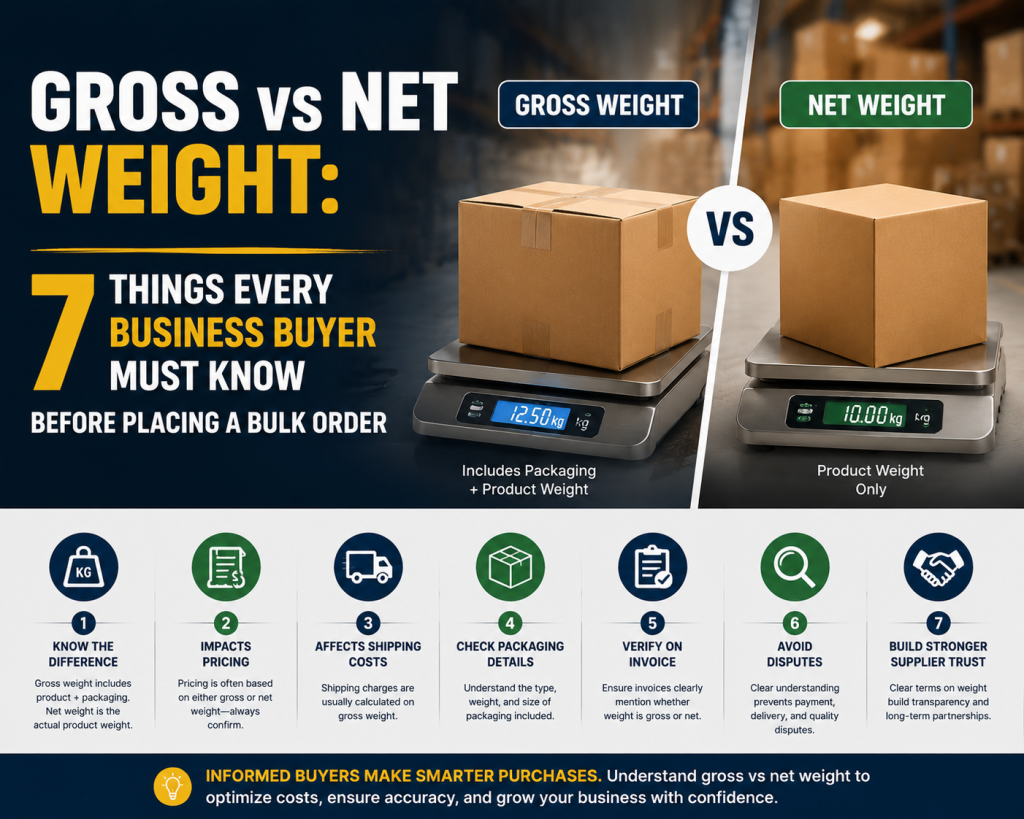
Let me strip away the textbook language and explain this the way it actually works when you’re buying products for resale.
Net weight is the weight of the product itself. Nothing else. Just the item. If you’re selling a ceramic mug, the net weight is the mug alone — no box, no bubble wrap, no carton, no pallet. Just the mug sitting naked on a scale.
Gross weight is everything. The product plus every single thing wrapped around it, packed with it, and containing it. The mug, the foam insert, the individual box, the master carton, the tape, the corner protectors, the pallet — all of it together on the scale. That’s your gross weight.
The confusion happens because different people in the supply chain use these terms in slightly different contexts. A factory might quote you “gross weight per carton.” A freight forwarder talks about “gross weight per shipment.” Amazon wants “unit weight” for FBA. Customs wants “net weight per item” for duty calculations on certain product categories.
Same two words. Different meaning depending on who’s asking and why.
2. Tare Weight — The Missing Piece Most People Forget
You can’t fully understand gross vs net weight without knowing tare weight. It’s the third piece of the puzzle that most guides mention briefly and then move on from. But it matters more than people realize.
Tare weight is the weight of the packaging and containers alone — without the product inside. Think of it this way:
Gross Weight minus Net Weight equals Tare Weight.
Or flip it around: Net Weight plus Tare Weight equals Gross Weight.
Why does this matter practically? Because when you’re calculating landed costs, you need to know how much of your shipping expense is going toward moving actual product versus moving cardboard and plastic. On lightweight products with heavy packaging — think glass items with foam inserts and double-wall cartons — your tare weight can be 40 to 60 percent of your gross weight. That’s a lot of money spent shipping air and cardboard.
I worked with a seller last year who was sourcing decorative glass candle holders. Each piece weighed 180g net. But with the individual box, foam inserts, dividers, and master carton allocation, the gross weight per unit hit 410g. More than half the shipping cost was packaging. We redesigned the packaging to cut tare weight by 30 percent without sacrificing protection. Saved her about $0.35 per unit on ocean freight. On a 10,000-unit order, that’s $3,500 back in her pocket.
That’s why understanding tare weight isn’t just academic. It’s a packaging optimization opportunity hiding in plain sight.
Gross vs Net Weight Formula with Real Examples
The formula itself is dead simple:
Gross Weight = Net Weight + Tare Weight (all packaging materials)
But let me show you how this plays out with a real product sourcing scenario, because the formula alone doesn’t capture the layers involved.
Example: Sourcing Silicone Spatula Sets (5-piece set)
Net weight of product (5 spatulas): 320g
Individual polybag: 8g
Color box with insert card: 95g
Units per master carton: 24 sets
Master carton (empty): 680g
Filler and tape: 120g
So for one unit:
Net weight = 320g
Tare weight = 103g (polybag + color box)
Gross weight per unit = 423g
For one master carton:
Net weight = 7,680g (320g × 24)
Tare weight = 3,272g (103g × 24 + 680g carton + 120g filler)
Gross weight per carton = 10,952g ≈ 11kg
Example: Sourcing Stainless Steel Mixing Bowls (3-piece nesting set)
Net weight of product (3 bowls): 1,450g
Shrink wrap and cardboard dividers: 85g
Color box: 320g
Units per master carton: 6 sets
Master carton (empty): 890g
Corner protectors and tape: 200g
Per unit:
Net weight = 1,450g
Tare weight = 405g
Gross weight per unit = 1,855g
Per master carton:
Net weight = 8,700g
Tare weight = 3,520g
Gross weight per carton = 12,220g ≈ 12.2kg
See how the tare weight stacks up? On the spatula set, packaging adds about 32 percent to the product weight. On the mixing bowls, it adds about 28 percent. These percentages matter when you’re calculating freight costs across thousands of units.
4. Why Gross vs Net Weight Matters for Shipping Costs
Here’s where the rubber meets the road. Freight companies don’t care about your net weight. They charge based on gross weight or volumetric weight whichever is higher. Let me explain both.
Actual gross weight is what the shipment weighs on a scale. Every gram of product and packaging combined.
Volumetric weight (also called dimensional weight) is calculated from the physical size of your cartons. The formula for air freight is typically: Length × Width × Height (cm) ÷ 5000 = volumetric weight in kg. Ocean freight uses different calculations based on cubic meters.
Your freight forwarder compares actual gross weight against volumetric weight and charges you the higher number. This is called “chargeable weight.”
Why does this matter for understanding gross vs net weight? Because if you only know your net weight when budgeting for a product, you’re going to underestimate your shipping costs. Sometimes by a little. Sometimes by a lot. It depends on how much packaging surrounds your product and how efficiently your cartons are packed.
I’ve seen new Amazon sellers calculate their landed cost using net weight from the supplier’s product listing, then get blindsided when the freight quote comes in 30 to 50 percent higher than expected. That margin they thought they had? Gone. The product that looked profitable on a spreadsheet? Barely breaks even once real shipping costs hit.
This is exactly why your product spec sheet needs to include both net weight AND gross weight per unit AND gross weight per carton AND carton dimensions. All four. Non-negotiable. Without them, you’re guessing at your most significant variable cost.
5. Gross vs Net Weight on Customs Declarations and Import Duties
Customs is where gross vs net weight gets genuinely confusing, because different countries and different product categories use different weight measurements for calculating duties.
Most customs declarations require both. When your freight forwarder or customs broker fills out import paperwork, they typically need to declare:
The net weight of the goods (product only, no packaging)
The gross weight of the shipment (everything including packaging and pallets)
Duties are sometimes calculated on net weight. For certain product categories — particularly food, chemicals, metals, and textiles import duties are assessed per kilogram of net weight. Not gross weight. This means the customs authority wants to know how much actual product is entering the country, separate from packaging materials.
Other duties use declared value regardless of weight. Many consumer goods categories assess duties as a percentage of the declared value (ad valorem), so weight doesn’t directly affect the duty amount. But it still appears on the paperwork and discrepancies can trigger audits or delays.
Getting it wrong causes problems. If you declare incorrect weights on customs documents — even accidentally — you risk delays, inspections, fines, or seizure of goods. I’ve seen shipments held at port for two weeks because the declared gross weight didn’t match what the container actually weighed at the terminal scale. The discrepancy was only 8 percent, but it flagged the system and everything stopped until it was resolved.
When you’re working with a sourcing agent or procurement partner, make sure they provide accurate weight declarations based on actual weighed cartons — not estimates from the factory’s product catalog. Catalog weights are often rounded or outdated. Real weights from production runs are what your customs documents need.
6. How Gross vs Net Weight Affects Your Amazon FBA Fees
Amazon FBA sellers — pay attention here. This section directly affects your profitability on every single unit you sell.
Amazon uses what they call “unit weight” for FBA fee calculations. And their definition doesn’t perfectly align with either gross or net weight as your supplier defines them. Here’s how Amazon thinks about it:
Item weight = the weight of your product in its selling packaging. That means the product itself plus the retail box, any inserts, manuals, accessories — everything the customer receives. This is essentially your unit-level gross weight minus the master carton allocation.
Shipping weight = item weight rounded up, with Amazon’s own packaging weight added on top. Amazon adds packaging weight because they put your product in their own box or poly bag before shipping to the customer.
Dimensional weight = Amazon also calculates dimensional weight based on your product’s packaged dimensions and uses whichever is larger — actual weight or dimensional weight — for fee calculation.
So what does this mean practically?
It means your FBA fees are based on something between net weight and gross weight. You need to know your unit-level gross weight (product plus retail packaging) to accurately predict your FBA fees before you commit to a product. If you only look at net weight from your supplier’s spec sheet, you’ll underestimate fees. If you use the full carton-level gross weight divided by units, you’ll overestimate.
The right number is: product weight + individual packaging weight = your FBA-relevant weight.
Get this number from your supplier before you finalize your product sourcing decision. Run it through Amazon’s FBA calculator. Make sure your margins still work with the real weight, not the optimistic one.
7. Getting Weight Specs Right on Your Product Sourcing Documents
After everything above, here’s the practical takeaway. When you’re communicating with suppliers, writing purchase orders, or building product spec sheets, you need to specify exactly which weight you’re talking about. Every single time. No assumptions.
On your product spec sheet, include all of these:
Net weight per unit (product only, grams or kg)
Gross weight per unit (product plus individual packaging)
Gross weight per master carton (everything inside one shipping carton)
Master carton dimensions (L × W × H in cm)
Number of units per master carton
Pallet configuration if applicable (cartons per layer, layers per pallet)
When your supplier quotes you a price, ask:
“Is the weight you listed net or gross?”
“Does that include individual packaging or just the bare product?”
“What’s the gross weight per export carton?”
“What are the carton dimensions?”
These questions sound basic. They are basic. But I promise you, half the sourcing mistakes I see come from someone assuming they knew which weight the supplier meant. The supplier says “weight: 500g” on their Alibaba listing. Is that net? Gross? Per unit? Per set? Nobody clarified. And three months later someone’s staring at a freight invoice, wondering where their profit went.
If you’re working with a procurement outsourcing partner, they handle these details as part of the standard process. Every quote gets verified with specific weight breakdowns. Every purchase order spells out net weight, gross weight, carton weight, and dimensions. No ambiguity. No surprises when the shipping bill arrives.
Common Mistakes People Make with Gross vs Net Weight
Let me run through the ones I see most often. Maybe you’ll recognize yourself in one of these. No judgment — they’re genuinely common.
Mistake 1: Using net weight to estimate shipping costs. Already covered this above, but it bears repeating because it’s the most expensive mistake on this list. Always use gross weight (or volumetric weight, whichever is higher) for freight budgeting.
Mistake 2: Assuming the supplier’s listed weight is gross. It usually isn’t. Most suppliers list net weight on their product pages because it’s a smaller, more attractive number. Always confirm.
Mistake 3: Forgetting that packaging changes affect weight. You asked for a nicer box? Thicker foam insert? Added a printed manual? All of that adds tare weight, which increases gross weight, which increases shipping cost. Every packaging upgrade has a freight cost attached to it. Factor that in when you’re making packaging decisions.
Mistake 4: Not weighing actual production samples. Factory spec sheets list theoretical weights. Actual production runs vary. Metal castings come out slightly heavier or lighter, depending on the batch. Packaging materials differ between suppliers. Always weigh real samples from your actual production run before finalizing logistics arrangements.
Mistake 5: Ignoring volumetric weight entirely. Some products are light but bulky. A set of silicone baking mats weighs almost nothing but takes up significant carton space. In those cases, you’re paying for volume, not weight. Gross weight becomes irrelevant and dimensional weight takes over. Know which scenario applies to your product.
Quick Reference: Gross vs Net Weight Comparison
For those who want the summary version to screenshot or bookmark:
Net Weight: Just the product. Nothing else. Used for customs duties on certain categories, nutritional labeling, product specifications, and Amazon item weight calculations.
Gross Weight: Product plus all packaging, cartons, and shipping materials. Used for freight quotes, shipping invoices, warehouse receiving, and logistics planning.
Tare Weight: Just the packaging without the product. Used for packaging optimization, cost reduction analysis, and calculating the difference between gross and net.
Chargeable Weight: The higher of actual gross weight or volumetric weight. This is what you actually pay for when shipping. Used by freight forwarders, couriers, and airlines.
Wrapping This Up
Gross vs net weight isn’t complicated once you understand what each term means and where each one applies in your supply chain. The problem isn’t comprehension — it’s communication. People assume. Suppliers abbreviate. Freight forwarders use shorthand. And somewhere in that chain of assumptions, money leaks out.
Fix it by being specific every time weight comes up in a conversation, a document, or a quote. Ask which weight. Write which weight. Confirm which weight. Three extra seconds of clarity saves thousands of dollars over a year of sourcing.
If you’re placing bulk orders and want someone to handle the weight specifications, supplier communication, and logistics coordination so you don’t have to think about it, reach out here or book a quick call. We deal with these details daily so our clients can focus on selling.