
Table of Contents
- Quick Background on Both Marks
- UL vs ETL Certifications: What Actually Differs
- The Money Side of Things
- How Long You’ll Wait
- Do Retailers and Inspectors Care Which One You Pick?
- So Which One Makes Sense for You?
- Common Questions I Get About This
Quick Background on Both Marks
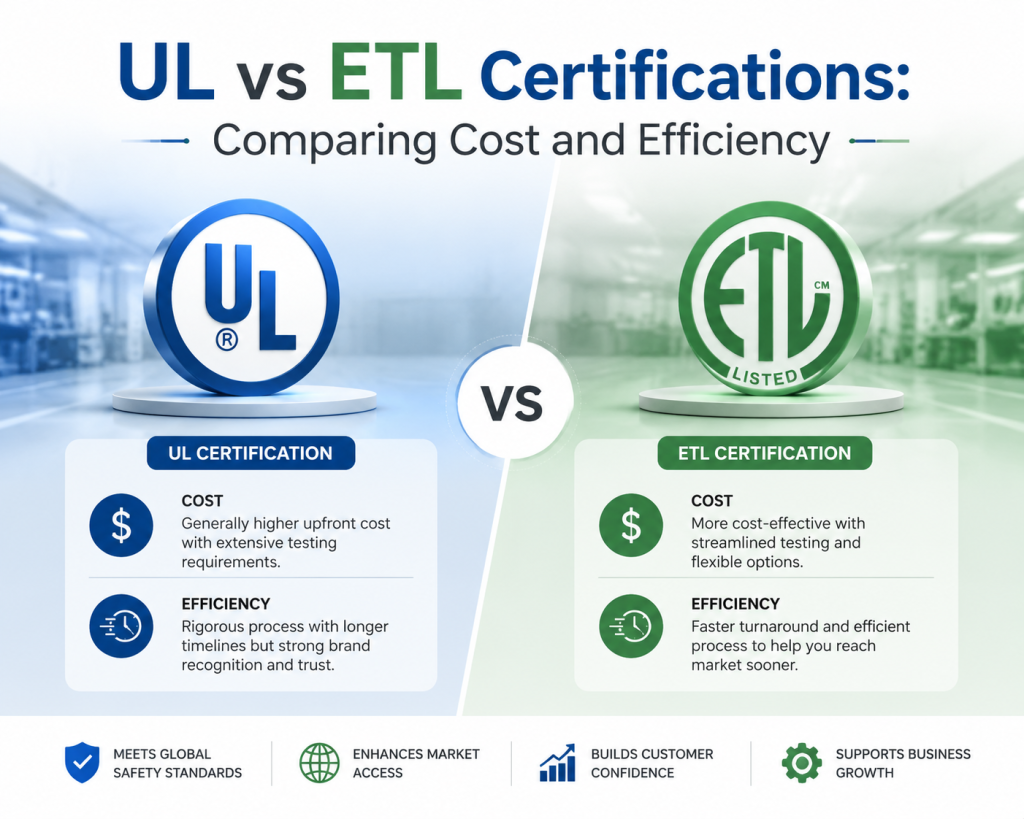
Look, I’ve helped manufacturers navigate this decision probably a hundred times now. And the confusion always starts in the same place. People think UL and ETL are fundamentally different things. They’re not. But the differences that do exist? They matter a lot when you’re watching your budget and racing a launch deadline.
Let me break it down simply.
UL has been around since 1894. They basically invented product safety testing in North America. Wrote many of the standards themselves. When your grandma says “make sure it has that safety mark on it,” she’s probably picturing the UL logo even if she doesn’t know the name.
ETL comes from Intertek. They hold the same NRTL accreditation from OSHA that UL does. Run the same tests. Apply the same pass/fail criteria. Different company, same outcome. Think of it like getting your car inspected at two different licensed shops. Both check the same things. Both give you the same sticker. You just might pay different prices and wait different amounts of time.
Both marks mean your product passed safety testing for the North American market. Period. No asterisks. No “but ETL is lesser.” Legally and technically, they carry equal weight.
UL vs ETL Certifications: What Actually Differs
Here’s where I see manufacturers get tripped up. They spend weeks researching technical differences that don’t really exist, while ignoring the practical differences that actually affect their business.
The testing standards? Identical. Both organizations test against ANSI/UL standards. Your product goes through the same electrical safety evaluations, fire resistance checks, mechanical hazard assessments, and environmental exposure tests regardless of which lab runs them.
What actually changes between UL and ETL comes down to three things. Your wallet. Your calendar. And how much you care about logo recognition on your packaging.
That’s it. Three things. Everything else is noise.
The Money Side of Things
I’ll be straight with you because I’ve seen the invoices from both sides.
UL charges more. Sometimes significantly more. A straightforward product like a basic lighting fixture or power strip might cost $10,000 to $15,000 through UL. Something complex with multiple standards involved? You’re looking at $30,000 to $50,000 or beyond. Then there’s annual fees on top for follow-up inspections and continued mark usage.
ETL typically comes in 10% to 40% cheaper for the same product. That lighting fixture? Maybe $8,000 to $11,000. The complex product? Could save you $10,000 or more versus the UL quote.
Why does this gap exist? Honestly, it’s market dynamics. UL had a near-monopoly for decades. They set prices without real competition. ETL came in hungry, positioned on affordability, and forced the conversation about value. They run leaner operations and negotiate more flexibly on complex projects.
For a startup burning through runway, saving $10,000 to $15,000 on certification isn’t trivial. That money buys inventory. Funds a marketing push. Covers three months of a contractor’s salary. When you’re working with a sourcing partner and managing tight margins on imported products, every dollar you save on certification goes directly toward building the business.
How Long You’ll Wait
Time kills products. I’ve watched manufacturers miss entire selling seasons because certification took longer than expected. Holiday product stuck in testing until January? Congratulations, you just lost your window.
My experience with UL timelines: expect 8 to 12 weeks minimum. I’ve seen projects stretch to 16 weeks when things get backed up or when the product needs modifications after initial testing. UL processes a massive volume of projects. Queues build. Especially during peak submission periods in spring and early summer when everyone’s trying to get products ready for Q4.
ETL moves faster. Consistently. I’ve seen equivalent products clear in 4 to 8 weeks. Intertek maintains shorter queues and seems more willing to offer expedited processing without astronomical rush fees.
Here’s where the speed difference really compounds. Say your product fails initial testing. Needs a design tweak. You fix it, resubmit, and wait again. If your base timeline is 4 weeks instead of 10, that revision cycle hurts way less. You might still hit your launch date. With UL’s longer baseline, one failed test can push your entire timeline back months.
Do Retailers and Inspectors Care Which One You Pick?
Short answer: no. Not in any way that should influence your decision.
I’ve shipped products with ETL marks into Home Depot, Walmart, Amazon, Costco. Never once had a purchasing department reject a product because it carried ETL instead of UL. Their procurement teams understand NRTL accreditation. They care that you have a valid mark from an accredited lab. Which specific lab? Doesn’t matter to them.
Building inspectors and AHJs accept both marks equally. They’re required to by law. If you ever run into an inspector who questions an ETL mark (rare but it happens with older inspectors who grew up only seeing UL), point them to OSHA’s NRTL program page. Problem solved immediately.
Consumer recognition is the one area where UL has an edge. Regular people know the UL logo. They’ve seen it their whole lives on appliances and electronics. ETL doesn’t have that same household familiarity. But honestly? How many consumers actually check certification marks before buying a product? In my experience, very few outside of specific safety-conscious categories like baby products or space heaters.
So Which One Makes Sense for You?
After walking dozens of manufacturers through this exact decision, here’s my honest take.
Go with ETL when budget matters, speed matters, or both. If you’re a smaller manufacturer, a startup, or anyone operating on tight margins with aggressive timelines, ETL gives you the same safety credential for less money in less time. There’s no rational reason to pay more and wait longer unless you have a specific strategic reason for the UL mark.
Go with UL when your product sits in a category where consumers actively look for safety marks. Space heaters. Baby monitors. Smoke detectors. Products where the average buyer actually flips the unit over and checks for a certification logo before purchasing. In those categories, UL’s brand recognition arguably adds consumer confidence that justifies the premium.
Mix and match if you’re launching multiple products. Nothing says you have to pick one lab for everything. Use ETL for products where speed and cost matter most. Use UL for flagship items where the mark adds marketing value. Smart manufacturers treat this as a strategic decision on a product-by-product basis.
For businesses managing product development across multiple SKUs with quality control requirements at various stages, building a certification strategy early prevents expensive surprises later in the process.
Common Questions I Get About This
“Is ETL actually accepted everywhere UL is?”
Yes. Both carry NRTL accreditation. Both satisfy NEC, building codes, and AHJ requirements across all 50 states and Canadian provinces. Legally identical acceptance.
“Can I switch from UL to ETL on an existing product?”
You can. Requires retesting since the new lab needs to verify independently. But if your product already passes UL standards, it’ll pass ETL testing since the standards are literally the same document.
“My factory in China says they can get UL certification cheaper. Should I trust that?”
Be careful here. Some overseas labs offer UL or ETL testing at lower prices but cut corners on follow-up inspections or factory audits. Make sure any lab you use holds current NRTL accreditation and that the certification includes proper ongoing compliance monitoring. Cheap upfront that leads to a revoked mark later costs you far more.
“Which is faster if I need to recertify after a product change?”
ETL, in my experience. Minor modifications might clear in 2 to 4 weeks through Intertek versus 4 to 6 through UL. Major redesigns require full retesting either way, but ETL’s shorter queues still give them the speed advantage.
Bottom Line
The UL vs ETL certifications debate isn’t really about which mark is “better.” They accomplish the same thing. They satisfy the same requirements. They open the same doors with retailers and regulators.
The real question is simpler than people make it. Do you want to pay more and wait longer for stronger consumer brand recognition? Or do you want to save money, move faster, and accept that most buyers won’t notice or care which specific mark sits on your product?
For most manufacturers I work with, especially those in early growth stages, ETL is the smarter play. Save the budget. Hit the timeline. Get to market. That’s what builds businesses.