
A client messaged me last month asking whether she should order 500 phone cases from Alibaba or AliExpress. She’d been buying samples on AliExpress for three months. Good quality. Fast shipping. Easy process. Now she wanted to scale up and assumed Alibaba would automatically be cheaper at 500 units.
I pulled up her AliExpress supplier’s Alibaba storefront. Same factory. Same product photos. The Alibaba listing showed a unit price 40% lower than AliExpress. Obvious win, right?
Not quite. The Alibaba listing required 1000 unit MOQ. Shipping wasn’t included (AliExpress price included free shipping). The Alibaba quote didn’t include the custom packaging she wanted. And the payment terms required 30% deposit before production with no buyer protection until goods shipped.
After calculating actual landed cost including shipping, customs, and the MOQ she’d need to meet, her real savings at 500 units was 12%, not 40%. And she’d tie up $3,200 in inventory instead of $1,800. For her cash flow situation, AliExpress at slightly higher per-unit cost was actually the smarter move until she could commit to 1000+ units.
The Alibaba vs AliExpress decision isn’t about which platform is “better.” Both platforms belong to the same parent company (Alibaba Group). They serve different buying scenarios. Choosing wrong doesn’t just cost money. It costs time, creates cash flow problems, and sometimes results in product you can’t sell because you ordered too much of the wrong thing.
Table of Contents
| # | Section |
| 1 | The Real Difference Between Alibaba and AliExpress |
| 2 | Alibaba vs AliExpress: Platform DNA Comparison |
| 3 | Pricing and True Cost Breakdown |
| 4 | Minimum Order Quantities: What Actually Happens |
| 5 | Product Customization Capabilities |
| 6 | Supplier Verification and Scam Risk |
| 7 | Payment Protection: What’s Actually Covered |
| 8 | Shipping Costs and Logistics |
| 9 | When to Use AliExpress (And When to Graduate) |
| 10 | When Alibaba Makes Sense |
| 11 | The Third Option Nobody Mentions |
| 12 | FAQ |
The Real Difference Between Alibaba and AliExpress
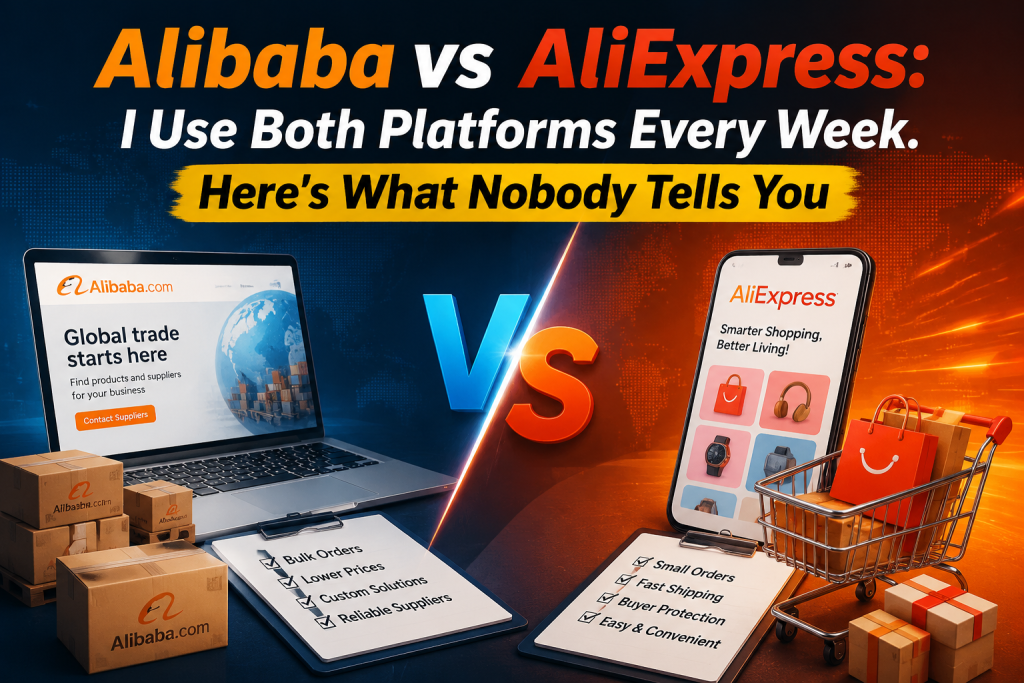
Think of it this way. AliExpress is a retail store where Chinese manufacturers and traders sell finished products directly to individual buyers worldwide. You browse, click buy, pay the listed price, and receive your package in 7-30 days. The experience feels like Amazon or any online store.
Alibaba is a trade show floor where manufacturers display their production capabilities and negotiate custom orders with business buyers. You browse to find potential suppliers, then enter a negotiation process involving quotes, samples, production terms, and logistics arrangements. Nothing happens with one click. Everything requires conversation.
Same parent company. Completely different buying experiences. Completely different cost structures. Completely different risk profiles.
Alibaba vs AliExpress: Platform DNA Comparison
| Factor | Alibaba | AliExpress |
| Buyer type | Businesses, brands, resellers | Individuals, small businesses, dropshippers |
| Order size | 100-100,000+ units typical | 1-50 units typical |
| Pricing | Negotiable, volume-dependent | Fixed listing price |
| Customization | Full (logo, design, packaging, materials) | Limited to none |
| Shipping | Buyer arranges or negotiates with supplier | Included in price usually |
| Payment | Trade Assurance, T/T, L/C | Credit card, PayPal-like |
| Lead time | 15-45 days production + shipping | Ships from stock, 7-30 days total |
| Communication | Direct with factory/trading company | Minimal, transactional |
| Product listing | Capability showcase, not exact product | Exact product you receive |
| Buyer protection | Trade Assurance (conditional) | Full refund guarantee (stronger) |
Pricing and True Cost Breakdown
The price you see on each platform tells different stories. AliExpress prices include everything: product cost, domestic shipping to warehouse, international shipping to your door, platform fees, and seller margin. What you see is what you pay. Simple.
Alibaba prices show only the FOB (Free On Board) or EXW (Ex Works) product cost. That’s the starting point, not the final number. On top of that Alibaba price, you’ll pay for international freight (sea, air, or express), customs duties and import taxes, domestic delivery from port to your warehouse, inspection costs if you’re smart about quality control, and sometimes sample costs before production begins.
A real example from last quarter. Client compared prices for a stainless steel water bottle:
AliExpress price: $8.50 per unit, free shipping, arrives in 12 days. Total cost for 100 units: $850.
Alibaba quoted price: $4.20 per unit FOB Yiwu. Sounds like massive savings. But the real math: $4.20 product cost + $1.80 sea freight per unit (at 100 units, sea freight minimum charges make per-unit shipping expensive) + $0.60 customs duty + $0.40 domestic delivery. Actual landed cost: $7.00 per unit. Total for 100 units: $700. Real savings: 18%.
Now the same comparison at 1000 units. AliExpress doesn’t offer volume discounts, so still $8.50 per unit ($8,500 total). Alibaba at 1000 units: $3.40 per unit (volume discount) + $0.80 sea freight per unit (better rate at volume) + $0.50 customs + $0.20 domestic delivery. Actual landed cost: $4.90 per unit. Total: $4,900. Real savings: 42%.
The pattern is clear. Below 200-300 units, AliExpress convenience and included shipping narrow the price gap significantly. Above 500 units, Alibaba’s volume pricing creates substantial savings that justify the additional complexity. The crossover point varies by product category, weight, and shipping method.
Minimum Order Quantities: What Actually Happens
Alibaba listings show MOQs that range from 1 piece to 10,000 pieces. Those numbers are starting positions for negotiation, not absolute rules. Here’s what actually happens when you contact suppliers.
Listed MOQ says 500 units. You message asking for 200 units. Three possible responses: “Yes, we can do 200 units at slightly higher price” (most common for trading companies). “Our minimum production run is 500, cannot go lower” (common for actual factories with production line setup costs). “We can do 200 units but no customization, stock product only” (compromise offer).
About 60-70% of Alibaba suppliers will negotiate below their listed MOQ if you ask professionally. The price per unit increases as quantity decreases, but the door is usually open. Trading companies are more flexible than factories because they aggregate orders from multiple buyers to meet factory minimums.
AliExpress has no MOQ. Buy one piece or fifty pieces at the same per-unit price. This simplicity is AliExpress’s core advantage for small buyers and people testing products before committing to bulk orders.
The practical advice: use AliExpress to test products (buy 5-10 units, verify quality, test market response). Once you’ve validated demand and know exactly what you want, move to Alibaba for volume pricing. This staged approach reduces risk while capturing volume savings when you’re ready. A sourcing partner can help navigate the transition from AliExpress testing to Alibaba production orders.
Product Customization Capabilities
This is where the platforms diverge most dramatically.
AliExpress sells finished products from existing inventory. What you see in the listing photo is what arrives at your door. Customization options are extremely limited. Some sellers offer basic logo printing on stock products (minimum 50-100 pieces usually). Some offer color selection from existing options. But changing materials, dimensions, packaging design, or product features? Not happening on AliExpress.
Alibaba connects you with manufacturers who produce to your specifications. Custom logo, custom colors, custom materials, custom dimensions, custom packaging, custom everything. This is where brands are built. You’re not buying someone else’s product. You’re having YOUR product manufactured to YOUR specifications.
The customization capability on Alibaba comes with requirements though. Custom molds cost $500-5,000+ depending on complexity. Custom packaging design requires minimum print runs (typically 1000-3000 pieces). Custom materials may require fabric or component MOQs from the supplier’s own vendors. Each customization adds lead time, cost, and complexity.
For brands building differentiated products, Alibaba’s customization capability is essential. For resellers buying existing products to flip on Amazon or Shopify, AliExpress’s ready-made inventory is faster and simpler. Your business model determines which platform’s customization level matches your needs.
Supplier Verification and Scam Risk
Both platforms have scammers. The scam types differ.
AliExpress scams typically involve: products that don’t match listing photos (bait and switch), counterfeit products sold as genuine, products that never ship (rare due to platform holding payment), and quality significantly below listing description.
AliExpress protection is strong. The platform holds your payment until you confirm receipt. If the product doesn’t arrive or doesn’t match the description, you open a dispute and typically receive a full refund. The platform sides with buyers in most disputes. Risk per transaction is low because individual order values are small.
Alibaba scams are more sophisticated and higher stakes: factories that take deposits and disappear, trading companies that misrepresent their manufacturing capability, suppliers that produce quality samples then ship inferior bulk production, and companies that exist only as Alibaba storefronts with no real factory behind them.
Alibaba verification tools help but don’t eliminate risk. “Gold Supplier” status means the company paid for a membership (starting around $2,000-6,000/year). It doesn’t verify product quality or business ethics. “Verified Supplier” means a third-party inspection company visited their facility and confirmed it exists. Better signal, but still not a quality guarantee. Trade Assurance protects your payment if the supplier fails to ship or ships products that don’t meet agreed specifications, but the dispute process is slower and more complex than AliExpress.
The real verification process for Alibaba suppliers involves: checking business license validity, requesting factory photos and videos (live, not stock), ordering samples before bulk orders, conducting pre-production inspection, and running a small trial order before committing to large volumes. Professional sourcing from China includes these verification steps as standard practice.
Payment Protection: What’s Actually Covered
AliExpress Buyer Protection covers you if: the product never arrives (full refund after delivery deadline passes), the product is significantly different from the listing description (full or partial refund after dispute), or the product arrives damaged (partial or full refund depending on damage).
The protection is automatic. You don’t need to opt in. The platform holds payment in escrow until you confirm satisfaction or the protection period expires. Disputes are resolved within 7-15 days typically. For orders under $500, this protection is robust and reliable.
Alibaba Trade Assurance covers you if: the supplier doesn’t ship by the agreed date (refund of payment), the product quality doesn’t match the agreed specifications (refund or reship), or the supplier disappears after receiving payment (refund from Alibaba’s guarantee fund).
The coverage has conditions. You must pay through Alibaba’s platform (not direct bank transfer). You must have clear written specifications agreed with the supplier through the platform’s messaging system. And you must file claims within specific timeframes. Many buyers lose Trade Assurance protection by paying outside the platform (suppliers often request direct T/T transfer to avoid platform fees) or by failing to document specifications clearly in platform messages.
My strong recommendation: never pay Alibaba suppliers outside the Trade Assurance system for your first three orders with any supplier. The 2-3% platform fee is insurance against losing your entire order value. Once you’ve established trust through successful orders, direct payment becomes reasonable for the cost savings. But not before.
Shipping Costs and Logistics
AliExpress shipping is simple. Most listings offer free or low-cost shipping. Sellers absorb shipping costs into product pricing. Delivery takes 7-30 days depending on shipping method selected. You track your package with a tracking number. It arrives at your door. Done.
The hidden reality: “free shipping” on AliExpress means the seller uses the cheapest possible shipping method (often untracked economy mail taking 30-60 days) unless you pay for upgraded shipping. The $8.50 water bottle with “free shipping” might take 45 days to arrive. Paying $3-5 extra for express shipping (7-12 days) is usually worth it for time-sensitive orders.
Alibaba shipping requires decisions and arrangements. Common options:
Express (DHL, FedEx, UPS): Fast (3-7 days), expensive ($5-15/kg), best for samples and small urgent orders under 100 kg.
Air freight: Moderate speed (7-12 days), moderate cost ($3-8/kg), good for orders 100-500 kg where speed matters.
Sea freight: Slow (25-45 days), cheapest ($0.50-2.00/kg for full container), best for large orders over 500 kg where time isn’t critical.
At small order volumes (under 100 units of most products), Alibaba shipping costs per unit are high because minimum charges apply regardless of shipment size. A sea freight shipment has minimum charges around $200-400 even for a tiny shipment. Spread across 50 units, that’s $4-8 per unit just for ocean freight. At 1000 units, the same minimum charge becomes $0.20-0.40 per unit. Volume transforms shipping economics dramatically.
For brands scaling from small to medium volumes, understanding these shipping economics helps determine when the Alibaba vs AliExpress crossover point makes financial sense for your specific products. Supplier negotiation should always include shipping terms as part of the total cost discussion.
When to Use AliExpress (And When to Graduate)
Use AliExpress when:
You’re testing product ideas before committing capital. Buy 5-20 units of different products, test market response, identify winners before investing in bulk inventory.
Your order quantities are below 100-200 units. The convenience, included shipping, and buyer protection make AliExpress more practical at these volumes despite higher per-unit cost.
You’re dropshipping. AliExpress’s single-unit fulfillment and direct-to-customer shipping (with some suppliers) supports dropship models that Alibaba doesn’t accommodate.
You need products immediately. AliExpress ships from existing stock. No production wait time. If you need inventory in 7-14 days, AliExpress delivers where Alibaba requires 15-45 days of production time.
You don’t need customization. If you’re reselling existing products without branding, AliExpress’s ready-made inventory is perfectly adequate.
Graduate to Alibaba when:
Your order quantities consistently exceed 200-500 units. The volume pricing savings justify the additional complexity and longer lead times.
You need custom branding, packaging, or product modifications. Alibaba suppliers offer full customization that AliExpress cannot provide.
You’re building a brand (not just reselling). Differentiated products require manufacturing relationships that only Alibaba (or direct factory relationships) can provide.
Your cash flow supports larger inventory investments. Alibaba orders tie up more capital for longer periods. You need financial stability to handle 30-45 day production times plus 25-45 day shipping.
You’ve validated your product and market. Don’t use Alibaba for experiments. Use it for proven products where you’re confident in demand.
The Third Option Nobody Mentions
Here’s what most Alibaba vs AliExpress comparison articles miss entirely. Both platforms are marketplaces where you’re navigating thousands of suppliers alone, trying to distinguish quality factories from trading companies from outright scammers. Both platforms leave you responsible for quality verification, specification development, logistics coordination, and problem resolution.
The third option is working with a professional sourcing company that handles supplier identification, verification, negotiation, quality control, and logistics coordination on your behalf. You get Alibaba-level pricing (often better, because sourcing agents have established factory relationships with pre-negotiated terms) with less risk than either platform because someone with experience is managing the process.
This option makes sense when your order values exceed $5,000-10,000 per order, when you need custom product development, when quality consistency is critical to your brand, or when you don’t have time to manage the sourcing process yourself. The sourcing fee (typically 5-10% of order value) is often offset by better pricing, fewer quality failures, and avoided costly mistakes.
Not every business needs a sourcing partner. If you’re ordering 200 phone cases from a verified AliExpress seller, handle it yourself. But if you’re placing $20,000 orders for custom-branded products from factories you’ve never visited, professional support reduces risk significantly.
The Alibaba vs AliExpress decision comes down to your current business stage, order volume, customization needs, and risk tolerance. Neither platform is universally better. Each serves its purpose at different points in your business growth. Start with AliExpress to test and validate. Move to Alibaba when volume and customization needs justify the complexity. And consider professional sourcing support when order values make the stakes too high for marketplace navigation alone.
If you’re at the transition point between platforms and need guidance on supplier selection, specification development, or quality verification for your first Alibaba orders, schedule a conversation or reach out directly.
FAQ
Can I buy from the same supplier on both Alibaba and AliExpress?
Yes, many Chinese suppliers maintain storefronts on both platforms simultaneously. The same factory sells individual units on AliExpress at retail markup and bulk orders on Alibaba at wholesale pricing. You can often find a supplier’s Alibaba storefront by searching their company name from their AliExpress shop page. This is actually a useful sourcing strategy: buy samples on AliExpress to verify quality with full buyer protection, then contact the same supplier on Alibaba for bulk pricing once you’ve confirmed the product meets your standards. The supplier already knows their product satisfies you, which strengthens your negotiating position on Alibaba. However, verify that the Alibaba and AliExpress storefronts actually belong to the same company. Some trading companies copy product photos from other sellers’ AliExpress listings and post them on Alibaba without actually having access to the same factory or product quality.
Is Alibaba safe for first-time buyers?
Alibaba is safe when you follow proper verification steps and use Trade Assurance payment protection. The platform itself is legitimate and processes billions in transactions annually. The risk comes from individual suppliers, not the platform. For first-time buyers, follow these rules: always pay through Trade Assurance (never direct bank transfer on first orders), always order samples before bulk production, always document specifications in platform messages (not just email or WeChat), verify supplier business licenses through Alibaba’s verification system, and start with a small trial order (lowest MOQ the supplier accepts) before committing to large volumes. Following these steps, your financial risk is limited to sample costs until you’ve verified the supplier delivers as promised. The most common mistake first-time Alibaba buyers make is sending large deposits via direct wire transfer to save the Trade Assurance fee, then having no recourse when the supplier underdelivers or disappears.
At what order volume should I switch from AliExpress to Alibaba?
The crossover point depends on your product’s weight, value, and shipping method, but general guidelines work for most consumer products. Below 100 units: AliExpress is almost always more practical. The per-unit savings on Alibaba are eaten by shipping minimums and the time cost of managing the process. Between 100-300 units: calculate your actual landed cost on both platforms including all shipping, duties, and fees. The savings on Alibaba at this volume are typically 10-20%, which may or may not justify the additional complexity and longer lead time. Above 500 units: Alibaba almost always wins on cost, typically saving 30-50% on landed cost compared to AliExpress pricing. The volume justifies sea freight rates, production setup costs are amortized across more units, and suppliers offer meaningful volume discounts. Above 1000 units: you should absolutely be on Alibaba or working directly with factories. Buying 1000+ units on AliExpress means leaving thousands of dollars on the table in unnecessary per-unit markup.
Which platform is better for dropshipping in 2026?
AliExpress remains the primary platform for dropshipping due to its single-unit fulfillment capability, direct-to-customer shipping options, and no minimum order requirements. Some AliExpress suppliers offer dedicated dropshipping programs with blind shipping (no Chinese sender information on packages), faster processing, and slightly better pricing for consistent dropshippers. Alibaba is not designed for dropshipping. Suppliers expect bulk orders, not individual shipments to different addresses daily. However, a hybrid model works for established dropshippers: use Alibaba to source bulk inventory shipped to a third-party fulfillment center (in your target market country), then fulfill individual orders from that local warehouse. This hybrid approach gives you Alibaba bulk pricing with fast domestic delivery to customers, eliminating the 15-30 day shipping times that kill dropshipping conversion rates. The upfront inventory investment is higher, but customer satisfaction and repeat purchase rates improve dramatically compared to shipping individual packages from China.