
A wig brand founder flew to Xuchang, China last year to visit the factory producing her “100% virgin Remy human hair” wigs. She’d been selling these wigs online for two years at premium pricing. Customers loved them. Five-star reviews mentioned the natural feel and styling versatility. Business was growing.
At the factory, she watched workers sort hair bundles at long tables. She asked her translator to confirm the material. The factory manager smiled and explained that her “virgin Remy” wigs contained approximately 60% human hair and 40% high-temperature synthetic fiber blended together. The synthetic fiber was so advanced that neither she nor her customers could tell the difference by touch or appearance.
She’d been marketing blended wigs as pure human hair for two years. Her product was genuinely good. Customers were happy. But her marketing claims were inaccurate, her pricing was based on a material she wasn’t receiving, and her margin was built on a misunderstanding she never thought to verify.
Understanding the types of wig materials at a manufacturing level isn’t optional for brands in this space. It’s the difference between building a defensible business and building one that collapses the moment a competitor or customer discovers what’s actually on their head.
Table of Contents
| # | Section |
| 1 | Why Wig Material Selection Decides Your Brand’s Fate |
| 2 | The 3 Types of Wig Materials Explained |
| 3 | Type 1: Human Hair (Grades, Origins, and Reality) |
| 4 | Type 2: Synthetic Fiber (Technology Has Changed Everything) |
| 5 | Type 3: Human Hair and Synthetic Blends |
| 6 | Types of Wig Materials: Full Comparison Chart |
| 7 | How Factories Misrepresent Wig Materials |
| 8 | How to Verify What You’re Actually Getting |
| 9 | Which Material Fits Which Market Segment |
| 10 | How to Specify Wig Materials in Production Orders |
| 11 | FAQ |
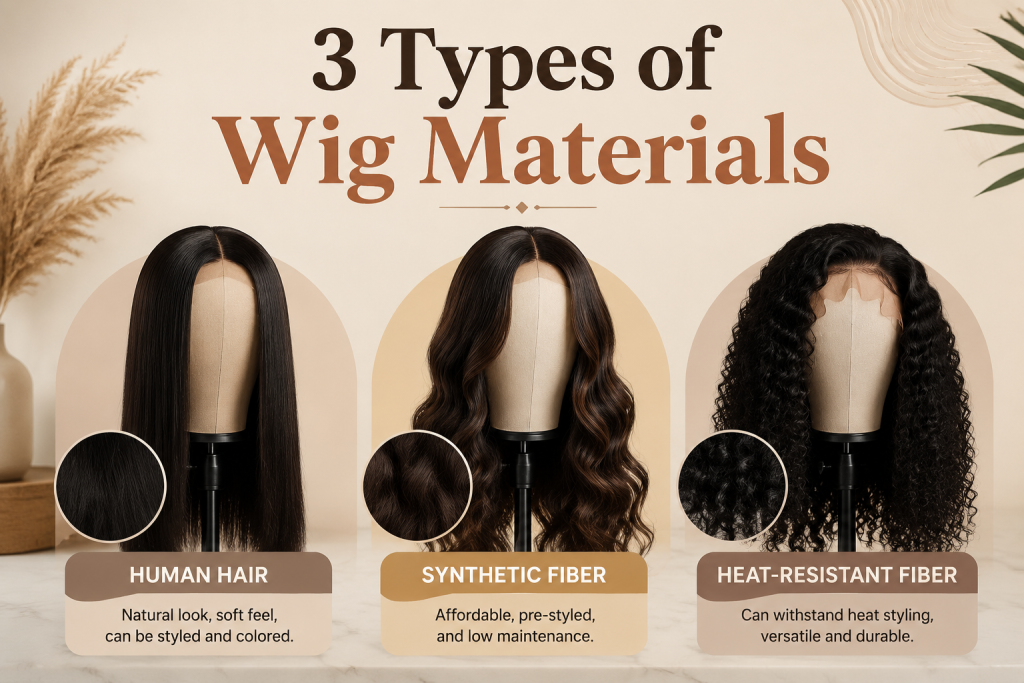
The 3 Types of Wig Materials Explained
The wig industry uses three fundamental material categories. Every wig product on the market falls into one of these three types, regardless of marketing language, brand positioning, or price point. The types of wig materials are: human hair, synthetic fiber, and human hair/synthetic blends. Each category contains multiple grades and quality levels that dramatically affect performance, appearance, and wholesale cost.
Type 1: Human Hair (Grades, Origins, and Reality)
Human hair wigs represent the premium end of the market. They command the highest prices because they offer the most natural appearance, the most styling versatility, and the longest usable lifespan. They also carry the most complex supply chain, the highest risk of misrepresentation, and the widest quality variation within the category.
Origin matters enormously. Human hair for wigs comes from donors worldwide, but origin determines hair characteristics that affect the final product.
Indian hair: Fine to medium texture, naturally straight to wavy, slight natural wave pattern. The largest volume source globally. Most “virgin” hair on the market originates from Indian temples where devotees donate hair during religious ceremonies. This temple hair is collected, sorted by length, and sold to processors. Indian hair accepts color and chemical processing well due to its relatively fine cuticle structure.
Chinese hair: Thick, coarse, extremely strong. Naturally straight with round cross-section. Abundant supply but requires heavy processing to achieve textures other than straight. The thickness makes it durable but harder to blend with finer natural hair textures. Primarily used in the Asian domestic market and for straight wig styles.
Brazilian, Peruvian, Malaysian (marketed origins): Here’s where honesty matters. The vast majority of hair marketed as “Brazilian,” “Peruvian,” or “Malaysian” is actually Indian or Chinese hair that’s been processed and textured to mimic the characteristics associated with those origins. Genuine hair sourced directly from Brazilian or Peruvian donors exists but in tiny quantities compared to market demand. When a factory offers unlimited quantities of “Brazilian virgin hair” at consistent pricing, that hair almost certainly originated elsewhere and was processed to match expected texture profiles.
European/Russian hair: The rarest and most expensive. Fine texture, natural color variation, soft cuticle structure. Genuine European hair costs 3-5x more than Indian hair at wholesale because supply is extremely limited. Used in the highest-end custom wigs and medical wigs. If a supplier offers “European hair” at prices comparable to Indian hair, it’s not European hair.
Grading system (and why it’s mostly marketing):
The wig industry uses grade numbers (8A, 9A, 10A, 12A, etc.) that have zero standardization. No industry body defines what “10A” means. Every factory assigns their own grades to their own quality levels. One factory’s “8A” might equal another factory’s “10A.” These grades are marketing tools, not technical specifications.
What actually determines human hair quality:
Cuticle integrity: “Remy” means the hair cuticles are aligned in the same direction (root to tip), which prevents tangling. “Non-Remy” hair has mixed cuticle directions and tangles easily unless the cuticles are chemically stripped (creating “fallen hair” that’s smooth but less durable). True Remy hair costs more because it requires careful collection and sorting to maintain directional alignment.
Virgin vs processed: “Virgin” means no chemical treatment (no coloring, no perming, no relaxing). The hair retains its natural color, texture, and cuticle structure. Truly virgin hair is increasingly rare because most donors have used some hair products or treatments. “Processed” hair has been chemically treated to achieve a specific color or texture. Processing isn’t bad, but it reduces hair longevity and limits further styling options.
Single donor vs mixed: Single-donor hair (all strands from one person) has the most consistent texture and color. Mixed-donor hair (blended from multiple people) may have slight texture inconsistencies. Single-donor commands premium pricing but is harder to source in consistent quantities.
Wholesale cost (2026):
Indian Remy hair (raw, unprocessed): $80-200 per kg depending on length and quality. Shorter lengths (10-14 inches) at the lower end. Longer lengths (22-30 inches) at the higher end.
Indian processed hair (colored, textured): $60-150 per kg. Processing adds cost but lower-grade raw material reduces base price.
Chinese hair (raw): $40-100 per kg. Abundant supply keeps prices lower despite thick, strong fiber quality.
“Brazilian/Peruvian” (processed Indian): $100-250 per kg. The premium reflects processing costs and marketing positioning, not origin.
European/Russian (genuine): $300-800 per kg. Limited supply drives extreme pricing.
Finished wig wholesale cost (human hair, full lace construction): $80-400 per unit depending on hair grade, length, density, and cap construction. A 16-inch Indian Remy full lace wig from Xuchang factories runs $120-180 per unit at 50+ piece orders.
Sourcing notes: Xuchang (Henan province, China) is the global center of wig manufacturing, processing an estimated 70%+ of the world’s wig hair. Qingdao (Shandong province) is the second major hub. Both cities have hundreds of wig factories ranging from small workshops to large-scale operations. Sourcing from China for wig materials requires understanding which factories actually process hair versus which ones simply trade finished products from smaller workshops.
Type 2: Synthetic Fiber (Technology Has Changed Everything)
Synthetic wig fiber has evolved dramatically in the past decade. The stiff, shiny, obviously-fake synthetic wigs of the past have been replaced by advanced fibers that closely mimic human hair in appearance, movement, and touch. For many market segments, modern synthetic fiber delivers better value than human hair when performance requirements are properly matched to material capabilities.
Fiber types:
Standard synthetic (Kanekalon, Toyokalon): The most common synthetic wig fibers. Made from modacrylic (modified acrylic) polymer. These fibers mimic hair appearance reasonably well but have a slight synthetic sheen that trained eyes can detect. Not heat-resistant. Cannot be styled with hot tools (curling irons, flat irons) without melting. Holds its manufactured style permanently, which is both an advantage (no daily styling needed) and limitation (can’t change the style).
High-temperature synthetic (heat-friendly fiber): Advanced synthetic fibers engineered to withstand heat styling up to 150-180°C (300-360°F). These fibers can be curled, straightened, and restyled with standard hot tools, mimicking human hair’s styling versatility. The fiber texture and movement are significantly more natural than standard synthetic. This is the fiber type most commonly blended with human hair in “blended” wigs because it’s nearly indistinguishable by touch.
Futura fiber: A premium synthetic fiber with extremely natural appearance and feel. Resists heat up to 200°C (400°F). Holds curl memory while allowing restyling. The closest synthetic approximation to human hair currently available. Costs 2-3x more than standard synthetic but still far less than human hair.
Protein fiber (bio-synthetic): Newer technology incorporating protein molecules into synthetic fiber structure to mimic human hair’s protein composition. These fibers absorb and release moisture similarly to human hair, reducing static and improving natural movement. Still emerging technology with limited factory availability.
Performance characteristics:
| Property | Standard Synthetic | Heat-Friendly Synthetic | Human Hair |
| Natural appearance | Good | Very good | Excellent |
| Heat styling | No (melts) | Yes (up to 180°C) | Yes (up to 230°C) |
| Lifespan | 3-6 months daily wear | 6-12 months daily wear | 1-3 years daily wear |
| Color fading | Minimal (color locked in fiber) | Minimal | Moderate (especially processed) |
| Tangling | Low (if quality fiber) | Moderate | Moderate to high |
| Weight | Light | Light to medium | Medium to heavy |
| Maintenance | Low (wash, air dry, wear) | Moderate | High (styling, conditioning, careful storage) |
| Rain/humidity behavior | Frizz-resistant | Moderate frizz resistance | Frizzes like natural hair |
Wholesale cost (2026):
Standard synthetic fiber (raw, per kg): $15-40 depending on quality grade and manufacturer.
Heat-friendly synthetic fiber (raw, per kg): $30-70 depending on heat tolerance level and manufacturer.
Futura fiber (raw, per kg): $60-120.
Finished wig wholesale cost (synthetic, machine-made): $8-45 per unit depending on fiber quality, length, style complexity, and cap construction. A standard 16-inch synthetic wig from Chinese factories runs $12-25 per unit at 100+ piece orders.
Finished wig wholesale cost (synthetic, hand-tied lace front): $25-80 per unit. The hand-tied construction adds significant labor cost regardless of fiber type.
The cost difference between synthetic and human hair finished wigs is dramatic. A brand can offer four synthetic wigs at the price point of one human hair wig, opening entirely different market segments and purchase frequency patterns.
Sourcing notes: Synthetic wig production is concentrated in the same Xuchang and Qingdao regions as human hair production. Many factories produce both types. The raw synthetic fiber itself comes from chemical manufacturers in Japan (Kaneka Corporation produces Kanekalon), Korea, and increasingly China. Chinese-produced synthetic fibers have improved significantly in quality and now compete with Japanese fibers at 40-60% of the cost for most commercial applications.
Type 3: Human Hair and Synthetic Blends
Blended wigs combine human hair and synthetic fiber in the same wig unit. This category is the most misrepresented in the industry because blended wigs can look and feel nearly identical to pure human hair wigs while costing significantly less to produce.
Common blend ratios:
70% human / 30% synthetic: Premium blend. Maintains most human hair characteristics (styling versatility, natural movement) while reducing cost and adding synthetic benefits (color retention, reduced tangling). The most common ratio in wigs marketed as “human hair” that are actually blends.
50% human / 50% synthetic: Mid-range blend. Noticeable reduction in heat styling capability compared to pure human hair. Still looks natural. Significant cost reduction. Common in mid-priced wig lines.
30% human / 70% synthetic: Economy blend. Primarily synthetic performance with human hair added for natural texture at the hairline and part area where scrutiny is highest. Marketed as “human hair blend” when honestly labeled.
Why blends exist:
Cost reduction is the obvious reason. But blends also solve genuine performance problems. Pure human hair wigs are heavy (especially at longer lengths). Adding lightweight synthetic fiber reduces total wig weight, improving comfort for all-day wear. Pure human hair tangles more than quality synthetic fiber. Blending reduces tangling while maintaining natural appearance. Pure human hair frizzes in humidity. Synthetic fiber in the blend provides frizz resistance that pure human hair lacks.
A well-engineered blend can genuinely outperform pure human hair for specific use cases. The problem isn’t blending itself. The problem is selling blends as pure human hair at pure human hair prices.
Wholesale cost (2026):
70/30 blend finished wig (lace front): $50-150 per unit. Approximately 30-40% less than equivalent pure human hair construction.
50/50 blend finished wig (lace front): $35-100 per unit. Approximately 50% less than pure human hair.
30/70 blend finished wig (lace front): $25-60 per unit. Approaching synthetic pricing with human hair marketing appeal.
Types of Wig Materials: Full Comparison Chart
| Factor | Human Hair | Synthetic Fiber | Blended |
| Natural appearance | Superior | Good to very good | Very good |
| Heat styling | Full (up to 230°C) | Limited or none | Partial (up to 150-180°C) |
| Lifespan (daily wear) | 1-3 years | 3-12 months | 6-18 months |
| Wholesale cost (finished wig) | $80-400 | $8-80 | $25-150 |
| Retail price range | $150-1000+ | $20-150 | $80-400 |
| Maintenance level | High | Low | Moderate |
| Color options | Requires dyeing | Unlimited (pre-colored) | Limited dyeing |
| Weight | Heavy | Light | Medium |
| Tangling | Moderate-high | Low | Low-moderate |
| Humidity resistance | Poor (frizzes) | Good | Moderate |
| Target market | Premium, medical, luxury | Fashion, costume, budget | Mid-range, value-premium |
| MOQ (typical) | 30-100 units | 100-500 units | 50-200 units |
| Lead time | 3-6 weeks | 2-4 weeks | 3-5 weeks |
How Factories Misrepresent Wig Materials
I’ve seen every misrepresentation in this industry during factory audits and quality inspections across wig production facilities. These are the most common deceptions.
Selling blends as pure human hair. The most widespread issue in the industry. Factories blend 30-40% high-temperature synthetic fiber into human hair wigs and sell them as “100% human hair.” The synthetic fiber is virtually undetectable by touch or visual inspection alone. Only burn testing or chemical analysis reveals the blend. This happens at every price level, from budget factories to mid-range suppliers.
Upgrading grade labels without upgrading material. A factory buys 8A-equivalent raw hair, processes it, and labels the finished wig as “12A grade.” Since no standardized grading system exists, there’s no external authority to contradict the claim. The factory charges 12A prices for 8A material.
Misrepresenting origin. Indian temple hair processed and textured to mimic Brazilian curl patterns gets labeled “100% Brazilian virgin hair.” Chinese hair chemically treated to reduce thickness gets labeled “Peruvian body wave.” The processing is skilled enough that the finished product genuinely resembles hair from the claimed origin, but the raw material cost is a fraction of genuine origin-specific hair.
Using non-Remy hair labeled as Remy. True Remy hair (cuticles aligned root-to-tip) requires careful collection and sorting that adds cost. Non-Remy hair is cheaper but tangles. Factories chemically strip cuticles from non-Remy hair (acid bath treatment), then coat the stripped hair with silicone to create temporary smoothness. This “fake Remy” feels silky smooth initially but the silicone washes out within 5-10 washes, revealing the tangling, matting mess underneath. Customers experience dramatic quality degradation after the first few weeks of use.
Substituting fiber brands. A factory quotes pricing based on premium Kanekalon or Futura fiber, then substitutes cheaper Chinese-produced fiber in production. The finished wig looks similar but the cheaper fiber has shorter lifespan, less natural movement, and higher flammability.
How to Verify What You’re Actually Getting
Burn test: The simplest material verification. Pull a few strands from the wig and burn them with a lighter. Human hair burns slowly, smells like burning protein (similar to burning feathers), and leaves soft black ash that crumbles. Synthetic fiber melts, forms a hard plastic bead, smells chemical/plastic, and produces black smoke. Blended material shows both behaviors (some strands burn like hair, some melt like plastic). This test immediately reveals whether a “100% human hair” claim is accurate.
Bleach test: Apply hair bleach to a small hidden section. Human hair lightens in color as the bleach oxidizes melanin pigment. Synthetic fiber doesn’t change color because there’s no melanin to oxidize. This test distinguishes human hair from synthetic without destroying the sample (the bleached section can be cut away).
Chemical solvent test: Acetone (nail polish remover) dissolves most synthetic fibers but doesn’t affect human hair. Soak a few strands in acetone for 30 minutes. If they dissolve or become gummy, synthetic fiber is present.
Microscope examination: Under 100x magnification, human hair shows visible cuticle scales (overlapping layers like roof shingles). Synthetic fiber shows smooth, uniform surface without cuticle structure. This test also reveals whether cuticles have been chemically stripped (stripped hair shows damaged, irregular surface rather than intact cuticle pattern).
Require these tests on samples from every production batch as part of your quality control protocol. Any factory that refuses material verification testing is almost certainly misrepresenting their materials.
Which Material Fits Which Market Segment
Premium/luxury market ($200+ retail): Human hair, specifically verified Remy hair from documented origin with intact cuticles. Your customers at this price point expect maximum styling versatility, multi-year lifespan, and completely natural appearance. They’ll detect synthetic fiber and leave devastating reviews. Invest in material verification for every batch.
Mid-range market ($80-200 retail): High-quality blends (70/30 human/synthetic) or heat-friendly synthetic with premium construction (hand-tied lace front). This segment offers the best margin opportunity because material costs are moderate while perceived value remains high. Honest marketing as “human hair blend” or “premium heat-friendly fiber” builds trust without requiring pure human hair costs.
Value market ($30-80 retail): Heat-friendly synthetic fiber with quality cap construction. This segment prioritizes style variety and purchase frequency over longevity. Customers buy multiple wigs for different looks rather than investing in one premium piece. Low material cost enables competitive pricing while quality construction ensures positive reviews.
Fashion/costume market (under $30 retail): Standard synthetic fiber with machine-made construction. Maximum style variety at minimum cost. Short expected lifespan is acceptable because customers treat these as fashion accessories, not long-term investments.
Medical market ($150-500+ retail): Requires the softest, most natural materials with the most comfortable cap construction. Human hair or premium Futura fiber on hand-tied monofilament caps. This segment values comfort and natural appearance above all else. Customers are experiencing hair loss and need products that restore confidence. Material quality and construction comfort justify premium pricing. Consider working with a product development partner to engineer cap comfort features specific to medical wig users.
How to Specify Wig Materials in Production Orders
Your product specification sheet for wig products should eliminate all ambiguity about materials. Vague specifications like “human hair wig” give factories room to substitute cheaper materials.
Material specifications:
- Hair/fiber type: State explicitly (“100% Indian Remy human hair, no synthetic fiber content” or “Heat-friendly synthetic fiber, minimum 180°C heat tolerance” or “70% human hair / 30% heat-friendly synthetic blend”)
- Origin (if human hair): Specify and require documentation (“Indian temple-sourced hair with collection documentation”)
- Processing: State acceptable processing (“Virgin unprocessed” or “Single-process color #1B only” or “Steam-processed body wave texture, no chemical texturing”)
- Cuticle status: Specify (“Full cuticle intact, aligned root-to-tip” or “Cuticle-intact Remy alignment verified by microscope inspection”)
- Fiber brand (if synthetic): Specify manufacturer (“Kanekalon fiber” or “equivalent quality Chinese-produced modacrylic, minimum 180°C heat tolerance verified by testing”)
- Length: Specify measured length after construction (“16 inches measured from crown to ends after wig construction, not stretched”)
- Density: Specify percentage (“130% density” or “150% density” with reference sample for visual verification)
- Color: Provide physical color ring sample or specify industry color number with acceptable tolerance
Testing requirements:
- Burn test on 3+ random units per production batch (verify material composition)
- Bleach test on 1+ unit per batch (confirm human hair content if specified)
- Heat tolerance test for heat-friendly synthetic (apply 180°C iron to fiber sample, verify no melting or damage)
- Tangle test (comb test after 10 wash cycles on sample unit)
- Shedding test (pull test measuring fiber loss per 100 brush strokes)
- Color fastness test (wash sample 5 times, measure color change against original)
These specifications and tests protect your brand from material substitution. Document everything in your supplier agreements and verify compliance through quality inspection on every production batch.
The three types of wig materials each serve legitimate market segments when specified correctly and sourced honestly. Human hair delivers premium performance at premium cost. Synthetic fiber delivers accessible styling at accessible pricing. Blends offer middle-ground value when marketed truthfully. The material itself isn’t the problem in this industry. The misrepresentation is.
Specify exactly what you want. Test what you receive. And market what you actually sell. That combination builds wig brands that survive long-term in a market where customer trust is everything.
If you’re developing a wig product line and need help with material specification, factory verification in Xuchang or Qingdao, or quality protocols that catch material substitution before shipment, schedule a conversation or reach out directly.
FAQ
How can I tell if my supplier is selling blended wigs as pure human hair?
The burn test is your fastest and most reliable field verification method. Pull three to five strands from different areas of the wig (crown, nape, sides) and burn them individually with a lighter. Pure human hair burns slowly with an orange flame, produces a smell identical to burning feathers or fingernails, and leaves soft black ash that crumbles between your fingers. Synthetic fiber melts rather than burns, forms a hard plastic bead at the burned end, produces chemical-smelling black smoke, and the melted bead is hard and cannot be crumbled. If even one strand from your “100% human hair” wig melts and forms a plastic bead, synthetic fiber is present and the material claim is false. Perform this test on samples from every production batch, pulling strands from multiple locations on the wig since some factories strategically place human hair at inspection-likely areas (hairline, part) while using synthetic in less visible areas (interior layers, nape). A quality inspector visiting the factory can perform this test during pre-shipment inspection on random units from the production batch.
Which type of wig material lasts longest with daily wear?
Quality human hair wigs last longest in absolute terms, typically 1-3 years of daily wear with proper maintenance. However, “proper maintenance” is the critical qualifier. Human hair wigs require regular deep conditioning, gentle detangling, professional restyling every 4-6 weeks, and careful storage on wig stands. Without this maintenance, human hair wigs degrade to unusable condition within 6-12 months, performing no better than quality synthetic. For customers who won’t commit to maintenance routines, heat-friendly synthetic wigs lasting 6-12 months with minimal care actually deliver better value per dollar spent. The “longest lasting” material depends entirely on the end user’s maintenance commitment. When developing your product line, match material selection to your target customer’s realistic maintenance behavior, not their aspirational intentions.
What minimum order quantities should I expect for each wig material type?
MOQs vary by material type, factory size, and customization level. For human hair wigs with custom specifications (specific hair grade, custom color, custom cap construction), expect MOQs of 30-100 units per style from most Xuchang factories. Some smaller workshops accept 20-unit minimums at slightly higher per-unit pricing. For synthetic wigs with custom styles, MOQs typically start at 100-500 units per style because synthetic wig production is more automated and factories need volume to justify machine setup. Stock synthetic styles (existing molds and colors) may have MOQs as low as 50 units. For blended wigs, MOQs fall between human and synthetic, typically 50-200 units per style. These MOQs are negotiable, especially through established sourcing relationships where the factory trusts repeat order potential. First orders often require meeting full MOQ, while subsequent orders from proven buyers may receive flexibility on minimums.