
A haircare brand owner contacted me wanting to launch a “complete styling tool collection.” She had a logo, packaging designs, and an Instagram following ready to buy. What she didn’t have was any understanding of which types of combs and brushes actually belonged in her collection, what materials made sense for her price point, or how manufacturing costs varied between a wide-tooth comb and a boar bristle brush.
She assumed all combs cost roughly the same to produce. They don’t. A basic plastic fine-tooth comb costs $0.15 to manufacture. A handmade acetate dressing comb costs $3.50. Same product category, twenty-three times the price difference at wholesale. Without understanding the types of combs and brushes available and their manufacturing realities, she would have either overpriced cheap products or underpriced expensive ones. Both paths kill margins.
Whether you’re building a haircare brand, adding styling tools to an existing beauty line, or private-labeling combs and brushes for retail, understanding what each type does, what it costs to produce, and who buys it determines whether your product line generates profit or collects dust in a warehouse.
Table of Contents
| # | Section |
| 1 | Why Understanding Comb and Brush Types Matters for Your Brand |
| 2 | Types of Combs (7 Essential Varieties) |
| 3 | Types of Brushes (5 Essential Varieties) |
| 4 | Complete Comparison: All 12 Types of Combs and Brushes |
| 5 | Material Options and Cost Implications |
| 6 | Which Types Sell Best in Which Markets |
| 7 | How to Specify Combs and Brushes for Manufacturing |
| 8 | FAQ |
Types of Combs: 7 Essential Varieties
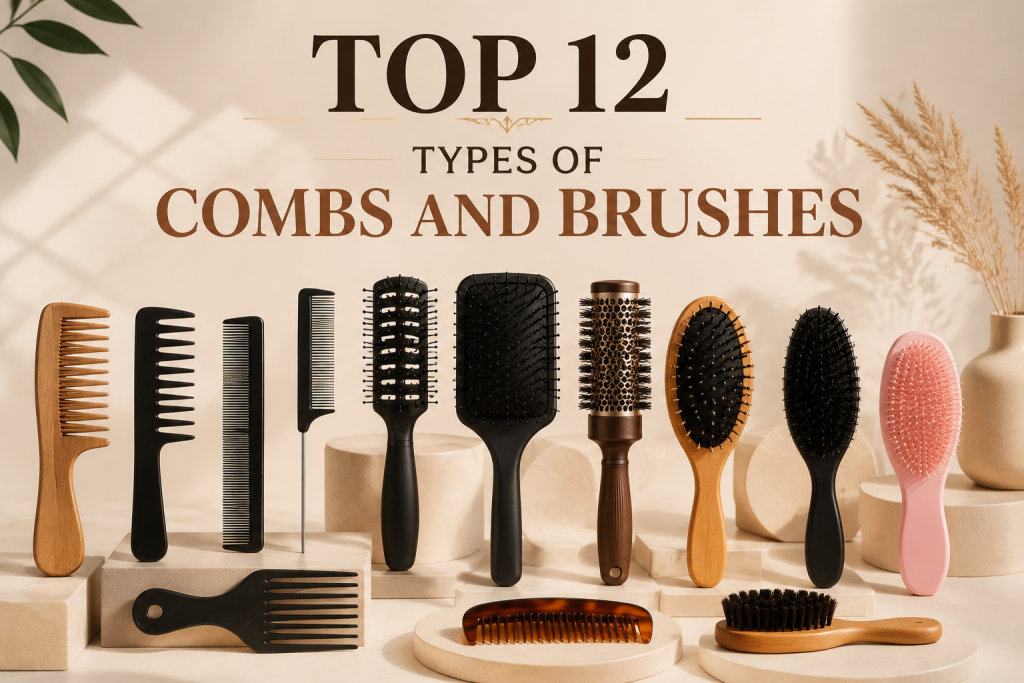
1. Wide-Tooth Comb
The workhorse of detangling. Teeth spaced 5-8mm apart glide through wet or tangled hair without pulling or breaking strands. Every hair type benefits from a wide-tooth comb, making it the highest-volume seller in the comb category.
Manufacturing: Injection-molded plastic (ABS or polycarbonate) is standard. Bamboo and wood versions require CNC machining or hand-carving. Seamless construction without mold lines is the quality differentiator. Cheap versions have visible mold seams that snag hair.
Wholesale cost: Plastic $0.20-0.60. Bamboo $0.80-1.50. Wood (sandalwood, peach wood) $1.50-4.00. Acetate $2.00-3.50.
MOQ: Plastic 1000-5000 units. Natural materials 500-2000 units.
2. Fine-Tooth Comb
Teeth spaced 1-2mm apart for precise styling, parting, and smoothing. Used by professionals for sectioning hair and creating clean parts. Also used for lice detection (medical application) and finishing styles.
Manufacturing: Requires tighter injection mold tolerances than wide-tooth. Teeth must be perfectly uniform without burrs or rough edges. Quality control rejection rates are higher because thin teeth break during demolding if the process isn’t precise.
Wholesale cost: Plastic $0.15-0.50. Carbon fiber composite $0.80-1.50. Acetate $2.00-3.00.
MOQ: Plastic 2000-5000 units. Carbon fiber 1000-3000 units.
3. Rat Tail Comb
Fine-tooth comb with a long, thin pointed handle (the “tail”) used for sectioning, parting, and creating precise divisions in hair. Essential professional tool for hairstylists. The tail tip material matters: metal tips for precision, plastic tips for gentleness on scalp.
Manufacturing: Two-component construction (comb body + tail) or single-piece injection molding. Metal-tipped versions require assembly step adding labor cost. Carbon fiber versions popular in professional market for heat resistance during chemical services.
Wholesale cost: Plastic $0.20-0.45. Carbon fiber $0.70-1.20. Metal-tipped $0.40-0.80.
MOQ: 1000-3000 units typical.
4. Dressing Comb
Combination comb with both fine teeth and wide teeth on the same body, separated by a solid center section. The all-purpose comb that handles both detangling (wide side) and smoothing (fine side). Standard inclusion in hotel amenity kits and travel sets.
Manufacturing: Slightly more complex mold than single-spacing combs due to dual tooth configurations. Quality versions have polished teeth tips (rounded, not sharp) that prevent scalp scratching.
Wholesale cost: Plastic $0.25-0.60. Acetate $2.50-4.00. Hotel amenity grade (thin, disposable) $0.05-0.12.
MOQ: Standard 1000-5000 units. Hotel/amenity 10,000-50,000 units.
5. Barber Comb
Longer than standard combs (typically 18-22cm), designed for professional barbering. Tapered design with graduating tooth spacing. Used in conjunction with scissors for cutting techniques. Must withstand daily professional use without breaking or warping.
Manufacturing: Requires durable materials (carbon fiber composite, high-impact ABS, or vulcanized rubber). Professional-grade barber combs undergo flex testing to ensure they don’t snap during use. Heat resistance matters because barbers work near blow dryers and hot tools.
Wholesale cost: Standard plastic $0.30-0.70. Carbon fiber $1.00-2.00. Professional-grade rubber $1.50-2.50.
MOQ: 500-2000 units for professional grade.
6. Afro Pick / Hair Pick
Long, widely-spaced teeth (often metal or strong plastic) on a handle, designed for lifting and shaping textured, coily, and afro-textured hair. Teeth are longer than standard combs (5-10cm) to penetrate dense curl patterns without disrupting curl definition.
Manufacturing: Metal picks require stamping or casting plus finishing (powder coating or chrome plating). Plastic picks need reinforced tooth bases to prevent snapping in dense hair. Fist-shaped or decorative handle picks require custom mold tooling.
Wholesale cost: Plastic $0.30-0.80. Metal (stainless steel) $0.80-2.00. Decorative/custom handle $1.50-3.50.
MOQ: 1000-3000 units. Custom mold tooling $800-2500 for decorative handles.
7. Wooden/Bamboo Comb
Natural material combs positioned as eco-friendly, anti-static alternatives to plastic. Sandalwood, neem wood, peach wood, and bamboo are common materials. The anti-static property is genuine: wood doesn’t generate static electricity like plastic, reducing frizz during combing.
Manufacturing: CNC machining from solid wood blanks, then hand-sanding and polishing. Bamboo combs are pressed from bamboo strips or CNC-cut from solid bamboo. Natural oil finishing (tung oil, linseed oil) protects the wood without chemical coatings. Each piece has slight natural variation, which is either a selling point (artisanal) or a quality control challenge depending on your brand positioning.
Wholesale cost: Bamboo $0.60-1.50. Peach wood $1.00-2.50. Sandalwood $2.50-6.00. Neem wood $1.50-3.00.
MOQ: 500-2000 units. Sandalwood often 300-500 minimum due to material cost.
Sourcing note: Wooden comb production is concentrated in Jiangxi and Anhui provinces in China. Bamboo comb production centers in Zhejiang and Fujian. Sourcing from China for natural material combs requires verifying wood species claims, as cheaper woods are sometimes substituted for premium species like sandalwood.
Types of Brushes: 5 Essential Varieties
8. Paddle Brush
Large, flat rectangular or oval brush head with a cushioned base and widely-spaced bristles. Designed for detangling and smoothing long, straight to wavy hair. The cushion base flexes during brushing, reducing pulling force on hair and scalp.
Manufacturing: Multi-component assembly: handle (wood, plastic, or bamboo), rubber cushion pad, bristles (nylon, boar, or mixed) inserted into cushion. Assembly is partially manual in most factories. The cushion inflation (air pocket inside the rubber pad) is a quality indicator. Properly inflated cushions provide bounce. Flat, deflated cushions indicate poor assembly or material degradation.
Wholesale cost: Nylon bristle/plastic handle $1.00-2.50. Boar bristle/wood handle $3.50-7.00. Bamboo handle/mixed bristle $2.00-4.00.
MOQ: 500-2000 units.
9. Round Brush
Cylindrical brush used for blow-dry styling, creating volume, and curling hair with heat. Barrel diameter determines curl size: small barrels (25mm) create tight curls, large barrels (53mm+) create loose waves and volume. Professional stylists use multiple sizes.
Manufacturing: Complex assembly involving barrel core (aluminum for heat conduction, ceramic-coated for heat distribution, or plastic for non-heat use), bristle insertion (machine-tufted or hand-inserted), and handle attachment. Thermal round brushes with vented aluminum barrels require precision manufacturing to ensure even heat distribution.
Wholesale cost: Basic plastic/nylon $1.20-2.50. Ceramic barrel/boar bristle $3.00-6.00. Professional thermal $4.00-8.00.
MOQ: 500-1500 units per size. Sets of 3-4 sizes common for professional lines.
10. Vent Brush
Open-backed brush with widely spaced bristles and ventilation holes in the brush head. Designed for blow-drying: the vents allow hot air to pass through the brush directly to hair, reducing drying time. Lightweight construction for comfortable extended use during styling.
Manufacturing: Injection-molded body with inserted bristles (ball-tipped nylon standard). The vent hole pattern is engineered for optimal airflow. Cheap versions have insufficient venting that defeats the purpose. Quality versions have smooth, rounded vent edges that don’t catch hair.
Wholesale cost: $0.80-2.00 for standard nylon/plastic. $2.00-3.50 for premium construction with rubberized grip.
MOQ: 1000-3000 units.
11. Boar Bristle Brush
Natural bristle brush using hair from boars (wild pigs). Boar bristles distribute natural scalp oils from root to tip, creating shine and reducing frizz without static. The gold standard for fine to normal hair types seeking natural shine and smoothness.
Manufacturing: Bristle sourcing is the primary cost driver. Genuine boar bristles are graded by stiffness, length, and color. First-cut bristles (longest, stiffest) command premium prices. Bristle insertion into the brush pad is labor-intensive, often done by hand for quality brushes. Mixed bristle brushes (boar + nylon) reduce cost while maintaining some natural bristle benefits.
Wholesale cost: 100% boar bristle $4.00-12.00 depending on bristle grade and brush size. Mixed boar/nylon $2.50-5.00. Vegan alternatives (sisal, plant fiber) $2.00-4.00.
MOQ: 300-1000 units for pure boar. 500-2000 for mixed.
Sourcing note: Boar bristle supply comes primarily from China and India. Quality grading varies significantly between suppliers. Require bristle grade specification and sample verification in your product specifications. Some suppliers substitute cheaper horse hair or synthetic fiber for boar bristle in production after approving genuine boar bristle samples.
12. Detangling Brush
Flexible-bristle brush specifically engineered to glide through knots and tangles without pain or breakage. Bristles are typically cone-shaped (thinner at tip, thicker at base) and set at varying heights to separate tangles progressively. The category exploded after Tangle Teezer’s market success proved consumer demand for pain-free detangling.
Manufacturing: The bristle flexibility and cone-shape geometry are the engineering differentiators. Bristles are injection-molded as part of the brush head (not inserted separately), creating a one-piece construction that’s durable and waterproof. The specific bristle flex pattern is often patent-protected, so verify freedom-to-operate before developing similar designs. Custom bristle geometry requires new mold tooling ($3,000-8,000).
Wholesale cost: $0.80-2.50 for standard designs. $2.00-4.00 for premium ergonomic designs with custom bristle patterns.
MOQ: 1000-5000 units for existing mold designs. 3000-5000 for custom mold designs (to amortize tooling cost).
Complete Comparison: All 12 Types of Combs and Brushes
| Type | Primary Use | Material Options | Wholesale Cost Range | Best Market Segment |
| Wide-tooth comb | Detangling wet hair | Plastic, bamboo, wood, acetate | $0.20-4.00 | Universal, highest volume |
| Fine-tooth comb | Parting, smoothing, precision | Plastic, carbon fiber, acetate | $0.15-3.00 | Professional, everyday |
| Rat tail comb | Sectioning, parting lines | Plastic, carbon fiber, metal-tip | $0.20-1.20 | Professional stylists |
| Dressing comb | All-purpose dual spacing | Plastic, acetate | $0.05-4.00 | Travel, hotel, everyday |
| Barber comb | Professional cutting | Carbon fiber, rubber, ABS | $0.30-2.50 | Professional barbers |
| Afro pick | Textured hair shaping | Metal, reinforced plastic | $0.30-3.50 | Natural hair community |
| Wooden/bamboo comb | Anti-static, eco-friendly | Sandalwood, bamboo, neem, peach | $0.60-6.00 | Eco-conscious, premium |
| Paddle brush | Smoothing long hair | Nylon/plastic, boar/wood, bamboo | $1.00-7.00 | Everyday, premium |
| Round brush | Blow-dry styling, volume | Ceramic, aluminum, plastic barrel | $1.20-8.00 | Professional, at-home styling |
| Vent brush | Fast blow-drying | Plastic/nylon | $0.80-3.50 | Everyday, salon |
| Boar bristle brush | Shine, oil distribution | Boar bristle, mixed, vegan fiber | $2.50-12.00 | Premium, natural beauty |
| Detangling brush | Pain-free knot removal | Flexible injection-molded plastic | $0.80-4.00 | Kids, curly hair, mass market |
Material Options and Cost Implications
The handle and body material you choose positions your product in a specific price tier and market segment. Here’s how material selection affects manufacturing cost, perceived value, and target customer.
Plastic (ABS, polycarbonate, polypropylene): Lowest cost, highest volume capability. Injection molding produces consistent units at $0.15-2.50 per piece depending on complexity. Unlimited color options. Mold tooling costs $1,500-5,000 per design. Best for mass market, value positioning, and high-volume retail. Perceived as basic unless design and finish elevate it.
Bamboo: Mid-range cost with strong eco-positioning. $0.60-3.00 per piece. Growing consumer demand for sustainable materials makes bamboo a strong differentiator. Requires moisture-sealing treatment to prevent cracking. Slight natural variation between pieces. Best for eco-conscious brands, natural beauty positioning, and gift sets.
Wood (beech, maple, olive, sandalwood): Premium positioning material. $1.50-8.00 per piece depending on wood species. Sandalwood carries fragrance that adds sensory appeal. Requires hand-finishing for smooth edges. Natural grain patterns make each piece unique. Best for luxury brands, artisanal positioning, and high-margin retail.
Acetate (cellulose acetate): Premium comb material derived from plant cellulose. $2.00-5.00 per piece. Mimics the appearance of tortoiseshell or horn without animal materials. Hand-polished to glass-smooth finish that never snags hair. Hypoallergenic and anti-static. Best for luxury brands and fashion-forward positioning.
Metal (aluminum, stainless steel): Used for brush barrels (thermal styling) and pick teeth. Adds weight and perceived quality. Requires surface treatment (anodizing, powder coating, chrome plating) to prevent corrosion. Best for professional tools and premium styling instruments.
For brands developing multi-product collections, mixing materials across the line creates natural price tiering. Offer plastic-handled basics at entry price, bamboo mid-range, and wood or acetate premium pieces. Same brand, three price points, three customer segments served. Work with a product development partner to engineer cohesive design language across materials.
Which Types Sell Best in Which Markets
Mass retail (Target, Walmart, drugstores): Wide-tooth combs, detangling brushes, paddle brushes, vent brushes. Plastic construction. Price points $4-15 retail. Volume is everything. Focus on packaging appeal and impulse purchase positioning.
Professional/salon supply: Barber combs, rat tail combs, round brush sets, carbon fiber combs. Durability and performance matter more than aesthetics. Price points $8-35 retail. Professional endorsement drives purchasing.
Natural/eco beauty (Whole Foods, indie retailers, DTC): Bamboo combs, wooden combs, boar bristle brushes, plant-fiber alternatives. Sustainability story and material sourcing transparency drive purchase decisions. Price points $12-45 retail. Packaging must reinforce eco-positioning (recycled cardboard, no plastic).
Textured hair market (beauty supply, DTC brands): Wide-tooth combs, afro picks, detangling brushes, boar bristle brushes. This market values products designed specifically for their hair type rather than generic “all hair” positioning. Price points $8-30 retail. Community trust and authentic marketing matter more than mass distribution.
Luxury/gift market (department stores, boutiques): Acetate combs, sandalwood combs, premium boar bristle brushes with wood handles. Presentation, materials, and craftsmanship justify premium pricing. Price points $25-100+ retail. Gift packaging and unboxing experience are part of the product.
Children’s market: Detangling brushes, wide-tooth combs with character handles. Must meet CPSC safety standards and ASTM F963 for children’s products (no small parts, non-toxic materials, rounded edges). Price points $5-15 retail. Fun design drives parent purchasing.
Understanding which types of combs and brushes perform in which channels helps you build a focused product line rather than trying to serve every segment with one SKU. Market intelligence on your specific target channel should drive your product development decisions.
How to Specify Combs and Brushes for Manufacturing
Your product specification sheet should cover these parameters for every comb and brush SKU:
Comb specifications:
- Overall dimensions (length x width x thickness in mm)
- Tooth count and spacing (mm between teeth)
- Tooth length (mm from base to tip)
- Tooth tip profile (rounded radius in mm, must be smooth with no sharp edges)
- Material (specific polymer grade for plastic, specific wood species for natural)
- Surface finish (polished, matte, textured, hand-sanded)
- Color (Pantone reference with acceptable Delta E tolerance)
- Mold line treatment (fully polished away, acceptable location if visible)
- Flex test requirement (bend angle without breaking)
- Drop test requirement (height and surface for impact testing)
Brush specifications:
- Handle material, length, diameter, and grip treatment
- Brush head dimensions and shape
- Bristle material (specific type: nylon 6.12, boar first-cut, etc.)
- Bristle length, diameter, and tip shape (ball-tipped, tapered, flat-cut)
- Bristle density (tufts per square cm or total bristle count)
- Cushion material and inflation level (for paddle brushes)
- Barrel material and diameter (for round brushes)
- Assembly method (machine-tufted, hand-inserted, injection-molded)
- Pull-out force test (minimum force to extract a bristle tuft, ensures bristles don’t shed during use)
Safety and compliance:
- Material safety testing: Heavy metals (lead, cadmium) below limits per target market regulations
- BPA-free certification if polycarbonate is used
- REACH compliance for EU market
- Prop 65 compliance for California market
- CPSIA compliance if marketing to children under 12
- Flammability testing if required by target market
Specify everything. Test against specifications during quality inspection. Factories that produce combs and brushes handle thousands of SKUs simultaneously. Without precise specifications, your order gets whatever the production line happens to produce that day.
The 12 types of combs and brushes covered here represent the core product categories available for brand development. Each type serves a specific function, targets a specific customer, and carries a specific cost structure. Building a profitable product line means selecting the types that match your brand positioning, specifying materials that match your price point, and verifying production quality against those specifications consistently.
The comb and brush category rewards brands that understand manufacturing realities. Margins are healthy when you source correctly. They evaporate when you overpay for basic products or underpay and receive quality that generates returns.
If you’re developing a comb and brush product line and need support with material sourcing, factory selection, cost negotiation, or quality verification, schedule a conversation or reach out directly.
FAQ
What is the most profitable type of comb or brush to private label?
Detangling brushes currently offer the strongest margin opportunity in the comb and brush category. Manufacturing cost runs $0.80-2.50 per unit while retail pricing holds at $12-25 depending on brand positioning and packaging quality. That’s a 5-10x markup from factory to consumer, which is exceptional for a hair tool. The category still carries consumer demand momentum from the pain-free detangling trend that Tangle Teezer established. However, be aware of patent considerations. Several bristle geometry designs are patent-protected. Before investing in mold tooling for a detangling brush, conduct a freedom-to-operate search or develop a genuinely differentiated bristle pattern. The second strongest margin opportunity is bamboo and wooden combs positioned in the eco-beauty segment. Manufacturing costs of $0.60-2.50 support retail pricing of $12-30 when packaging and brand story justify the premium. The sustainability narrative provides marketing differentiation that plastic combs cannot match regardless of functional performance.
How do I verify that my supplier is using genuine boar bristles and not synthetic substitutes?
Three verification methods work reliably. First, the burn test: pull a single bristle and burn it with a lighter. Genuine boar bristle (animal hair) burns slowly, smells like burning hair or feathers, and leaves soft ash. Synthetic nylon melts, forms a hard bead, and smells like plastic. Second, visual inspection under magnification: genuine boar bristles have a natural taper (thicker at base, thinner at tip) and show a slightly irregular surface texture under 50x magnification. Synthetic bristles have perfectly uniform diameter and smooth surface. Third, the water absorption test: genuine boar bristles absorb water and become slightly softer when wet. Synthetic bristles don’t absorb water and maintain identical stiffness wet or dry. Perform these tests on random samples from every production batch during quality inspection. Specify in your purchase order that bristle material substitution is grounds for order rejection and require the factory to provide bristle source documentation with each shipment.
What MOQs should I expect when ordering custom-designed combs and brushes from Chinese factories?
MOQs depend on whether you’re using existing molds or creating custom tooling. For existing mold designs (you choose from the factory’s catalog and add your logo), MOQs typically start at 1000-3000 units for plastic combs, 500-1000 units for wooden combs, and 500-2000 units for brushes. For fully custom designs requiring new mold tooling, MOQs increase to 3000-5000 units for plastic products because the factory needs volume to justify the $1,500-8,000 mold investment. Some factories will accept lower MOQs (1000-2000 units) if you pay for the mold tooling separately upfront rather than amortizing it across units. Wooden and bamboo products with custom shapes but no injection mold (CNC-machined instead) can often start at 300-500 units because CNC setup costs are lower than injection mold tooling. Negotiate MOQs as part of your overall supplier relationship discussion. First orders often require meeting full MOQ, but established relationships with proven reorder patterns frequently receive MOQ flexibility on subsequent orders.