
I had a client last year who was sourcing furniture from factories in Hebei province, about 300 kilometers south of Beijing. His supplier was trucking every single container down to Shanghai for export. That’s roughly 1,100 kilometers of inland trucking. Each container cost an extra $800-1,000 in domestic transport before it even touched a ship.
When I asked why Shanghai, the answer was simple: “That’s where my freight forwarder books vessels.” Nobody had ever suggested using Tianjin, which sits about 200 kilometers from his supplier’s factory. Switching ports saved him $600-750 per container in inland trucking alone. On 24 containers per year, that’s $14,400-18,000 in annual savings. Same products. Same ocean freight rates. Same destination port in the US. Just a smarter origin port choice.
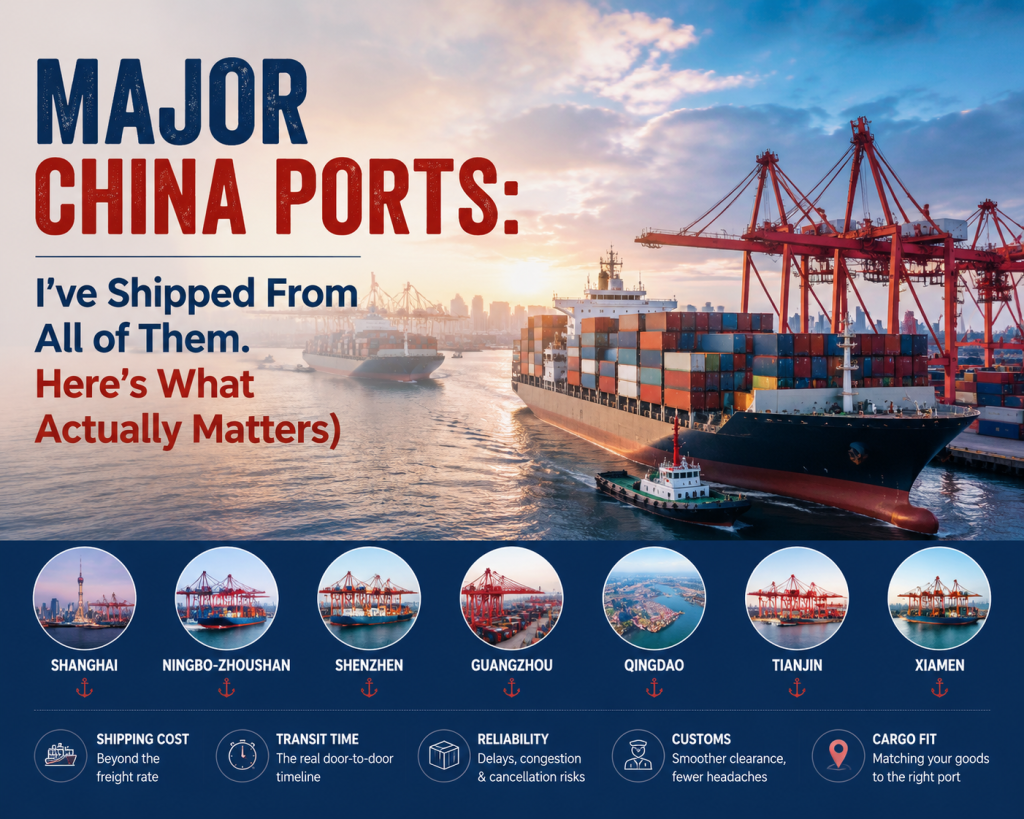
This is why understanding major China ports matters when you’re sourcing products from Chinese factories. The port your goods ship from affects your inland transport cost, your transit time, your congestion risk, and sometimes even your ocean freight rate. Most importers never question which port their supplier uses. They should.
China operates seven of the world’s ten busiest container ports. The country’s coastline stretches over 14,500 kilometers with hundreds of ports, but twelve of them handle the vast majority of export cargo that importers like you care about. Let me walk you through each one based on what I’ve learned shipping from all of them over the years.
Table of Contents
| # | Section |
| 1 | Why Port Selection Matters for Your Bottom Line |
| 2 | Port of Shanghai |
| 3 | Port of Ningbo-Zhoushan |
| 4 | Port of Xiamen |
| 5 | Port of Guangzhou |
| 6 | Port of Shenzhen |
| 7 | Port of Hong Kong |
| 8 | Port of Dalian |
| 9 | Port of Tianjin |
| 10 | Port of Qingdao |
| 11 | Port of Yantai |
| 12 | Port of Rizhao |
| 13 | Port of Lianyungang |
| 14 | Quick Comparison: All 12 Major China Ports |
| 15 | How to Choose the Right Port for Your Shipment |
| 16 | FAQ |
Port of Shanghai
Shanghai is the world’s busiest container port. Has been for over a decade running. It handled over 49 million TEUs (twenty-foot equivalent units) in recent years. To put that in perspective, the entire Port of Los Angeles handles about 9-10 million TEUs annually. Shanghai moves five times that volume.
The port operates across two main areas. Yangshan Deep Water Port sits on an island connected to the mainland by the 32-kilometer Donghai Bridge. This is where the big vessels dock — the ultra-large container ships that carry 20,000+ TEUs. Waigaoqiao terminals handle the rest, located along the Yangtze River within the city proper.
Manufacturing regions served: Yangtze River Delta — Jiangsu, Zhejiang, Anhui, and Shanghai itself. This region produces electronics, textiles, machinery, automotive parts, chemicals, and consumer goods. If your supplier operates anywhere in eastern China between Nanjing and Hangzhou, Shanghai is likely their default port.
Transit times to major destinations: US West Coast (Los Angeles/Long Beach) 12-16 days. US East Coast (New York/Savannah) 28-35 days via Suez or Panama Canal. Europe (Rotterdam/Hamburg) 25-32 days. Australia (Melbourne/Sydney) 12-15 days.
What I’ve learned shipping from here: Shanghai offers the most frequent vessel departures to virtually every global destination. You’ll find daily sailings to major routes. That frequency means flexibility — if you miss one vessel, another leaves tomorrow. The downside? Congestion. During peak season (August through October), terminal wait times increase. Trucking within Shanghai itself can add 1-2 days due to traffic and port access restrictions. Container pickup and return at Yangshan requires crossing that bridge, which has weight and time restrictions.
Cost consideration: Ocean freight rates from Shanghai are competitive due to volume and carrier competition. But inland trucking to Shanghai from factories more than 300 kilometers away adds meaningful cost. If your supplier is in Zhejiang province, ask whether Ningbo might be closer and cheaper for inland transport.
Port of Ningbo-Zhoushan
Ningbo-Zhoushan ranks as the world’s busiest port by total cargo tonnage — over 1.2 billion tons annually when you include bulk commodities alongside containers. For container traffic specifically, it handles over 33 million TEUs, making it the world’s third busiest container port.
The port combines Ningbo’s traditional harbor facilities with Zhoushan’s deep-water island terminals. The natural deep-water channels here accommodate the largest vessels afloat without dredging — a significant operational advantage over ports that require constant channel maintenance.
Manufacturing regions served: Southern Zhejiang province — Yiwu (small commodities), Wenzhou (shoes, eyewear, electrical), Taizhou (plastics, auto parts), Jinhua (hardware, tools), and Ningbo itself (appliances, textiles, auto parts, molds). If you’re buying from the Yiwu market or factories in southern Zhejiang, Ningbo is almost certainly your origin port.
Transit times: US West Coast 12-15 days. US East Coast 27-34 days. Europe 24-30 days. Southeast Asia 5-8 days.
What I’ve learned: Ningbo is Shanghai’s less congested neighbor. Many importers don’t realize that Ningbo often offers identical sailing schedules to Shanghai (same vessels stop at both ports) but with less terminal congestion and faster truck turnaround times. During peak season when Shanghai backs up, Ningbo keeps moving more smoothly. I’ve had shipments clear Ningbo terminals in hours that would have waited a day or more at Yangshan.
The Yiwu-Ningbo corridor is particularly well-developed. Factories in the Yiwu small commodities cluster can truck to Ningbo port in about 2-3 hours. That same shipment to Shanghai takes 4-5 hours through heavier traffic.
Cost consideration: Freight rates from Ningbo are typically identical to Shanghai on shared routes. Inland trucking from Zhejiang factories is often $200-400 cheaper than routing to Shanghai. For sourcing from Yiwu market specifically, Ningbo is the natural and most cost-effective port choice.
Port of Xiamen
Xiamen sits on China’s southeastern coast in Fujian province, facing Taiwan across the strait. It handles around 12 million TEUs annually. Smaller than Shanghai or Shenzhen, but strategically important for specific manufacturing regions and product categories.
The port’s location makes it the natural export point for Fujian province’s manufacturing base and parts of inland Jiangxi province. Xiamen’s terminals are modern and efficient, with less congestion than the mega-ports further north and south.
Manufacturing regions served: Fujian province — Quanzhou (shoes, sportswear, stone products), Putian (shoes, electronics), Zhangzhou (food products, flowers), Fuzhou (electronics, textiles), and Xiamen itself (electronics, machinery). Also serves parts of Jiangxi province (ceramics, furniture, fireworks).
Transit times: US West Coast 14-18 days. US East Coast 30-36 days. Europe 26-33 days. Southeast Asia 3-6 days.
What I’ve learned: Xiamen is underrated by many importers. The port runs efficiently with shorter truck queues and faster terminal processing than Shenzhen or Shanghai. If your supplier is in Fujian — and a lot of shoe, sportswear, and stone product factories are — Xiamen is your port. Don’t let a freight forwarder route your Fujian-origin cargo to Shenzhen just because they have better carrier relationships there. The inland trucking cost difference doesn’t justify it.
Xiamen also has strong connections to Taiwan and Southeast Asia, making it useful for multi-country sourcing strategies where components come from different origins.
Cost consideration: Ocean freight rates from Xiamen can be slightly higher than Shanghai or Shenzhen on some routes due to lower volume and fewer carrier options. But the savings on inland transport from Fujian factories typically more than offset any rate premium. Calculate total cost, not just ocean freight in isolation.
Port of Guangzhou
Guangzhou (historically known as Canton) operates one of China’s oldest trading ports, now modernized into a major container facility handling over 24 million TEUs annually. The port sits at the head of the Pearl River Delta, connected to the South China Sea through the Pearl River estuary.
Nansha terminal is the primary container facility — a massive modern complex that opened in phases starting in the early 2000s. It’s positioned to serve the entire Pearl River Delta manufacturing region, competing directly with Shenzhen and Hong Kong for the same cargo.
Manufacturing regions served: Northern and central Guangdong province — Guangzhou (auto manufacturing, chemicals, electronics), Foshan (furniture, ceramics, lighting, aluminum), Zhongshan (lighting, locks, hardware), Dongguan (electronics, toys, furniture), and parts of Hunan and Guangxi provinces via rail connections.
Transit times: US West Coast 14-17 days. US East Coast 30-36 days. Europe 25-32 days. Africa (various) 18-25 days.
What I’ve learned: Guangzhou’s Nansha port is the smart choice for factories in Foshan, Zhongshan, and northern Guangdong. I’ve had clients shipping furniture from Foshan who were routing containers to Shenzhen’s Yantian terminal — that’s 150+ kilometers through some of the most congested highways in China. Switching to Nansha cut their inland trucking time from a full day to 2-3 hours and saved $300-500 per container.
The port also handles significant volumes of bulk cargo (steel, grain, vehicles) alongside containers, which means the surrounding infrastructure supports heavy and oversized cargo well. If you’re importing machinery or large furniture pieces that need special handling, Guangzhou’s facilities handle it routinely.
Cost consideration: Rates from Guangzhou Nansha are competitive with Shenzhen on most routes. Fewer sailing options than Shenzhen on some lanes, but adequate frequency for most importers. The real savings come from reduced inland transport for factories in the northern Pearl River Delta.
Port of Shenzhen
Shenzhen’s port complex — primarily Yantian, Shekou, and Chiwan terminals — handles over 30 million TEUs annually, making it China’s third-busiest container port. Yantian International Container Terminal is the flagship facility, one of the single busiest container terminals on earth.
Shenzhen sits immediately north of Hong Kong, and the two ports have historically competed for the same Pearl River Delta cargo. Over the past two decades, Shenzhen has steadily captured market share from Hong Kong due to lower costs and direct factory proximity.
Manufacturing regions served: Southern Guangdong — Shenzhen (electronics, technology hardware), Dongguan (electronics, toys, shoes, furniture), Huizhou (electronics, chemicals), eastern Pearl River Delta broadly. This is China’s electronics manufacturing heartland. If you’re sourcing consumer electronics, phone accessories, LED products, or tech hardware, your goods almost certainly ship from Shenzhen.
Transit times: US West Coast 12-15 days. US East Coast 28-34 days. Europe 24-30 days. Southeast Asia 3-7 days.
What I’ve learned: Yantian is the go-to terminal for electronics and high-value cargo. The terminal’s security and handling standards are among the best in China. Carriers prioritize Yantian for their premium services. If your cargo is time-sensitive or high-value, Yantian offers reliability that justifies any small cost premium.
However, Yantian has experienced significant congestion events. In 2021, a COVID-related partial closure created weeks of delays that rippled through global supply chains. The terminal has since improved contingency planning, but the lesson stands: don’t put all your eggs in one terminal. Having Shekou or Nansha as backup options gives you flexibility when disruptions hit.
Shekou terminal handles more general cargo and offers slightly lower costs than Yantian. For non-electronics products from the Shenzhen/Dongguan area, Shekou is worth considering.
Cost consideration: Yantian rates are competitive on major routes due to massive volume. Inland trucking from Dongguan and Shenzhen factories is minimal — often under $200 per container. This short factory-to-port distance is one reason the Pearl River Delta became such a dominant manufacturing region. Your sourcing decisions in this region benefit from some of the lowest total logistics costs in China.
Port of Hong Kong
Hong Kong was once the world’s busiest container port. Today it handles around 16-17 million TEUs — still massive, but surpassed by mainland competitors. The port operates as a free port with no customs duties on most goods, which creates unique advantages for certain trade flows.
Kwai Tsing Container Terminals form the main facility, located in the western New Territories. The port’s deep natural harbor can accommodate the largest vessels without tidal restrictions.
Manufacturing regions served: Historically served the entire Pearl River Delta. Today, Hong Kong primarily handles transshipment cargo (goods transferring between vessels), cargo requiring free port benefits, and shipments from factories that need Hong Kong’s unique regulatory environment (no export duties, no foreign exchange controls, simplified documentation).
Transit times: US West Coast 13-16 days. US East Coast 29-35 days. Europe 25-31 days.
What I’ve learned: Hong Kong’s role has shifted dramatically over the past 15 years. Most direct factory exports now ship from Shenzhen or Guangzhou because it’s cheaper and faster — no need to truck cargo across the border into Hong Kong. But Hong Kong still makes sense in specific situations.
If you’re consolidating cargo from multiple suppliers into one container (a consolidation shipment), Hong Kong’s bonded warehouses and free port status make this easier. If your supplier needs to avoid mainland China’s export documentation requirements for any reason, Hong Kong provides an alternative. If you’re doing triangular trade (buying from China, selling to a third country, with documentation showing Hong Kong as the origin), the free port facilitates this.
For straightforward factory-to-your-warehouse shipments? Shenzhen or Guangzhou will almost always be cheaper and faster than routing through Hong Kong.
Cost consideration: Ocean freight rates from Hong Kong are slightly higher than Shenzhen on most routes. Plus you’re paying for cross-border trucking from mainland factories to Hong Kong terminals. The total cost premium is $300-800 per container compared to shipping directly from Shenzhen. Only worth it when Hong Kong’s specific advantages (free port status, consolidation services, documentation flexibility) provide value that exceeds this premium.
Port of Dalian
Dalian sits at the southern tip of China’s Liaoning province, on the Liaodong Peninsula facing the Yellow Sea. It handles around 4-5 million TEUs of container traffic plus massive volumes of bulk cargo (oil, grain, ore, chemicals). Dalian is northeastern China’s primary gateway to international shipping.
Manufacturing regions served: Dongbei (Northeast China) — Liaoning, Jilin, and Heilongjiang provinces. This region produces heavy machinery, petrochemicals, agricultural products, seafood, timber products, and increasingly, auto parts and electronics. Dalian also serves as the primary port for trade with Japan and South Korea due to geographic proximity.
Transit times: Japan (Tokyo/Yokohama) 2-3 days. South Korea (Busan) 1-2 days. US West Coast 14-18 days. Europe 28-35 days.
What I’ve learned: Dalian is the port you use when sourcing from northeastern China. There’s really no alternative that makes geographic sense. The next closest major port is Tianjin, which is 800+ kilometers away by road. If your supplier is in Liaoning, Jilin, or Heilongjiang, Dalian is your port. Period.
The port handles cold chain cargo well — important if you’re importing seafood or frozen products from this region. Dalian’s seafood processing industry is significant, and the port infrastructure supports refrigerated container handling efficiently.
Sailing frequency to North America and Europe is lower than from Shanghai or Shenzhen. You might have 2-3 sailings per week to US West Coast versus daily from Shanghai. Plan your production schedule around available vessel departures.
Cost consideration: Ocean freight rates from Dalian to US/Europe tend to run $200-500 higher per container than from Shanghai due to lower volume and fewer carrier options. But if your factory is in the northeast, the inland trucking savings far outweigh any ocean rate premium. Don’t truck northeastern China cargo to Shanghai just for a slightly cheaper ocean rate — the math doesn’t work.
Port of Tianjin
Tianjin is northern China’s largest port and Beijing’s maritime gateway. It handles around 21 million TEUs annually, ranking among China’s top five container ports. The port sits on the Bohai Sea coast, serving the massive Beijing-Tianjin-Hebei economic region (known as Jing-Jin-Ji) with a combined population exceeding 110 million people.
Manufacturing regions served: Hebei province (steel products, furniture, glass, textiles), Tianjin (automotive, electronics, petrochemicals, food processing), Beijing (technology, pharmaceuticals), and parts of Shanxi, Inner Mongolia, and Henan provinces via rail connections.
Transit times: US West Coast 14-18 days. US East Coast 30-36 days. Europe 26-33 days. Japan 3-4 days. South Korea 2-3 days.
What I’ve learned: Remember my furniture client from the opening? Tianjin was the answer. Northern China’s manufacturing base is enormous but often overlooked by importers who default to southern ports. Hebei province alone produces massive quantities of steel furniture, glass products, and textiles. All of that cargo belongs at Tianjin, not Shanghai.
Tianjin’s port also connects to an extensive rail network reaching deep into inland China. If you’re sourcing from Henan, Shanxi, or even parts of Shaanxi province, rail-to-port connections through Tianjin can be more cost-effective than trucking to any coastal port.
Winter weather affects operations occasionally. The Bohai Sea can experience ice conditions in January-February, though modern icebreaking capabilities keep the port operational year-round. Fog delays happen more frequently than at southern ports.
Cost consideration: Rates from Tianjin are competitive with Shanghai on major routes. Inland trucking from Hebei factories to Tianjin runs $200-500 per container depending on distance. Compare that to $800-1,200 for trucking the same cargo to Shanghai. The savings are real and immediate. When negotiating with suppliers in northern China, confirm they’re using Tianjin rather than absorbing unnecessary trucking costs that get passed to you in the product price.
Port of Qingdao
Qingdao (also spelled Tsingtao — yes, like the beer) operates on the Yellow Sea coast of Shandong province. It handles around 25 million TEUs annually, making it one of China’s top container ports. The port’s deep-water facilities at Qianwan Bay and the newer Dongjiakou port area provide modern, efficient terminal operations.
Manufacturing regions served: Shandong province — China’s second-largest provincial economy. Shandong produces home appliances (Haier and Hisense are headquartered here), tires and rubber products, textiles, food products, machinery, and chemicals. Qingdao also serves as a gateway for cargo from Henan and parts of Jiangsu province.
Transit times: US West Coast 13-17 days. US East Coast 29-35 days. Europe 25-32 days. Japan 2-3 days. South Korea 1-2 days.
What I’ve learned: Qingdao is the workhorse port for Shandong province, and Shandong produces more than most importers realize. If you’re buying tires, rubber products, home appliances, or food products from Chinese suppliers, there’s a good chance your goods originate in Shandong and ship from Qingdao.
The port runs efficiently with good infrastructure and reasonable congestion levels. It’s large enough to attract frequent vessel calls from all major carriers but not so overwhelmed that it experiences the chronic congestion issues of Shanghai or Shenzhen during peak season.
Qingdao also handles enormous volumes of bulk cargo — crude oil, iron ore, coal — which means the surrounding logistics infrastructure supports heavy cargo well. If you’re importing machinery, metal products, or other heavy goods from Shandong, the port handles it routinely.
Cost consideration: Ocean freight rates from Qingdao sit between Shanghai rates and northern port rates — competitive on major routes with adequate carrier options. Inland trucking from Shandong factories to Qingdao is typically $150-400 per container. The province’s highway network connecting manufacturing cities to the port is well-developed and relatively uncongested compared to Guangdong or Jiangsu.
Port of Yantai
Yantai sits on the northern coast of Shandong province, on the Bohai Sea. It handles around 4 million TEUs of container traffic alongside significant bulk cargo volumes (aluminum, gold, fruit, seafood). Yantai is smaller than neighboring Qingdao but serves specific manufacturing clusters effectively.
Manufacturing regions served: Northern and eastern Shandong — Yantai (gold processing, wine, machinery, auto parts), Weihai (fishing equipment, textiles, food), and surrounding agricultural regions (apples, peanuts, seafood). Yantai is also a major hub for trade with South Korea and Japan due to its geographic position directly across the Yellow Sea.
Transit times: South Korea (Incheon) 14-16 hours by ferry. Japan 2-3 days. US West Coast 15-19 days. Europe 28-35 days.
What I’ve learned: Yantai is a niche port that matters if your supplier is in northern Shandong. The ferry connections to South Korea make it particularly relevant for supply chains involving both Chinese and Korean components or processing. Some importers use the Yantai-Incheon ferry route for time-sensitive cargo that doesn’t justify air freight costs.
For most importers sourcing general consumer products, Qingdao will be the better choice from Shandong due to more frequent international sailings. But if your factory is physically closer to Yantai than Qingdao, the inland trucking savings might make Yantai worthwhile — especially for LCL (less than container load) shipments where consolidation services at Yantai are less congested.
Cost consideration: Fewer international sailing options means slightly higher rates on some routes compared to Qingdao. Best suited for regional trade (Japan, Korea) and for factories in immediate proximity. For US and Europe-bound cargo, compare total cost (inland trucking + ocean freight) between Yantai and Qingdao before deciding.
Port of Rizhao
Rizhao (meaning “sunshine” in Chinese) sits on the southern Shandong coast between Qingdao and Lianyungang. It’s primarily a bulk cargo port — one of China’s largest for iron ore, coal, grain, and timber imports — but handles growing container volumes around 5-6 million TEUs.
Manufacturing regions served: Southern Shandong and northern Jiangsu border region. Local industries include timber processing, food products, steel products, and building materials. Rizhao also serves as an import gateway for raw materials feeding inland Chinese manufacturing.
Transit times: Similar to Qingdao for most international routes. Japan 2-3 days. South Korea 1-2 days. US West Coast 14-18 days.
What I’ve learned: Rizhao is relevant for importers in two specific situations. First, if your supplier is in the Linyi area of southern Shandong (a major plywood, furniture, and building materials production cluster), Rizhao is the closest port. Linyi produces enormous quantities of plywood and engineered wood products for export, and much of it ships through Rizhao.
Second, if you’re importing raw materials into China for processing (timber, pulp, grain), Rizhao’s bulk handling infrastructure is excellent and often less congested than competing ports.
For general consumer product exports, Qingdao typically offers better service frequency and carrier options. But for wood products and building materials from the Linyi cluster specifically, Rizhao saves meaningful inland transport cost.
Cost consideration: Limited container shipping options compared to Qingdao. Works best for specific product categories from nearby manufacturing clusters. Always compare total landed cost rather than choosing based on ocean freight rate alone.
Port of Lianyungang
Lianyungang sits at the northern tip of Jiangsu province, where the ancient Silk Road historically met the sea. Today it handles around 5 million TEUs of container traffic and serves as the eastern terminus of the New Eurasian Land Bridge — the rail corridor connecting China to Europe through Central Asia.
Manufacturing regions served: Northern Jiangsu province and parts of Anhui and Henan provinces. Local industries include pharmaceuticals, chemicals, food processing, crystal products, and light manufacturing. The port’s rail connections make it relevant for inland provinces that lack direct coastal access.
Transit times: US West Coast 14-18 days. Europe 26-33 days (by sea) or 14-18 days (by rail via Land Bridge). Japan 2-3 days. South Korea 1-2 days.
What I’ve learned: Lianyungang’s unique advantage is the rail connection to Europe. If you’re selling into European markets and your supplier is in inland China (Henan, Anhui, western Jiangsu), the China-Europe rail service through Lianyungang can cut transit time nearly in half compared to ocean freight. Rail costs more than ocean but less than air — it occupies a middle ground that works for time-sensitive cargo that doesn’t justify air freight prices.
For standard ocean freight to North America, Lianyungang offers fewer sailing options than Shanghai (which is only 600 kilometers south). Most importers sourcing from this region default to Shanghai. But if your factory is in northern Jiangsu or you’re interested in the rail-to-Europe option, Lianyungang deserves consideration.
Cost consideration: Ocean rates slightly higher than Shanghai due to lower volume. Rail-to-Europe service costs roughly $4,000-8,000 per container (varies significantly by season and demand) versus $1,500-3,000 for ocean. The rail option makes financial sense when transit time savings justify the premium — perishable goods, fashion items with short selling windows, or urgent restocking situations.
Quick Comparison: All 12 Major China Ports
| Port | Annual TEUs (millions) | Primary Region | Best For | Transit to US West Coast |
| Shanghai | 49+ | Yangtze River Delta | Electronics, textiles, machinery | 12-16 days |
| Ningbo-Zhoushan |
Complete blog
Quick Comparison: All 12 Major China Ports
| Port | Annual TEUs (millions) | Primary Region | Best For | Transit to US West Coast |
| Shanghai | 49+ | Yangtze River Delta | Electronics, textiles, machinery, general cargo | 12-16 days |
| Ningbo-Zhoushan | 33+ | Southern Zhejiang | Small commodities, appliances, molds, hardware | 12-15 days |
| Xiamen | 12+ | Fujian | Shoes, sportswear, stone, ceramics | 14-18 days |
| Guangzhou | 24+ | Northern Pearl River Delta | Furniture, ceramics, lighting, aluminum | 14-17 days |
| Shenzhen | 30+ | Southern Pearl River Delta | Electronics, tech hardware, toys | 12-15 days |
| Hong Kong | 16-17 | Transshipment/consolidation | Multi-supplier consolidation, free port benefits | 13-16 days |
| Dalian | 4-5 | Northeast China | Machinery, seafood, agricultural, petrochemicals | 14-18 days |
| Tianjin | 21+ | Beijing-Hebei region | Steel furniture, glass, textiles, automotive | 14-18 days |
| Qingdao | 25+ | Shandong | Appliances, tires, rubber, food products | 13-17 days |
| Yantai | 4+ | Northern Shandong | Gold processing, machinery, Korea/Japan trade | 15-19 days |
| Rizhao | 5-6 | Southern Shandong | Plywood, building materials, timber products | 14-18 days |
| Lianyungang | 5+ | Northern Jiangsu | Rail-to-Europe, pharmaceuticals, chemicals | 14-18 days |
How to Choose the Right Port for Your Shipment
Most importers never actively choose their origin port. Their supplier picks it. Their freight forwarder picks it. Someone picks it, and the importer just pays whatever shows up on the invoice. That’s leaving money on the table.
Here’s how I approach port selection for clients at eSourcing Solution when we’re setting up new supply chains.
Start with factory location. Plot your supplier’s factory address on a map. Identify the two or three closest major ports. The closest port by road distance is your starting point — not your final answer, but your starting point.
Check sailing frequency. A port 100 kilometers from your factory that only has weekly sailings to your destination might cost you more in waiting time than a port 250 kilometers away with daily departures. Your freight forwarder can pull sailing schedules for comparison. Ask them to quote from multiple origin ports rather than just their default.
Calculate total origin cost. Add inland trucking (factory to port) plus any local port charges plus ocean freight rate. Compare this total across your port options. I’ve seen cases where a port 200 kilometers further away offered ocean rates low enough to offset the extra trucking. I’ve seen the opposite too. The math changes by route and by season.
Consider congestion patterns. During Chinese New Year (January-February) and peak shipping season (August-October), major ports like Shanghai and Shenzhen experience congestion that adds 2-5 days to your timeline. Smaller ports like Ningbo, Xiamen, or Tianjin often keep moving more smoothly during these periods. If your shipment timing falls during peak season, a less congested port might save you days of waiting.
Think about backup options. Supply chain disruptions happen. COVID taught everyone that lesson. Having a secondary port option identified and ready means you can pivot quickly when your primary port experiences problems. I keep backup routing plans for every client’s supply chain. When Yantian shut down in 2021, clients with pre-planned Nansha or Shekou alternatives kept shipping while others waited weeks.
Match port capabilities to cargo type. Shipping refrigerated goods? Make sure your port has adequate reefer plug capacity. Shipping hazardous materials? Confirm the port handles your specific hazmat class. Shipping oversized machinery? Verify heavy-lift crane availability. Not every port handles every cargo type equally well.
Ask your supplier what they recommend. Factories ship containers regularly. They know which ports their trucking companies service efficiently. They know which ports have smoother export customs processing for their product category. Their recommendation carries weight — just verify it against your own cost analysis rather than accepting it blindly.
When I’m conducting procurement intelligence for clients entering new product categories, port selection is part of the total landed cost analysis from day one. The port decision connects directly to your supplier negotiation because inland transport costs often get buried in the supplier’s FOB price. Understanding which port makes geographic sense gives you leverage to question inflated logistics charges hidden in product pricing.
Connecting Ports to Your Sourcing Strategy
Let me tie this together with something practical. When you’re evaluating suppliers during the sourcing process, factory location relative to a major port should factor into your decision. Two suppliers offering identical products at identical FOB prices aren’t actually equal if one sits 50 kilometers from Shenzhen port and the other sits 500 kilometers from the nearest major port.
That 500-kilometer distance adds $400-800 to every container in trucking costs. Over a year of regular shipments, that’s thousands of dollars in hidden cost that doesn’t show up in the unit price comparison but absolutely shows up in your landed cost and profit margin.
During product development and supplier selection, I map factory locations against port proximity as a standard evaluation criterion. It’s not the deciding factor — product quality, pricing, capability, and reliability matter more — but it’s a tiebreaker that adds up over time.
Similarly, when conducting quality control inspections before shipment, understanding the factory-to-port timeline helps you schedule inspections with appropriate buffer time. If your factory needs two days to truck containers to a distant port, your inspection needs to happen earlier in the production timeline than if the port is two hours away.
The twelve major China ports I’ve covered here handle the vast majority of export cargo leaving China for international markets. Each one serves specific manufacturing regions. Each one has strengths and limitations. And each one affects your bottom line differently depending on where your factory sits and where your goods are headed.
Stop accepting whatever port your supplier or freight forwarder defaults to without questioning it. Ask why that port. Ask what alternatives exist. Run the numbers on total origin cost from factory floor to vessel departure. The savings won’t show up on any single line item — they show up in your annual logistics spend when you add up dozens of shipments routed more intelligently.
If you’re setting up new supply chains from China or questioning whether your current logistics routing makes financial sense, schedule a conversation about optimizing your origin port selection. Or reach out directly with questions about specific supplier regions and which ports serve them best.
FAQ
Which China port should I use if my supplier is in Guangdong province?
Guangdong is China’s largest manufacturing province and it’s served by three major ports: Shenzhen, Guangzhou, and Hong Kong. The right choice depends on where exactly in Guangdong your factory sits. Suppliers in Shenzhen, Dongguan, or Huizhou (eastern Pearl River Delta) should ship from Shenzhen — either Yantian terminal for electronics and high-value goods or Shekou for general cargo. Suppliers in Foshan, Zhongshan, Jiangmen, or Zhaoqing (northern and western Pearl River Delta) should ship from Guangzhou’s Nansha terminal. It’s geographically closer and avoids the brutal cross-delta trucking through Guangdong’s congested highway network. Hong Kong only makes sense for consolidation shipments combining goods from multiple suppliers, or when you specifically need free port documentation benefits. For straightforward single-supplier shipments, mainland ports (Shenzhen or Guangzhou) are cheaper and faster than routing through Hong Kong. Ask your supplier which port they normally use, then verify it makes geographic sense by checking the driving distance. If they’re trucking past a closer major port to reach a more distant one, ask why. Sometimes there’s a good reason (better sailing schedule, carrier relationship). Sometimes it’s just habit that costs you money.
How do I find out which port my Chinese supplier ships from?
Ask them directly. It’s a normal business question that every supplier expects from professional buyers. When requesting quotes, ask for the FOB port — this tells you exactly which port they’re pricing from. If they quote “FOB Shanghai” but their factory is in Hebei province, that’s a signal worth investigating. They might be absorbing $800+ in inland trucking and building it into your unit price. You could potentially get a lower FOB price by switching to “FOB Tianjin” and eliminating that unnecessary trucking cost. During your supplier evaluation process, factory location and default shipping port should be standard questions alongside pricing, MOQ, and production capacity. If a supplier is reluctant to discuss logistics details, that’s a yellow flag about transparency. Professional factories know their port, their trucking costs, and their typical transit times. They should share this information readily. Your freight forwarder can also confirm which port cargo originates from by checking the bill of lading port of loading field on past shipments.
Does it matter which China port I use if I’m shipping to the US West Coast?
Yes, but perhaps less than you’d think for ocean transit time alone. Most major China ports reach Los Angeles or Long Beach in 12-18 days — the difference between Shanghai (12-16 days) and Dalian (14-18 days) is only 2-3 days of ocean transit. Where port selection really matters for US West Coast shipments is total origin time and cost. That includes inland trucking time from factory to port (can range from 2 hours to 2 days depending on distance), port processing and vessel waiting time (varies by port congestion), and inland trucking cost (ranges from $100 to $1,200+ depending on factory-to-port distance). A shipment from a Hebei factory trucked to nearby Tianjin and loaded on a vessel within 2 days will arrive at your US warehouse faster than the same shipment trucked 1,100 kilometers to Shanghai even though Shanghai’s ocean transit is 2 days shorter. Total door-to-door time matters more than port-to-port transit time. Always calculate the complete timeline from factory pickup to US warehouse delivery when comparing port options.
What happens if my chosen port experiences congestion or closure?
Port disruptions happen more often than most importers plan for. Typhoons close southern China ports several times each summer. COVID caused extended closures at multiple ports in 2021-2022. Labor actions, equipment failures, and policy changes can all disrupt operations. The smart approach is having a backup port identified before you need it. For every supply chain I manage, I maintain a primary and secondary port routing plan. If your primary port is Shenzhen Yantian, your backup might be Shenzhen Shekou or Guangzhou Nansha. If your primary is Shanghai Yangshan, your backup might be Ningbo. The backup should be geographically close enough that switching doesn’t require completely different inland logistics. When disruption hits, contact your freight forwarder immediately about rerouting. Carriers often offer vessel calls at alternative ports during disruptions. The importers who recover fastest are those who’ve already identified alternatives and can make decisions quickly rather than scrambling to research options while their cargo sits waiting. Build contingency planning into your sourcing strategy from the beginning rather than treating it as an emergency response.
Can I request my supplier use a different port than their default?
Absolutely. You’re the buyer. You can specify the FOB port in your purchase agreement. However, understand the implications. If you request a port that’s further from their factory than their default, inland trucking costs increase and someone pays for that — either the supplier absorbs it (unlikely without a price adjustment) or you pay a higher FOB price. If you request a closer port that the supplier doesn’t normally use, they might not have established trucking relationships there, which could cause logistical friction initially. The best approach is discussing port options during price negotiation. Ask your supplier to quote FOB from two or three different ports. Compare the total cost (FOB price + your ocean freight from each port) to find the optimal combination. Sometimes a supplier’s default port is genuinely the best option. Sometimes it’s just what they’ve always done and nobody questioned it. Professional suppliers will accommodate reasonable port change requests, especially for regular orders with meaningful volume. Frame it as a mutual optimisation, lower logistics costs benefit the ongoing business relationship for both parties.