
I’ll never forget standing in a denim mill outside Ahmedabad. Three days I spent there. Watching roll after roll come off those looms. And you know what hit me? Not the noise. Not the heat. It was how wildly different each roll looked. One felt stiff enough to prop against a wall. The next one? Soft like an old bedsheet. Another had this weird metallic sheen under the fluorescent lights. All of it labeled “denim.” All of it completely different products.
That trip changed how I talk to clients about denim fabric types. Because here’s the thing. Telling your manufacturer “I need denim” is about as useful as walking into a lumber yard and saying “give me wood.” Which wood? For what? How thick? The word covers too much ground on its own.
I’ve watched clients lose real money picking the wrong denim for their product. Returns pile up. Customers complain. Margins disappear. So let me walk you through nine denim fabric types that actually matter if you’re buying fabric for production. Not textbook stuff. Real talk from someone who’s touched these fabrics in factories and seen what works.
Table of Contents
| No. | Section | What You’ll Learn |
| 1 | What Makes Denim Different From Other Fabrics | Core construction and why it matters |
| 2 | Raw Denim (Dry Denim) | Unwashed, untreated premium denim |
| 3 | Selvedge Denim | Self-finished edge heritage fabric |
| 4 | Stretch Denim | Elastane-blended comfort fabric |
| 5 | Organic Denim | Sustainably grown cotton denim |
| 6 | Colored Denim | Beyond traditional indigo |
| 7 | Crushed Denim | Textured wrinkled finish |
| 8 | Poly Denim | Polyester-blended durable fabric |
| 9 | Bull Denim | Heavyweight canvas-style denim |
| 10 | Chambray | Lightweight denim alternative |
| 11 | How to Choose the Right Denim Type | Decision framework for buyers |
| Common Questions About Denim Fabric | FAQ section |
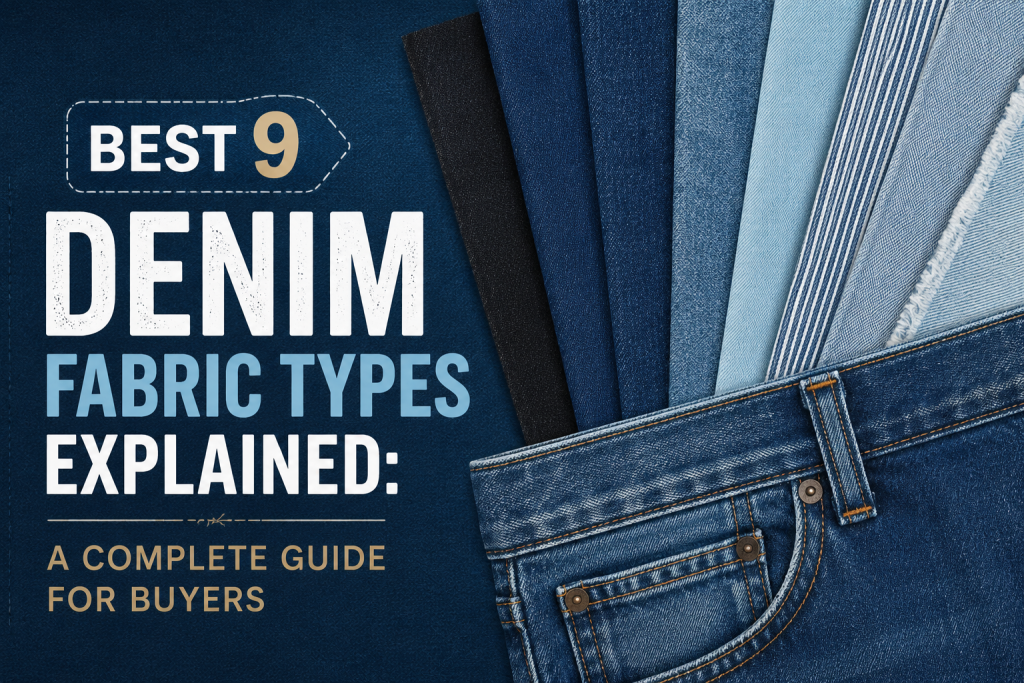
1. What Makes Denim Different From Other Fabrics
Quick foundation before we get into types. Denim isn’t just “blue cotton fabric.” Lots of blue cotton exists that isn’t denim.
What makes denim denim is the weave. Twill weave. The weft thread goes under two or more warp threads, creating that diagonal rib you can see on the surface. Traditionally, warp threads get dyed indigo while weft stays white. That’s why your jeans are blue on the outside and lighter on the inside.
This construction is what gives denim its toughness. Its ability to fade in interesting ways over time. Its particular drape and feel in your hands. The global cotton industry supplies the raw fiber, but it’s the weave that transforms cotton into denim.
Every type below shares this twill foundation. What changes is the fiber blend, the weight, the finishing, and the loom type.
2. Raw Denim (Dry Denim)
Think of raw denim as denim in its most honest form. Nothing done to it after weaving. No washing. No softening chemicals. No fake distressing. It comes off the loom, gets cut, gets sewn, and that’s it. You get it exactly as it was made.
Weighs anywhere from 11 oz to 21 oz per square yard. Usually on the heavier side because stiffness is part of the whole appeal.
People who love raw denim really love it. The fabric molds to your body over months. Develops fade patterns unique to how you move, where you sit, what you carry in your pockets. Every pair becomes one of a kind. Premium brands build entire identities around this experience.
But here’s what trips up first-time buyers. Raw denim shrinks. Sometimes 3 percent. Sometimes 10 percent. Depends on whether it’s been sanforized or not. You’ve got to communicate sizing carefully or you’ll drown in returns from confused customers whose jeans suddenly don’t fit after the first wash.
Works best for premium jeans, heritage workwear, limited drops, and denim jackets marketed as investment pieces.
3. Selvedge Denim
Selvedge. Sometimes spelled “selvage.” Refers to the self-finished edge that old shuttle looms create. These narrow looms weave fabric with a clean bound edge that won’t fray or unravel. Modern wide looms cut fabric edges raw, which need overlocking.
Runs 12 oz to 23 oz typically. Heritage market likes it heavy.
Why does anyone care about an edge? Because that clean selvedge edge signals craftsmanship. When you cuff your jeans and that neat little edge shows, denim nerds notice. It says “this was made slowly, on old equipment, with intention.” Japanese mills have built legendary reputations around their selvedge quality.
The catch? Selvedge fabric is narrow. Only 28 to 32 inches wide versus 60+ inches for modern denim. More waste when cutting patterns. Higher cost per garment. Expect 30 to 50 percent more expense compared to regular denim of similar quality. Your retail price needs to absorb that.
Best for premium lines, Japanese-inspired collections, heritage brands, and limited runs where exclusivity justifies the price tag.
For brands sourcing selvedge from specialty mills, a textile sourcing partner helps navigate the minimum orders and quality specs that vary wildly between suppliers.
4. Stretch Denim
Add a little elastane to cotton denim and everything changes. Usually 1 to 5 percent. Tiny amount. Massive difference in how the fabric moves and feels on a body.
Weight sits between 8 oz and 14 oz mostly. Lighter because the stretch compensates for the structure that heavier weight provides.
Let me be blunt. Stretch denim outsells rigid denim in almost every market segment right now. Comfort wins. People want jeans they can actually move in. Skinny fits literally require stretch to be wearable. The athleisure wave pushed comfort expectations into every clothing category and denim had to adapt or die.
But not all stretch is equal. Cheap elastane degrades fast. Knees bag out. Waistbands go loose. The jeans look sad after six months. Quality elastane (Lycra brand specifically) holds recovery much longer. When you’re specifying stretch denim for production, don’t just say “2% elastane.” Specify the quality. Your customers will feel the difference even if they can’t name why.
Also worth knowing: stretch denim behaves differently during cutting and sewing. Patterns need adjustment for recovery. Inexperienced factories produce wildly inconsistent sizing with stretch fabrics. I’ve seen size runs where the “medium” was bigger than the “large” because nobody accounted for fabric recovery properly.
Best for women’s jeans, slim fits, jeggings, casual wear, and anything where comfort drives the purchase decision.
5. Organic Denim
Organic denim uses cotton grown without synthetic pesticides, herbicides, or GMO seeds. Farming follows certification standards like GOTS or OCS that verify organic claims from field to finished fabric.
Available across the full weight spectrum, 8 oz to 16 oz, because “organic” describes how the cotton was grown, not how the fabric is constructed.
Consumer demand for sustainable products keeps climbing year over year. Organic denim lets brands make environmental claims that actually hold up to scrutiny. Third-party certification means you can prove it, not just say it. And in an era where greenwashing accusations destroy brand trust overnight, provable claims matter enormously.
The reality check: organic denim costs 20 to 40 percent more than conventional. Supply is tighter. Lead times stretch longer. And you need to verify certification at every single stage of your supply chain. One uncertified step and your organic claim falls apart.
Best for sustainable fashion lines, eco-conscious brands, premium basics, and brands whose customers genuinely care about environmental impact and will pay accordingly.
A supply chain verification partner makes sure those organic certifications are real and maintained through every production stage.
6. Colored Denim
Swap indigo for any other color and you’ve got colored denim. Black. White. Gray. Red. Forest green. Mustard. Whatever you want. The twill construction stays the same. Only the dye changes.
Usually runs 8 oz to 14 oz. Fashion applications prefer softer hand feel so lighter weights dominate.
Colored denim lets brands expand beyond blue without changing silhouettes. Seasonal collections use color for freshness. Black denim specifically has become a wardrobe staple that rivals traditional blue in sales volume. It’s not a trend anymore. It’s permanent.
The problem nobody warns you about: color fastness. Cheap colored denim bleeds during washing. Stains other clothes in the load. Fades unevenly. Looks terrible after five washes. You absolutely must specify color fastness standards (Grade 4 minimum for wash fastness) and test before committing to bulk. Black denim fades faster than indigo naturally, so dye process selection matters even more.
Best for fashion collections, seasonal ranges, black denim basics, kids’ wear, and colored accessories.
7. Crushed Denim
Crushed denim gets mechanically processed to create permanent wrinkled, textured surfaces. The fabric is twisted, compressed, or chemically treated to set irregular creases that stay put.
Lighter weights work best here. 6 oz to 12 oz. They crush more effectively and drape better with the texture.
The appeal is visual interest without printing or embellishment. That three-dimensional surface catches light differently across the garment. Creates depth and movement. Works for pieces that need to stand out from standard smooth denim on a rack.
Fair warning though. Crushed texture relaxes over time with washing and wearing. Quality treatments hold longer but some softening is inevitable. And forget about pattern matching at seams. The irregular surface makes it impossible. Plan your construction accordingly.
Best for fashion dresses, skirts, casual jackets, accessories, and bohemian-style collections.
8. Poly Denim
Blend cotton with polyester, usually 60/40 to 80/20 ratios, and you get poly denim. The polyester adds durability, wrinkle resistance, and color retention while bringing cost down.
Runs 7 oz to 14 oz. Polyester lets you go lighter while keeping structure.
I’ll be honest. The primary reason people choose poly denim is cost. Polyester is cheaper than cotton. Blended denim reduces raw material expense. But there are legitimate performance benefits too. Wrinkles less. Dries faster. Holds color longer. For workwear and uniforms where easy care matters more than premium feel, poly denim makes practical sense.
The downside? It doesn’t breathe well. Feels warmer. Won’t develop those natural fade patterns denim lovers chase. And knowledgeable consumers can tell. In premium or fashion markets, poly denim reads as cheap. The hand feel gives it away immediately.
Best for workwear uniforms, budget lines, kids’ wear where durability trumps feel, bags, accessories, and upholstery.
9. Bull Denim
Bull denim is the heavyweight champion. Dense. Thick. Tough. Typically 14 oz and above. Unlike regular denim with its colored face and white back, bull denim often uses the same color for warp and weft. Solid color both sides.
This is utility fabric. Not fashion fabric. The dense weave resists tearing, abrasion, and puncture better than lighter denim types. You could probably stop a butter knife with it. Maybe that’s an exaggeration. But not by much.
Sewing bull denim requires industrial equipment. Home machines struggle with it. Manufacturers need heavy-duty needles and appropriate thread weights. The stiffness means it won’t drape. Won’t flow. Won’t do anything graceful. But it will last approximately forever.
Best for heavy-duty workwear, bags and backpacks, upholstery, aprons, tool rolls, and anywhere you need fabric that refuses to quit.
10. Chambray: The Imposter
I’m including chambray because people confuse it with lightweight denim constantly. And that confusion causes real production problems.
Chambray uses a plain weave. Over one, under one. Denim uses twill weave. Over two, under one. Different construction entirely. Chambray looks like denim from across a room but feels completely different in your hands. Lighter. Softer. No diagonal rib.
Weight sits between 3 oz and 7 oz. Inherently lightweight.
When clients tell me they want “lightweight denim” for shirts, they usually mean chambray but don’t know the word. Clarifying this early saves weeks of sampling confusion. If you specify “lightweight denim” to a mill, you’ll get thin denim. If you actually wanted chambray, you’ll be disappointed and confused about why it doesn’t look right.
Best for shirts, blouses, summer dresses, lightweight casual wear, and children’s clothing.
For brands working across multiple denim fabric types in one collection, a product development partner prevents these specification miscommunications between your design team and the factory floor.
11. How to Choose the Right Denim Type
Three questions. That’s all you need.
What’s the product? Jeans need different denim than bags. Shirts need different denim than workwear. Match weight and stretch to actual end use. A 16 oz bull denim dress would be unwearable. A 7 oz chambray work apron would disintegrate in a month.
Who’s buying it? Premium customers want raw or selvedge and will pay. Mass market wants stretch and comfort from day one. Eco-conscious buyers seek organic certification. Workwear buyers need poly blends that survive industrial laundering. Know your customer.
What’s your price point? Selvedge and organic cost significantly more. If you’re selling $40 jeans at retail, selvedge isn’t financially viable. If you’re at $200+, conventional poly blend undermines your brand positioning. Match fabric cost to retail reality.
Common Questions About Denim Fabric
Which denim type sells the most globally?
Stretch denim. By a wide margin. Comfort drives purchasing decisions across every market segment right now.
Which type lasts the longest physically?
Bull denim and heavy raw denim above 16 oz. Though stretch denim with quality elastane maintains its shape better in everyday wearing because it recovers instead of bagging.
Can I use multiple denim types in one collection?
Yes and you should. Most successful denim brands offer rigid selvedge for premium pieces, stretch for everyday styles, and chambray for shirts. Variety within consistent quality standards.
What weight works best for standard jeans?
10 oz to 14 oz covers most applications. Lighter for warm climates and slim fits. Medium for year-round wear. Heavier for workwear and heritage styles.
How do I check denim quality before committing to bulk?
Request swatches. Test them yourself. Wash them. Check shrinkage. Check color fastness. Check stretch recovery. A quality inspection service runs standardized textile tests so you know exactly what you’re getting before spending production money.