
So there I was. Phone buzzing at 7am on a Tuesday. Client on the other end sounding like he hadn’t slept. His container? Stuck at port. Fully loaded. Shipping line flat out refusing to move it. Why? Because somewhere in that mixed shipment, three pallets of cleaning products sat there without a single MSDS document on file. Nobody would touch it.
Took two days to sort out. Two days of demurrage charges piling up. Two days of his buyer in Rotterdam sending increasingly angry emails. Two days of me making calls to the factory asking “where is this paperwork and why didn’t we have it ready?”
Could’ve been avoided. Completely. If someone, anyone, had asked one question before that container got packed: “Hey, does anything in here need an MSDS?”
I bring this up because it’s not rare. Not even close. Happens to experienced exporters all the time. People who’ve shipped hundreds of containers get blindsided by MSDS requirements on products they never thought of as chemical or hazardous. And the bill for getting it wrong? Always bigger than doing it right from the start.
Table of Contents
| No. | Section | What You’ll Learn |
| 1 | What Does MSDS Actually Stand For | Full meaning and basic definition |
| 2 | MSDS vs SDS: The Name Change Nobody Told You About | Why both terms exist and which is current |
| 3 | Why Shipping Companies Demand MSDS Documents | The practical reasons behind the requirement |
| 4 | What Information Does an MSDS Contain | All 16 sections broken down simply |
| 5 | Which Products Need an MSDS for Shipping | Surprising products that require documentation |
| 6 | How to Get an MSDS for Your Products | Step-by-step process for exporters |
| 7 | What Happens When You Ship Without an MSDS | Real consequences and costs |
| 8 | MSDS Requirements by Shipping Method | Air, sea, and ground differences |
| 9 | Common MSDS Mistakes That Delay Shipments | Preventable errors I see constantly |
| 10 | Questions Shippers Ask Me All the Time | FAQ section |
1. What Does MSDS Actually Stand For
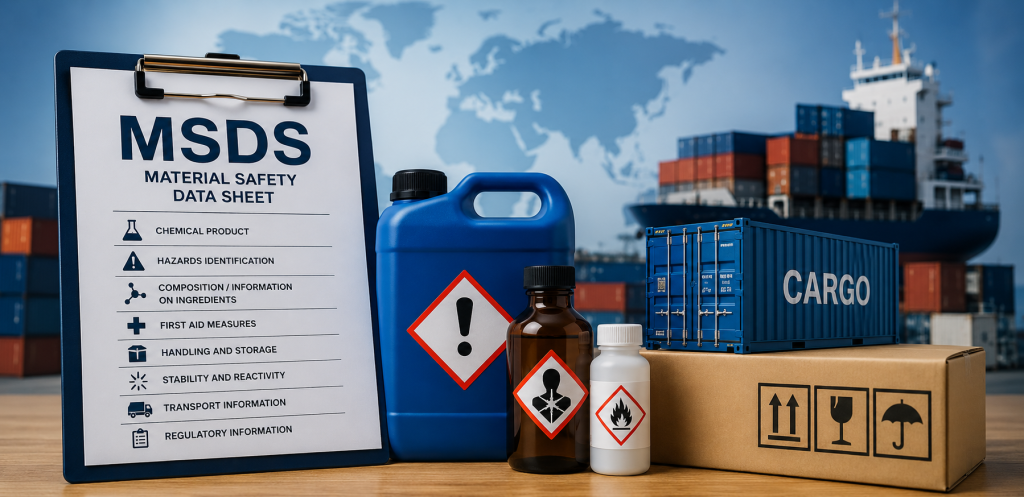
MSDS. Material Safety Data Sheet. That’s the full name. Basically it’s a document that tells everyone in the supply chain what they’re dealing with. What’s in the product. What makes it dangerous. How to handle it without getting hurt. What to do if something goes wrong.
Think of it like a product’s medical file. Complete history. Known risks. Emergency procedures. Everything a warehouse worker, ship crew member, or firefighter would need to know if that product started leaking or burning at 2am in the middle of the ocean.
For shipping specifically? The MSDS tells carriers whether your stuff can safely sit next to other cargo. Whether it needs refrigeration. Whether it reacts badly with certain materials. Whether the packaging has to meet specific standards. The United Nations built the Globally Harmonized System around communicating exactly this kind of information across borders.
Without it, carriers are flying blind. And they won’t do that. Not anymore.
2. MSDS vs SDS: The Name Change Nobody Told You About
OK so here’s a thing that trips people up all the time. Officially? The document isn’t called MSDS anymore. Hasn’t been for years. It’s just SDS now. Safety Data Sheet. They dropped the “Material” part when the GHS system went global. America made it official back in 2012 through OSHA’s Hazard Communication Standard update.
But nobody got the memo apparently. Or they got it and ignored it. Because in the real world, on actual shipping docks and in actual freight forwarder offices, everyone still says MSDS. Your carrier emails you asking for “the MSDS.” Your customs broker’s checklist says “MSDS.” The factory in China sends you a file labeled “MSDS.” Old habits.
Does it matter? Not really. Same document. Same information. Same purpose. If someone asks for MSDS, hand them the SDS. If a form says SDS, your MSDS works fine. The content inside is what counts.
What DOES matter though? The format. Old MSDS documents had 8 sections. Current ones need 16 sections following GHS structure. If your document still uses that old 8-section layout, it’s outdated. Carriers will reject it. Customs will flag it. Get it updated to 16 sections regardless of what you call the thing.
3. Why Shipping Companies Demand MSDS Documents
Let me be clear about something. Shipping lines aren’t asking for MSDS to create busywork. They’re not doing it to slow you down or make your life harder. They’re doing it because if your undocumented product explodes on their vessel, they go to prison. Not metaphorically. Actually.
Carriers face criminal liability for what travels on their ships and planes. If something catches fire mid-ocean and the investigation reveals they loaded it without proper documentation? Massive fines. Criminal charges against officers. Insurance claims denied. Operating licenses threatened.
So yeah. They want to know what’s in your boxes.
Specifically, they need the MSDS for three reasons. First, safety classification. Where does your container go on the ship? Next to what? How far from the engine room? The MSDS answers these questions.
Second, emergency response. Something leaks at sea. Crew needs to know immediately. Is it toxic? Flammable? Does water make it worse? The MSDS tells them without guessing.
Third, legal compliance. The IMDG Code for ocean freight and IATA regulations for air freight both mandate safety documentation for classified goods. Carriers who ignore this lose their ability to operate.
4. What Information Does an MSDS Contain
Sixteen sections. Each one serves a purpose. I’ll break them down without the regulatory jargon that makes most people’s eyes glaze over.
Section 1: Identification. What’s the product called? Who made it? What’s it used for? Emergency phone number that someone actually answers at 3am.
Section 2: Hazard identification. The danger summary. Signal words like “Danger” or “Warning.” What specifically is hazardous about this thing.
Section 3: Composition. Ingredients list. Chemical names. Concentrations. CAS numbers which are basically social security numbers for chemicals.
Section 4: First aid. Someone breathed it in. Got it on their skin. Splashed it in their eyes. Accidentally swallowed some. What do you do for each scenario.
Section 5: Firefighting. It’s on fire. What puts it out? What makes it worse? What should firefighters wear while dealing with it?
Section 6: Spill response. It leaked. How do you clean it up? How do you stop it spreading? What about the environment?
Section 7: Handling and storage. Keep it cool? Keep it dry? Keep it away from what? Don’t stack it near what?
Section 8: Exposure controls. Workers handling this stuff daily. What protects them? Gloves? Masks? Ventilation?
Section 9: Physical properties. What does it look like? Smell like? Flash point. Boiling point. pH. The measurable stuff.
Section 10: Stability. What makes it react? What should never be stored next to it? What happens when it breaks down?
Section 11: Toxicology. How does it hurt people? Short term? Long term? Through what routes?
Section 12: Ecology. Fish die if this hits water? Does it accumulate in the food chain?
Section 13: Disposal. How do you throw it away legally and safely?
Section 14: Transport information. THIS is the section your shipping company actually reads first. UN number. Shipping name. Hazard class. Packing group. This section determines whether your shipment moves or sits.
Section 15: Regulations. Which specific laws apply to this product in which jurisdictions.
Section 16: Other info. When was this document last updated? What changed since last version?
5. Which Products Need an MSDS for Shipping
Here’s where it gets interesting. And by interesting I mean “where exporters get expensive surprises.”
You hear MSDS and picture drums of acid. Industrial solvents. Obviously dangerous chemicals. Sure, those need it. But so do a bunch of products you’d never think twice about.
Perfume. Yep. Alcohol content makes it flammable. Every fragrance shipment needs MSDS documentation.
Hand sanitizer. Same reason. High alcohol content. Learned this one the hard way during 2020 when everyone suddenly started shipping sanitizer without realizing it’s classified as flammable liquid.
Nail polish. Flammable solvents. Nail polish remover too. Anything in that category.
Aerosol anything. Deodorant. Hairspray. Cooking spray. Compressed gas in a can equals hazardous goods documentation required.
Lithium batteries. This one catches electronics exporters constantly. Power banks. Laptops. Phones. Anything with a lithium battery technically needs MSDS documentation for transport. The battery itself is the regulated item.
Candles. Scented candles. The fragrance oils and sometimes the wax composition trigger requirements.
Cleaning products. Even the “natural” ones. Even the “eco-friendly” ones. If it cleans things, it probably contains something that requires documentation.
Paint. Obvious for industrial. Less obvious for craft paint, kids’ paint sets, wood stain, and markers.
Adhesives. Super glue. Epoxy. Hot glue sticks. Most contain solvents or reactive chemicals.
General rule of thumb? If it could burn, corrode, poison, react, or explode under any circumstances during transport, it probably needs an MSDS. When you’re not sure, ask your freight forwarder before booking. That conversation costs nothing. Finding out at port costs everything.
For exporters whose product lines include items needing MSDS, working with a compliance-focused sourcing partner means documentation gets handled during production. Not during panic.
6. How to Get an MSDS for Your Products
Two scenarios here. Either you make the product yourself or you buy it from someone else.
You manufacture it:
You’re on the hook for creating the MSDS. You need to know exactly what’s in your product, down to the chemical level, and have it assessed against GHS classification criteria.
Hire a regulatory consultant. For a straightforward product with a simple formula, expect $200 to $500 per document. Complex formulations with dozens of ingredients? $500 to $1,500. Worth every penny compared to port delays.
Or use MSDS authoring software if you’ve got someone in-house who knows chemistry and regulatory classification. Tools exist for this. ERA Environmental is one option among several.
You source it from a supplier:
Ask them for it. Directly. Early. Like, during your first conversation about the product. Not three days before shipping.
Your manufacturer is legally required to provide MSDS for any product containing hazardous substances. It should come as standard documentation alongside your certificates of analysis and test reports.
If they can’t provide one? Or won’t? That tells you something important about that supplier. Either they don’t actually know what’s in their own product. Or they’re dodging documentation requirements. Neither answer should make you comfortable placing a large order with them.
Key requirements for the document itself:
Must be in English (internationally accepted) or destination country language. Must reference your specific product, not some generic category. Must be current, reviewed within 3 to 5 years. Must follow the 16-section GHS format. Miss any of these and it gets rejected.
For brands juggling multiple SKUs from different factories, a documentation coordination partner collects MSDS from each supplier so you’re not chasing paperwork from six different factories the week before shipping.
7. What Happens When You Ship Without an MSDS
Short answer? Nothing you want.
Longer answer? Here’s the sequence of bad things that unfolds.
Scenario one: caught at origin. Shipping line’s documentation team spots the gap. Your container doesn’t load. Sits on the terminal. Storage charges start. $50 to $200 per day depending on the port. You scramble for paperwork while the meter runs.
Scenario two: caught at destination. Somehow it got loaded without detection. Customs at the other end catches it during document review. Container held for inspection. Inspection fees hit your buyer. Delay charges accumulate. Your customer is livid because they’re paying for your mistake.
Scenario three: incident during transit. The product leaks. Or reacts with something nearby. Or catches fire. Now you’re looking at cargo damage claims from other shippers. Carrier penalties. Criminal investigation potentially. Insurance denial because you shipped without documentation. Environmental cleanup if it reaches water.
One of my clients got hit with $14,000 in combined charges. Single container. Cleaning products without MSDS. The document would have cost $300 to prepare. Three hundred dollars versus fourteen thousand. I still bring this up in meetings when clients push back on documentation costs.
And here’s the kicker. Repeat offenders get blacklisted. Shipping lines keep databases. Get flagged twice, three times? They stop accepting your bookings. Then you’re stuck with more expensive carriers or worse, nobody willing to carry your goods at all.
8. MSDS Requirements by Shipping Method
Not all transport is equal when it comes to MSDS requirements. What flies by sea might get rejected by air.
Ocean freight: IMDG Code governs. MSDS required for all dangerous goods classifications. Submit to shipping line 48 to 72 hours before vessel departure. They need review time. Don’t send it the morning of.
Air freight: IATA Dangerous Goods Regulations. Strictest of all modes. Products that ship freely by sea get restricted or flat out banned by air. Lithium batteries are the classic example. Severe air restrictions that don’t exist for ocean. Airlines reject aggressively for any documentation gap. Any.
Ground freight: ADR in Europe. DOT in America. TDG in Canada. Less strict than air generally but still mandatory for classified goods. MSDS must be accessible to drivers throughout the journey. If they get pulled over for inspection and can’t produce it, that’s a problem.
Courier services (DHL, FedEx, UPS): Their own requirements layered on top of everything else. Often want MSDS during booking before the package enters their system. Automated screening flags anything suspicious. Have your MSDS ready before you even try to book or you’ll bounce off their system repeatedly.
9. Common MSDS Mistakes That Delay Shipments
Same mistakes. Over and over. Every single one preventable.
Wrong language. Chinese-language MSDS submitted for a shipment heading to Germany. Rejected. Need English at minimum. Destination language ideally.
Old format. Eight sections instead of sixteen. Means the document predates GHS adoption. Carriers won’t accept it. Doesn’t matter if the information inside is accurate.
Too generic. “Cleaning Products” as the product name instead of the specific product being shipped. Each formulation needs its own document. One MSDS doesn’t cover your entire product range.
Section 14 incomplete. Transport information section left blank or partially filled. This is literally the section carriers read first. No UN number? No hazard class? No packing group? Rejected immediately.
No emergency contact. Section 1 needs a 24-hour number. Not your office line that nobody answers on weekends. A real number. Services like CHEMTREC provide this for a subscription fee. Worth it.
Name mismatch. Product name on MSDS says one thing. Commercial invoice says something different. Packing list says something else entirely. Carriers flag discrepancies. Everything across all documents must match exactly.
For exporters handling complex shipments with multiple regulated items, a logistics documentation partner catches these errors before they reach anyone who can reject your shipment.
10. Questions Shippers Ask Me All the Time
Does literally every product need an MSDS?
No. Only products containing hazardous substances or materials classified under dangerous goods regulations. Cotton t-shirts? No. Wooden furniture? No. Perfume? Yes. Batteries? Yes. When you’re unsure, the UN Recommendations on Transport of Dangerous Goods provides classification guidance. Or just ask your freight forwarder. They deal with this daily.
Whose job is it to provide the MSDS?
Manufacturer creates it. You as the exporter provide it to the carrier. If you’re buying from a factory, demand the MSDS as part of your standard documentation package. Same time you ask for test reports and quality certificates. Not later. Not at shipping time. At the beginning.
What does it cost to get one prepared?
Simple product, straightforward formula: $200 to $500 from a consultant. Complex formulation needing lab analysis: $500 to $1,500. Portfolio management across many SKUs: $1,000 to $5,000 annually on subscription services. Compare any of these numbers to a $14,000 port delay and the math does itself.
How often do I need to update it?
Every 3 to 5 years minimum. Immediately if formulation changes. Immediately if new hazard data emerges. Immediately if regulations shift. A document from 2016 shipping in 2025 will raise eyebrows even if nothing about the product changed.
Can I write my own?
Technically yes if you know GHS classification inside and out. Practically? Most companies hire specialists because mistakes create legal liability. If your classification is wrong and something happens during transport, you’re exposed to negligence claims that no amount of “I tried my best” will deflect.
One MSDS for all countries?
The GHS format works internationally. One properly prepared document covers global shipping. But you might need translations for specific destinations. And some countries tack on additional national requirements beyond GHS. Core document stays the same though.
Supplier won’t give me one. Now what?
Three options. Commission an independent lab to analyze the product and prepare the MSDS yourself (expensive, $1,000+). Find a different supplier who takes compliance seriously (my recommendation). Or don’t ship the product until you have documentation (safest choice if you can’t get it any other way).
A quality assurance partner applies pressure on reluctant suppliers and verifies that whatever MSDS they eventually provide is actually accurate and complete.
One Last Thing
Look. MSDS documentation isn’t exciting. Nobody wakes up thrilled about 16-section safety data sheets. I get it. But I’ve watched this single missing document cost clients thousands. Damage relationships with buyers who waited weeks for stuck goods. Create legal exposure that keeps people up at night.
My advice? Build MSDS collection into your process from day one. New product confirmed for your line? MSDS request goes out that same week. Alongside quality specs. Alongside packaging requirements. At the very beginning. When it costs nothing and prevents everything that comes later.
Don’t be my client with the container stuck at port. Be the one whose shipments clear without a single question asked.