
My first year in this business, I made a mistake that still embarrasses me. Client had 6 CBM of goods ready to ship from Shenzhen. Not a huge volume. I automatically booked LCL because, well, it wasn’t enough to fill a container. Seemed obvious. Smaller shipment, shared container, pay only for your space. Basic logic.
Except it wasn’t cheaper. Not even close. By the time the LCL charges stacked up, the handling fees, the CFS charges at both ends, the per-CBM rate that month, my client paid almost what a 20-foot FCL would have cost. And it took nine extra days to arrive. Nine days. For the privilege of paying nearly the same amount.
That’s when I learned something about FCL vs LCL that most shipping guides won’t tell you straight. The decision isn’t as simple as “small shipment equals LCL, big shipment equals FCL.” There’s a gray zone in the middle where the wrong choice costs you real money. And most importers live in that gray zone without knowing it.
Table of Contents
| No. | Section | What You’ll Learn |
| 1 | What FCL and LCL Actually Mean | Basic definitions without the jargon |
| 2 | The Real Cost Difference Between FCL and LCL | Dollar figures and breakeven points |
| 3 | Transit Time: How Much Longer Does LCL Take | Specific day counts and why |
| 4 | Cargo Safety: Which Method Protects Your Goods Better | Damage risk comparison |
| 5 | When FCL Makes More Sense | Scenarios favoring full containers |
| 6 | When LCL Makes More Sense | Scenarios favoring shared containers |
| 7 | The Breakeven Point Most People Get Wrong | Volume threshold calculation |
| 8 | Hidden Costs Nobody Warns You About | Fees that change the math |
| 9 | Can You Mix Both Methods | Hybrid shipping strategies |
| 10 | Questions Importers Ask Me Weekly | FAQ section |
1. What FCL and LCL Actually Mean
Let’s get the basics out of the way fast.
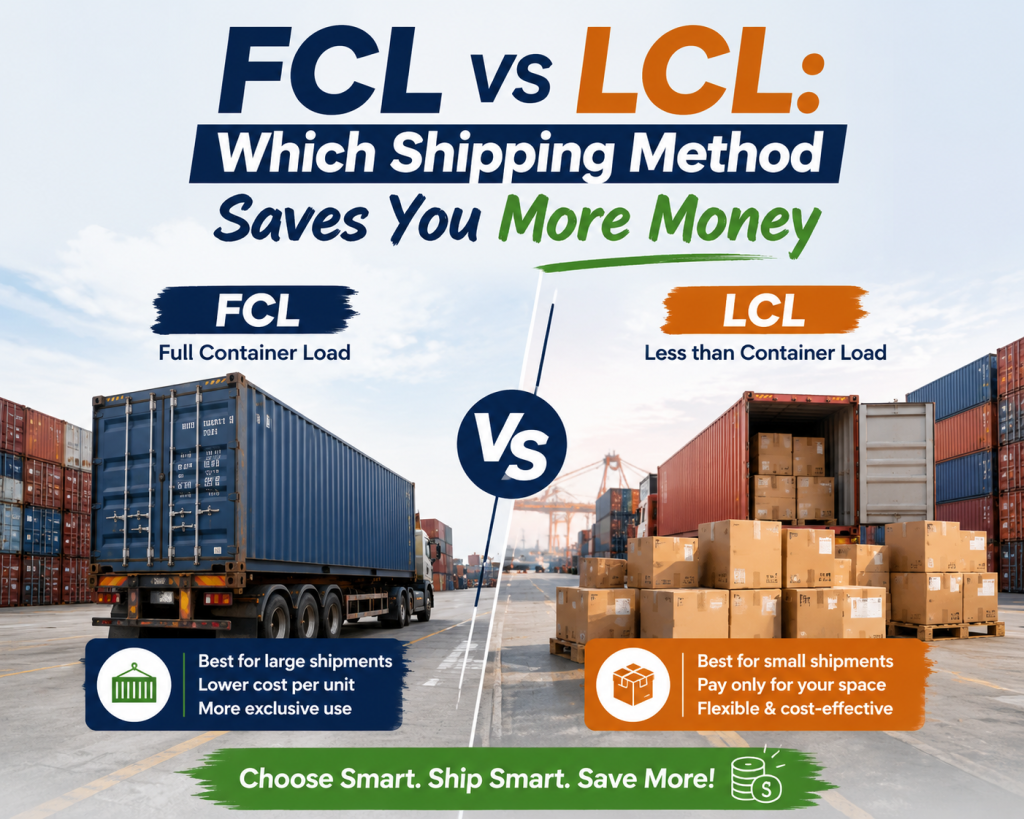
FCL stands for Full Container Load. You book an entire container. 20-foot or 40-foot. The whole box is yours. Nobody else’s cargo goes inside. Doesn’t matter if you fill it completely or leave space empty. You’re paying for the container, not the space you use.
LCL stands for Less than Container Load. Your cargo shares a container with other shippers’ goods. You pay based on volume (cubic meters) or weight (whichever is greater). A consolidator collects shipments from multiple shippers, packs them into one container, and splits the cost.
Simple enough on paper. The complications start when you try to figure out which one actually costs less for your specific situation. Because the answer changes depending on volume, route, season, cargo type, and about six other variables that nobody mentions in the basic explainers.
The World Shipping Council provides good background on how containerized shipping works globally, but the practical FCL vs LCL decision requires more specific knowledge.
2. The Real Cost Difference Between FCL and LCL
I’m going to use actual numbers here. Not theoretical ranges. Real costs from shipments I’ve handled on the China-to-US route because that’s what most of my clients ship.
LCL pricing (recent rates, China to US West Coast):
Per CBM rate: $45 to $85 depending on season and consolidator. But that’s just the ocean freight portion. Add origin CFS (Container Freight Station) charges: $15 to $30 per CBM. Destination CFS charges: $25 to $50 per CBM. Documentation fees at both ends. Handling charges. Possible warehouse storage if you don’t pick up fast enough.
A 5 CBM LCL shipment realistically costs $500 to $900 total for ocean freight and related charges. Sometimes more during peak season.
FCL pricing (same route, same period):
20-foot container: $1,200 to $2,500 depending on carrier and season. That’s the all-in ocean freight. A 20-foot container holds roughly 28 to 30 CBM of cargo.
So here’s where the math gets interesting. If your LCL shipment hits 10 CBM, you’re potentially paying $1,000 to $1,800 in combined LCL charges. At that point, a 20-foot FCL at $1,500 costs the same or less. And you get the whole container. With space left over.
The crossover point shifts with market conditions, but as a working rule? Once you’re above 8 to 10 CBM, start getting FCL quotes. You might be surprised.
3. Transit Time: How Much Longer Does LCL Take
This is where LCL really hurts and nobody talks about it enough.
Ocean transit time itself is identical. Whether your goods travel FCL or LCL, the ship takes the same number of days crossing the ocean. That part doesn’t change. A vessel from Shanghai to Los Angeles takes roughly 12 to 15 days regardless of how your cargo is loaded.
But LCL adds time on both ends. Significant time.
At origin: Your goods go to a CFS warehouse. They sit there until the consolidator has enough cargo to fill a container. Could be 2 days. Could be 7 days. Depends on the route and how busy the consolidator is. Then the container gets packed and delivered to the port. Add another day or two.
At destination: Container arrives at port. Gets moved to a CFS warehouse. Gets unpacked (deconsolidated). Your goods get separated from everyone else’s. You get notified. You arrange pickup or delivery. This process adds 3 to 7 days after the vessel arrives.
Total extra time for LCL versus FCL? Typically 7 to 14 additional days. On a shipment that might only take 15 days by ocean, that’s potentially doubling your total transit time.
For businesses running lean inventory or facing customer deadlines, those extra days matter enormously. I’ve had clients lose sales because their LCL shipment arrived two weeks after their competitor’s FCL shipment of the same product.
4. Cargo Safety: Which Method Protects Your Goods Better
I’ll be direct. FCL is safer for your cargo. Not slightly safer. Significantly safer.
With FCL, your container gets loaded at the factory. Sealed. That seal doesn’t break until it reaches your warehouse or the customs inspection point. Nobody else touches your goods. Nobody else’s goods touch yours. One loading. One unloading. Minimal handling.
With LCL? Your goods get handled multiple times. Loaded onto a truck at the factory. Unloaded at the origin CFS. Stored in a warehouse. Loaded into a container alongside other people’s cargo. Unloaded at destination CFS. Stored again. Finally loaded for delivery to you.
Every handling point is a damage opportunity. Every time someone moves your boxes, something can get dropped, crushed, or stacked wrong. And here’s the part that really bothers me. Your goods share space with strangers’ cargo. You don’t control what goes next to your stuff. I’ve seen shipments arrive with water damage because another shipper’s poorly sealed liquid product leaked during transit. Your goods. Their mess. Your insurance claim.
The International Chamber of Commerce publishes trade terms that define responsibility during transit, but damage prevention starts with choosing the right shipping method for your cargo type.
For fragile, high-value, or moisture-sensitive products, FCL eliminates most handling damage risk. The cost difference often pays for itself in avoided damage claims.
If you’re shipping goods that require careful handling, working with a quality-focused sourcing partner ensures proper packaging standards before cargo leaves the factory regardless of shipping method.
5. When FCL Makes More Sense
FCL wins in these situations. No question.
Volume above 10 CBM. Once you cross that threshold, FCL pricing usually beats LCL on a per-unit basis. Get quotes for both and compare, but FCL almost always wins here.
Time-sensitive shipments. Need goods by a specific date? FCL gives you predictable transit times without the consolidation delays that make LCL unpredictable.
Fragile or high-value cargo. Electronics. Glassware. Ceramics. Anything that breaks when handled roughly. FCL means less handling. Less handling means less breakage. The math works even if FCL costs slightly more because you’re not filing damage claims.
Consistent monthly volumes. If you ship regularly, booking FCL on a schedule gives you better rates through volume contracts with carriers. LCL rates fluctuate more because you’re at the mercy of consolidator pricing.
Products that can’t share space. Food products. Anything with strong odors. Chemicals. Products that absorb smells or moisture from neighboring cargo. FCL keeps your goods isolated.
Full production runs. Ordered a full production batch from your factory? Ship it all together in one FCL rather than splitting across multiple LCL shipments over weeks.
6. When LCL Makes More Sense
LCL isn’t always the worse option. Sometimes it’s genuinely the right call.
Volume under 5 CBM. Below this threshold, FCL almost never makes financial sense. You’d be paying for 25+ CBM of empty space. LCL lets you pay only for what you’re actually shipping.
Sample shipments. Sending product samples to buyers or testing markets with small quantities. LCL handles these efficiently without committing to full container costs.
Multiple origin points. Sourcing from three different factories in different cities? Each one might produce 3 to 4 CBM. Shipping three separate FCL containers makes no sense. LCL from each origin, or consolidate at a CFS before shipping FCL. Depends on the math.
Cash flow constraints. Smaller orders shipped LCL mean smaller purchase orders. Less capital tied up in inventory. For businesses managing tight cash flow, LCL lets you order more frequently in smaller batches rather than committing to large FCL-sized orders.
Testing new products. Launching something new? Ship a small LCL quantity first. Test the market. If it sells, scale up to FCL on the next order. Better than committing to a full container of something that might not move.
Seasonal fill-ins. Mid-season restock of a few popular items. Not enough volume for FCL. LCL gets product on shelves faster than waiting to accumulate enough for a full container.
For importers managing multiple small orders from various suppliers, a global sourcing coordinator can consolidate shipments strategically to hit FCL thresholds and reduce per-unit shipping costs.
7. The Breakeven Point Most People Get Wrong
Everyone wants a simple answer. “At what volume should I switch from LCL to FCL?” And every shipping guide gives the same vague answer: “around 15 CBM” or “when your container is half full.”
Those numbers are outdated. Or they’re based on routes and rates that don’t match yours.
Here’s how to actually calculate your breakeven. It takes five minutes.
Step one: Get an LCL quote for your exact volume, route, and cargo type. Include ALL charges. Origin CFS. Destination CFS. Documentation. Handling. Everything. Not just the per-CBM ocean rate.
Step two: Get an FCL quote for the same route. Same timing. All-in price for a 20-foot container.
Step three: Divide the FCL price by your cargo volume. That gives you your effective per-CBM cost if you ship FCL.
Step four: Compare. If your all-in LCL per-CBM cost exceeds the FCL per-CBM cost, switch to FCL.
In my experience on major Asia-to-US and Asia-to-Europe routes right now? The breakeven sits around 8 to 12 CBM for a 20-foot container. Lower than most guides suggest. Rates have shifted. LCL surcharges have increased. The old “15 CBM rule” doesn’t hold anymore.
But here’s what people really get wrong. They only compare price. They forget to factor in the 7 to 14 extra days LCL adds. They forget the higher damage risk. They forget the unpredictability of consolidation schedules. When you add time cost and risk cost to the financial comparison, FCL often wins at even lower volumes.
8. Hidden Costs Nobody Warns You About
Both FCL and LCL have costs that don’t appear in the initial quote. Knowing them prevents ugly surprises on your invoice.
LCL hidden costs:
Minimum charge per shipment (usually 1 CBM minimum even if you’re shipping 0.3 CBM). Peak season surcharges that spike LCL rates 30 to 50 percent. Warehouse storage at destination CFS if you don’t collect within free days (usually 3 to 5 days). Examination fees if customs selects your consolidated container for inspection (you pay your share even though it wasn’t your goods they wanted to check).
FCL hidden costs:
Demurrage (charges for keeping the container at port beyond free days). Detention (charges for keeping the container at your warehouse beyond free days). Chassis fees in some markets. Port congestion surcharges during busy periods. Container cleaning fees if you return it dirty.
Both methods:
Terminal handling charges. Documentation fees. Customs brokerage. Delivery from port to your warehouse. Insurance (which you should always have regardless of method).
The quote you receive from a freight forwarder is rarely the final number you pay. Budget 15 to 25 percent above quoted rates for these additional charges. Better to be pleasantly surprised than financially blindsided.
9. Can You Mix Both Methods
Absolutely. And smart importers do this regularly.
Strategy one: FCL for core products, LCL for accessories. Your main product line ships in volume. FCL makes sense. But you also need small quantities of packaging materials, spare parts, or complementary products from different suppliers. Those go LCL.
Strategy two: FCL for planned orders, LCL for urgent restocks. Regular inventory replenishment ships FCL on a schedule. But when something sells faster than expected and you need product quickly, a small LCL shipment fills the gap while your next FCL order is in production.
Strategy three: Consolidation to convert LCL into FCL. Multiple small orders from different suppliers in the same region? Have them all deliver to a single warehouse. Consolidate into one FCL container. You pay local trucking to the consolidation point but save significantly on ocean freight versus shipping each order LCL separately.
A logistics-savvy sourcing partner coordinates these consolidation strategies across multiple suppliers, timing production schedules so goods arrive at the consolidation warehouse within the same window.
10. Questions Importers Ask Me Weekly
Can I book a 40-foot container if I only need 20 feet of space?
You can. But why would you? A 40-foot costs more than a 20-foot. If your cargo fits in 20 feet, book 20 feet. The only exception: if the 40-foot rate is barely higher than the 20-foot rate (happens sometimes on certain routes) and you might use the extra space for additional orders.
What if my LCL shipment gets delayed because the consolidator is waiting for other cargo?
It happens. Especially on less popular routes with lower shipping volumes. You have limited control over this. Choosing a busy, high-volume consolidator on major routes reduces the risk. But if timing is critical, this unpredictability alone might justify paying for FCL.
Is my cargo insured automatically?
No. Carrier liability is extremely limited. The Hague-Visby Rules cap carrier liability at roughly $500 per package unless you declare higher value. Always buy separate cargo insurance regardless of FCL or LCL. It costs roughly 0.3 to 0.5 percent of cargo value. Cheap protection.
Can I ship hazardous goods LCL?
Some consolidators accept DG (dangerous goods) cargo for LCL. Many don’t. Those who do charge significant premiums and have strict documentation requirements. FCL is almost always easier and sometimes the only option for hazardous materials. Your MSDS documentation needs to be perfect either way.
What’s the maximum weight for a 20-foot container?
Roughly 18,000 to 21,000 kg depending on the container and route restrictions. But most cargo “cubes out” (fills the volume) before it “weighs out” (hits the weight limit). Unless you’re shipping something dense like stone, metal, or liquids, volume is usually your constraint, not weight.
How far in advance should I book?
FCL: 2 to 3 weeks before cargo is ready. Gives you time to secure space and good rates. LCL: 1 to 2 weeks. But during peak season (August through October for Asia routes), book earlier for both. Space gets tight and rates spike.
The Bottom Line
FCL vs LCL isn’t a permanent decision. It’s a calculation you should run for every shipment. Your volumes change. Rates change. Seasons change. What made sense last quarter might not make sense this quarter.
But if I had to give one piece of advice? Most importers wait too long to switch from LCL to FCL. They keep shipping LCL at 8, 9, 10 CBM because “it’s not a full container.” Meanwhile they’re paying nearly FCL prices with worse transit times and higher damage risk.
Run the numbers. Get both quotes. Compare honestly. Include the hidden costs and the time value. Then decide based on math, not habit.