
Where Are Nike Shoes Made? Not Where You Think
Where are Nike shoes made? I got curious about this last month. Pulled out every pair of Nikes in my closet. Five pairs total. Checked every tongue label. Three said Vietnam. One said Indonesia. One said China. Five shoes, three countries. And not a single one made in America despite Nike being headquartered twenty minutes from my office in Oregon.
That pretty much tells the whole story of modern athletic footwear manufacturing. But the details behind those labels are way more interesting than most people realize.
I work in global sourcing and I’ve spent time in factories across Asia that produce for brands exactly like Nike. Not Nike specifically, I should clarify, but the same type of contract manufacturers in the same industrial zones using the same production methods. So I have a decent window into how this world actually operates behind the scenes.
Let me walk you through where Nike shoes actually get made, why those specific countries, and what’s shifting in 2026.
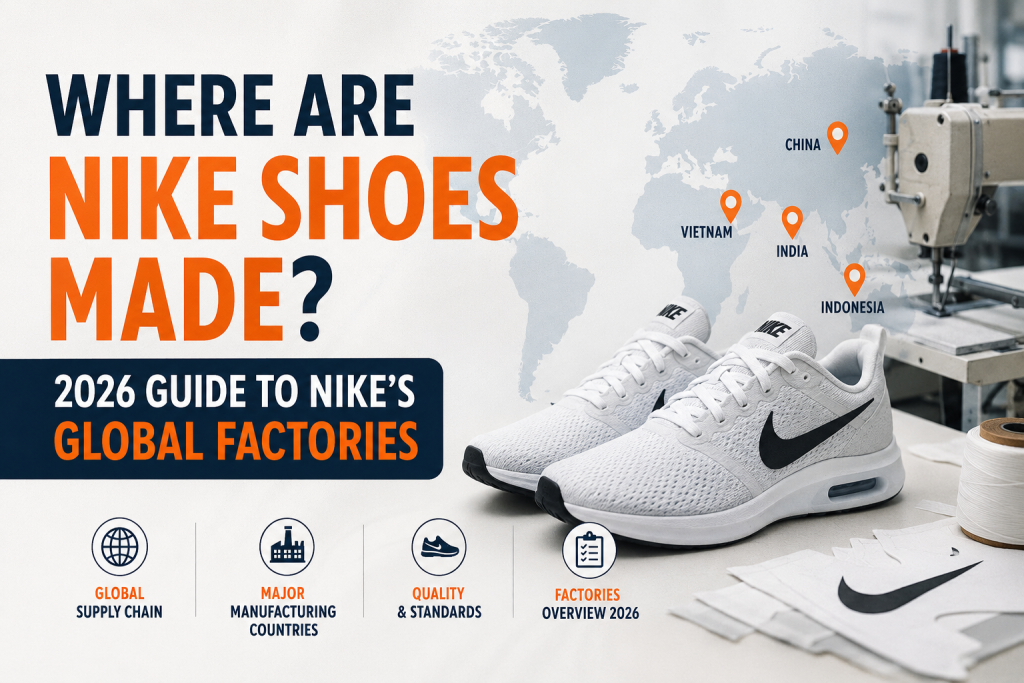
First Thing: Nike Doesn’t Make Anything
This trips people up. Nike is a design and marketing company. They sketch shoes in Portland. They film commercials with athletes. They run stores and websites. But they don’t own a single factory anywhere on earth. Zero.
Every Nike shoe gets made by an independent contract manufacturer. Nike tells them what to build, provides exact specifications, sends quality inspectors, and pays them per pair produced. But the factory, the workers, the equipment? Belongs to someone else entirely.
Their factory network is massive. Something like 500 factories across 40-plus countries for all products. For shoes specifically, we’re talking around 100 to 120 facilities concentrated in Southeast Asia.
Adidas does the same thing. Puma too. New Balance. It’s industry standard. The brand owns the design and the customer relationship. The factory owns the production capability. Everyone stays in their lane.
Why? Because building and maintaining shoe factories costs billions. And if labor costs shift or trade policies change or demand drops, you’re stuck with enormous fixed assets in the wrong place. Contract manufacturing gives Nike flexibility to move production around without that anchor. Same logic applies to smaller brands using procurement outsourcing instead of building their own factories.
Vietnam Makes Half of All Nike Shoes Now
This is the big one. Vietnam produces roughly 50% of Nike’s total footwear output. Half. Of everything. That’s millions upon millions of pairs annually flowing out of Vietnamese factories.
Ten years ago China held the top manufacturing spot for Nike. Vietnam overtook them around 2019-2020 and the gap has only widened since.
I was in the Binh Duong province industrial area outside Ho Chi Minh City about three years back. Not for Nike work, different client, different product. But you can’t miss the footwear factories there. Enormous complexes behind high walls. Shuttle buses carrying thousands of workers in matching uniforms at shift change. The scale is genuinely hard to comprehend until you see it in person. One facility I drove past had its own apartment blocks for workers. Like a small city dedicated to making shoes.
Nike’s biggest Vietnamese partners are companies most consumers have never heard of. Pou Chen. Chang Shin. Tae Kwang Vina. These are Taiwanese and Korean-owned manufacturers that built mega-facilities in Vietnam specifically to serve Western athletic brands. Pou Chen alone has over 300,000 employees globally. They’re basically the world’s largest shoemaker that nobody knows by name.
So why did Vietnam win this manufacturing race?
Wages. Vietnamese factory workers earn maybe 60-70% of what Chinese workers earn for equivalent roles. When you’re making a product where labor is the single biggest cost component, that gap matters enormously multiplied across millions of units.
Demographics help too. Young population. High literacy. Workers who can be trained quickly and who show up reliably. Factories told me turnover is their biggest headache in Vietnam, workers jumping ship for slightly higher pay at the factory next door, but the available labor pool is deep enough to keep lines running.
Trade deals sealed it. Vietnam signed the CPTPP, the EU-Vietnam FTA, and other agreements that slash tariffs on Vietnamese exports to major consumer markets. A shoe made in Vietnam enters Europe with lower duties than the same shoe made in China. That tariff difference alone can be worth several dollars per pair.
And the Vietnamese government rolled out the red carpet. Tax holidays for foreign manufacturers. Purpose-built industrial zones with ready infrastructure. Streamlined permits. They wanted this business and they made it easy to set up shop.
China: Shrinking But Not Disappearing
China’s share of Nike shoe production has dropped from over 30% around 2010 to roughly 18-21% today. Steady decline. But 20% of Nike’s global footwear volume is still an enormous number of shoes.
What stays in China? The complicated stuff. Shoes with Flyknit uppers that require specialized knitting machines. Models with complex Air Max units. Limited editions using unusual materials. Products where the technical expertise and supporting component supply chains in China are simply deeper than what exists elsewhere yet.
I talked to a guy who managed footwear procurement intelligence for a mid-size brand last year. He put it simply. “Vietnam can make your bread-and-butter running shoe beautifully. But if you need something with six different materials, a custom midsole compound, and a construction method that only three factories in the world can do? Two of those three factories are probably in Guangdong.”
That tracks with what I’ve seen. China’s manufacturing ecosystem has decades of accumulated knowledge, specialized sub-suppliers, and technical workers who’ve been solving complex production problems for 25 years. You can’t replicate that overnight in a newer manufacturing country no matter how cheap the labor is.
Rising wages are the obvious reason for the shift away. Chinese factory workers now earn substantially more than Vietnamese or Indonesian workers. For a basic athletic shoe where the construction is straightforward, paying premium labor rates doesn’t make sense when equivalent quality is achievable elsewhere for less.
But China isn’t going anywhere in Nike’s supply chain. It’s just moving upmarket. Higher-value products. More technical complexity. Smaller runs of premium models. The work that justifies higher costs because nobody else can do it as well.
Indonesia: Steady and Reliable Third Place
Indonesia accounts for roughly 20-25% of Nike’s shoe production. Factories cluster on Java island. Tangerang and Serang in Banten province near Jakarta. Semarang in Central Java. Some facilities in East Java too.
Indonesian factories tend to handle the middle ground. Not the cheapest basic shoes that go to the lowest-cost producers. Not the most technically demanding models that stay in China. The mainstream athletic footwear that needs solid craftsmanship at competitive pricing.
Something interesting about Indonesia that doesn’t get discussed much. Workforce stability. A sourcing contact of mine who spent eight years working with Indonesian shoe factories told me their biggest advantage isn’t cost. It’s that workers stay. Turnover rates in Indonesian factories run significantly lower than Vietnam. Workers stick around for years. Decades sometimes.
Why does that matter? Because a stitcher who’s been assembling shoe uppers for twelve years produces more consistent work than someone trained six months ago. Fewer defects. Less rework. Better quality control outcomes without needing as much inspection intervention. That consistency has real value even if the hourly wage is slightly higher than the newest, cheapest manufacturing country.
Smaller Players in Nike’s Network
Beyond Vietnam, China, and Indonesia, Nike produces shoes in several other countries at lower volumes:
India handles some production, mostly for the massive domestic Indian market. Simpler constructions. Growing gradually as India’s consumer market expands.
Cambodia produces a small slice. Lower wages than Vietnam but less developed infrastructure. Good for basic styles.
Brazil makes Nike shoes specifically for South American consumers. Brazil’s import tariffs on foreign-made goods are brutal, sometimes 30-40%. Manufacturing locally avoids that entirely.
Mexico serves the North American market with proximity advantages. USMCA trade benefits. Faster delivery to US consumers than shipping from Asia.
This geographic spread isn’t random. It’s deliberate risk management. If one country has a political crisis, natural disaster, or sudden tariff change, Nike doesn’t lose their entire production capacity. They shift volume to other facilities. Same principle behind why smart brands diversify their supplier relationships rather than depending on a single source.
How Nike Decides Which Factory Makes Which Shoe
Not every model goes to every factory. The routing decision depends on several things I’ve seen play out across the industry:
Technical capability. Can this factory actually produce this shoe? Does it have the right machines, trained workers, and material sourcing connections? Advanced models go to proven facilities.
Volume needs. A shoe expected to sell 5 million pairs needs a factory that can crank out 50,000 pairs monthly without quality dropping. Limited releases of 30,000 pairs can go to smaller specialized shops.
Cost math. A $70 retail shoe has tighter manufacturing budget than a $200 shoe. Lower-priced models route to lowest-cost countries. Premium models can absorb higher production costs.
Trade policy. Which destination market is this shoe primarily for? Route production to the country with the best tariff treatment for that market.
Speed. Some factories turn orders faster. For restocks of suddenly viral styles, speed to market beats cost savings.
What Footwear Sellers Can Learn From Nike’s Approach
If you’re building a shoe brand or sourcing footwear for your business, Nike’s playbook offers practical lessons even at smaller scale:
Vietnam is currently the best overall option for athletic and casual footwear. Cost, quality, capacity, and trade advantages all align there in 2026.
China remains essential for technically complex products. If your design pushes boundaries on materials or construction, Chinese factories likely have capabilities that newer manufacturing countries haven’t developed yet.
Don’t put everything in one basket. Even having two factory relationships instead of one gives you leverage and backup options.
Factory relationships compound over time. Nike’s best partners have produced for them 20+ years. That depth creates priority treatment, collaborative problem-solving, and quality consistency that new customers don’t get immediately. Building those relationships through proper sourcing channels accelerates the process.
Quality oversight cannot be optional. Nike has thousands of people dedicated to quality assurance across their network. At whatever scale you operate, having clear product specifications and inspection processes prevents the quality drift that inevitably happens without oversight.
What’s Changing Right Now
Few things worth watching in 2025-2026:
US tariff policy keeps shifting. New duties on Chinese and Southeast Asian goods can change the cost equation between countries overnight. Manufacturers and brands both have to stay nimble.
Automation is creeping in. Robotic cutting, automated gluing, 3D-printed midsoles. As machines replace hand labor for certain steps, the wage difference between countries matters less. Could eventually bring some production closer to consumers.
Vietnamese wages climbing fast. 8-12% annual increases. The cost gap with China narrows every year. Within a decade the labor arbitrage that drove the Vietnam shift may largely disappear.
Sustainability pressure mounting. Shipping shoes across oceans generates significant carbon emissions. Brands face growing pressure to regionalize production. Making shoes closer to where they’re sold reduces transport emissions but increases manufacturing costs in higher-wage countries.
The Bottom Line
Where are Nike shoes made in 2026? Mostly Vietnam at around 50%. Indonesia at 20-25%. China at 18-21%. Plus smaller volumes across India, Cambodia, Brazil, Mexico, and others. All in factories Nike doesn’t own, operated by contract manufacturers who also produce for competing brands.
This network represents decades of strategic decisions balancing cost, quality, trade policy, risk, and capacity. It’s sophisticated supply chain management at global scale.
For businesses looking to source footwear or understand how these manufacturing networks function, the same regions and often the same factories that serve Nike also work with smaller brands. The infrastructure exists. The skilled workers exist. What you need is proper oversight, clear specifications, and reliable sourcing partnerships to access it effectively.
Interested in exploring footwear sourcing or connecting with verified manufacturers in these regions? Schedule a conversation or reach out here. We help brands navigate factory selection, manage quality control, and build supply chains that deliver consistent results. The benefits include factory verification, production oversight, and the kind of sourcing support that gives growing brands access to manufacturing quality they couldn’t access alone.