
International trade has rules.
Those rules determine who pays for what, when risk transfers from seller to buyer, and who handles insurance. CIP is one of those rules. It stands for Carriage and Insurance Paid To, and if you’re importing goods, you need to understand it.
Get CIP wrong and you might pay for costs twice, leave gaps in insurance coverage, or fight with suppliers over who’s responsible for damaged cargo. Here’s everything you need to know about CIP incoterms.
Table of Contents
| # | Section | Key Points Covered |
| 1 | What Does CIP Mean in Incoterms? | Definition, full name, basic concept |
| 2 | How CIP Incoterms Work | Process flow, responsibilities breakdown |
| 3 | Seller’s Obligations Under CIP | What supplier must do and pay |
| 4 | Buyer’s Obligations Under CIP | What importer must do and pay |
| 5 | Risk Transfer in CIP Incoterms | When risk moves from seller to buyer |
| 6 | Cost Breakdown in CIP | Who pays what expenses |
| 7 | Insurance Requirements for CIP | Coverage levels, who arranges it |
| 8 | CIP vs CIF Incoterms | Key differences explained |
| 9 | CIP vs CPT Incoterms | Insurance distinction |
| 10 | CIP vs DAP Incoterms | Delivery and risk differences |
| 11 | When to Use CIP Incoterms | Best situations and scenarios |
| 12 | When NOT to Use CIP | Situations where CIP doesn’t fit |
| 13 | CIP Incoterms 2020 Updates | Changes from 2010 version |
| 14 | Common CIP Mistakes | Errors that cause problems |
| 15 | CIP in Different Transport Modes | Air, ocean, rail, truck applications |
| 16 | Documentation for CIP Shipments | Required paperwork |
| 17 | Final Thoughts on CIP Incoterms | Summary and recommendations |
What Does CIP Mean in Incoterms?
CIP stands for Carriage and Insurance Paid To. It’s one of 11 incoterms defined by the International Chamber of Commerce (ICC).
Under CIP, the seller pays for transportation and insurance to get goods to a named destination. But, and this is important, risk transfers to the buyer much earlier, when goods are handed to the first carrier.
So seller pays freight and insurance all the way to your door (or wherever you specify). But if something goes wrong during transit, that’s your problem once the carrier takes possession.
This creates a gap. Seller’s paying for insurance, but you’re bearing the risk. That’s why understanding CIP matters, especially if you’re doing bulk product sourcing from China or working with a China sourcing agent.
CIP works for any transport mode: ocean, air, rail, truck, or combinations. That’s different from CIF, which only applies to ocean freight.
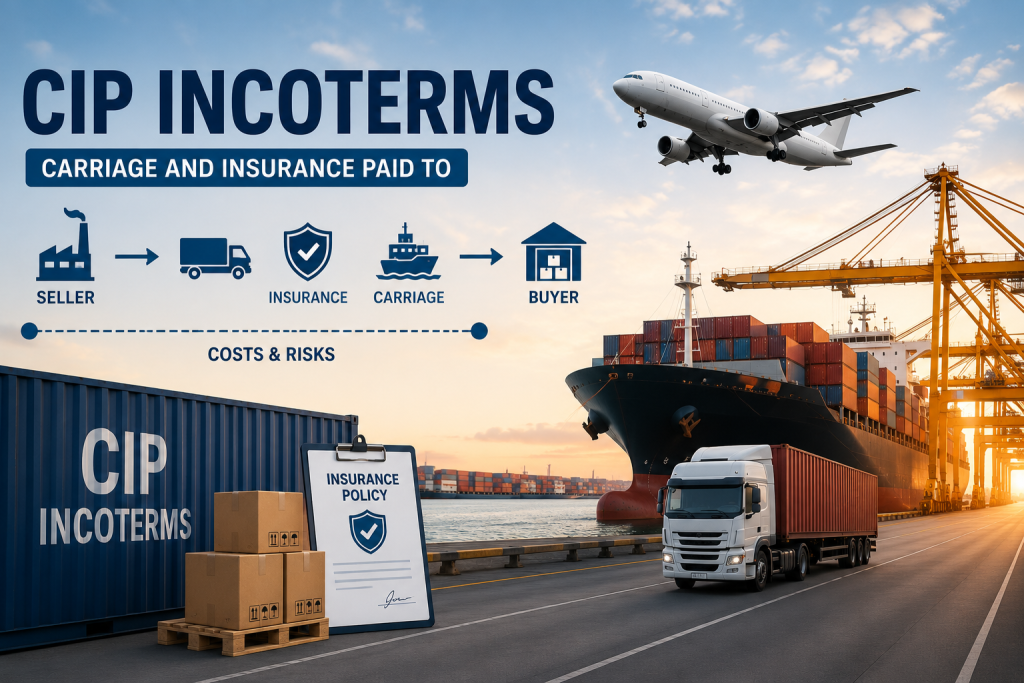
How CIP Incoterms Work
Here’s the basic flow under CIP:
1. Seller prepares goods
Packs, labels, and gets everything ready for shipment at their facility.
2. Seller arranges transport
Books freight with carrier(s) to deliver goods to the named destination. Could be your warehouse, a port, or any place you specify.
3. Seller buys insurance
Purchases cargo insurance covering the journey to the named destination.
4. Seller delivers to carrier
Hands goods over to the first carrier. This is when risk transfers to you, even though goods haven’t left the origin country yet.
5. Goods travel to destination
Transport happens. Seller already paid for this and insurance covers the cargo (to some extent).
6. Buyer receives goods
You take delivery at the named place. Unload, clear customs if needed, move to final location.
7. Buyer pays any remaining costs
Import duties, customs clearance, unloading at destination, onward transport to your facility.
Key thing to remember: seller pays freight and insurance to destination, but risk transfers much earlier when goods leave seller’s hands.
Seller’s Obligations Under CIP
Under CIP incoterms, the seller must:
Provide the goods and commercial invoice
Deliver what was agreed, with proper documentation.
Pack goods appropriately
Package for the journey to destination. Needs to withstand handling and transport.
Arrange and pay for main carriage
Book and pay for transport from origin to the named destination you specified.
Obtain cargo insurance
Buy insurance covering at least 110% of contract value with Institute Cargo Clauses (A) coverage or equivalent. This is minimum coverage. Seller might buy more.
Handle export formalities
Get export license if needed, pay export duties, complete customs export clearance.
Deliver goods to first carrier
Hand over cargo to the carrier at origin. After this point, risk is yours.
Provide proof of delivery
Give you transport documents showing goods were delivered to carrier.
Pay for pre-carriage
If goods need to move from factory to port or airport before main transport, seller covers that cost.
Notify buyer
Inform you when goods have been delivered to carrier and provide tracking details.
Seller’s job is getting goods moving toward you, with freight and insurance paid. But they’re not responsible if cargo gets damaged after the carrier takes it, even though their insurance covers it.
If you’re using global sourcing services, make sure your supplier understands their CIP obligations. Some try to cut corners on insurance or packaging.
Buyer’s Obligations Under CIP
Under CIP incoterms, you (the buyer) must:
Pay the purchase price
Pay what you agreed to pay for the goods.
Take delivery
Accept goods when they arrive at the named destination.
Bear risk after handover
Accept all risk once seller delivers goods to the first carrier. If cargo gets damaged or lost in transit, you file the insurance claim, not the seller.
Handle import formalities
Arrange and pay for import customs clearance, import duties, taxes, and related costs.
Unload at destination
Pay for unloading at the named place (unless unloading is included in the carrier’s quote).
Arrange onward transport
If the named place isn’t your final destination, you handle and pay for additional transport.
Pay for inspection (if required)
If you want pre-shipment inspection beyond what’s standard, you pay for it.
Provide information to seller
Tell seller the exact named destination and any special requirements.
The tricky part with CIP: you’re taking risk early but seller’s paying freight and insurance. You might not even know there’s damage until cargo arrives, then you need to claim against seller’s insurance policy, which might not cover everything.
Working with procurement outsourcing partners helps manage this complexity. They coordinate with suppliers and handle insurance claims if needed.
Risk Transfer in CIP Incoterms
This is where CIP gets confusing.
Risk transfers: When seller delivers goods to the first carrier at origin.
Cost responsibility: Seller pays freight and insurance all the way to named destination.
See the gap? Seller’s still paying for stuff after risk has transferred to you.
Example:
You buy goods CIP Los Angeles. Supplier in Shanghai delivers container to carrier at Shanghai port. Risk transfers here (goods are now at your risk). Container ships to Los Angeles (seller already paid freight and insurance). Container arrives damaged. You file the insurance claim because you bore the risk during transit.
This split between risk and cost creates issues. The insurance seller bought? You’re the one who needs to claim against it if something goes wrong. But it’s seller’s policy, so you’re dealing with their insurance company and their coverage limits.
That’s why many buyers prefer DAP or DDP terms. Keeps things cleaner. But if you’re using CIP, understand this split and make sure seller’s insurance is adequate.
Cost Breakdown in CIP
Who pays what under CIP incoterms:
Seller Pays:
Export packing, loading at origin facility, transport to port/airport (pre-carriage), export customs clearance, export duties and fees, terminal handling charges at origin (usually), main freight to named destination, cargo insurance to named destination, unloading from main carrier at destination (sometimes, depends on contract)
Buyer Pays:
Import customs clearance, import duties and taxes, terminal handling charges at destination (usually), unloading at final destination, transport from named place to your facility (if applicable), storage or demurrage if you delay pickup, insurance gaps (if seller’s coverage isn’t enough)
The “named place” matters. If you specify “CIP Los Angeles Port,” seller’s obligations end at the port. You handle everything after. If you specify “CIP your warehouse in Denver,” seller pays for transport all the way there.
Choose your named destination carefully. The further you push it, the more seller pays but the longer you’re bearing risk with their insurance.
If you’re managing supplier negotiation and cost optimization, understand these splits. You might save money on one term while paying more on another.
Insurance Requirements for CIP
CIP incoterms 2020 changed insurance requirements significantly.
Minimum coverage:
Seller must provide insurance equal to at least 110% of the contract value under Institute Cargo Clauses (A) or similar comprehensive coverage.
This is “all risks” coverage, protecting against most causes of loss or damage during transit. It’s better coverage than CIF requires (which only needs Institute Cargo Clauses C, more limited).
What Institute Cargo Clauses (A) covers:
Physical loss or damage from external causes, theft, non-delivery, general average contributions, most risks except those specifically excluded
What’s NOT covered (common exclusions):
Inherent defects in goods, improper packing, delay (even if delay causes loss), insolvency of carrier or warehouse, war and strikes (unless added separately), willful misconduct
Buyer’s rights:
You can ask seller to increase insurance coverage beyond the minimum. You pay the extra premium, but seller arranges it.
Why this matters:
If goods get damaged and seller’s insurance doesn’t fully cover your loss, you’re stuck with the gap. Some buyers purchase their own contingency insurance on top of seller’s coverage.
When sourcing through procurement intelligence systems, track insurance coverage as part of your risk management. Don’t assume seller’s minimum coverage is enough.
CIP vs CIF Incoterms
People confuse CIP and CIF. Both involve seller paying freight and insurance, but they’re different.
CIP (Carriage and Insurance Paid To):
Any transport mode (air, ocean, rail, truck), risk transfers when goods delivered to first carrier, insurance: Institute Cargo Clauses (A) minimum (comprehensive coverage), named place can be anywhere (port, airport, warehouse, etc.)
CIF (Cost, Insurance, and Freight):
Ocean and inland waterway transport ONLY, risk transfers when goods loaded on vessel at origin port, insurance: Institute Cargo Clauses (C) minimum (limited coverage), named port of destination
Key differences:
| Aspect | CIP | CIF |
| Transport modes | Any | Ocean only |
| Risk transfer point | First carrier | On vessel |
| Insurance coverage | Comprehensive (A) | Limited (C) |
| Destination type | Any named place | Port only |
When to use which:
Ocean freight? Can use either, but CIP gives better insurance. Air freight? Must use CIP (CIF doesn’t apply). Multi-modal? Use CIP. Want better insurance? Use CIP.
CIF is older and more traditional for ocean freight. CIP is more flexible and offers better protection. If you’re doing bulk product sourcing from China by sea, consider CIP over CIF for the improved insurance coverage.
CIP vs CPT Incoterms
CIP and CPT are almost identical except for one thing: insurance.
CIP (Carriage and Insurance Paid To):
Seller pays freight to named destination, seller buys cargo insurance, risk transfers at first carrier
CPT (Carriage Paid To):
Seller pays freight to named destination, seller does NOT buy insurance, risk transfers at first carrier
The only difference: Insurance.
With CIP, seller must arrange and pay for cargo insurance. With CPT, seller doesn’t. That means under CPT, goods travel at your risk with no insurance unless you arrange it yourself.
When to use which:
Want seller to handle insurance? Use CIP. Want to choose your own insurance? Use CPT and buy your own policy. Don’t want insurance at all? Use CPT (not recommended).
Most buyers prefer CIP because it’s one less thing to manage. But if you have good insurance rates or want specific coverage, CPT lets you control the insurance yourself.
CIP vs DAP Incoterms
CIP and DAP both involve seller paying freight to destination, but risk transfer differs.
CIP (Carriage and Insurance Paid To):
Seller pays freight and insurance to named destination, risk transfers when goods delivered to first carrier (early), buyer handles import customs and duties, buyer bears risk during most of transport
DAP (Delivered at Place):
Seller pays freight to named destination, risk stays with seller until goods are ready for unloading at destination, buyer handles import customs and duties, seller bears risk during entire transport
Key difference: When risk transfers.
CIP: Risk transfers early (first carrier), but seller pays freight/insurance all the way
DAP: Risk stays with seller until delivery at destination
Which is better?
DAP is cleaner for buyers. You don’t worry about transit damage because seller bears that risk. But DAP often costs more because seller prices in that risk.
CIP can be cheaper (seller’s not carrying risk as long), but you’re gambling on seller’s insurance being adequate if something goes wrong.
If you’re managing quality control processes, DAP might be preferable. Supplier stays responsible for goods longer.
When to Use CIP Incoterms
CIP works well in these situations:
1. Multi-modal shipments
Goods moving by ocean, then rail, then truck? CIP covers all legs. CIF doesn’t.
2. Air freight
CIF doesn’t apply to air shipments. CIP does.
3. You want seller to arrange insurance
Seller handles the insurance policy and coverage. You don’t need to shop for cargo insurance.
4. Inland destinations
You want goods delivered to an inland city, not just a port. CIP works for any named place.
5. You have confidence in seller’s insurance
If you trust seller to buy adequate coverage, CIP simplifies things.
6. You want control over import process
CIP lets you handle customs clearance and duties yourself (unlike DDP where seller does it).
7. Cost certainty
Seller quotes one price including freight and insurance to your specified location. Easier budgeting.
CIP is popular for global sourcing because it’s flexible and keeps costs predictable while letting buyer maintain control over import formalities.
When NOT to Use CIP
CIP doesn’t fit every situation:
1. You don’t trust seller’s insurance
If you’re worried seller might buy minimal coverage or use a sketchy insurance company, CPT (and buy your own insurance) or DAP (seller keeps risk) might be better.
2. High-value or fragile goods
The gap between risk transfer and cost responsibility creates problems with valuable cargo. DAP keeps seller on the hook longer.
3. Seller doesn’t understand incoterms
If supplier doesn’t know what CIP means, you’ll end up fighting over responsibilities. Use simpler terms like FOB or EXW and handle logistics yourself.
4. You want door-to-door with seller responsible
CIP makes you bear risk during transit. If you want seller responsible all the way, use DAP or DDP.
5. Complicated customs clearance
If import customs is complex in your country and you’d rather seller handle it, DDP is better than CIP.
6. Ocean freight with traditional trading partners
Many established ocean freight relationships still use CIF out of habit and familiarity. If it works, no need to change.
7. You have better insurance rates
If your cargo insurance rates beat what seller can get, use CPT and arrange your own coverage.
CIP Incoterms 2020 Updates
The Incoterms 2020 revision made important changes to CIP:
Main change: Insurance coverage level
Old (Incoterms 2010):
CIP required minimum Institute Cargo Clauses (C) coverage, same as CIF. That’s limited coverage.
New (Incoterms 2020):
CIP now requires Institute Cargo Clauses (A) coverage, comprehensive “all risks” coverage.
This makes CIP significantly better for buyers. Seller must provide more complete insurance protection.
Why the change?
CIP is often used for containerized goods, which are more valuable and vulnerable than bulk cargo traditionally shipped under CIF. The ICC decided buyers needed better protection.
Other clarifications:
Can specify exact named place for delivery (not just city), clearer guidance on who handles unloading at various points, better explanation of risk transfer vs cost responsibility
What this means for you:
If your contract says “CIP Incoterms 2020,” seller must provide comprehensive insurance. If it says “CIP Incoterms 2010,” coverage might be limited. Always specify which version.
When working with procurement outsourcing services, make sure they’re using current incoterms and understanding the insurance requirements.
Common CIP Mistakes
These errors cause the most problems with CIP:
1. Not specifying exact named place
“CIP USA” doesn’t work. Need “CIP Los Angeles Port” or “CIP our warehouse, 123 Main St, Denver CO.” Vague destinations create disputes.
2. Assuming seller bears transit risk
Because seller paid for freight and insurance, buyers think seller’s responsible if cargo gets damaged. Wrong. Risk transferred when carrier took possession.
3. Not checking insurance coverage
Seller’s insurance might meet minimum requirements but not cover your specific risks. Review the policy or buy supplemental coverage.
4. Confusing CIP with CIF
Using ocean freight and accidentally mixing up terms. They’re different, mainly in insurance quality and where they apply.
5. Not understanding when to file claims
Cargo arrives damaged. Buyer waits for seller to fix it. But under CIP, you own the risk and need to file insurance claim promptly with seller’s insurer, not seller.
6. Ignoring incoterms version
Contract doesn’t specify “Incoterms 2020” or “Incoterms 2010.” Creates ambiguity about insurance requirements.
7. Wrong party arranging import customs
Seller tries to handle import clearance (that’s your job under CIP). Or you expect seller to do it (they won’t). Know who does what.
8. Not inspecting cargo on arrival
You need to inspect and document damage immediately. Wait too long and insurance might deny claims.
If you’re doing product sourcing, have someone who understands incoterms review your purchase agreements before signing.
CIP in Different Transport Modes
CIP works across all transport methods, but application differs:
Ocean Freight
Most common use of CIP. Seller arranges container shipping, pays freight to named port or inland destination, buys comprehensive marine cargo insurance.
Considerations: Named place could be destination port or final inland location. If naming a port, you handle getting cargo from port to warehouse. Seller’s insurance covers ocean leg and usually includes port-to-port.
Air Freight
CIP works perfectly for air cargo (CIF doesn’t apply to air).
Considerations: Fast transit means risk window is shorter. Insurance claims for air cargo often simpler. Named place could be destination airport or your facility. Air freight rates usually include more ground handling than ocean.
Rail Freight
Growing importance with China-Europe rail routes.
Considerations: Multi-country transit creates complex insurance situations. Make sure seller’s insurance covers the entire rail route. Named place typically final rail terminal or beyond.
Truck/Road Freight
Common for regional trade or final leg of multi-modal shipment.
Considerations: Shorter distances, faster transit. Named place could be your warehouse door. Insurance straightforward for domestic truck legs.
Multi-Modal (Most Complex)
Goods moving by truck, then ocean, then rail, then truck to final destination.
Considerations: CIP excels here (unlike CIF which only covers ocean). Insurance must cover all transport modes. Risk transfers at first carrier, but goods might change carriers 3-4 times. Make sure no gaps in insurance between modes.
Documentation for CIP Shipments
You’ll need these documents for CIP shipments:
Commercial Invoice
Shows transaction value, payment terms, and incoterms. Must say “CIP [named place] Incoterms 2020.”
Packing List
Details what’s in each package, weights, dimensions.
Bill of Lading or Air Waybill
Transport document proving carrier took possession of goods. This is when risk transferred to you.
Insurance Certificate or Policy
Proof of cargo insurance. Should show Institute Cargo Clauses (A) coverage for at least 110% of invoice value.
Certificate of Origin
May be required depending on goods and destination country.
Export License (if needed)
Seller handles this for controlled goods.
Import License (if needed)
You handle this for controlled goods.
Customs Entry Documents
You complete these for import clearance at destination.
Inspection Certificates
If required by buyer or regulations.
Keep all documents. If you need to file an insurance claim, you’ll need the bill of lading, commercial invoice, packing list, and insurance certificate.
When using benefits delivered through a sourcing partner, they often help coordinate all documentation to ensure nothing’s missing.
Final Thoughts on CIP Incoterms
CIP incoterms offer flexibility and convenience. Seller handles freight and insurance to your specified location. You manage import formalities and final delivery.
But the split between risk transfer and cost responsibility creates complexity. You’re bearing risk while seller’s insurance protects cargo. If something goes wrong, you’re filing claims against their policy.
Understand this dynamic before agreeing to CIP terms. Make sure seller’s insurance is adequate. Inspect cargo immediately on arrival. Document any damage right away.
For most situations, CIP works well, especially multi-modal shipments or when you want seller to handle logistics but keep control of import process yourself.
Need help negotiating incoterms with suppliers? Get in touch and we’ll review your specific situation. Want to optimize your entire sourcing and logistics setup? Book a consultation and let’s talk about terms, costs, and risk management strategies.
Understanding CIP incoterms prevents expensive mistakes and keeps shipments moving smoothly. Get the terms right upfront and everyone knows exactly what they’re responsible for.