
Your gods need to get from point A to point B over land.
Truck or train? Full truckload or shared? Fast and pricey or slow and cheap? These choices affect your costs, delivery times, and whether your customers get products when promised.
Land transport moves the vast majority of goods within countries and across borders that share land. Understanding your options means smarter shipping decisions and better margins.
Here’s everything you need to know about land transport and how to pick the right method for your situation.
Table of Contents
| # | Topic | What You’ll Learn |
| 1 | What is Land Transport? | Definition and overview |
| 2 | Types of Land Transport | Road and rail options |
| 3 | Road Transport Explained | Trucking methods and details |
| 4 | Rail Transport Explained | Train freight basics |
| 5 | Pros and Cons | Advantages and disadvantages |
| 6 | Land Transport Costs | What affects pricing |
| 7 | How to Choose the Right Option | Decision factors |
| 8 | Best Practices | Tips for smart shipping |
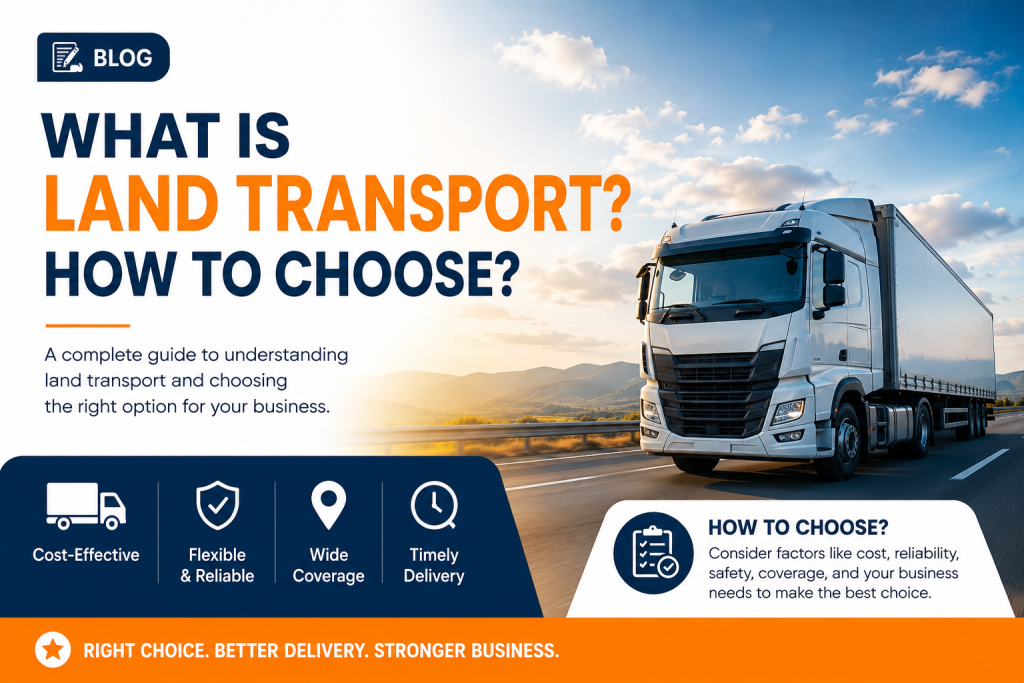
What is Land Transport?
Land transport is moving goods or people over land using roads or railways. For shipping purposes, it means transporting cargo by truck or train.
Basic definition:
Any freight movement that happens on land. Mostly trucks on roads and trains on rails. The backbone of domestic shipping everywhere.
What it covers:
Local deliveries within a city. Regional shipping between cities. Cross-country freight. International transport between countries sharing borders. The first and last legs of nearly every shipment.
Why it dominates:
Even gods that travel by sea or air need land transport at both ends. Container arrives at port? Truck moves it inland. Package flies to airport? Truck delivers final mile. Land transport connects everything.
Two main modes:
Road transport (trucks) and rail transport (trains). Each has strengths and weaknesses depending on distance, cargo type, cost, and sped requirements.
According to the Bureau of Transportation Statistics, trucks move the majority of freight by value in most developed economies. Land transport literally keps economies running.
When doing bulk product sourcing from China, land transport handles geting your gods from arival ports to final destinations.
Types of Land Transport
Land transport breaks down into several categories:
Road Transport (Trucking):
The most flexible and common. Trucks reach almost anywhere with roads. Multiple subcategories based on load size and service type.
Rail Transport:
Trains moving freight on railways. Efficient for heavy loads over long distances. Less flexible than trucks but often cheaper for bulk cargo.
Intermodal Transport:
Combining modes. Container moves by ship, then rail, then truck. Uses standardized containers that transfer between transport types without unloading cargo.
Multimodal Transport:
Similar to intermodal but under single contract. One provider cordinates multiple transport modes. Simpler for shippers since one company manages everything.
Pipeline Transport:
Technically land transport for liquids and gases. Oil, natural gas, water. Not relevant for most product shipping but worth mentioning.
For physical products, you’re mainly dealing with road and rail. Most businesses use trucking for flexibility, with rail entering the picture for long-distance bulk shipments.
Road Transport Explained
Trucking dominates land transport. Here are the main types:
Full Truckload (FTL):
Your gods fill an entire truck. You pay for the whole truck whether full or not. Best when you have enough cargo to fill a trailer. Faster since no stops for other freight. More secure since truck only caries your goods.
Good for: Large shipments, time-sensitive cargo, fragile items needing minimal handling.
Less Than Truckload (LTL):
Your goods share truck space with other shipments. Pay only for space you use. More economical for smaller loads. Slower since truck makes multiple stops. More handling means more damage risk.
Good for: Smaller shipments (150-15,000 lbs typically), cost-sensitive freight, non-urgent deliveries.
Partial Truckload:
Between FTL and LTL. Larger than typical LTL but doesn’t fill truck. Less handling than LTL. Can be cost-effective for medium loads.
Good for: Medium shipments too big for LTL but not filing full truck.
Parcel Shipping:
Small packages through cariers like UPS, FedEx, USPS. For individual items or small boxes. Door-to-door service. Tracking included.
Good for: Ecommerce, small items, individual customer deliveries.
Expedited Trucking:
Rush delivery. Dedicated trucks, team drivers, priority handling. Costs significantly more but moves fast.
Good for: Emergencies, just-in-time manufacturing, critical shipments.
Flatbed Trucking:
Open trailers for oversized or oddly shaped cargo. Construction materials, machinery, large equipment that won’t fit standard trailers.
Good for: Heavy machinery, building materials, oversized items.
Refrigerated Trucking (Refer):
Temperature-controlled trailers. For perishables, pharmaceuticals, anything needing climate control.
Good for: Food, medicine, temperature-sensitive products.
Drayage:
Short-distance container moves, usually port to warehouse. Specialized trucking for intermodal shipping.
Working with procurement outsourcing services helps determine which trucking type fits your specific needs.
Rail Transport Explained
Trains handle freight differently than trucks:
How it works:
Gods loaded into rail cars or containers. Trains haul them along railway networks. Efficient for moving large volumes long distances.
Carload:
Your freight fills one or more rail cars. Like FTL but for trains. Good for bulk commodities, large volumes.
Intermodal Rail:
Containers travel by rail then transfer to trucks. Combines rail efficiency with truck flexibility. Common for long-distance shipping.
Unit Trains:
Entire train carries single commodity from one origin to one destination. Used for coal, grain, oil. Very efficient but only for massive volumes.
Bulk Freight:
Lose materials like coal, grain, ore. Specialized rail cars. Cheapest way to move heavy bulk over distance.
What rail moves well:
Heavy goods. Bulk commodities. Long distances. Non-urgent freight. High volumes. Things where cost matters more than speed.
What rail doesn’t do well:
Door-to-door delivery (needs trucks for final mile). Time-sensitive cargo. Small shipments. Flexible routing. Areas without rail infrastructure.
Cost advantage:
Rail typically costs less per ton-mile than trucking for long distances. The longer the haul, the more rail’s eficiency pays off.
Environmental benefit:
Rail produces less emissions per ton-mile than trucking. According to the Association of American Railroads, trains are roughly 3-4 times more fuel-efficient than trucks for freight.
The catch:
Rail rarely goes door-to-door. You almost always need trucks to connect rail terminals to actual origins and destinations. This is why intermodal combining both is so popular.
Pros and Cons
Honest assessment of land transport:
Road Transport Pros:
- Goes almost anywhere with roads
- Door-to-door delivery
- Flexible routing and scheduling
- Faster for short-medium distances
- Good for time-sensitive cargo
- No transfers needed
- Wide availability of cariers
- Suits all shipment sizes
Road Transport Cons:
- More expensive for long distances
- Affected by traffic and weather
- Higher emissions than rail
- Driver shortages cause delays
- Fuel costs impact pricing
- Limited cargo weight/size per truck
- Road congestion in urban areas
Rail Transport Pros:
- Cheaper for long distances
- Handles heavy/bulk cargo well
- More fuel-efficient
- Lower emissions
- Less affected by traffic
- Can move massive volumes
- Reliable scheduling on main routes
- Good for non-urgent freight
Rail Transport Cons:
- Rarely door-to-door (needs trucks)
- Less flexible routing
- Slower for shorter distances
- Limited by rail network coverage
- Transfer handling adds complexity
- Not suitable for small shipments
- Fixed schedules less flexible
- Infrastructure limitations in some regions
The reality:
Most shiping uses a combination. Trucks for flexibility and final delivery. Rail for long-distance bulk movement. Smart logistics combines both based on what each does best.
Land Transport Costs
What actually affects your shipping costs:
Distance:
Obvious one. Farther means more expensive. But cost per mile often decreases with distance, especially for rail.
Weight:
Heavier cargo costs more. Trucks have weight limits (usually 80,000 lbs gross in US). Overweight requires special permits and equipment.
Volume/Dimensions:
Bulky lightweight cargo can “cube out” a truck before hitting weight limits. You pay for space used, not just weight.
Service Type:
FTL vs LTL vs expedited. Faster and more dedicated service costs more. Shared space (LTL) costs less but takes longer.
Fuel Prices:
Fuel surcharges fluctuate with diesel prices. Can add 20-40% to base rates. Major cost variable.
Route:
Popular lanes with lots of freight cost less (cariers want the business). Remote or unusual routes cost more. Backhaul oportunities reduce costs.
Season:
Peak seasons (harvest, holidays) increase demand and prices. Capacity tightens, rates rise. Plan around these when possible.
Cargo Type:
Hazardous materials cost more (special handling, permits). Refrigerated costs more than dry. Oversized requires special equipment.
Accessorial Fees:
Liftgate service, inside delivery, residential delivery, appointment scheduling, detention time. These add up.
Market Conditions:
Suply and demand for trucks. Driver availability. Economic conditions. Rates fluctuate with market dynamics.
Insurance:
Cargo insurance based on value. Higher value gods cost more to insure during transport.
According to DAT Freight & Analytics, trucking rates can swing 30-50% based on seasonal demand and market conditions. Timing matters.
For suplier negotiation and cost optimization, understanding these cost drivers helps you negotiate better shipping rates.
How to Chose the Right Option
Decision factors for picking land transport:
Distance:
Short to medium (under 500 miles)? Trucking usually makes sense. Long distance (1,000+ miles)? Consider rail or intermodal for cost savings.
Cargo Weight and Size:
Heavy bulk over long distance? Rail wins on cost. Standard paletized goods? Trucking flexibility usually better. Oversized? Specialized flatbed trucking.
Time Sensitivity:
Need it fast? Trucking, possibly expedited. Time flexible? Rail or standard trucking saves money. Just-in-time? Reliable trucking with guaranteed delivery.
Budget:
Tight budget, flexible timing? LTL or rail. Need speed regardless of cost? FTL or expedited. Balance? Standard FTL or intermodal.
Shipment Frequency:
Regular shipments? Contract rates and dedicated capacity. Occasional? Spot market rates. High volume? Consider dedicated fleet or rail contracts.
Cargo Value:
High value? More security (FTL, fewer transfers). Standard value? LTL aceptable. Affects insurance and handling needs.
Destination Accessibility:
Remote location? Trucking (rail might not reach). Near rail terminal? Intermodal viable. Urban delivery? Trucking with appropriate vehicle size.
Special Requirements:
Temperature control? Refer trucking. Hazmat? Certified carriers. Fragile? Fewer transfers (FTL over LTL).
Reliability Needs:
Critical timing? Dedicated trucking. Some flexibility? Standard options. Rail reliable on main routes but transfers add variables.
Decision framework:
Start with your priorities. Sped, cost, or reliability—usually can’t max all three. Pick what matters most, then chose transport mode that delivers it. When you’re global sourcing, these decisions multiply across your supply chain.
Best Practices
Tips for smart land transport:
Plan Ahead:
Book transport early, especially during peak seasons. Last-minute shipping costs more and risks capacity shortages. Forecast needs and reserve capacity.
Consolidate Shipments:
Combine smaller shipments into larger ones. FTL often cheaper per unit than multiple LTL shipments. Cordinate orders to ship together.
Optimize Packaging:
Eficient packaging maximizes space usage. Don’t pay to ship air. But don’t under-pack and risk damage. Balance protection with space eficiency.
Understand Incoterms:
Know who’s responsible for transport at each stage. Affects costs and liability. Clear terms prevent disputes and surprise charges.
Build Carier Relationships:
Reliable carriers give better service and rates to regular customers. Develop relationships rather than always chasing cheapest spot rates.
Use Technology:
Transportation management systems (TMS) optimize routing, track shipments, manage costs. Even small operations benefit from shipping software.
Compare Multiple Quotes:
Don’t accept first quote. Rates vary significantly between carriers. Use freight brokers or load boards to compare options.
Consider Intermodal:
For long distances, intermodal (rail + truck) often beats pure trucking on cost while maintaining reasonable delivery times.
Track Everything:
Monitor shipments in transit. Catch delays early. Kep customers informed. Data helps optimize future shipping.
Plan for Problems:
Build buffer time into schedules. Have backup cariers identified. Weather, breakdowns, and delays happen.
Negotiate Contracts:
Regular shipping volume? Negotiate contract rates instead of spot pricing. Provides cost predictability and capacity assurance.
Verify Insurance:
Understand carrier liability limits. They’re often lower than cargo value. Get additional cargo insurance for valuable shipments.
Audit Freight Bills:
Cariers make billing errors. Audit invoices against quotes. Recover overcharges. Ads up over time.
Working with quality control ensures gods are properly prepared for transport, reducing damage and delays.
FAQs About Land Transport
What is land transport in logistics?
Land transport in logistics means moving goods over land using roads (trucks) or railways (trains). It’s the most common form of freight transportation, handling everything from local deliveries to cross-country and cross-border shipping.
What are the main types of land transport?
The two main types are road transport (trucking) and rail transport (trains). Road transport includes full truckload (FTL), less than truckload (LTL), parcel, and specialized trucking. Rail includes carload, intermodal, and bulk freight services.
Which is cheaper, road or rail transport?
Rail is typically cheaper for heavy cargo over long distances (1,000+ miles). Road transport is usually more economical for shorter distances and offers door-to-door delivery. The best choice depends on distance,argo type, and volume.
What is the diference between FTL and LTL?
Full Truckload (FTL) means your goods fill an entire truck and you pay for the whole truck. Less Than Truckload (LTL) means your goods share truck space with other shipments and you pay only for the space you use. FTL is faster; LTL is cheaper for smaller loads.
Is land transport faster than sea transport?
For overland routes, yes. Land transport is much faster than sea freight for moving goods between locations connected by land. However, land transport can’t cross oceans, so sea transport is necessary for intercontinental shipping.
What is intermodal transport?
Intermodal transport combines multiple transportation modes (like rail and truck) using standardized containers. Cargo transfers between modes without being unloaded. It combines rail’s cost efficiency with trucking’s flexibility for door-to-door delivery.
How are land transport costs calculated?
Land transport costs depend on distance, weight, cargo dimensions, service type, fuel prices, route popularity, season, and special requirements. Cariers calculate rates based on these factors plus market conditions and accessorial fees.
What cargo is best suited for rail transport?
Rail works best for heavy bulk commodities, large volumes, and long-distance shipments where cost matters more than speed. Coal, grain, ore, containers, and automobiles commonly travel by rail. It’s not ideal for small or time-sensitive shipments.
Can land transport cross international borders?
Yes, between countries sharing land borders. Trucks and trains regularly cross borders with proper documentation and customs clearance. Cross-border land transport requires meting both countries’ regulations and customs requirements.
What’s the most flexible type of land transport?
Road transport (trucking) is the most flexible. Trucks can reach almost any location with roads, offer door-to-door delivery, provide flexible scheduling, and handle various cargo sizes. This flexibility makes trucking the dominant land transport mode.
Final Word on Land Transport
Land transport isn’t glamorous. Trucks and trains don’t get much attention. But they move the goods that keep economies running and businesses suplied.
Choosing right maters more than people think. Pick wrong and you overpay, miss deadlines, or damage gods. Pick right and you balance cost, speed, and reliability for your specific needs.
The key questions stay simple: How far? How heavy? How fast do you need it? What’s your budget? Answer these honestly and the right transport mode usually becomes clear.
For most businesses, trucking handles the bulk of land transport needs thanks to flexibility and door-to-door service. Rail enters the picture for long-distance bulk shipments where cost savings justify the reduced flexibility. Smart operations combine both.
Don’t just default to whatever you’ve always used. Evaluate each shipment’s needs. Compare options. Build relationships with reliable carriers. Use technology to optimize. Small improvements in transport decisions compound into significant savings over time.
Land transport might be the unglamorous workhorse of logistics. But mastering it gives you a real competitive edge.
Need help optimizing your land transport and logistics? Contact us to discuss your shipping requirements. Want to reduce transportation costs across your supply chain? Book a consultation and we’ll identify opportunities to ship smarter.