
Table of Contents
- What Is MOQ in the Supply Chain?
- Why Do Factories Set MOQ?
- What Really Drives MOQ Differences Across Products
- Which Product Types Usually Have More Flexible MOQs
- Which Types of Products Usually Have Rigid MOQs
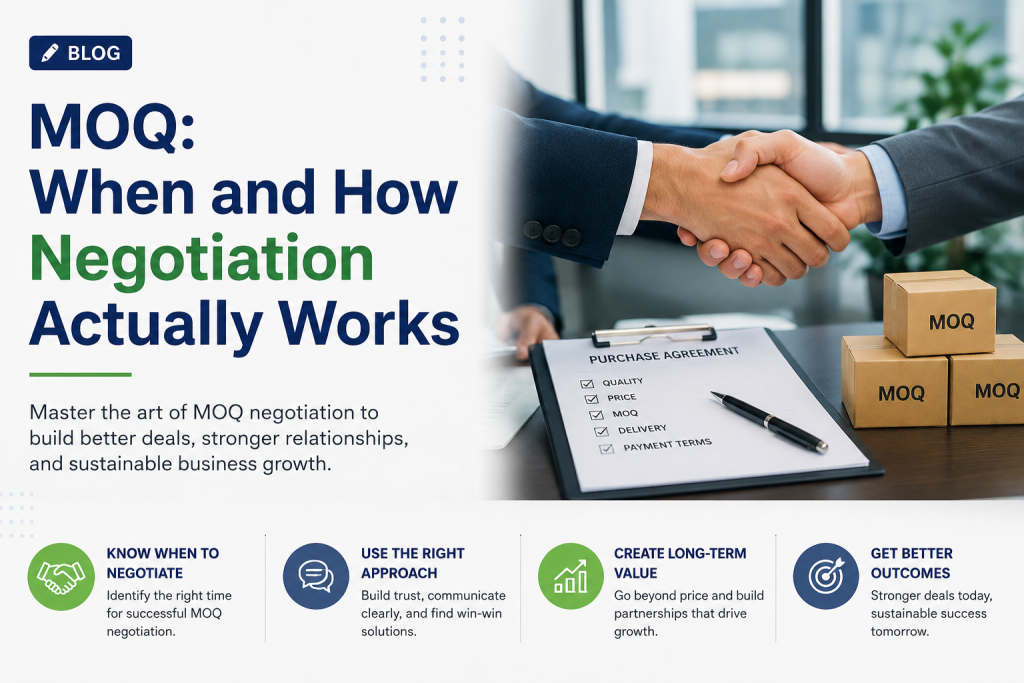
- When and How MOQ Negotiation Actually Works
- MOQ Blocking Your Project? Here’s How We Help
MOQ Detailed Guide
A client of mine once walked away from a supplier she loved. Great samples, fair pricing, quick replies. The deal died over one number: the factory wanted 5,000 units, she could only move 1,200 to start. She figured that was the end of it.
It wasn’t. We got the order placed at 1,500 with a small price bump. Took three emails.
That’s the thing about MOQ. Most people treat it like a locked door. It’s usually more of a heavy curtain. You just have to know where the edges are.
MOQ stands for minimum order quantity. It’s the smallest amount of a product a supplier is willing to make or sell you in a single order. Hit the number and they’ll run your production. Fall short and most of them won’t pick up the phone.
You’ll see MOQ written two ways. Sometimes it’s units, like 1,000 water bottles. Sometimes it’s dollars, like a $3,000 minimum spend across whatever mix of items you want. Both are common, and the second one trips up a lot of new buyers who only ask about unit counts.
MOQ sits at the front of almost every sourcing conversation, especially if you’re buying overseas. It shapes your cash flow, your storage needs, and honestly whether a product idea is even worth chasing. A killer product with a 10,000-unit minimum is a non-starter for someone testing the waters with a few grand.
So before you fall for a quote, ask for the MOQ. It tells you more about whether you can work with a factory than the unit price does.
It’s not about being difficult. Factories set MOQ because small runs lose them money.
Picture a production line. Before a single one of your units comes off it, someone has to set up the machines, swap out molds or tooling, calibrate the equipment, and pull staff onto the job. That setup costs the same whether you order 500 units or 50,000. Spread across 50,000 pieces, it’s pennies each. Spread across 500, it can wreck the whole margin.
Raw materials work the same way. Suppliers buy fabric, resin, metal, and components in bulk from their own vendors, and those vendors have minimums too. A factory can’t order a half-roll of custom-dyed fabric just because you want 200 shirts. The MOQ you see often rolls downhill from the MOQ the factory itself is stuck with.
Then there’s plain opportunity cost. A factory running your tiny order is a factory not running a bigger, more profitable one. Their time on the line is the product. MOQ protects it.
Once you see it from their chair, the number stops feeling like a wall and starts feeling like math. And math you can work with.
Here’s where people get confused. Two factories, same product category, wildly different minimums. What gives?
A few things move the needle more than anything else.
Tooling and molds come first. If your product needs a custom injection mold, that mold might cost a few thousand dollars to cut. The factory wants to spread that across enough units to make it worth their while, so the MOQ climbs. Off-the-shelf products with no custom tooling almost always have lower minimums.
Customization is the next big driver. A blank stock item the factory already makes? Low MOQ, sometimes none. Your logo printed on it? Higher. Your custom color, custom size, custom packaging? Higher still. Every change you ask for pushes the floor up, because the factory can’t resell your leftovers to anyone else.
Material sourcing matters too. If your product uses a common material the factory stocks daily, minimums stay low. If it needs a special component they have to order in, you inherit that component’s minimum. This is the silent reason behind a lot of surprise MOQs, and a good sourcing partner will catch it early. It’s a big part of what solid procurement intelligence is for.
Last one is the factory’s own size and focus. Big factories chase big clients and set big minimums. Smaller workshops live on flexibility and will take orders the giants laugh at. Knowing which factory to even approach is half the battle, which is exactly where global sourcing earns its keep.
Some products are just easier on the wallet when you’re starting small. If you’re testing a market or launching lean, lean toward these.
Stock products with light customization sit at the top. Think blank apparel with a printed logo, generic phone accessories, simple kitchen tools. The factory already makes the base item by the thousand, so adding your branding on a few hundred isn’t a stretch.
Print-on-demand and simple branded goods are friendly too. Mugs, tote bags, notebooks, stickers. The base product is mass-produced and your touch is a print layer on top. Minimums here can drop to a few dozen.
Apparel and textiles, surprisingly, can flex more than people expect, as long as you’re not demanding custom fabric. Order in existing colors and standard sizing and many factories will run 100 to 300 pieces.
Lightweight items with cheap materials round out the list. When the raw material cost per unit is low, the factory’s risk on a small run is low, so they bend. This is the sweet spot for first-time sellers, and it’s where a lot of our Amazon FBA sourcing clients get their start without blowing the budget.
Now the other side. Some products come with minimums that barely move no matter how charming your email is. Go in knowing this so you can budget for it.
Anything needing custom molds or tooling tops the list. Injection-molded plastics, die-cast metal parts, custom electronics housings. That upfront mold cost has to be earned back, so minimums of 3,000, 5,000, even 10,000 units are normal. You can sometimes negotiate the unit count, but the mold cost is the mold cost.
Custom-formulated products are rigid too. Cosmetics, supplements, cleaning products, anything with a recipe. The factory has to mix a batch, and batches have a minimum size set by their equipment. You can’t make a half-batch of face cream.
Electronics with custom components fall here as well. Custom PCBs, custom chips, special firmware. Each component drags its own minimum into your order, and they stack.
Packaging-heavy products can surprise you. Even if the item itself is flexible, custom rigid boxes, blister packs, or branded inserts often carry their own four-figure minimums. We see this constantly, which is why packaging optimization is a service on its own. Get the packaging strategy right and you can sometimes dodge a minimum you didn’t even know was coming.
Here’s the part everyone skips to. Can you actually talk a factory down? Yes. Sometimes. It depends on what you bring to the table.
First, know when negotiation has a real shot. You’ve got leverage when the product has no custom tooling, when you’re ordering during the factory’s slow season, when you can show you’ll reorder, or when you’re flexible on something they care about, like lead time or payment terms. You’ve got almost no leverage when the MOQ is driven by a mold or a raw-material batch. Pushing hard there just wastes goodwill.
Once you know you’ve got room, here’s what actually moves the number.
Offer to pay more per unit. Thisade. You want half the MOQ, so you offer to cover part of the lost efficiency with a higher unit price. Factories say yes to this more than any other ask, because their math still works. A 15 to 30 percent price bump on a smaller run is often the magic range.
Bundle a future commitment. Tell them this first order is a test, and put a realistic reorder plan in writing. Factories care about repeat customers far more than one-off buyers. “1,500 now, 5,000 in Q3 if it sells” is a sentence that opens doors. Real, signed reorder terms work even better. This kind of relationship-building over time is the heart of good supplier negotiation and cost optimization, and it pays off long after the first deal.
Be flexible on the stuff they care about. Take their standard color instead of your custom one. Accept their stock packaging for the first run. Give them a looser deadline so they can slot you into a gap in their schedule. Every bit of flexibility you offer is a chip you can trade for a lower minimum.
Order multiple products from one factory. Remember the dollar-value MOQ? You can sometimes hit a minimum by combining several items into one order, so no single product needs to hit its own count.
And timing matters more than people realize. Reach out during a slow stretch, like right after a big seasonal rush, and a factory hungry for work will bend further than one buried in orders.
One warning. If a factory drops their minimum to almost nothing with zero pushback, slow down. Sometimes that’s a trading company quietly marking up the price, not a real factory. Sometimes it’s a quality risk. A minimum that’s too good can cost you more than a fair one, which is why quality control checks aren’t optional once you’ve got an aggressive deal on the table.
Most MOQ headaches come down to one thing: you’re talking to the wrong factory, or you’re negotiating without knowing where the real floor sits. We fix both.
We’ve spent years inside Chinese and global supply chains, and we know which factories actually flex and which ones are wasting your time. Instead of you cold-emailing twenty suppliers and getting ghosted, we match your order size to factories that want it. Our procurement outsourcing service handles the back-and-forth so you’re not stuck decoding broken-English quotes at midnight.
Still in the idea stage? We help shape the product before you ever hit a minimum, so you don’t design yourself into a 10,000-unit corner. That’s the work behind product idea development, and it saves people real money. If you want a sense of the kind of results we deliver, the numbers speak for themselves.
You can book a free call and walk us through your product, or just reach out here and tell us what’s stuck. We’ll tell you straight whether your MOQ is negotiable, what it’ll cost to get it down, and which factory to talk to.
MOQ isn’t the end of your idea. It’s just a number waiting for the right conversation.