
| Table of Contents |
| The Origin of Huaqiangbei |
| One-Meter Counters in Huaqiangbei Market |
| Shanzhai (Copycat) Mobile Phones |
| Eight Recommended Markets in Huaqiangbei |
| Seven Tips for Sourcing in Huaqiangbei |
| Sourcing Electronics from Huaqiangbei? Here’s How We Help |
There’s a story that gets told about Huaqiangbei, and I half believe it. A buyer hands a vendor a photo of a brand-new phone that launched in the US that morning. The vendor nods, makes a call, and says come back in 72 hours. Three days later there’s a working clone on the counter.
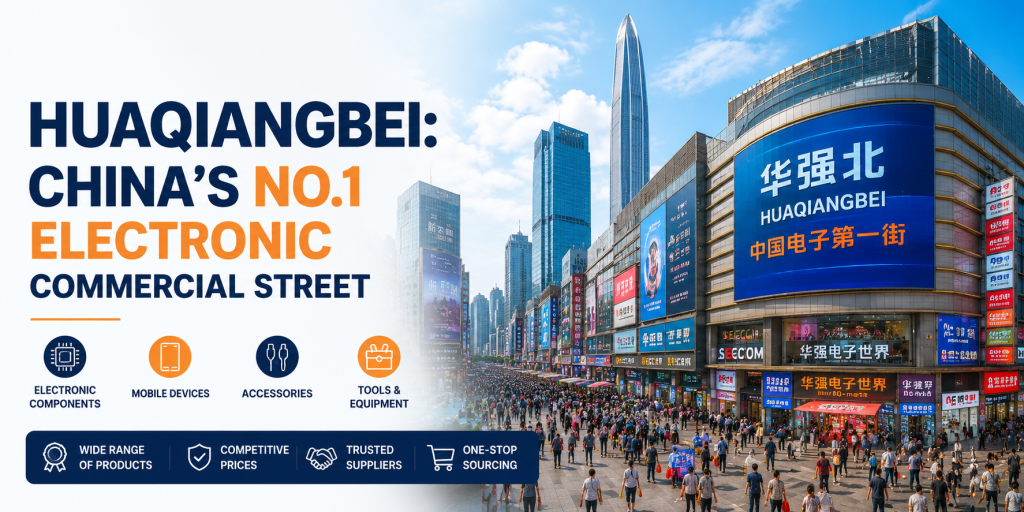
Whether or not that exact thing happened, it captures something real about this place. Huaqiangbei isn’t just a market. It’s the nervous system of the global electronics trade, packed into a few square kilometers of Shenzhen. If a chip, a cable, a screen, or a circuit board exists anywhere on earth, you can probably buy it here by the afternoon.
I’ve sourced from Huaqiangbei more times than I can count, and it still amazes me. It also still trips up first-timers in the same predictable ways. So let me walk you through what it is, how it got here, and how to shop it without getting fleeced.
The Origin of Huaqiangbei
Huaqiangbei didn’t start as an electronics bazaar. It started as a manufacturing district.
Back in the early 1980s, when Shenzhen became China’s first special economic zone, this stretch of the city filled up with electronics factories. State-owned plants, assembly lines, component makers. The name itself comes from one of those early companies, and “bei” just means north, marking the northern end of Huaqiang Road.
For the first decade or so, this was a place where things were built, not sold. But factories need parts, and parts need sellers. Little shops started popping up to feed the assembly lines with components. Resistors, capacitors, wiring, connectors. What began as a supply chain for local manufacturing slowly turned into a marketplace of its own.
Then the 1990s hit and everything accelerated. The factories that made Shenzhen famous started moving to cheaper land on the outskirts, and the central Huaqiangbei district was left with all this commercial real estate and a deep, dense network of people who knew electronics cold. The shops took over. By the 2000s, Huaqiangbei had transformed into the largest electronics trading hub in the world, a title it still holds.
What makes it special isn’t just size. It’s the concentration. Within a short walk you can buy a single transistor, a finished smartphone, the machine that assembles smartphones, and the engineer who’ll redesign your circuit board over lunch. That whole ecosystem living in one place is why hardware startups from all over the planet make the pilgrimage here. It’s also why serious global sourcing for electronics almost always runs through Shenzhen at some point.
One-Meter Counters in Huaqiangbei Market
Here’s a detail that confuses almost every first-time visitor. You walk into one of the big markets expecting stores, and instead you find counters. Hundreds of them. Thousands. Each one about a meter wide, jammed side by side in endless rows like a stock exchange floor for electronics.
This is the famous one-meter counter system, and once you understand it, the whole market makes sense.
Each counter is its own tiny business. The person sitting behind it might specialize in nothing but USB-C connectors, or camera modules, or a specific family of microchips. One meter of counter space, one narrow specialty, often run by a single trader who knows their corner of the market better than anyone alive.
It looks chaotic. It isn’t. It’s hyper-specialization at a scale that’s hard to picture until you see it. Need a particular obsolete chip that the manufacturer stopped making in 2009? Somewhere in these counters is a person who has a drawer full of them. Need ten thousand of a common component by tomorrow morning? Three counters away, someone can make that happen.
The counters work because they’re connected. The trader in front of you might not physically have your part, but they have a network. They’ll make a call, someone runs it over from a warehouse, and the deal closes. The visible market is just the front end of a massive, invisible web of stock.
For a buyer, this system is a gift and a trap. The gift is selection and speed nothing else on earth can match. The trap is that quality and authenticity vary wildly from counter to counter, and you can’t tell the good operators from the sketchy ones by looking. That’s exactly where solid procurement intelligence earns its money, because knowing which counters to trust is most of the game.
Shanzhai (Copycat) Mobile Phones
You can’t talk about Huaqiangbei without talking about shanzhai. The word literally means “mountain stronghold,” an old term for bandits operating outside official control, and it got attached to the copycat electronics culture that Huaqiangbei became famous for.
In the 2000s and early 2010s, this place was the global capital of knockoff phones. Clones of iPhones, Samsungs, Nokias, often with wild twists the originals never had. Phones with two SIM slots before that was normal. Phones with built-in TV antennas. Phones shaped like cigarette packs, cars, or cartoon characters. The shanzhai makers weren’t just copying. They were remixing, fast and fearless, and selling for a fraction of the brand-name price.
I want to be clear and honest here, because this matters for any legitimate buyer. Straight-up counterfeits that copy a brand’s logo and trademark are illegal, and they’ll get your shipment seized at customs and you sued. That’s not a sourcing strategy. That’s a lawsuit waiting to happen. If you’re building a real business, you stay far away from trademark-infringing goods, full stop. Protecting your own brand with proper trademark and patent registration is the flip side of this same coin, and it’s worth doing early.
But the shanzhai story has a more interesting second half that’s easy to miss. That same culture of fast, cheap, fearless iteration is what made Shenzhen the hardware innovation capital it is today. The skills the shanzhai makers built, designing a working phone in weeks, sourcing every component locally, manufacturing at insane speed, didn’t disappear. They evolved. A lot of today’s legitimate Shenzhen hardware startups grew straight out of that ecosystem.
So the modern reality is split. The illegal counterfeit trade still exists in corners, and you should avoid it completely. But the same infrastructure now powers a thriving market in white-label and OEM products, unbranded electronics you can legally buy, put your own brand on, and sell. That’s the legitimate version of the shanzhai magic, and it’s where the real opportunity is. Turning a rough idea into a real, branded, legal product is the whole point of product idea development, and Huaqiangbei is one of the best places on earth to do it.
Eight Recommended Markets in Huaqiangbei
Huaqiangbei isn’t one building. It’s a district of them, each with its own focus. Wandering in blind wastes days, so here are eight worth knowing, and what each is actually good for.
SEG Electronics Market is the one everyone knows, and for good reason. It’s the landmark, a towering building packed floor after floor with components, gadgets, and finished products. It’s a great first stop because it gives you the whole range in one place, from raw parts to assembled devices. Crowded, busy, and a solid orientation point.
Huaqiang Electronic World is another giant, heavy on components and electronic parts. If you’re sourcing the building blocks, chips, modules, connectors, this is prime territory. Deep selection and serious traders who know their stock.
SEG Communication Market focuses on phones and phone accessories. Cases, chargers, cables, screens, batteries, repair parts. If your business touches mobile accessories, you can fill an entire catalog here in an afternoon.
Long Sheng Communication Market is another mobile-focused spot, strong on phones and the parts that go into them. Good for repair-shop supplies and accessory sourcing, often with sharper pricing if you compare against the bigger halls.
Yuanwang Digital Mall (sometimes called Yuanwang or the “international” market) leans toward finished consumer electronics and digital gadgets. Headphones, speakers, smart devices, the kind of stuff you’d put on a retail shelf. More consumer-facing than the raw-component halls.
Manhar Digital Plaza is worth a look for digital products and accessories, with a mix of consumer gear and components. A useful stop to cross-check prices you’ve seen elsewhere in the district.
Tongtian Ground Communication Market specializes heavily in mobile phone parts and repair components. If you run or supply phone repair operations, this is a goldmine of screens, flex cables, batteries, and the small parts that are hard to find elsewhere.
Huaqiang Plaza rounds out the list as a broad market covering a wide spread of electronics, good for general browsing and for filling gaps when a specific counter elsewhere came up empty.
A word on strategy. Don’t try to hit all eight in one trip unless you have days to burn. Pick the two or three that match your product, go deep, and compare prices across them. The same item can swing 20 or 30 percent between buildings, and the only way to know is to walk it. If that legwork sounds brutal, it is, which is one reason buyers hand it to a procurement outsourcing team that already knows which floor and which counter to head straight for.
Seven Tips for Sourcing in Huaqiangbei
I’ve made plenty of mistakes in these markets. Here are seven things I wish someone had told me before my first trip.
First, always test before you pay. This is the big one. Plug it in. Power it on. Check the screen, the ports, the buttons. The market moves fast and not every counter stands behind what they sell, so once you’ve handed over cash and walked away, you’ve usually lost any recourse. Bring a power bank, a multimeter if you’re buying components, and the patience to actually check what you’re buying.
Second, watch out for refurbished and recycled parts sold as new. This is everywhere in the components and phone-parts world. A chip that’s been pulled off an old board, cleaned up, and re-sold as factory-fresh looks identical to the untrained eye but can fail fast. Ask directly whether parts are new or recycled, and learn the visual tells, or bring someone who knows them. A proper quality control inspection catches this before it ends up in your product.
Third, negotiate, but understand the floor. Prices here have room, especially as quantity climbs. But Huaqiangbei already runs on thin margins, so don’t expect to slash a price in half the way you might at a tourist market. Push politely, buy more to get better unit pricing, and know that real leverage comes from volume and repeat business. That’s the core of any good supplier negotiation and cost optimization.
Fourth, mind the minimums. Some counters will sell you a single piece. Many want a minimum quantity, especially for anything custom or branded. The minimum can also be a clue about who you’re dealing with, since a counter that’s really a reseller behaves differently from one tied to a factory. If MOQ is new to you, it’s worth understanding how MOQ works and when you can negotiate it before you start haggling.
Fifth, separate the traders from the factories. Most counters are traders, middlemen who buy from factories and mark up. That’s fine for small quantities and fast turnaround. But if you’re ordering in real volume or need custom work, you want to get closer to the actual manufacturer to cut the markup and control quality. Figuring out who’s who is hard from the front of a one-meter counter, and it’s a big part of what an experienced sourcing partner sorts out for you.
Sixth, bring a translator or local help. English is limited once you get past the surface, and the real prices, the real conversations, and the real relationships happen in Chinese. A good translator who understands electronics, not just language, pays for themselves many times over by the end of a single day.
Seventh, plan your logistics before you buy a thing. This is where solo buyers fall apart. You buy from fifteen counters across four buildings and suddenly you’ve got fifteen bags of fragile electronics that someone has to gather, test, repackage, and ship safely overseas, often through customs that scrutinizes electronics. Without a consolidation plan, the savings you fought for at the counter evaporate in shipping headaches and damaged goods. If you’re moving serious quantity, handing the whole flow to a bulk sourcing operation in China turns chaos into one clean shipment.
One more honest note that doesn’t fit neatly into a numbered tip. The biggest hidden cost of doing Huaqiangbei yourself isn’t the parts. It’s the flights, the hotels, the days off work, and the risk of going home with a batch that doesn’t work. When buyers weigh that against hiring help, the math often surprises them, which is why our breakdown of China sourcing agent cost is worth a read before you book anything.
Sourcing Electronics from Huaqiangbei? Here’s How We Help
Here’s the straight truth. You can fly to Shenzhen and figure Huaqiangbei out yourself. People do it every week. But electronics are unforgiving. One bad batch of recycled chips, one counterfeit issue at customs, one vendor who vanishes after you’ve paid, and your whole project stalls.
We’re already on the ground, and we know this district the way you know your own neighborhood. We know which counters sell genuine new parts and which ones recycle. We know how to find the factory behind the trader so you’re not paying a stack of middleman markups. And we know how to test, consolidate, and ship electronics so they arrive working and clear customs clean.
Instead of you burning a week wandering eight markets, our procurement outsourcing service does the walking, the vetting, and the negotiating for you. Still shaping your idea? We help take it from concept to a real, legal, branded product through product idea development, so you don’t accidentally design yourself into a trademark problem or an impossible bill of materials. If you want proof, the kind of results we deliver speaks for itself.
You can book a free call and tell us what you’re trying to build, or just reach out here with your product and target quantity.
Huaqiangbei is the greatest electronics market in the world. It can build your business or eat your budget, and the difference is mostly knowing who to trust. Now you’ve got a head start.