
| Table of Contents |
| How Does Payment Actually Work on Alibaba? |
| What Is the Safest Way to Pay on Alibaba? |
| What Is the Most Cost-Effective Way to Pay Alibaba Suppliers? |
| How to Negotiate Payment Terms With Suppliers |
| Frequently Asked Questions |
| Worried About Paying Suppliers? Here’s How We Help |
how to pay Alibaba suppliers Detail Guide
When it comes to paying suppliers on Alibaba, buyers really only worry about two things. Is my money safe? And am I paying more than I have to?
Everything else is noise. So this guide skips the click-by-click checkout tour Alibaba already gives you and focuses on the actual decisions, the ones that cost you money or peace of mind if you get them wrong. Which method, at which order size, with how much protection, and where the fees are really hiding.
Let’s get into it.
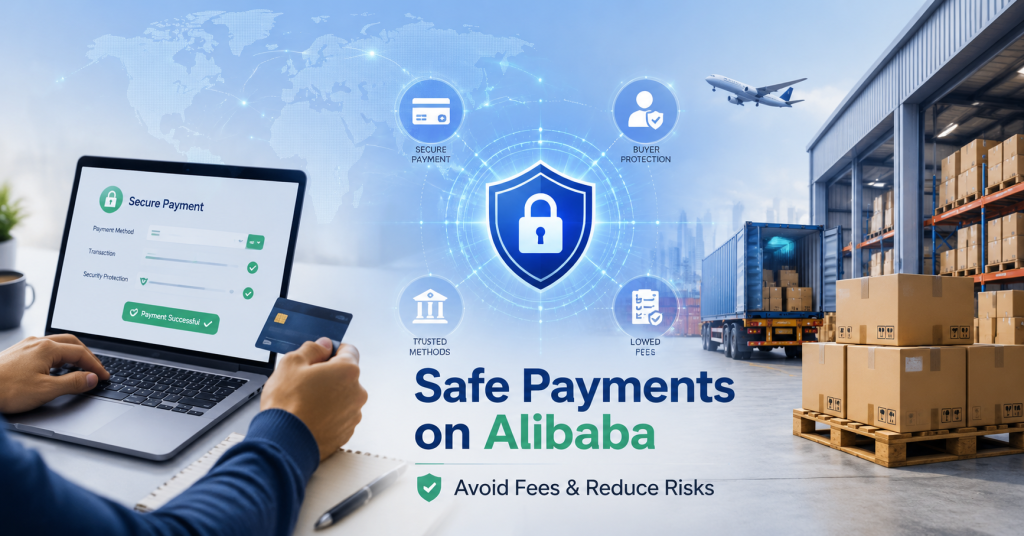
How Does Payment Actually Work on Alibaba?
You’ve got two broad roads. Pay through Alibaba, or pay the supplier directly. They behave completely differently, so know which one you’re on.
Pay through Alibaba and your order is covered by Trade Assurance, Alibaba’s buyer-protection program. Your payment is effectively held against an agreement until you confirm the goods are right. That protection comes with two kinds of fees, and it’s worth knowing who actually pays each.
The first is the platform service fee charged to the supplier. Alibaba bills suppliers roughly 2 to 3 percent per transaction, capped somewhere around $100 to $350. On paper that’s the supplier’s cost. In reality, most suppliers quietly bake it into their unit price, so you’re often paying it without seeing it on your invoice.
The second is the buyer-side payment processing fee. This one’s on you, usually around 2.99 percent or a flat fee depending on the method you pick. Here’s the part worth understanding: that fee mostly passes through to banks and payment providers. Alibaba isn’t padding it with a big markup. You’re paying the cost of moving money internationally, not an Alibaba tax.
For a first order, or any time you’re dealing with a supplier you don’t know yet, that processing fee is cheap insurance. Paying 3 percent to keep a refund path beats saving 3 percent and eating a $5,000 loss. Alibaba’s own Trade Assurance overview is worth a quick read for the fine print.
Then there’s the other road: paying suppliers directly. Wire straight to their bank by T/T, or worse, Western Union or MoneyGram. It looks cheaper because you dodge the 2.99 percent. But you also throw away every shred of buyer protection. If the supplier vanishes, ships defective goods, or sends something that doesn’t clear customs, you’re on your own with no one to call. Sometimes a direct wire is fine, once trust is earned. On a first order with a stranger, it’s how people lose everything. Knowing which suppliers have actually earned that trust is exactly what real procurement intelligence is for.
What Is the Safest Way to Pay on Alibaba?
The single safest setup is Trade Assurance paid with a credit card or PayPal.
Why those two? Because you get double protection. Alibaba’s own dispute system on one side, and your card issuer’s or PayPal’s chargeback rights on the other. If a dispute somehow slips past Alibaba, your bank is still standing behind you. Two safety nets instead of one.
This is the right call for small orders. Samples, test runs, first orders in the few-hundred to roughly $1,000 range. The fee stings a little, but at that order size the protection is everything and the dollar cost of the fee is small.
It’s the wrong call for large orders, and here’s the honest reasoning. Credit card processing fees are percentage-based, so on a $30,000 order that 3 percent becomes a painful $900. And many Chinese suppliers flat-out refuse PayPal on big transactions because the fees gut their margin and chargebacks scare them. Push PayPal on a large order and you’ll either get refused or watch the supplier pad the price to cover it.
One more thing safety-minded buyers forget. Trade Assurance protects you against a supplier not delivering. It does not automatically guarantee the goods are good. A supplier can ship exactly what a vague agreement said and still send junk. That’s why the safest buyers pair payment protection with a real quality control inspection before the balance releases. Protection plus inspection is the combo. Either one alone leaves a gap.
What Is the Most Cost-Effective Way to Pay Alibaba Suppliers?
Cost and safety pull in opposite directions, so the cheapest method depends almost entirely on your order size. Here’s the real decision tree.
For large orders, wire transfer (T/T) wins. Bank fees on a wire are mostly flat, usually around $40 to $80 depending on intermediary banks, with no upper limit on the amount. So on a big order that flat fee is a rounding error next to a percentage-based card fee. Processing takes about 3 to 7 business days for an international wire.
If your country supports it, domestic or local T/T is even better. Alibaba automatically prioritizes a local payment channel when one’s available, and these run cheaper and faster, sometimes a fee as low as a single unit of local currency and processing in 1 to 2 business days, with transfer limits up to around $1 million per transaction. The catch is availability. Local T/T mainly exists in developed markets like the US, Canada, Germany, the UK, and France, plus a handful of emerging ones like Indonesia, Malaysia, and the Philippines. If you see it at checkout, take it.
Online banking is the sweet spot for mid-size orders, and how it’s priced depends on your region.
Some regions use capped percentage fees. In the US, for example, online banking runs about 2.99 percent capped at $30. That cap is the magic. On any order above $1,000 the fee maxes at $30, which makes online banking the cheapest option fast. Below $1,000, a card or PayPal is usually faster and safer for the same money.
Other regions use a flat fee, typically around $15 per transaction regardless of order size. Trustly covers much of Europe (Sweden, Denmark, Norway, Germany, the UK, and others), iDEAL handles the Netherlands, and Pix (Brazil), Pay-easy (Japan), and FPX (Malaysia) work similarly. Processing ranges from a couple of hours to 1 to 2 business days. A flat $15 is a great deal on a mid-to-large order. On a tiny order under $500, though, a percentage method like a card can actually come out cheaper.
A couple of extras worth knowing. Buy Now, Pay Later options like Klarna and Afterpay are spreading across the US, Canada, and Europe, usually 3 to 4 interest-free installments. For the buyer they carry fees similar to credit cards and come with amount limits, so they suit small orders. And Letter of Credit (L/C) exists but almost nobody uses it for normal sourcing. Higher bank fees, stricter paperwork, longer timelines. Skip it unless you have a specific reason.
If you’re paying outside Alibaba’s local channels, watch the exchange rate too. The quiet cost in a lot of international payments isn’t the fee, it’s a bad conversion rate your bank bakes in. Services like Wise (https://wise.com) or Payoneer (https://www.payoneer.com) often beat a bank’s rate by enough to matter on a big transfer. And combining several small orders into one larger one trims both product cost and payment overhead, which is part of why bulk sourcing from China saves money in places people don’t expect.
The short version: big order, wire it. Mid-size with a fee cap or flat fee available, use online banking. Small order or new supplier, pay the small fee for card or PayPal protection and sleep fine.
How to Negotiate Payment Terms With Suppliers
The standard term is 30/70. Thirty percent deposit to start production, seventy percent balance before shipping or against the bill of lading. It’s fair, it’s normal, and it’s where almost everyone starts.
Whether you can move it comes down mostly to one thing: your order size.
On small orders, there’s usually little room. Most suppliers hold firm at 30/70, and honestly that’s fine. For orders in the few-hundred to roughly $1,000 range, your energy is better spent finding a reliable supplier who’ll even take a small order, and arranging a quality control inspection in China before you pay the balance. That inspection is how experienced buyers manage risk when the terms themselves won’t budge. Your order size and the supplier’s minimums shape this whole conversation, so it helps to understand how MOQ works and when you can negotiate it before you start.
As your order value climbs, or as you become a repeat buyer, the door opens. Suppliers get far more willing to offer a smaller deposit, or deferred terms like OA 30 days, where you pay 30 days after receiving the goods. That kind of leverage is built over time, and it’s the core of real supplier negotiation and cost optimization. The best lever you’ll ever have is a credible promise of repeat orders. “Better terms now, and I’ll reorder every quarter if this goes well” moves suppliers more than haggling on a single deal.
For larger orders, especially anything over about $10,000, smart buyers add a factory audit before placing the order, not just an inspection after. An audit verifies the supplier can actually produce at the quality and volume promised. It’s the difference between trusting a website listing and trusting a verified factory.
And one hard rule. Be very wary of any supplier demanding 100 percent upfront, particularly to a personal account. Established factories expect deposit-and-balance. A demand for everything in advance is one of the oldest scam patterns there is. The other trap is negotiating great terms with the wrong company entirely. Plenty of “suppliers” on Alibaba are trading companies marking up a factory’s price, and they have less room to flex because the margin isn’t theirs. Knowing whether you’re talking to the real factory changes the whole negotiation, and sorting that out before you wire a deposit is a big part of what a procurement outsourcing team handles.
Frequently Asked Questions
Is it safe to pay Alibaba suppliers by bank transfer?
A direct wire (T/T) is the cheapest way to move large amounts, but on its own it gives you no buyer protection. Once it clears, the money’s gone if the supplier doesn’t deliver. It’s reasonable for trusted suppliers and big orders, but for a first order with someone new, pay through Trade Assurance so you keep a refund path.
Who actually pays the Alibaba transaction fee, the buyer or the supplier?
Both, in different ways. Alibaba charges suppliers a platform service fee of around 2 to 3 percent (capped near $100 to $350), which most suppliers fold into their price, so buyers indirectly cover it. Buyers also pay a separate processing fee of roughly 2.99 percent or a flat amount, which mostly passes through to banks rather than to Alibaba.
What’s the cheapest way to pay for a large Alibaba order?
A wire transfer, because its fee is flat (around $40 to $80) with no upper limit, so it barely registers on a big order. If your country supports local or domestic T/T or capped online banking, those can be cheaper and faster still. Avoid percentage-based card fees on large orders.
Should I ever pay a supplier’s personal bank account?
No. Legitimate suppliers receive payment to a company account matching their registered business name. A request to pay a personal account, or one in a different name or country, is a major scam signal. Stop and verify first.
When can I negotiate better payment terms than 30/70?
Mostly as your order size grows or you become a repeat buyer. Large or recurring orders can earn a smaller deposit or deferred terms like OA 30 days. On small first orders, terms rarely move, so manage risk with an inspection instead.
Worried About Paying Suppliers? Here’s How We Help
Here’s the truth that gets lost in fee tables. The payment method is rarely the real risk. The real risk is who you’re paying and whether the goods are any good. Trade Assurance protects the transaction, but it can’t confirm your supplier is a real factory instead of a marked-up middleman, and it can’t tell you the product is right before your balance releases.
That’s our job. We vet suppliers before a dollar moves, run factory audits on bigger orders, and structure terms that tie your balance payment to a passed inspection, so you never pay full price for a bad batch. The whole flow, from vetting to terms to inspection to shipping, runs through our procurement outsourcing service. If you want a sense of the kind of results we deliver, the numbers speak for themselves.
You can book a free call and walk us through your order, or just reach out here with your supplier and product details.
Pay safely by following one rule: keep your protection until you’ve confirmed the goods are real and right. Match the method to your order size, and you’ll stop overpaying on fees at the same time.