
| Table of Contents |
| Selling on Amazon: A Quick Walkthrough |
| How to Find the Right Product to Sell on Amazon |
| Sourcing Your Amazon Product: What Are Your Options? |
| Why Choose Sourcing Agents Over Manufacturers? |
| How eSourcing Solution Can Help You Sell Products on Amazon |
| Frequently Asked Questions |
| Final Thoughts |
how to sell products on Amazon: The Latest Guide
I’ve watched a lot of people start an Amazon business, and the ones who fail almost never fail at the Amazon part. Setting up a seller account, listing a product, that’s the easy stuff. They fail at the product. Wrong product, wrong supplier, or a great product sourced so badly the margins disappear.
So while this guide covers how to sell on Amazon end to end, I’m going to spend most of it on the part that actually decides whether you make money: finding and sourcing the right product. Get that wrong and the slickest listing in the world won’t save you. Get it right and the rest mostly takes care of itself.
Let’s start with the setup, then get to the part that matters.
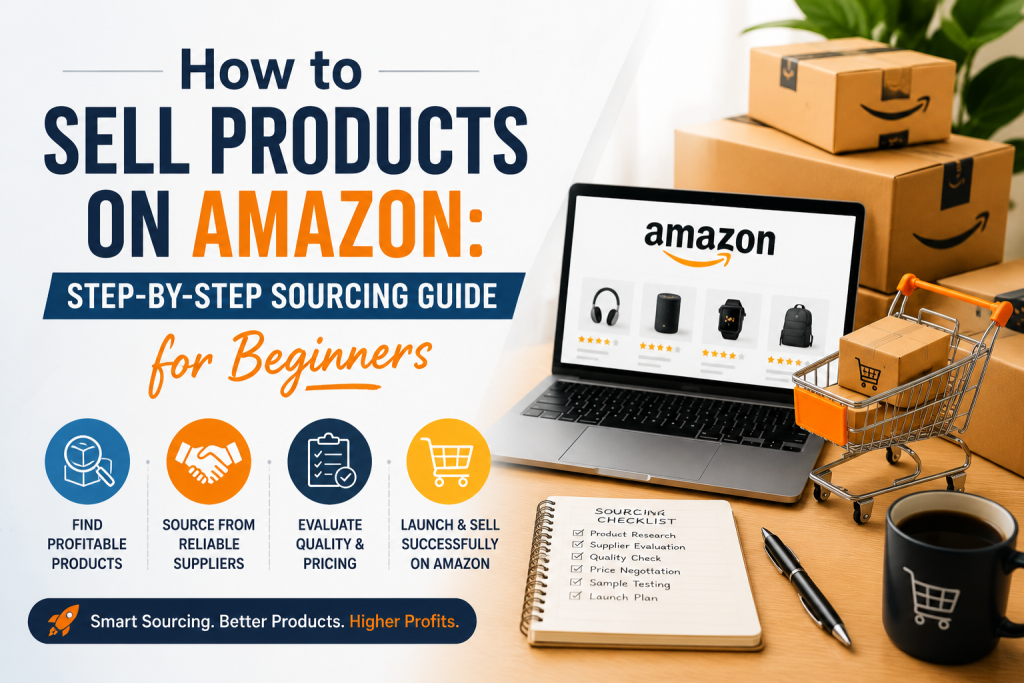
Selling on Amazon: A Quick Walkthrough
Before the product talk, here’s the lay of the land, the selling models and the basic steps to get a store live.
Types of Amazon Selling Models
There are a handful of ways to sell on Amazon, and the one you pick shapes everything else.
Private label is the big one, and it’s what most serious sellers chase. You find a product, put your own brand on it, and sell it as yours. More upfront work, but you own the brand and the margins, and you’re not in a price war with a hundred identical listings. This is where sourcing matters most, because you’re commissioning your own product.
Wholesale means buying branded products in bulk from a manufacturer or distributor and reselling them. Lower branding effort, but you’re competing on someone else’s product, often against the brand itself.
Retail and online arbitrage is buying cheap retail stock and flipping it on Amazon. Low barrier, but it doesn’t scale well and the margins are thin.
Dropshipping has you list products that ship directly from a supplier when an order comes in. Low upfront cost, but tight margins and Amazon has strict rules about it.
Handmade is Amazon’s lane for artisans selling their own crafted goods.
For anyone building a real business, private label is usually the play, and that’s the model this guide leans toward, because it’s the one where smart sourcing turns into real profit.
How to Sell Products on Amazon: Basic Steps to Get Started
Here’s the practical sequence to get from zero to a live store.
Step 1: Choose a selling plan. Amazon offers two. The Individual plan charges a small per-item fee and suits very low volume or testing. The Professional plan is a flat monthly fee and makes sense once you’re selling more than a handful of units a month, which is almost everyone serious. Most sellers go Professional from the start.
Step 2: Create your Seller Central account. This is your command center. You’ll need your business details, a bank account, tax information, and a valid ID. Set this up carefully and accurately, because account issues later are a genuine headache to untangle.
Step 3: Enroll in Brand Registry (optional but recommended). If you’re private labeling, registering your brand unlocks better listing tools, protection against hijackers copying your listing, and access to features like A+ Content. It requires a registered trademark, which is worth getting anyway. Protecting your brand early with proper trademark and patent registration saves you real grief once you start selling well and copycats appear.
Step 4: List your products. Create your product listing with a clear title, quality images, bullet points that sell the benefits, and an accurate description. This is your storefront, so it’s worth doing well, but remember a great listing for a bad product still loses.
Step 5: Set prices and fulfillment method. Decide your pricing (factoring in all your costs and Amazon’s fees), and choose how you’ll fulfill orders. Fulfilled by Amazon (FBA) means Amazon stores, packs, and ships for you and handles customer service, which gets you Prime eligibility. Fulfilled by Merchant (FBM) means you handle it yourself. Most private label sellers use FBA for the Prime badge and the hands-off logistics.
Step 6: Launch and monitor performance. Go live, then watch your metrics, sales, reviews, ad performance, inventory levels, and adjust. The launch is the beginning, not the finish line.
That’s the whole setup. Notice how mechanical it is. None of it is where businesses are won or lost. That happens earlier, in the product choice, which is where we go now.
How to Find the Right Product to Sell on Amazon
This is the single most important decision you’ll make, so slow down here. Picking the right product is most of the battle.
What Makes a Product Good?
After seeing plenty of winners and losers, here’s what actually separates a good Amazon product from a money pit.
Healthy demand, manageable competition. You want a product people are actively searching for and buying, but not one so saturated that you’re the thousandth identical listing. The sweet spot is proven demand with room to differentiate.
A sensible price range. Products in the rough $20 to $50 range tend to work well for new sellers. Below that, margins get squeezed after Amazon’s fees and ad costs. Way above it, buyers hesitate and your cash gets tied up in expensive inventory.
Small, light, and durable. Shipping and storage cost real money, and fragile items mean returns and damage claims. A small, sturdy product keeps your costs down and your headaches few.
Not seasonal, not restricted. Year-round demand beats a product that only sells in December. And steer clear of restricted or heavily regulated categories (certain electronics, supplements, anything with safety certifications) until you know what you’re doing, because the compliance burden can sink a beginner.
Room to improve on what exists. The best opportunities are products where the current listings have a clear weakness, mediocre quality, weak photos, common complaints in the reviews, that you can beat. Reading the negative reviews of your competitors is one of the most useful things you can do, because customers will literally tell you how to build a better product. Turning those insights into an actual improved product is exactly what product idea development is about.
Which Tools to Use for Amazon Product Hunting?
You don’t have to guess. There are solid tools built for exactly this research.
Jungle Scout (https://www.junglescout.com) is the best-known, giving you estimated sales, revenue, and competition data right on Amazon listings, plus a product database you can filter. Helium 10 (https://www.helium10.com) is the other heavyweight, a full suite covering product research, keyword research, and listing optimization. Both are paid, and both pay for themselves fast if they steer you away from one bad product.
Amazon itself is free research. The Best Sellers lists, the “Customers also bought” sections, the autocomplete suggestions in the search bar, all of it tells you what’s selling and what people are looking for. And Google Trends helps you check whether a product’s demand is rising, steady, or quietly dying.
The tools give you the numbers, but the judgment is still yours. Data tells you a product sells; it can’t tell you whether you can source it well at a price that leaves you a margin. That’s where the next part comes in, and where a lot of promising products fall apart.
Sourcing Your Amazon Product: What Are Your Options?
You’ve found a product. Now you have to actually get it made and into Amazon’s warehouse, profitably. This is where the real work lives, and you’ve basically got two roads.
DIY Sources
The do-it-yourself route means finding and managing suppliers on your own, usually through platforms like Alibaba, 1688, or by visiting markets in China such as Yiwu.
It can absolutely work, and going direct can mean lower costs. But it’s a lot to carry alone. You’re vetting suppliers you can’t see, communicating across a language gap and a time zone, negotiating terms and minimums, arranging samples, checking quality, sorting out shipping and customs, all yourself. For a first-timer, any one of those can go wrong expensively. I’ve seen people wire deposits to “factories” that turned out to be middlemen, or receive a bulk order that looked nothing like the sample. The savings are real if you know what you’re doing. The risks are just as real if you don’t.
Sourcing Agents
The other road is a sourcing agent, someone on the ground in China who handles the supplier side for you. You tell them the product and your requirements, and they find suppliers, negotiate, check quality, and arrange shipping.
You pay a fee for this, but it buys you local knowledge, language, relationships, and a buffer against the expensive mistakes. A good agent already knows which suppliers are reliable and which to avoid, which alone can save you more than the fee. This is the core of what procurement outsourcing does, and for most new Amazon sellers it’s the difference between a smooth first order and a costly lesson. If you’re weighing the cost, our honest breakdown of China sourcing agent cost lays out the real numbers so you can compare.
Why Choose Sourcing Agents Over Manufacturers?
People often ask why not just go straight to the factory and cut out the middleman. Fair question, and there are real reasons an agent often beats going direct, especially when you’re starting out.
Lower MOQs
Factories want volume. Their minimum order quantities are often far higher than a new seller can handle, sometimes thousands of units for a product you wanted to test with a few hundred. A sourcing agent can often negotiate a lower minimum, or combine orders, or find a supplier whose minimum actually fits your budget. Understanding how MOQ works and when you can negotiate it is one of the biggest early hurdles, and an agent shortcuts it for you.
Faster and Clearer Communication
Dealing with a factory directly often means slow replies, a language barrier, and specs getting lost in translation. An agent who speaks both languages and understands your goals communicates fast and clearly, catching the misunderstandings before they become a wrong production run. That speed matters when you’re racing to get a product launched.
Better Control
This is the big one. An agent on the ground can actually visit the factory, check the production, and inspect your goods before they ship, things you simply can’t do from another continent. That oversight is your protection against paying full price for a bad batch. Pairing your order with real quality control inspection is the closest thing to a guarantee you’ll get, and it’s far harder to arrange when you’re going direct and solo.
To be fair, once you’re at serious scale with a proven product and a trusted factory relationship, going more direct can make sense to squeeze costs. But for finding, testing, and launching products, especially your first ones, an agent’s flexibility and oversight usually win.
How eSourcing Solution Can Help You Sell Products on Amazon
Here’s where we fit, and what we actually do to make your Amazon sourcing work.
Yiwu Market Advantage
We’re plugged into Yiwu and the wider Chinese supply network, the largest small-commodities market on earth. That means access to a vast range of products and the supplier relationships to get you good prices and reliable quality. For a lot of Amazon products, especially in homeware, accessories, and general merchandise, this is a serious edge, and it’s built on years of hands-on global sourcing.
Amazon Prep Services
Getting a product made is only half of it. Amazon has strict requirements for how inventory arrives at its warehouses, labeling, packaging, poly bagging, carton specs, and getting any of it wrong means rejected shipments and delays. We handle the FBA prep so your goods arrive compliant and ready, and smart packaging optimization keeps your products protected and your freight efficient at the same time. If you want the full picture of sourcing specifically for Amazon, our guide on sourcing products from China for Amazon FBA goes deeper.
Supply Chain Optimization
Beyond a single order, we help you build a supply chain that holds up, reliable suppliers, sensible inventory timing, negotiated costs, and consolidated shipping. That’s where supplier negotiation and cost optimization quietly adds margin to every order you place, not just the first one. To see what all this adds up to for sellers, the kind of results we deliver tells the story better than I can.
Frequently Asked Questions
How much money do I need to start selling on Amazon?
It varies widely, but for a private label product most sellers need at least a few thousand dollars to cover initial inventory, Amazon fees, product photography, and some advertising to launch. Starting too thin is a common mistake, because you need enough stock to not sell out mid-launch and enough budget to run ads. Sourcing well, with sensible minimums, helps you start without overcommitting cash.
Is it better to use FBA or FBM?
For most private label sellers, FBA (Fulfilled by Amazon) is the better choice because it gets you the Prime badge, handles storage and shipping, and covers customer service, which dramatically widens your buyer pool. FBM (Fulfilled by Merchant) can make sense for large, heavy items where FBA fees are high, or if you already have your own fulfillment setup.
Do I really need a sourcing agent, or can I use Alibaba myself?
You can use Alibaba yourself, and plenty of people do. But for a first product, an agent reduces the risk of the expensive mistakes, bad suppliers, miscommunication, quality problems, that catch new sellers. The agent fee is often less than what one bad order would cost you. As you gain experience, you can decide how much to handle directly.
How do I find a profitable product to sell on Amazon?
Look for proven demand with manageable competition, a price point around $20 to $50, a small and durable item, year-round (not seasonal) sales, and ideally a category where existing listings have weaknesses you can beat. Tools like Jungle Scout and Helium 10 give you the data, and reading competitors’ negative reviews shows you how to build something better.
What’s the difference between a sourcing agent and a manufacturer?
A manufacturer makes the product; a sourcing agent finds and manages manufacturers on your behalf. Agents often offer lower effective minimums, clearer communication, and on-the-ground quality control, which makes them especially useful when you’re starting out or testing products. Going direct to a manufacturer can save costs at scale once you have a proven product and a trusted relationship.
Final Thoughts
Selling on Amazon isn’t really about Amazon. The platform is the easy part, set up an account, list a product, click launch. The business is won or lost in the two decisions almost everyone underestimates: which product you choose, and how well you source it.
Pick a product with real demand and room to be better. Source it through someone who can actually check quality and negotiate your terms, instead of wiring money overseas and hoping. Do those two things well and you’ve cleared the hurdles that trip up most new sellers.
If you want help on the sourcing side, finding the product, vetting the supplier, checking the quality, and getting it Amazon-ready, you can book a free call and tell us what you’re planning, or just reach out here with your product idea and target quantity.