
| Table of Contents |
| What Is DHL eCommerce? |
| What Is DHL Express? |
| What Is the Difference Between DHL eCommerce and DHL Express? |
| How to Choose Between DHL eCommerce and DHL Express? |
| Frequently Asked Questions |
| Conclusion |
DHL eCommerce vs DHL Express: A Pro Guide
Here’s a mistake I’ve watched cost wholesalers real money: they hear “DHL” and assume it’s all one fast, premium service, so they ship everything the expensive way and watch their margins bleed. Then someone else does the opposite, sends a time-sensitive shipment on the cheap track, and it crawls for three weeks while their customer fumes.
The truth is DHL runs two very different services under the same name, and they’re built for completely different jobs. Pick the wrong one and you either overpay or you’re slow. So let me break down DHL eCommerce versus DHL Express in plain terms, and help you figure out which fits what you’re actually shipping.
What Is DHL eCommerce?
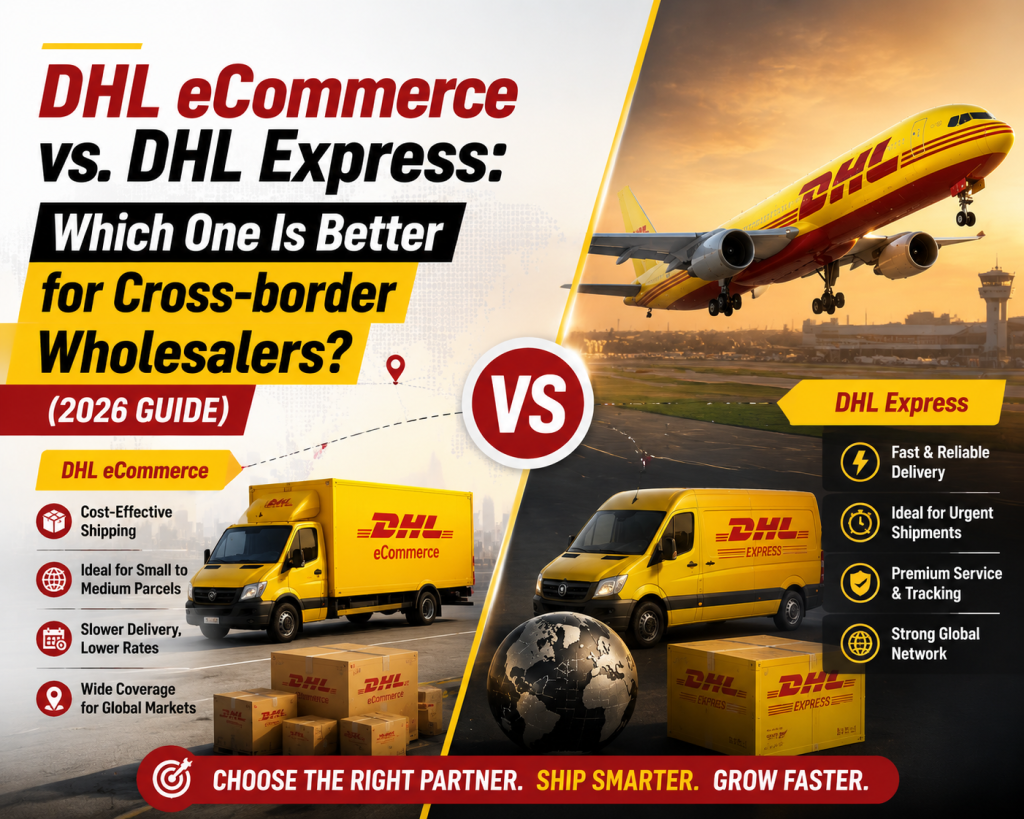
DHL eCommerce is the budget-friendly, slower service, built for high volumes of smaller, lighter parcels where speed isn’t critical.
Think of it as the economy option. It’s designed for online sellers and wholesalers shipping lots of low-to-mid value packages, the kind of stuff where your customer expects standard delivery, not next-day. To keep costs down, DHL eCommerce often uses a mix of its own network and local postal services for the final leg of delivery, which is part of why it’s cheaper and also why it’s slower.
The trade-offs come with the territory. Transit times are longer, often a week to a few weeks depending on the route, and the tracking can be less detailed than the premium service, sometimes going quiet for stretches before updating. For the right kind of shipment, none of that matters. For a $15 phone case that the buyer is happy to wait for, paying premium express rates would be throwing money away.
This is the service that makes sense for a lot of e-commerce fulfillment, especially the steady stream of smaller orders that fill a typical store. If you’re moving that kind of volume, getting your shipping method matched to your products is a real margin lever, and it’s part of what we think about in packaging optimization, because lighter, smarter packaging directly lowers what these parcels cost to send.
What Is DHL Express?
DHL Express is the premium, fast, fully-tracked service, the one most people picture when they hear the DHL name.
This is international shipping built for speed and reliability. We’re talking delivery in a handful of business days to most major destinations, sometimes just two or three, with detailed door-to-door tracking the whole way and DHL’s own network handling the shipment end to end rather than handing it off to local post. You also generally get stronger customer support and smoother customs handling, since Express is geared toward business shipments that need to move now.
The catch is the price. DHL Express costs significantly more than eCommerce, and the cost is driven heavily by weight and dimensions, so it gets expensive fast on anything bulky. Where it earns its keep is on shipments that are time-sensitive, higher value, or where reliable tracking and fast customs clearance actually matter to your business, samples you need urgently, a restock that’s running tight, or a high-value order where a three-week transit is a real risk.
For wholesalers, Express is often the right call for samples and urgent shipments, while the bulk of your goods move by slower freight. Sorting out which shipments justify the premium is exactly the kind of thing a procurement outsourcing partner helps you optimize, because the right mix saves more than people expect.
What Is the Difference Between DHL eCommerce and DHL Express?
Let me lay the differences out clearly, because this is where the decision actually lives.
Speed is the headline difference. Express is fast, often a few business days. eCommerce is slow, frequently a week to several weeks depending on the destination and the postal handoff. If speed matters, that alone settles it.
Cost runs the opposite way. eCommerce is the cheaper service by a wide margin, which is its whole reason for existing. Express costs considerably more, and the gap widens as parcels get heavier or bulkier.
Tracking differs in detail. Express gives you rich, near-real-time door-to-door tracking through DHL’s own network. eCommerce tracking is lighter and can go quiet during the postal leg, which unsettles customers who are used to watching every scan.
Network and handling differ too. Express stays within DHL’s own controlled network start to finish, which is why it’s faster and more reliable. eCommerce often hands the final-mile delivery to local postal services to keep costs down, trading some speed and visibility for a lower price.
Best-fit shipments differ as a result. eCommerce suits high volumes of smaller, lighter, lower-value, non-urgent parcels, classic e-commerce orders. Express suits urgent, higher-value, or time-sensitive shipments where speed and tracking justify the premium.
The short version: Express buys you speed, reliability, and visibility at a higher price. eCommerce trades those for a much lower cost on parcels that can afford to wait.
How to Choose Between DHL eCommerce and DHL Express?
So which one’s right for you? It comes down to a few honest questions about what you’re actually shipping.
How urgent is it? This is the first filter. If a shipment needs to arrive fast, samples you’re waiting on, a restock that’s running tight, anything a customer expects quickly, Express is worth the cost. If it can comfortably wait a week or more, eCommerce saves you real money.
What’s the value of the goods? On low-value parcels, paying premium Express rates can eat the whole margin, so eCommerce makes sense. On high-value shipments, the faster transit and tighter tracking of Express are cheap insurance against a lost or stuck parcel.
How big and heavy is it? Express pricing punishes weight and size hard. For anything bulky, Express gets expensive quickly, and at a certain point neither DHL service is your best option, you’d look at sea or air freight instead. For genuinely large volume, the math usually points to consolidated freight rather than parcel service, which is core to bulk sourcing from China.
How much does tracking matter to your customer? If you’re selling to buyers who expect to watch every scan, Express’s detailed tracking reduces support headaches and “where’s my order” messages. For patient buyers of cheap goods, eCommerce tracking is fine.
The practical answer for most wholesalers is a mix, not one or the other. Use Express for samples, urgent restocks, and high-value orders where speed and reliability earn their cost. Use eCommerce for the steady flow of smaller, non-urgent parcels. And once your volume is large enough, move the bulk by freight entirely and reserve DHL for the shipments that truly need it. Building that kind of sensible shipping mix is part of the supply chain optimization work that quietly protects your margins, and the kind of results we deliver for clients often comes down to exactly these unglamorous logistics decisions.
Frequently Asked Questions
Is DHL eCommerce the same as DHL Express?
No. They’re two separate services under the DHL name. DHL Express is the premium, fast, fully-tracked service that delivers in a few business days through DHL’s own network. DHL eCommerce is the slower, cheaper service for high volumes of smaller parcels, often using local postal services for final-mile delivery. They’re built for different jobs.
Which is cheaper, DHL eCommerce or DHL Express?
DHL eCommerce is significantly cheaper, which is its main advantage. DHL Express costs considerably more, and the price climbs quickly with weight and parcel size. For low-value, non-urgent parcels, eCommerce saves real money; for urgent or high-value shipments, Express is often worth the premium.
How long does DHL eCommerce take versus DHL Express?
DHL Express typically delivers in a handful of business days to major destinations, sometimes just two or three. DHL eCommerce usually takes about a week to several weeks depending on the route and the local postal handoff. Exact times vary by destination, so confirm current estimates with DHL for your specific lane.
Which should wholesalers use for samples?
For samples, DHL Express is usually the better choice, because you typically need them quickly and the value of getting a sample fast outweighs the higher shipping cost. Save DHL eCommerce or freight for the larger, non-urgent shipments that follow once you’ve approved the sample.
At what point should I use freight instead of DHL?
Once you’re shipping large volume or heavy, bulky goods, parcel services like DHL get expensive, and consolidated sea or air freight usually becomes the cheaper option per unit. Many wholesalers use DHL Express for urgent small shipments and freight for the bulk of their inventory, getting the best of both.
Conclusion
DHL eCommerce and DHL Express aren’t competitors so much as tools for different jobs. Express is your fast, reliable, fully-tracked option for shipments that can’t wait and goods worth protecting. eCommerce is your economical workhorse for the steady stream of smaller parcels that can afford to take their time.
The wholesalers who get this right don’t pick one and use it for everything. They match the service to the shipment, Express for urgent and high-value, eCommerce for routine, and freight once the volume justifies it. That mix is where the savings hide.
If you’d like help building a shipping setup that fits your products and protects your margins, alongside the sourcing and quality side, you can book a free call and walk us through what you’re moving, or just reach out here with your product and volume.