
| Table of Contents |
| What Is a Sourcing Agent, Exactly? |
| What Does a Sourcing Agent Actually Do Day-to-Day? |
| Why Businesses Hire Sourcing Agents Instead of Going Direct |
| Types of Sourcing Agents You’ll Run Into |
| What Is Global Sourcing and How Does It Connect? |
| China Sourcing: Why Everyone Keeps Going Back |
| What Do We Get From China? More Than You Think |
| How to Pick the Right China Sourcing Agent |
| What a Good Sourcing Agent Costs (And Why It’s Worth It) |
| Red Flags That Scream “Bad Agent” |
| When You Don’t Need a Sourcing Agent |
| How to Get Started With Your First Sourcing Age |
A friend of mine lost $47,000 on his first product order from China. No sourcing agent. No quality checks. Just a supplier he found on Alibaba who seemed “trustworthy” based on a few email exchanges and some product photos that turned out to be stolen from another company’s catalog.
His container arrived six weeks late. Half the units were defective. The packaging looked nothing like what he approved. And the supplier? Stopped answering messages the day the money cleared.
That story isn’t unusual. I’ve heard versions of it dozens of times from business owners who tried to handle overseas sourcing themselves. And every single one of them eventually asked the same question: what is a sourcing agent, and why didn’t I hire one from the start?
Let me break this down properly.
What Is a Sourcing Agent, Exactly?
A sourcing agent is a person or company based in or deeply connected to a manufacturing region, usually China, Vietnam, India, or another major production hub, who acts as your eyes, ears, and boots on the ground.
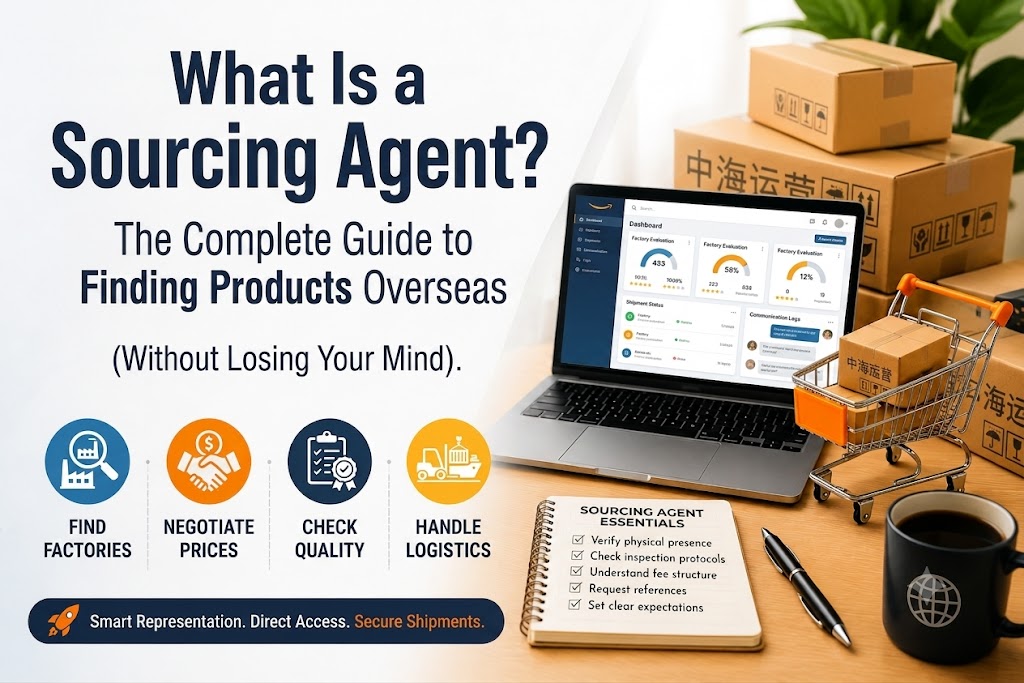
They find factories for you. They negotiate prices. They check product quality before it ships. They handle logistics headaches so you don’t have to wake up at 3 AM trying to coordinate with someone twelve time zones away through broken Google Translate conversations.
Think of them like a buyer’s agent in real estate. The seller (the factory) has their own interests. You need someone looking out for yours. Someone who speaks the language, knows the local business culture, understands manufacturing processes, and can spot a scam factory from a legitimate operation before you wire a single dollar.
That’s your answer to what is a sourcing agent.
They sit between you and the supplier, but not as a middleman adding cost without value. A good one actually saves you money because they know what things should cost, they know which factories pad their quotes for foreign buyers, and they know how to push back without blowing up the relationship.
According to a Harvard Business Review analysis on global supply chain management, companies with professional procurement intermediaries report significantly fewer supply disruptions and better cost outcomes than those managing factory relationships independently.
What Does a Sourcing Agent Actually Do Day-to-Day?
Here’s where it gets specific. A sourcing agent’s job covers a lot more ground than people realize when they first start looking into overseas manufacturing.
Finding the right supplier. This isn’t just searching Alibaba. A real agent has existing relationships with factories, visits them personally, checks their actual production capacity, reviews their export licenses, and verifies they can actually produce what they claim at the volume you need. Anyone can find a factory listing online. Finding one that won’t ghost you after payment takes local knowledge.
Price negotiation. Factories in China quote different prices to different buyers. If you’re ordering from overseas with no local representation, you’re almost certainly paying the “foreigner markup.” An agent who negotiates in Mandarin, understands local cost structures, and buys across multiple clients has serious pricing power you’ll never have alone.
Quality control and inspection. This is where most DIY sourcing falls apart. Your agent arranges pre-production samples, checks materials during production, and does final inspections before anything gets packed into a container. They catch problems when fixing them is still cheap, not after 10,000 defective units land at your warehouse. The International Organization for Standardization (ISO) sets quality management frameworks that reputable sourcing agents use as benchmarks during factory evaluation and production inspection.
Communication management. Time zones, language barriers, cultural differences in how “yes” doesn’t always mean “yes,” your agent handles all of it. They translate not just words but intent. When a factory says delivery will be “a little delayed,” your agent knows whether that means two days or two months.
Shipping and logistics coordination. From factory floor to freight forwarder to your door, they manage the chain. Documentation, customs paperwork, shipping method selection, all of it.
Why Businesses Hire Sourcing Agents Instead of Going Direct
If you’re wondering what is a sourcing agent and why businesses choose to work with one instead of contacting suppliers directly, the answer comes down to expertise, time, and access to reliable suppliers. The DIY approach sounds appealing in theory. Cut out the middleman, save money, keep control. In practice, it usually goes sideways for three reasons.
First, you don’t know what you don’t know about foreign manufacturing markets. The factory certifications that matter versus the ones that are meaningless. The regions that specialize in your product category versus the ones that’ll take your order and subcontract it to someone else. The payment terms that protect you versus the ones that leave you exposed.
Second, you can’t be there. Unless you’re planning to fly to Shenzhen every time you need to check on a production run, you need someone local. Photos from the factory can be staged. Video calls can be rehearsed. But a sourcing agent walking through the factory floor unannounced on a random Tuesday? That tells you the truth about what’s actually happening with your order.
Third, the math usually works out better even after paying the agent’s fee. Between better pricing, fewer defective units, less rework, and avoided disasters, most businesses come out ahead financially with an agent versus going solo.
The companies behind procurement intelligence services have data showing that professional sourcing consistently reduces total landed costs compared to direct buyer-factory relationships, especially for businesses placing their first several orders. Research published by McKinsey & Company on procurement excellence confirms that structured procurement intermediation reduces costs by 8-15% on average across industries.
Types of Sourcing Agents You’ll Run Into
Not all agents operate the same way, and understanding the differences saves you from hiring the wrong type for your situation.
Individual agents are solo operators, usually based in a manufacturing city like Yiwu, Guangzhou, or Shenzhen. They’re often former factory employees or trading company staff who went independent. Lower overhead means lower fees, but they can get overwhelmed if your order is complex or your volume grows fast.
Sourcing companies are firms with teams covering multiple product categories, dedicated quality control departments, and established processes for handling everything from initial supplier search through final shipment. They cost more than solo agents but bring structure, backup personnel, and broader factory networks. For serious product lines or ongoing purchasing relationships, this model tends to be more reliable.
Trading companies pretending to be agents are middlemen who buy from factories and resell to you at a markup while calling themselves “agents.” The difference? A real agent is transparent about factory identity and pricing. A trading company hides both. Always ask if you can visit the factory directly. If the answer is no or gets dodged, you’re probably dealing with a trader, not an agent.
What Is Global Sourcing and How Does It Connect?
Global sourcing is the broader strategy of looking beyond your domestic market to find suppliers, manufacturers, and materials from anywhere in the world that offers the best combination of price, quality, and reliability.
It’s not just about finding cheap labor. Smart global sourcing considers total cost of ownership, which includes the price per unit plus shipping, duties, quality failure rates, lead times, intellectual property risk, and supply chain resilience. Sometimes the cheapest factory quote ends up being the most expensive option once everything else is factored in.
The World Trade Organization’s trade statistics portal shows how interconnected global manufacturing has become, with intermediate goods crossing borders multiple times before reaching the final consumer.
A sourcing agent is the tactical execution arm of a global sourcing strategy. The strategy says “we need to manufacture overseas to hit our target margins.” The agent makes that actually happen without the wheels falling off.
Companies that approach this strategically by developing proper product specifications before they even start talking to factories get dramatically better results than those who show up saying “I want something like this, how much?”
China Sourcing: Why Everyone Keeps Going Back
People love to talk about moving manufacturing out of China. Vietnam is the next big thing. India is scaling up. Mexico for nearshoring. And yes, supply chains are diversifying. But here’s the reality nobody puts in their LinkedIn posts: China still dominates global manufacturing for most product categories, and it’s not particularly close.
China sourcing remains the default for most consumer products because the ecosystem there is unmatched. It’s not just that factories exist. It’s that the entire supply chain exists within a tight geographic radius. Raw material suppliers, component manufacturers, assembly plants, packaging companies, testing labs, freight forwarders, all within driving distance of each other in places like the Pearl River Delta.
That density means faster production timelines, lower logistics costs between production stages, and more flexibility when you need to change something mid-run. Try getting a custom component made in Vietnam and you might find the factory needs to import the raw materials from China. That adds time, cost, and complexity. Data from the United Nations Industrial Development Organization (UNIDO) consistently places China as the world’s largest manufacturing output producer, accounting for nearly 30% of global manufacturing value added.
The manufacturing workforce is experienced. The tooling capabilities are mature. The infrastructure (roads, ports, power grid) supports massive production volumes without breaking down. None of this happened overnight. China spent four decades building this manufacturing ecosystem, and replicating it elsewhere takes more than a few years of government incentives.
That said, a good china sourcing agent will also tell you when China isn’t the right fit. Some products make more sense manufactured elsewhere due to tariff structures, material proximity, or regulatory requirements. The best agents are honest about this rather than pushing everything through Chinese factories because that’s where their relationships are.
What Do We Get From China? More Than You Think
When people ask what do we get from China, they usually think of electronics and cheap plastic goods. The reality is staggering in its breadth.
Electronics and components, obviously. Phones, laptops, circuit boards, LED lighting, cables, chargers, smart home devices. China produces something like 90% of the world’s consumer electronics.
But also: furniture, textiles, automotive parts, medical devices, industrial equipment, sporting goods, toys, cosmetics packaging, kitchen appliances, hand tools, pet products, garden equipment, promotional merchandise, building materials, solar panels, batteries, and roughly a thousand other categories. The U.S. Census Bureau’s Foreign Trade data breaks down bilateral trade figures, showing hundreds of product categories flowing from China into the United States alone.
The businesses sourcing products from China range from Amazon FBA sellers ordering 500 units of a private label product to Fortune 100 companies ordering millions of units per quarter. The scale flexibility is part of what makes it work. You can find factories willing to do relatively small minimum order quantities alongside factories tooled up for massive volume production.
For Amazon sellers specifically, sourcing products from China for Amazon FBA has become almost standard practice because the margins simply don’t work any other way for most product categories at competitive price points.
How to Pick the Right China Sourcing Agent
Once you understand what is a sourcing agent and how they can support your business, the next step is finding the right partner. This is where most people mess up. They Google “sourcing agent China,” pick someone from the first page of results or a recommendation in a Facebook group, and hope for the best. Here’s a better approach.
Verify their physical presence. A legitimate agent should be able to show you their office, introduce team members on video, and provide a verifiable business address. Not a virtual office. Not a co-working space they rent by the hour. An actual operation.
Ask about their inspection process. Vague answers like “we check everything” mean nothing. You want specifics. What’s their inspection protocol? Do they use AQL sampling standards? The Acceptable Quality Limit (AQL) standard defined by the American Society for Quality is the industry benchmark, and any credible agent should be fluent in it. Can they provide sample inspection reports from previous clients? How many inspectors do they employ? What happens when they find defects, and what’s their escalation process?
Check their specialization. An agent who claims expertise in every product category probably has deep expertise in none of them. The factory relationships that matter for electronics sourcing are completely different from those needed for textiles or furniture. Find someone who knows your specific product world.
Understand their fee structure. Commission-based agents (taking a percentage of order value) have an incentive to keep your costs high. Fixed-fee agents don’t have that conflict. Service-fee models where you pay a flat rate per project or per month align their interests with yours better. There’s no single “right” model, but you should understand the incentives behind whatever they propose.
Request references from current clients. Not testimonials on their website because those can be fabricated. Actual introductions to real businesses currently using their services who’ll talk to you honestly about their experience.
Companies like eSourcing Solution that handle procurement outsourcing typically offer all of this transparently because their business depends on long-term client relationships rather than one-off transactions.
What a Good Sourcing Agent Costs (And Why It’s Worth It)
Before deciding whether the cost is justified, it helps to understand what is a sourcing agent and what they actually handle for your business. Agent pricing varies wildly, and cheap isn’t always bad while expensive isn’t always good. Here’s what the market generally looks like.
Commission-based agents typically charge between 3% and 10% of your order value. Lower percentages for larger orders, higher for smaller ones. The risk here is that your agent has zero incentive to negotiate your price down because their cut shrinks proportionally.
Fixed service fee models charge a flat rate per project or a monthly retainer. You might pay $500 to $3,000 per sourcing project depending on complexity, or $1,000 to $5,000 monthly for ongoing support. This model gives the agent every reason to get you the best price possible because their income doesn’t change.
Some agents work on hybrid models with a smaller commission plus a service fee. Others charge per inspection or per factory visit as add-on services.
The question isn’t really “how much does an agent cost?” It’s “how much does NOT having an agent cost?” When you factor in the quality failures you avoid, the better pricing you get, the scams you sidestep, and the time you save, the agent fee is almost always the cheapest part of your sourcing budget.
For a detailed breakdown of actual costs, this guide on china sourcing agent costs lays it out with specific numbers across different service models. To put this in broader context, the Chartered Institute of Procurement and Supply (CIPS) reports that businesses using professional procurement support recover the cost of services within the first two to three order cycles through savings alone.
Red Flags That Scream “Bad Agent”
After years watching this space, certain patterns predict disaster with near-certainty.
They won’t tell you which factory is making your product. This usually means they’re a trading company, not an agent. They’re adding margin by hiding the source. You have no ability to verify quality, visit the factory, or switch agents later without losing your supplier relationship entirely.
They push you toward specific factories regardless of your needs. A good agent presents options. A compromised one has side deals with certain factories and steers every client there regardless of fit.
They don’t have a physical quality control team. If they’re “outsourcing” inspections to third parties or relying on factory self-inspection, you’re paying for a service that isn’t really being delivered.
Communication goes dark after payment. Legitimate agents maintain consistent communication throughout production because that’s literally the service. If you can’t get responses within 24 hours during active production, something is wrong.
They guarantee impossibly low prices. Manufacturing has real costs. Materials, labor, overhead, packaging, testing, these all have floors. If someone promises you pricing that’s 40% below every other quote, they’re either lying about quality, lying about the factory, or planning to disappear with your deposit.
They resist involving you in the process. Good agents welcome factory visits, encourage you to review quality standards, and want you to understand what’s happening. Bad ones create information barriers that make you dependent on them for everything. Protecting your trademark and patent registration becomes nearly impossible if your agent keeps you disconnected from factory identity and manufacturing details.
When You Don’t Need a Sourcing Agent
Full transparency: a sourcing agent isn’t the right call for every situation.
If you’re ordering commodity products with zero customization, standard items any supplier can provide identically, a sourcing agent adds cost without much value. You can handle that through established platforms with built-in buyer protection.
If you already have a trusted factory relationship running smoothly after years of proven performance, adding an agent into that existing relationship creates complexity without benefit.
If your order volumes are genuinely tiny, under $2,000 or so, the agent’s fee might not make economic sense relative to your order size. At that scale, platforms like Alibaba’s Trade Assurance provide basic protections that might be sufficient.
But the moment you’re doing custom product development, ordering above $5,000, entering a new product category, or scaling to volumes where quality failure costs become significant, that’s when professional sourcing support transforms from “nice to have” into “protecting my business.”
Services like supplier negotiation and cost optimization become particularly valuable as your volumes grow because the savings percentages apply to larger numbers, meaning the ROI of professional sourcing expertise grows proportionally with your business. The benefits delivered through structured procurement support compound over time as factory relationships deepen and processes get refined.
How to Get Started With Your First Sourcing Agent
Stop overthinking this and start with these concrete steps.
- Get your product specification locked down before you talk to anyone. The more specific you are about materials, dimensions, functions, packaging, and quality standards, the better any agent can serve you. If you need help creating a proper spec sheet, this guide on product spec sheets walks through exactly what to include.
- Research at least three to five agents before committing to one. Compare their specializations, fee structures, communication responsiveness, and willingness to answer detailed questions. The ones who ask YOU smart questions about your product and market are usually better than the ones who just quote a price immediately.
- Start with a smaller test order before committing to large volume. A good agent will support this approach because they know the first successful order leads to a long-term relationship. Anyone pushing you to go big immediately either doesn’t have your interests in mind or needs your money too badly, and neither is good.
- Set clear expectations in writing. Inspection criteria, communication frequency, timeline milestones, payment terms, what constitutes acceptable versus rejectable quality, document everything before production starts.
- Consider whether you need just a sourcing agent or a more complete procurement outsourcing arrangement that includes ongoing supplier management, quality control, packaging optimization, and logistics coordination. The answer depends on your team’s capacity and how central overseas manufacturing is to your business model. Some businesses also benefit from product idea development support before sourcing even begins, figuring out what to make before figuring out where to make it.
The Bottom Line
The bottom line is this: a sourcing agent is the difference between overseas manufacturing being a calculated business advantage and being an expensive gamble. The companies that consistently win at product sourcing aren’t the ones with the best luck or the biggest budgets. They’re the ones who invest in the right expertise on the ground, ask hard questions before sending money overseas, and treat supplier relationships as assets worth protecting professionally.
Your first sourcing agent might not be perfect. But having an imperfect agent beats having no agent and learning expensive lessons with your own capital. The $47,000 my friend lost would have paid for years of professional sourcing support with money left over for inventory.
Don’t be that cautionary tale.
If that’s you and you want wholesale pricing with real quality checks, you can book a free call and tell us what you’re after, or just reach out here with your product and quantity.