
| Table of Contents |
| What Does a China Sourcing Agent Do for Amazon FBA Sellers? |
| Why Amazon Sellers Use Sourcing Agents in China |
| What a Good FBA Sourcing Agent Should Handle |
| What a Good FBA Sourcing Agent Should Handle |
| Finding and Verifying the Right Factory |
| Samples and Product Development |
| Negotiating Price Without Destroying Quality |
| Quality Control for Amazon FBA Products |
| Amazon FBA Packaging and Labeling |
| Shipping From China to Amazon FBA |
| How Much Does a China Sourcing Agent Cost? |
| When Does an Amazon Seller Actually Need a Sourcing Agent? |
| How to Choose a Reliable China Sourcing Agent |
| Amazon FBA Sourcing Checklist |
| Frequently Asked Questions |
An Amazon seller finds a product for $7.50 on Alibaba. The numbers look fantastic. After a few messages with the supplier, the seller orders a sample, negotiates the product down to $6.80, and starts thinking about the launch.
Then the other costs start showing up.
Custom packaging costs extra. The MOQ changes after customization. The carton dimensions push freight costs higher. The supplier needs FNSKU files. Inspection isn’t included. Duties haven’t been calculated. And that $6.80 product suddenly looks very different when you calculate what it actually costs to get one sellable unit into Amazon.
That gap between a factory quote and a product sitting inside an Amazon fulfillment center is where many first-time sellers get caught.
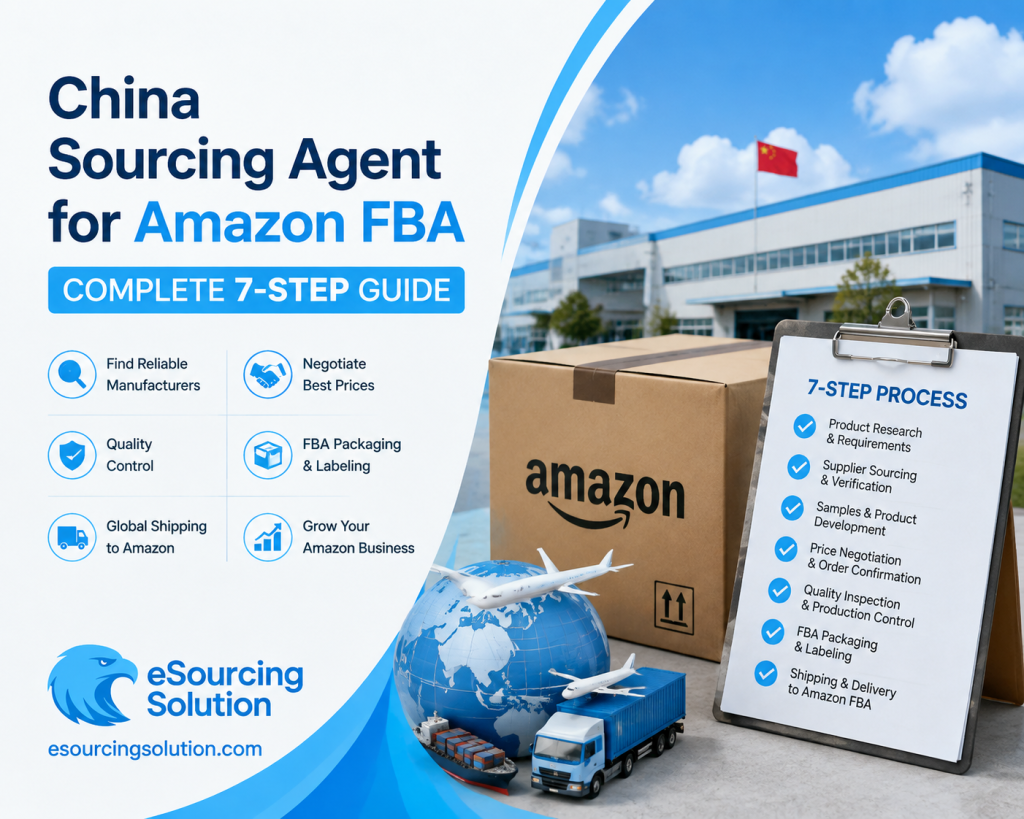
A China sourcing agent for Amazon FBA should help manage that entire process. Not just finding a factory. Not just asking for a lower price. The useful part is connecting sourcing, product development, quality control, packaging, and shipping so that what leaves the factory is actually what you expected to receive.
For an experienced importer with trusted factories, this may not be necessary. For a first-time private label seller putting $10,000, $30,000, or more into inventory, having someone on the ground can be a very different calculation.
Here’s how the process actually works.
What Does a China Sourcing Agent Do for Amazon FBA Sellers?
A sourcing agent represents the buyer during the manufacturing process. For an Amazon seller, that can start with finding manufacturers and continue through sampling, negotiation, production, inspection, packaging, and shipment coordination.
The distinction matters because Amazon sellers have requirements that an ordinary wholesale buyer may not have.
Your factory isn’t just making 2,000 silicone kitchen products. Those products may need branded retail packaging, individual barcodes, carton labels, specific carton dimensions, warning labels, inspection criteria, and shipping arrangements that match the shipment you’ve created in Amazon.
Amazon’s own current FBA guidance makes clear that packaging, barcode placement, and preparation affect how inventory is received. Amazon states that non-compliant inventory can be returned, refused, or repackaged at the seller’s expense. (Sell on Amazon)
That’s why an Amazon FBA sourcing agent needs to understand more than factory sourcing.
A capable partner should be able to help with:
- Supplier identification and verification
- RFQs and quotation comparison
- Sample coordination
- Private label customization
- MOQ negotiation
- Packaging development
- Production follow-up
- Quality inspections
- FBA preparation coordination
- Freight and shipment coordination
At eSourcing Solution, this broader supplier-search and purchasing work fits into our Global Sourcing services and Procurement Outsourcing services.
Why Amazon Sellers Use Sourcing Agents in China
There’s nothing stopping you from sourcing directly.
Plenty of Amazon sellers find factories themselves. Alibaba and other B2B platforms make supplier discovery much easier than it was 15 years ago.
But finding a company willing to quote your product isn’t usually the hardest part.
The harder questions come later.
Is it really a factory? Can it consistently make your product? Is the quote based on the same material specification as the other quotes? Will the production units match the approved sample? Who checks the cartons before they leave? What happens if the factory changes a component halfway through production?
This is why current competitor content aimed at Amazon sellers increasingly covers the full process rather than supplier search alone. JingSourcing, for example, positions FBA sourcing around supplier selection, customization, inspection, and shipping, while its current FBA material specifically discusses low MOQs, packaging customization, and product modification. (Jingsourcing)
The useful lesson isn’t that every Amazon seller needs an agent. It’s that supplier discovery is only one piece of the job.
Start With a Product Specification, Not a Supplier Search
One mistake first-time Amazon sellers repeatedly make is contacting factories too early.
They send a competitor’s Amazon link and ask:
“How much for 1,000 pieces?”
Three factories come back with three prices, so the seller chooses the cheapest one.
But what exactly did each factory quote?
Maybe Factory A quoted ABS plastic while Factory B quoted polypropylene. Maybe one included retail packaging and another quoted a plain polybag. Maybe the thickness, finish, accessory, logo method, or testing requirement is different.
Now you’re comparing numbers that don’t mean much.
Before serious supplier outreach, create a product specification sheet. It doesn’t need to look like an engineering manual. It needs to remove ambiguity.
Include the product dimensions, materials, colors, logo method, packaging, expected order quantity, testing requirements, reference images, tolerances where relevant, and anything that cannot be changed without your approval.
Our guide to creating a product specification sheet for sourcing goes deeper into this step.
For a new product that still needs design or manufacturing work, Product Idea Development can also come before supplier selection.
Finding and Verifying the Right Factory
The cheapest quote is not the same thing as the best supplier.
We’d rather see a seller compare three properly qualified factories than collect 30 random quotations.
A supplier should be checked against the actual job. That means looking at whether the business exists, whether the production setup matches what it claims, whether it has relevant product experience, and whether its capacity makes sense for your expected volume.
Before sending a production deposit, your supplier verification should cover at least:
- Business registration and factory identity
- Manufacturing location
- Production capability
- Experience with your product category
- Export experience
- Relevant certificates or test reports
- MOQ and capacity
- Quality management process
- Payment terms
- Who actually owns or controls production
That last point matters.
A supplier can look like a manufacturer online while subcontracting some or all of the production. Subcontracting isn’t automatically bad. Plenty of legitimate supply chains use specialist subcontractors. The problem is not knowing that it’s happening.
If the factory you approved isn’t the facility actually making the product, your original assessment may no longer mean much.
For sellers who don’t want to manage qualification themselves, this is one of the main jobs a procurement outsourcing partner should handle.
Samples Are Where You Learn What the Factory Can Really Do
Don’t treat the sample as a formality.
It’s your first practical test of the supplier.
Check the obvious things such as dimensions, finish, color, fit, function, and packaging. Then use the sample like a customer would.
Open it. Assemble it. Drop it if the product needs to survive drops. Wash it if customers will wash it. Put weight on it if that’s what buyers will do.
And document the approved version.
A common problem is approving a good sample and assuming mass production will automatically match it.
It may not.
Once you’ve approved the sample, lock down the important specifications and keep a reference sample where possible. The factory should understand that substitutions require approval.
This becomes especially important when you’re modifying an existing product for private label. Small changes in material thickness, coatings, adhesives, stitching, components, or packaging can produce a product that looks almost identical in a photo but performs very differently in the customer’s hands.
Negotiating Price Without Destroying Quality
Amazon sellers care about margins. They should.
But aggressive price negotiation can backfire if you don’t understand what is being removed from the quote.
Suppose a supplier quotes $5.20 and you push them to $4.70.
Great. What changed?
Maybe nothing. Maybe the factory had room.
Or maybe the material grade changed, packaging got thinner, inspection steps disappeared, or a component was swapped.
The right negotiation isn’t “give me your lowest price.”
It’s understanding the cost drivers.
Ask what happens to pricing at different quantities. Ask whether packaging can be changed. Compare tooling costs. Discuss payment terms. Find out whether changing a material or construction method reduces cost without hurting the customer experience.
Our Supplier Negotiation and Cost Optimization service is built around this kind of cost discussion rather than squeezing a factory blindly.
For Amazon sellers, the number that really matters is not the ex-factory unit price. It’s your landed cost and, ultimately, the margin left after Amazon fees, freight, duties, advertising, returns, and other selling costs.
Quality Control for Amazon FBA Products
Here’s the uncomfortable part.
Your Amazon customer doesn’t care that the factory caused the defect.
They bought from you.
A bad production run can turn into poor reviews, returns, refunds, and inventory you don’t want to sell. That makes quality control one of the most important parts of sourcing for FBA.
At eSourcing Solution, our publicly documented QC process covers incoming materials, in-process inspection, final inspection, supplier quality audits, factory inspection, and sampling-based checks. The company’s QC material also describes examples where problems were identified during production rather than after shipment. (eSourcing Solution)
For Amazon FBA sellers, think about QC in stages.
Pre-Production Inspection
Before the full run starts, confirm that the factory is working from the approved specification.
Materials, colors, components, packaging instructions, approved samples, and testing requirements should all be clear.
This is where you want to catch a substitution.
During-Production Inspection
A during-production check makes sense when the product is custom, the order is large, or the supplier is new.
You don’t need to wait until 5,000 units are finished to discover that the logo is printed in the wrong position.
If the problem is caught when 500 units have been made, you still have options.
Pre-Shipment Inspection
This is the inspection most Amazon sellers should know.
A sample of finished goods is checked before shipment against agreed criteria. Depending on the product, inspectors may review dimensions, workmanship, function, color, packaging, quantities, labeling, and other requirements.
Sampling plans such as ISO 2859/AQL are commonly used rather than inspecting every single unit. eSourcing Solution states that its QC process uses ISO 2859 sampling methods. (eSourcing Solution)
Container Loading Inspection
For larger shipments, a loading inspection checks what actually goes into the container.
This can help confirm quantities, carton condition, loading method, and whether the goods being shipped match the inspected order.
The key point is simple: inspection should happen while you still have some control.
Discovering a packaging error in China is annoying. Discovering it after the inventory has arrived at an Amazon fulfillment center is a much more expensive conversation.
You can see the full approach through eSourcing Solution’s Quality Control and Inspection services.
Amazon FBA Packaging and Labeling Can’t Be an Afterthought
This is one area where an ordinary sourcing agent and an FBA-aware sourcing agent can be very different.
Amazon has specific preparation and labeling requirements, and those requirements can vary by product.
Amazon’s July 2026 FBA guidance says products need the correct barcode, labels must remain scannable, and certain products require additional packaging or preparation. Amazon also warns that inventory with inadequate or non-compliant packaging may be refused, returned, or repackaged at the seller’s expense. (Sell on Amazon)
So don’t finish production and then ask:
“By the way, can you make this Amazon-ready?”
Discuss FBA requirements before packaging is finalized.
Your sourcing team should know the product’s destination and should coordinate the information supplied through your Amazon shipment workflow.
Depending on the product and shipment, this can involve unit barcodes, carton identification, polybag requirements, set labeling, warning labels, carton specifications, and product-specific prep.
Amazon’s current guidance also says labels should be placed on smooth, flat surfaces and that existing barcodes may need to be covered to avoid scanning errors. (Sell on Amazon)
For private label brands, packaging is also a sales tool. You need to balance Amazon compliance, shipping protection, carton size, cost, and customer experience.
That’s where Packaging Optimization becomes relevant.
Shipping From China to Amazon FBA
New sellers sometimes assume the factory quote plus freight equals the final cost.
It rarely tells the whole story.
A recent Amazon FBA community discussion shows exactly how confusing this can be for beginners. One seller described an $8 product where shipping a tiny 20-unit order worked out to roughly $19 per unit, turning what looked like an inexpensive product into a difficult margin calculation before Amazon fees or advertising. That’s one seller’s experience, not an industry benchmark, but it shows why landed cost needs to be calculated early. (Reddit)
Depending on the shipment, your cost calculation may include manufacturing, packaging, domestic China transport, inspection, freight, duties, customs clearance, delivery, and Amazon-related preparation.
Air freight is faster but often expensive for bulky or heavy products. Ocean freight is generally more practical for larger shipments, but lead times and planning become more important.
There is no universal “best” shipping method.
The right question is: what shipping method protects the launch date without destroying the margin?
For very small test orders, the answer may be express or air. Once volume grows, the economics can change significantly.
How Much Does a China Sourcing Agent for Amazon FBA Cost?
There isn’t one standard fee.
Some sourcing agents charge a percentage of the purchase order. Others use fixed project fees, service packages, or ongoing procurement arrangements.
The cheapest agent isn’t automatically the best deal.
You need to ask what the fee includes.
Does it cover supplier research only? Sample coordination? Negotiation? Factory visits? QC? Packaging? Shipping support?
If one agent charges less but every inspection, factory visit, and sample shipment is an extra fee, compare the total cost rather than the headline percentage.
We’ve covered the pricing models in more detail in our China Sourcing Agent Cost guide.
Do You Actually Need a China Sourcing Agent?
Not necessarily.
Here’s the decision we would make.
| Your Situation | Sourcing Agent? |
| First Amazon private label product | Usually yes |
| Custom or modified product | Strongly worth considering |
| Several factories need to be compared | Yes |
| Large inventory investment | Yes |
| Supplier requires close production follow-up | Yes |
| Simple off-the-shelf product | Maybe |
| You already have a proven factory and QC process | Probably not |
| Tiny test order | Depends on economics |
If you’re buying a standard item from a supplier you’ve worked with for five years, paying someone to “find” that supplier again doesn’t make sense.
If you’re a first-time seller wiring a large deposit to a factory you’ve never visited for a customized product you’ve never manufactured, that’s a different risk profile.
How to Choose a Reliable Amazon FBA Sourcing Agent in China
Don’t choose an agent because their website says “Amazon FBA expert.”
Ask them to show you how they work.
Start with your product. Have they sourced anything similar? How do they qualify factories? Who owns the supplier relationship? How do they make money? What happens if an inspection fails?
Then ask about Amazon.
Do they understand FBA packaging and labeling? Can they coordinate inspection against your approved specification? Can they work with your freight forwarder? How do they handle a factory that misses a production deadline?
A reliable agent should be comfortable answering specific questions.
Be cautious if every answer is some version of “don’t worry.”
You should worry a little. It’s your money.
Before hiring anyone, check:
- Company registration and business history
- Relevant product experience
- Supplier verification method
- Factory audit capability
- Fee structure
- Sample management process
- QC procedures
- Reporting method
- FBA packaging knowledge
- Shipping coordination process
- References or documented case examples
And get the commercial terms in writing.
Amazon FBA China Sourcing Checklist
Before you approve mass production, you should be able to answer these questions:
Product: Is there a final specification sheet? Is the approved sample documented? Are materials, dimensions, colors, logo, accessories, and packaging confirmed?
Supplier: Has the company been verified? Do you know who is actually manufacturing the goods? Has production capability been checked?
Commercial terms: Are unit price, MOQ, tooling, packaging, payment terms, lead time, and inspection expectations documented?
Quality: Is there an inspection checklist? When will inspection happen? What happens if the batch fails?
Amazon preparation: Are the correct product and shipment requirements confirmed using current Amazon instructions? Are labels and packaging being applied correctly?
Logistics: Do you know the shipping method, estimated landed cost, customs responsibilities, and destination?
If several answers are “I’m not sure,” don’t rush the deposit.
Fix the uncertainty first.
Frequently Asked Questions
Do Amazon FBA sellers need a sourcing agent in China?
No. Experienced sellers can work directly with factories. A sourcing agent is most useful when you need help finding and verifying suppliers, developing a product, managing production, inspecting goods, or coordinating FBA preparation.
Can a sourcing agent ship directly to Amazon FBA?
A sourcing partner can coordinate shipment from China to Amazon fulfillment centers, usually alongside a freight forwarder or logistics provider. The shipment still needs to follow Amazon’s current receiving, packaging, labeling, and shipment requirements.
How much does an Amazon FBA sourcing agent charge?
Fees vary by agent and project. Common structures include percentage commissions, fixed project fees, and ongoing procurement fees. Compare the services included rather than choosing solely by the lowest percentage.
Is Alibaba better than using a sourcing agent?
They do different jobs. Alibaba is useful for discovering suppliers. A sourcing agent can help evaluate factories, negotiate terms, manage samples, monitor production, inspect products, and coordinate other parts of the sourcing process.
How do I verify a China sourcing agent?
Check the company’s registration, history, product experience, fee structure, supplier verification method, QC process, references, and how transparent they are about the factories they recommend.
Should I inspect every Amazon FBA order?
For a new supplier or customized product, pre-shipment inspection is usually a sensible risk-control step. Additional inspections may make sense for complex products, large orders, or suppliers with previous quality problems.
Can a sourcing agent help with private label packaging?
Yes, if packaging development is part of their service. For Amazon sellers, packaging should be planned around branding, product protection, shipping cost, and current FBA preparation requirements.
How long does sourcing a private label product from China take?
There is no reliable universal timeline. A simple existing product can move faster, while a customized product may require several rounds of sampling, tooling, testing, packaging development, production, inspection, and shipping. Ask for a project timeline before committing to a launch date.
Final Thoughts
The job of a China sourcing agent for Amazon FBA isn’t to find you the cheapest product on Alibaba.
You can search Alibaba yourself.
The useful work happens between “I found a product” and “Amazon has received sellable inventory.”
That’s supplier verification. Specifications. Samples. Negotiation. Production checks. Packaging. Inspection. And making sure someone catches the stupid little mistake that would otherwise show up after 3,000 units have already been made.
For a new seller, that’s usually where the risk sits.
If that’s you and you want wholesale pricing with real quality checks, you can book a free call and tell us what you’re after, or just reach out with your product and quantity. The eSourcing Solution team can help with supplier sourcing, factory qualification, production management, quality control, and getting your order ready for the next step.
Book a consultation with eSourcing Solution or contact the eSourcing Solution team.