
| Table of Contents |
| How Long Does Sourcing From China Usually Take? |
| Stage 1: Preparing Your Product Requirements |
| Stage 2: Finding and Comparing Suppliers |
| Stage 3: Verifying the Factory |
| Stage 4: Sampling and Product Development |
| Stage 5: Negotiation and Order Confirmation |
| Stage 6: Mass Production |
| Stage 7: Quality Inspection and Shipping |
| What Can Delay Production in China? |
| How to Source Faster Without Taking Stupid Risks |
| China Product Sourcing Timeline by Product Type |
| Frequently Asked Questions |
A founder comes to us with a product idea and asks a simple question:
“Can I have 3,000 units ready in four weeks?”
Sometimes, yes.
Usually, no.
If you’re starting from scratch, a realistic timeline to source a product from China is often around 8 to 16 weeks before international shipping, depending on the product. A simple existing product can move faster. A custom product that needs tooling, several sample revisions, testing, custom packaging, or complicated materials can take much longer.
And that’s before you add ocean freight.
The mistake is thinking “production time” and “sourcing time” mean the same thing. A factory might tell you production takes 30 days, but that doesn’t include finding the factory, comparing quotes, verifying the supplier, developing samples, approving packaging, inspecting the finished order, or getting it shipped.
For an Amazon FBA seller planning a launch or a Shopify brand trying to avoid running out of stock, those extra weeks matter.
Let’s break down where the time actually goes.
How Long Does Sourcing From China Usually Take?
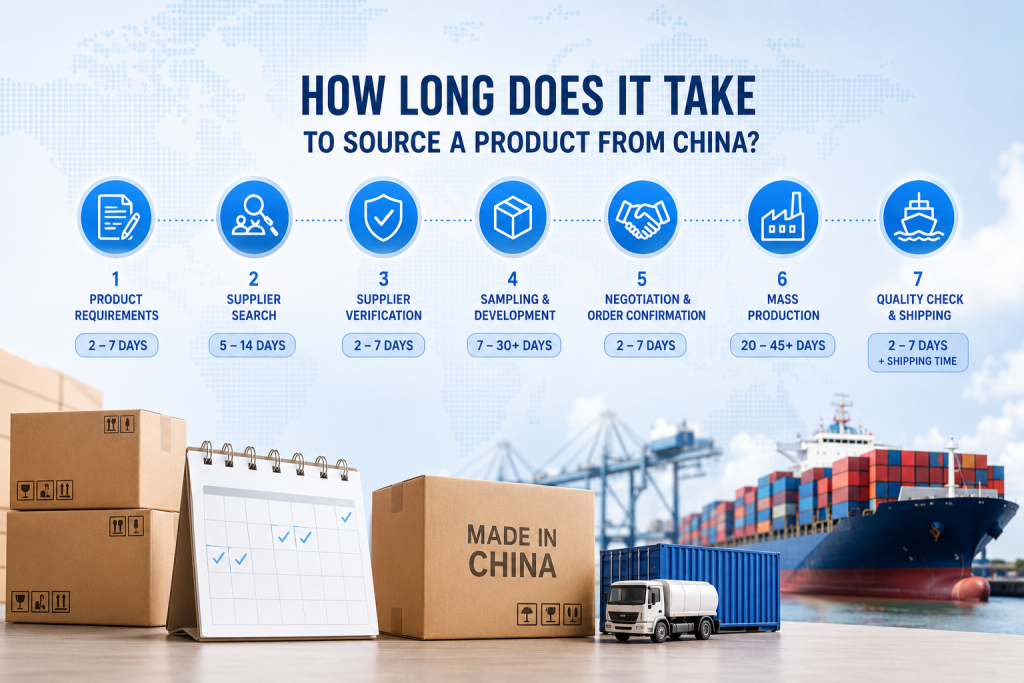
For a relatively straightforward product, you might spend one or two weeks preparing specifications and identifying suppliers, another one to three weeks getting and approving samples, then roughly three to six weeks in production.
Add inspection and shipment preparation, and you’re quickly looking at two to four months before international transit.
A customized product can easily take longer.
Here is a practical planning range:
| Stage | Typical Planning Range |
| Product requirements | 2 to 7 days |
| Supplier search and quotations | 5 to 14 days |
| Supplier verification | 2 to 7 days |
| Samples | 7 to 30+ days |
| Negotiation and PO confirmation | 2 to 7 days |
| Mass production | 20 to 45+ days |
| Inspection and shipment preparation | 2 to 7 days |
| Typical sourcing period before international transit | About 8 to 16 weeks |
These are planning ranges, not guaranteed industry standards. Actual lead times depend on the factory, product, order size, materials, tooling, testing requirements, season, and how quickly you approve decisions.
That distinction matters.
Even national manufacturing conditions move around. China’s National Bureau of Statistics reported a supplier delivery-time index of 49.9 in June 2026, indicating a slight lengthening in raw-material supplier delivery times during that period. The month before, the index was 49.2. That is a useful reminder that lead times aren’t fixed numbers you can copy from somebody else’s order.
Stage 1: Preparing Your Product Requirements
Typical time: 2 to 7 days
This is the step people want to skip.
Don’t.
If you contact factories without clear specifications, you don’t save time. You move the confusion further down the project, where fixing it becomes more expensive.
Imagine asking five factories for a quote for a backpack.
Factory A quotes $8.40. Factory B quotes $7.10. Factory C quotes $6.60.
Factory C wins, right?
Not necessarily.
Maybe Factory A quoted YKK zippers, heavier fabric, reinforced stitching, and individual retail packaging. Factory C may have priced a much simpler construction.
You need to define what everybody is quoting before comparing prices.
Your product specification should cover things such as materials, dimensions, colors, construction, logo method, packaging, order quantity, testing requirements, and reference photos.
For more detail, use eSourcing Solution’s product specification sheet guide.
If you’re still turning an idea into something a factory can actually manufacture, the Product Idea Development service is more relevant at this stage.
Stage 2: Finding and Comparing Suppliers
Typical time: 5 to 14 days
Once the requirements are clear, supplier research becomes much easier.
You can search Alibaba, use existing manufacturing networks, attend trade shows, contact factories directly, or work with a sourcing company.
The goal isn’t to collect 50 quotations.
You need enough qualified options to make a sensible comparison.
For each serious supplier, compare the same things: unit price, MOQ, tooling, sample cost, production lead time, payment terms, packaging, customization capability, and relevant manufacturing experience.
One mistake first-time importers repeatedly make is spending three weeks chasing the absolute lowest quote.
That can actually make the project slower.
If one factory is 8% cheaper but takes five days to answer every technical question, think about what communication will look like once your deposit has been paid.
Price matters. So does execution.
The eSourcing Solution Global Sourcing service is designed around finding and comparing suppliers rather than simply handing buyers a list of factory names.
Stage 3: Verifying the Factory
Typical time: 2 to 7 days
You found a supplier. They answer quickly. The quote looks good.
Now check them.
Supplier verification doesn’t need to drag on for weeks, but it should happen before a large deposit goes out.
Depending on the size and risk of the order, check:
- Business registration and license
- Factory location
- Production capability
- Relevant product experience
- Export experience
- Quality certificates where applicable
- Manufacturing equipment
- Production capacity
- Payment details
You also want to know whether you’re actually dealing with the manufacturer.
A trading company isn’t automatically bad. Neither is subcontracting.
The problem is believing Factory A is making your product when production is quietly being sent somewhere else.
For a simple stock product and a small test order, your verification can be lighter. For a $50,000 custom production run, we’d want much more confidence before sending money.
This is where Procurement Outsourcing can reduce the amount of supplier qualification and factory follow-up the buyer has to handle personally.
Stage 4: Sampling and Product Development
Typical time: 7 to 30+ days
This is the stage that destroys optimistic launch calendars.
A seller thinks:
“Sample takes seven days.”
Maybe the first one does.
But what happens if it’s wrong?
Let’s say you’re developing an outdoor bag. The first sample looks good, but the zipper feels cheap. You change the zipper.
The second sample arrives. Better zipper, wrong logo position.
Another revision.
Then you discover the retail box needs to be smaller because the current packaging is pushing up shipping costs.
Another change.
Suddenly a one-week sampling stage has become a month.
That’s not necessarily a bad thing.
A month spent fixing a sample is usually better than discovering the same problem after 5,000 units have been produced.
Once the final sample is approved, document it. Don’t rely on messages like “same as last sample.”
Your production specification and approved sample should become the reference for mass production.
Stage 5: Negotiation and Order Confirmation
Typical time: 2 to 7 days
By this point, you should know which factory you prefer.
Now confirm the commercial details.
That means more than asking the factory to knock another 20 cents off the price.
You need agreement on the final unit cost, MOQ, payment terms, tooling charges, production lead time, packaging, inspection conditions, shipping terms, and what happens if the product doesn’t match the approved specification.
Negotiation can move quickly when the buyer knows what they want.
It moves slowly when specifications keep changing.
This is another reason we prefer finalizing the important product decisions before serious price negotiation.
A supplier can’t give you a meaningful final price if you keep changing what they’re making.
For larger orders, eSourcing Solution’s Supplier Negotiation and Cost Optimization service focuses on the full commercial picture rather than chasing a low unit price at any cost.
Stage 6: Mass Production
Typical time: 20 to 45+ days
Now the factory starts making the actual order.
This is the number many suppliers refer to when they give you their “lead time.”
But production lead time depends heavily on what you’re buying.
A simple product made from materials already in stock may move quickly.
A custom product requiring new molds, specialty materials, printed packaging, components from several suppliers, or testing can take much longer.
Factory workload also matters.
If your supplier is running near capacity, your order may sit in a production queue.
Material availability matters too. Recent official Chinese data illustrates that supplier delivery conditions fluctuate month to month. In February 2026, for example, China’s supplier delivery-time index fell to 49.1, which the National Bureau of Statistics described as an increase in raw-material supplier delivery times. (国家统计局)
This is why “30 days” should be treated as a production estimate, not a promise from the universe.
Get the agreed lead time in writing and follow production rather than disappearing for a month and asking, “Is it finished?”
Stage 7: Quality Inspection and Shipping
Typical inspection and preparation time: 2 to 7 days, plus international transit
Finished does not mean ready to ship.
Before paying the final balance and releasing the goods, you may want a pre-shipment inspection.
Depending on the product and risk, quality control can happen at several points.
Pre-Production Inspection
Confirm materials, approved samples, components, packaging, and manufacturing instructions before the full run.
During-Production Inspection
Check the product while manufacturing is underway. This is particularly useful for large orders, custom products, or suppliers you’re working with for the first time.
Pre-Shipment Inspection
Inspect finished goods before shipment. Check workmanship, dimensions, function, quantities, labeling, and packaging against your agreed requirements.
Container Loading Inspection
For larger shipments, verify the cartons, quantities, container condition, and loading process.
Sampling methods such as AQL can be used when inspecting large production batches rather than checking every unit individually.
eSourcing Solution’s Quality Control and Inspection service describes its use of incoming material checks, in-process inspections, final inspections, factory audits, and ISO 2859 sampling methods.
Shipping comes after this, and transit time should be planned separately from sourcing time.
The China Holiday Problem Nobody Should Discover at the Last Minute
If you’re manufacturing in China, put major Chinese holidays into your calendar before you promise customers a launch date.
Spring Festival is the obvious one.
The official 2026 public holiday ran from February 15 through February 23, a nine-day period. National Day runs from October 1 through October 7 in 2026. (海淀区政府门户网站)
The official holiday dates aren’t necessarily the same thing as your factory’s practical production interruption. Staffing, supplier schedules, transport capacity, and individual factory arrangements can affect the period around a holiday.
So don’t work backward from the official nine days and assume you’re safe.
Ask your factory directly:
“When is your final production date before the holiday, and when will full production resume?”
That question is much more useful.
What Else Can Delay Sourcing From China?
Some delays are outside your control.
A lot aren’t.
The most common timeline problems usually come from unclear product specifications, slow sample approvals, material changes, packaging revisions, testing failures, factory capacity, missing components, inspection failures, and late shipping documents.
There’s another delay buyers don’t talk about enough.
The buyer.
If a factory sends you a packaging proof on Monday and you approve it the following Friday, you’ve just added four days yourself.
If you need to launch by a specific date, assign someone responsibility for quick approvals.
How to Source Faster Without Taking Stupid Risks
Speed doesn’t come from skipping supplier verification or quality inspection.
It comes from removing dead time.
Prepare a complete specification before requesting quotes. Send the same RFQ to suppliers so you’re comparing the same product. Decide what matters before samples start. Give factories consolidated feedback instead of sending five changes over five days.
You can also run some tasks in parallel.
While samples are being made, packaging concepts can be reviewed. While the preferred factory is being verified, commercial terms can be prepared.
What you don’t want to do is rush past a problem because you’ve already announced your launch date.
The factory doesn’t care about your Amazon launch calendar as much as you do.
Build some buffer into it.
China Product Sourcing Timeline by Product Type
These are practical planning ranges, not guarantees.
| Product Type | Approximate Sourcing Complexity |
| Existing stock product | 4 to 8 weeks before transit |
| Simple private label product | 6 to 10 weeks |
| Customized consumer product | 8 to 16 weeks |
| Apparel with custom materials | 8 to 16+ weeks |
| Custom bags/outdoor products | 10 to 18+ weeks |
| Product requiring new tooling | 12 to 20+ weeks |
| Complex regulated product | Potentially several months |
A basic product doesn’t need to spend four months in development just because somebody on the internet says sourcing takes four months.
And a custom molded product isn’t going to be ready in three weeks just because a supplier wants your deposit.
Plan around the actual product.
Should You Use a Sourcing Agent to Speed Things Up?
Sometimes.
A sourcing agent can’t make a mold cure faster or make an ocean vessel teleport across the Pacific.
What they can do is reduce delays caused by supplier search, slow communication, unclear requirements, sample coordination, production follow-up, and inspection scheduling.
| Situation | Is a Sourcing Agent Useful? |
| First import from China | Usually |
| Simple stock product | Maybe not |
| Custom private label product | Yes |
| Several factories involved | Yes |
| Existing trusted supplier | Less necessary |
| Large order requiring QC | Often useful |
| Product needs repeated development | Very useful |
The best reason to hire sourcing support isn’t “China is difficult.”
It’s that somebody needs to own the process.
Frequently Asked Questions
How long does it take to find a supplier in China?
For a clear product requirement, an initial supplier shortlist can often be developed within several days to two weeks. Verification, quotations, samples, and negotiation add more time before you should place a production order.
How long does manufacturing in China take?
Many straightforward consumer products may require roughly 20 to 45 days for mass production, but there is no standard lead time. Custom tooling, complex materials, testing, factory workload, and order size can extend production considerably.
How long does a sample from China take?
A simple sample may be ready in about a week. Customized samples can take several weeks, especially when multiple revisions or new tooling are required.
Can I source a product from China in 30 days?
It is possible for some existing products, particularly if the supplier has stock or production is simple. Thirty days is usually aggressive for a new custom product that still requires supplier selection, samples, production, and inspection.
Does Chinese New Year delay manufacturing?
It can. The official 2026 Spring Festival holiday runs for nine days from February 15 to February 23, but individual factory and supplier schedules can affect production for a broader period.
How long should an Amazon FBA seller plan before launching?
For a first custom private label product, planning several months ahead is safer than building the launch around the factory’s quoted production time alone. Sampling, QC, FBA packaging, international freight, customs, and unexpected corrections all need room in the schedule.
Does using a sourcing agent make sourcing faster?
It can reduce delays in supplier research, communication, sample management, factory follow-up, and inspections. It cannot eliminate legitimate manufacturing or shipping lead times.
Give Yourself More Time Than the Factory Quote
If a supplier says:
“Production: 30 days.”
Don’t put your Amazon launch exactly 30 days later.
That quote probably describes one part of the process.
Your real timeline starts before production and ends after the product has passed inspection and moved through logistics.
For a straightforward private label product, think in months rather than days. Build the specification properly, verify the supplier, approve the sample, monitor production, inspect the finished goods, and leave some breathing room for things that don’t go according to plan.
Because something usually doesn’t.
If that’s you and you want wholesale pricing with real quality checks, you can book a free call and tell us what you’re after, or just reach out here with your product and quantity. The eSourcing Solution team can help you build a realistic sourcing timeline, find suitable manufacturers, manage samples and production, and inspect your order before shipment.
Book a consultation with eSourcing Solution or contact the eSourcing Solution team.