
| Table of Contents |
| What Is FNSKU Labeling and Why Does It Matter? |
| FNSKU vs UPC vs ASIN: What Amazon Sellers Need to Know |
| Amazon FBA Packaging Requirements Before Shipping From China |
| Where Should FNSKU Labels Be Applied? |
| Common FNSKU Labeling Mistakes That Cost Sellers Money |
| How Chinese Factories Should Prepare FBA Products |
| Quality Control Checklist Before Sending Inventory to Amazon |
| Should You Ask Your Factory or Sourcing Agent to Handle FBA Prep? |
| FNSKU Labeling Checklist for First-Time Amazon Sellers |
| Frequently Asked Questions About FNSKU and FBA Packaging |
A lot of first-time Amazon sellers think the hard part is finding a product. They spend weeks researching suppliers, comparing prices, negotiating MOQs, and designing packaging.
Then the shipment arrives at Amazon. And suddenly there is a problem. The FNSKU label is missing. The barcode cannot be scanned. The packaging does not meet Amazon requirements. The inventory gets delayed.
This happens more often than new sellers expect. The reason is simple: most beginners think FBA preparation is an Amazon problem. It is not. FBA preparation starts at the factory.
Before your supplier produces 1,000, 5,000, or 10,000 units, you need a clear plan for labeling, packaging, inspection, and shipment preparation.
A small mistake during production can become an expensive problem after your products leave China.
At eSourcing Solution, we see this often when helping Amazon sellers source products overseas. A supplier may produce a good product, but small details like incorrect labels, weak packaging, or missing inspection steps can create unnecessary costs.
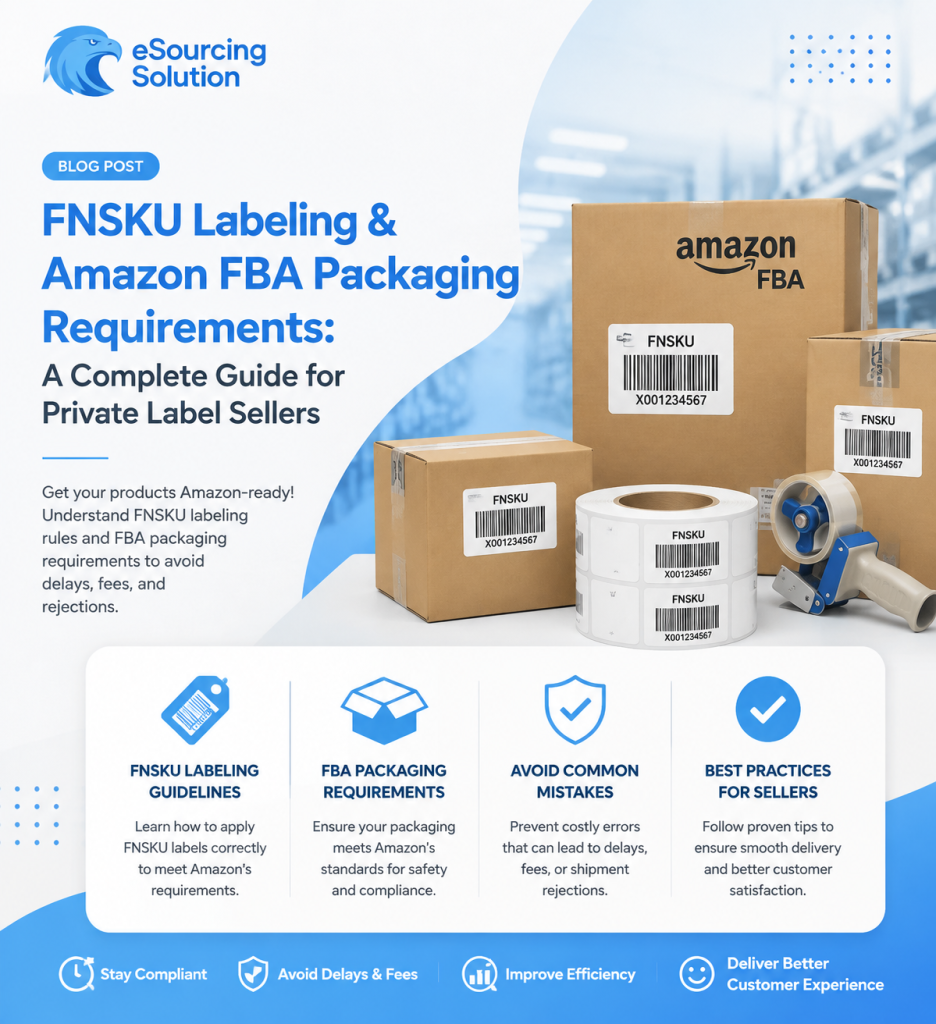
This guide explains exactly how FNSKU labeling works, what Amazon FBA packaging requirements you need to follow, and how to prepare products correctly before they leave your supplier.
What Is FNSKU Labeling?
FNSKU stands for Fulfillment Network Stock Keeping Unit.
It is an Amazon-specific barcode used to identify your inventory inside Amazon’s fulfillment system.
Think of it this way:
Your UPC identifies the product. Your ASIN identifies the Amazon listing. Your FNSKU identifies your specific inventory as a seller.
For many Amazon sellers importing private label products, the FNSKU label is placed directly on the product packaging before shipment to Amazon. Amazon requires products to have a scannable barcode or label that matches the inventory information in Seller Central. (Amazon Seller Central)
The biggest mistake beginners make is waiting until the product reaches a warehouse before thinking about FNSKU.
By then, it is usually too late.
If your supplier is manufacturing in China, the easiest workflow is normally:
- Create your Amazon listing.
- Generate the FNSKU barcode in Seller Central.
- Send the barcode file to your factory.
- Confirm label placement before mass production.
- Inspect samples before shipment.
This saves time and avoids paying extra fees later.
FNSKU vs UPC vs ASIN: What Is the Difference?
Many new sellers confuse these three codes.
Here is the simple version:
| Code | Purpose | Used By |
| UPC | Identifies the retail product | Retail systems |
| ASIN | Identifies the Amazon listing | Amazon marketplace |
| FNSKU | Identifies seller-specific inventory | Amazon FBA |
For example:
Imagine you create a private label water bottle brand. The bottle design, packaging, and product are yours.
Your UPC tells retailers what the product is. Your ASIN connects the product to your Amazon listing. Your FNSKU tells Amazon:
“This exact bottle belongs to this seller.”
The right barcode strategy depends on your business model, brand registration status, and Amazon account setup. Amazon’s current barcode rules determine whether sellers can use manufacturer barcodes or need Amazon barcodes such as FNSKU labels. (Amazon Seller Central)
For most private label sellers working with Chinese factories, preparing FNSKU labels during production is the safer approach.
Why FNSKU Labeling Should Be Done at the Factory
Some sellers think they can simply order products, ship them to the US, and fix labeling later. That sounds simple. It usually creates problems.
Here is what happens:
A factory produces 3,000 units. The products arrive at a third-party warehouse. Someone needs to open every carton. Every unit needs a label. Every barcode needs to be checked. The warehouse charges labor fees. Your inventory launch gets delayed. This is avoidable.
Having the factory apply FNSKU labels during production is usually faster and cheaper because workers are already handling each unit during packaging.
A good production workflow looks like this:
Before production
- Confirm packaging design
- Confirm barcode placement
- Confirm label size
- Approve samples
During production
- Factory applies labels
- QC team checks random units
- Packaging is verified
Before shipment
- Final inspection
- Barcode scanning test
- Carton inspection
This is where having a sourcing partner helps.
A supplier is focused on making products. A sourcing partner is focused on making sure the entire process works.
Amazon FBA Packaging Requirements Before Shipping From China
FNSKU labeling is only one part of preparing your products for Amazon.
A barcode can be perfectly printed and still fail if the packaging around it does not meet Amazon’s requirements.
This is where many first-time sellers underestimate the process. They think:
“Once the product is finished, we just put it in a box and ship it.”
That is not how FBA works.
Amazon receives millions of products through fulfillment centers. Every unit needs to be easy to identify, scan, store, and ship. Because of this, Amazon requires products to arrive with proper packaging, labeling, and preparation. (Amazon Seller Central)
When sourcing from China, your supplier needs to understand that they are not just manufacturing a product.
They are preparing inventory that needs to pass Amazon’s receiving process.
The Main Amazon FBA Packaging Requirements Sellers Need to Know
1. Every Unit Needs Proper Product Packaging
Your product should arrive as a customer-ready unit.
That means:
- No loose parts inside cartons
- No damaged retail boxes
- No missing accessories
- No unclear product bundles
- No exposed products that can be damaged during handling
For example:
A factory producing kitchen organizers may put 50 units into a master carton.
That is fine for shipping. But Amazon does not sell master cartons. Amazon receives individual sellable units.
Each organizer needs:
- Finished retail packaging
- Correct barcode
- Product protection
- Clear identification
The factory needs to understand the difference between shipping packaging and retail packaging.
2. Barcode Placement Matters
A common mistake we see:
The supplier applies the FNSKU label near the corner of the box.
It looks fine.
But during scanning, the barcode bends around the edge and cannot be read.
The label should be placed on a smooth, flat surface where Amazon scanners can easily access it. Amazon requires products to have an exterior scannable barcode or label that matches the inventory information. (Amazon Seller Central)
Avoid placing FNSKU labels:
- Across package seams
- On curved surfaces
- Under glossy plastic reflections
- Over damaged packaging areas
- Where another barcode remains visible
A simple barcode mistake can stop an entire shipment.
3. Poly Bags, Shrink Wrap, and Protective Packaging
Some products require extra protection before entering Amazon.
Common examples:
Clothing
Apparel is often placed inside transparent poly bags to prevent:
- Dust contamination
- Moisture damage
- Folding issues
Small Accessories
Products like:
- Jewelry
- Phone accessories
- Small tools
may require sealed packaging to prevent missing parts.
Fragile Products
Glass, ceramics, and delicate items usually need:
- Bubble wrapping
- Foam protection
- Individual boxes
- Stronger retail packaging
Amazon packaging requirements vary by product category, but products generally need secure packaging that protects the item and allows proper scanning. (YouTube)
4. Bundle Products Correctly
Bundles create many problems for new sellers.
Example:
You sell:
- One yoga mat
- One resistance band
- One carrying strap
Your factory packs everything together. But if Amazon receives them as separate pieces, your inventory may not match your listing.
The solution:
The entire bundle must be treated as one sellable unit.
Common requirements include:
- Secure packaging
- Correct barcode on the outside
- Bundle identification labels when needed
A sourcing mistake here can create inventory problems even if the product itself is perfect.
A Real Example: How Packaging Mistakes Cost Sellers Money
One Amazon seller contacted us after producing a private label kitchen product.
The product quality was acceptable. The supplier was reliable. The problem?
The factory changed the retail box design without approval. The new box was slightly smaller. The FNSKU label placement moved closer to the edge.
During inspection, the barcode scanner failed on several units. If those products had shipped directly to Amazon, the seller would have faced:
- Delayed inventory receiving
- Extra relabeling costs
- Lost launch time
The lesson:
Packaging is not decoration. Packaging is part of your supply chain.
How to Control FBA Quality Before Shipment
Many sellers only inspect the product itself. They check:
“Does the product work?”
That is not enough.
For Amazon FBA, you also need to inspect:
- Product quality
- Packaging quality
- Barcode accuracy
- Carton information
- Shipping preparation
A complete inspection process should include four stages.
Stage 1: Pre-Production Inspection
Before mass production begins, confirm:
- Final product specifications
- Packaging artwork
- Label position
- Barcode file
- Material requirements
- Product instructions
This prevents factories from making expensive mistakes. A supplier should never start mass production based on a simple conversation. Everything should be documented.
Stage 2: During Production Inspection
This step checks whether the factory follows the approved sample.
Inspect:
- Product dimensions
- Materials
- Color consistency
- Assembly quality
- Packaging process
- Label application
One common factory mistake is producing the first samples correctly but changing materials during mass production to reduce costs.
This is why production monitoring matters.
Stage 3: Pre-Shipment Inspection
Before your goods leave China, check:
Product Checklist
- Correct quantity
- No defects
- Correct accessories
- Correct branding
Packaging Checklist
- Retail box quality
- FNSKU placement
- Barcode scanning
- Carton markings
- Shipping labels
A final inspection is your last opportunity to fix problems before international shipping.
After the container leaves, every mistake becomes more expensive. You can learn more about professional inspection processes through our quality control services.
Stage 4: Container Loading Inspection
Many sellers ignore loading. That is a mistake.
During container loading, check:
- Correct carton count
- Proper carton condition
- No damaged boxes
- Correct shipment documents
- Photos of loaded cargo
A supplier can pass product inspection but still create problems during shipping preparation.
Should Your Factory Handle FNSKU Labeling or Should You Use a Prep Center?
There are three common options.
| Situation | Best Option |
| Private label product manufactured in China | Factory applies FNSKU labels |
| Small test order | Third-party prep center |
| Large repeat inventory | Factory-level preparation |
For most private label sellers importing from China, factory-level preparation makes the most sense.
Why?
Because your supplier already has the product. They already have workers handling packaging.
Adding labeling during production usually creates fewer extra steps.
Amazon has also been changing its own prep and labeling services, making seller-side preparation planning more important. (Amazon Seller Central)
FNSKU Labeling Checklist for First-Time Amazon Sellers
Before your shipment leaves China, confirm:
- FNSKU generated from Seller Central
- Barcode file sent to supplier
- Label placement approved
- Sample checked before mass production
- Barcode tested with scanner
- Old UPC/barcodes covered if required
- Packaging matches Amazon requirements
- Carton labels confirmed
- Final inspection completed
- Shipping documents reviewed
When Should You Use a Sourcing Agent for Amazon FBA Products?
Not every seller needs a sourcing agent. If you are ordering a simple product from a trusted factory, you may manage everything yourself.
But a sourcing partner becomes valuable when you need:
- Factory verification
- Supplier negotiation
- Packaging development
- Quality inspection
- Production monitoring
- FBA preparation
Here is a simple decision framework:
| Situation | Use a Sourcing Agent? |
| First product launch | Yes |
| Custom packaging | Yes |
| Multiple suppliers | Yes |
| Large inventory order | Usually |
| Simple existing product | Maybe not |
| Already have a trusted factory | Usually unnecessary |
Many Amazon sellers do not fail because they cannot find a supplier. They fail because they cannot manage the process after finding one. That is where professional procurement support helps.
Our procurement outsourcing service helps brands handle supplier communication, production follow-up, and quality checks from China.
Frequently Asked Questions About FNSKU Labeling
Is FNSKU the same as UPC?
No. UPC identifies the product.
FNSKU identifies your inventory inside Amazon FBA. They serve different purposes.
Can my factory apply FNSKU labels?
Yes. In many cases, this is the easiest option for private label sellers. Your factory can apply labels during packaging before shipment.
What happens if my FNSKU label is wrong?
Possible problems include:
- Shipment delays
- Relabeling costs
- Inventory receiving issues
- Additional preparation fees
Can I ship products to Amazon without checking packaging?
You can, but it is risky. Amazon receiving is not the place to discover factory mistakes. Fixing problems before shipment is almost always cheaper.
Is a sourcing agent the same as a trading company?
No.
A trading company usually sells products from its own supplier network. A sourcing agent works on your behalf to find suppliers, manage production, negotiate costs, and reduce risks.
Final Thoughts: FNSKU Labeling Is a Factory Process, Not Just an Amazon Task
Many sellers treat FNSKU labeling as a small sticker problem.
It is not. It is part of your entire supply chain.
The barcode, packaging, inspection, and shipment preparation all need to work together. The sellers who succeed with Amazon FBA are not just the ones who find cheap factories.
They are the ones who build reliable systems.
If that’s you and you want wholesale pricing with real quality checks, you can book a free call and tell us what you’re after, or just reach out here with your product and quantity.