
If you source products from China, you may have come across the terms OEM vs ODM in China. These terms are often used interchangeably and incorrectly. If you’re new to sourcing, you need to understand the distinction, as choosing the incorrect model can affect lead times, product expectations, and quotes.
This guide explains the core differences between OEM vs ODM in the context of Chinese manufacturing industries. It also details how to choose the right model for your business, including the risks involved and various benefits.
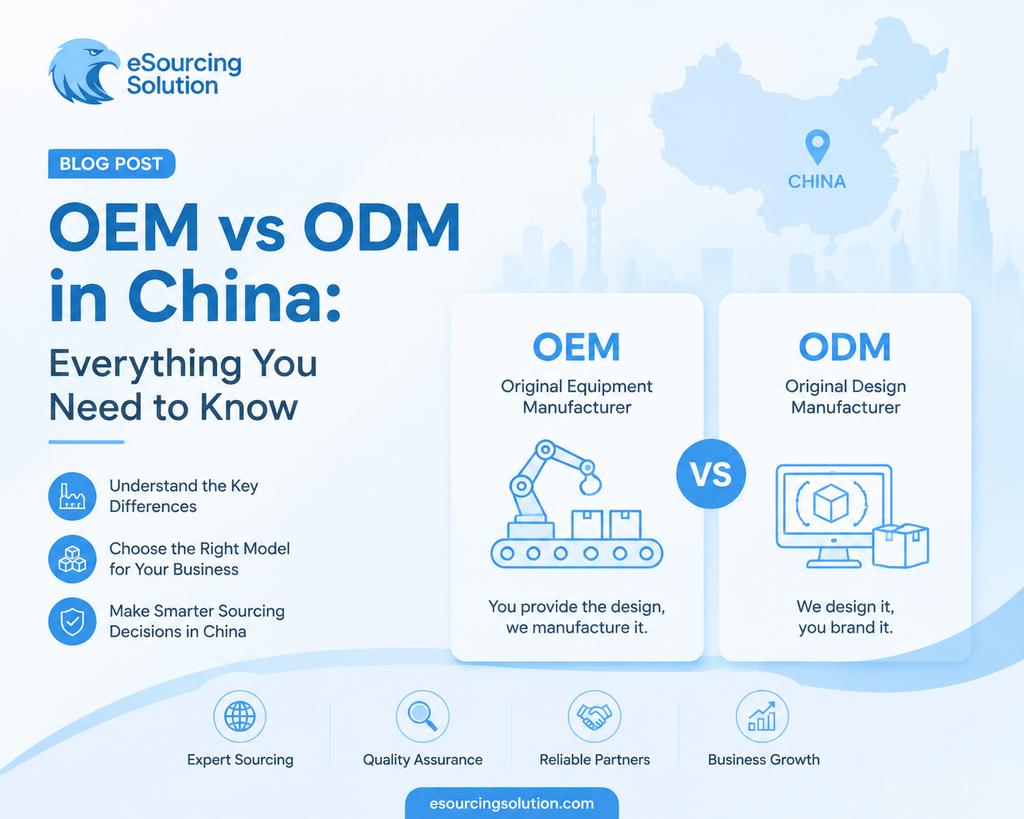
What is OEM Manufacturing?
OEM stands for Original Equipment Manufacturer in China. It refers to the production method that depends on your product design and specifications. You explain the idea, concept, and the technical requirements of the product, and the factory provides you with the latest facilities, technology, and labor. Basically, the end product is entirely yours and unique. No other brand sources that product.
For instance, you need to launch a unique product as an e-commerce seller. You do R&D and communicate your ideas to the factory. An OEM factory then utilizes its manpower and machinery to construct a product based on your design and requirements.
OEM is ideal if:
- You have a proprietary product design
- You have a private label brand requiring distinction
- You need to introduce a unique product into the market
Benefits of OEM Manufacturing
By employing OEM, you get
- IP ownership: You get full buyer and proprietary rights.
- Product differentiation: You get a custom, unique product not available to other buyers or sourcers via the same factory.
- Long-term use: You get to decide on the product’s growth and lifecycle.
Risks of OEM Manufacturing
- High upfront cost: Custom tooling, manufacturing, and engineering can incur costs up to $50,000 depending on the product specifications.
- Long production time: R&D, tooling, and sampling take months before the official production begins.
- High risk: The development cost and revenue depend on the buyer, as the product may not succeed in the market.
What is ODM Manufacturing?
ODM stands for Original Design Manufacturing in the context of China sourcing. The factory already has the product design. You purchase the base model from the company’s catalog, customize the logo, color, or materials, and sell under your own brand. In simple words, the factory owns the product design, and you own the brand.
ODM is also known as private labeling. Amazon FBA sellers mostly use it. Another category known as white labeling also falls under ODM.
For instance, if you have a private label, you can customize the product by adding branding elements. This is known as private labeling. If the company has a generic product, it can sell to more than one client. In this case, you handle the branding process. This is known as white labeling.
ODM is appropriate if:
- You’re entering a market quickly and need an existing product.
- You want to avoid tooling investment.
- You need shorter lead times.
Benefits of ODM Manufacturing
- Faster market time: The core design already exists so it doesn’t require tooling development.
- Lower upfront investment: The factory handles the tooling and R&D costs.
- Reduced development risk: The factory has production history on the product and knows the common failure risks.
Risks of ODM Manufacturing
- Limited differentiation: Multiple brands may source the same base design from the same factory.
- IP constraints: The ODM supplier typically retains ownership of the underlying design.
- Less customization: Modifications are restricted to what the factory’s existing tooling can accommodate.
OEM vs ODM in China: The Core Differences Explained
| Factor | OEM Manufacturing | ODM Manufacturing |
| Product design ownership | Buyer | Supplier |
| Customization level | Fully customizable | Limited |
| Speed to market | Slower — development required | Faster — design already exists |
| Tooling & development cost | Higher — buyer pays | Lower — factory absorbs |
| MOQ tendency | Higher | Lower |
| IP ownership | Typically retained by buyer | Typically retained by ODM |
| Product differentiation | High | Moderate to low |
| Best for | Brands building unique products | Brands prioritizing speed and simplicity |
Note: If you bring the product design, it’s known as OEM, and if the factory already has the product design and you customize it, that’s ODM.
Cost Breakdown of ODM and OEM
OEM manufacturing carries higher upfront costs. Tooling incurs significant costs (simple moulds costing $3,000; large-format tooling costing $50,000 and more). It also has longer development timelines (8–16 weeks from approved specifications to first production run), and a higher minimum order quantity to justify tooling amortisation.
ODM manufacturing has little or no tooling cost. The lead times are typically 2–6 weeks because the mould and process already exist. You pay for that speed in unit price.
Industries Using OEM and ODM Manufacturing in China
OEM is dominant in:
- Consumer electronics with proprietary designs
- Custom mechanical components
- Medical devices requiring specific technical specifications
- Apparel and footwear with proprietary patterns
ODM is dominant in:
- Amazon FBA and private label consumer goods
- Home goods, kitchenware, and general merchandise
- Toys, sporting goods, and seasonal products
- Entry-level electronics and accessories
How to Choose between OEM and ODM?
The crux lies in what you intend to sell.
Choose OEM if:
- Your product requires specific features or materials that don’t exist in any supplier’s catalog.
- You are building a brand where the product itself is the competitive differentiator
- You have the budget for a proper development phase
Choose ODM if:
- You are launching an experimental product and need to estimate demand before investing in custom development.
- Your differentiation is in branding, marketing, or customer experience.
- Your upfront budget for tooling and R&D is limited.
Choose both if:
Successful importers rarely commit to one model permanently. The smartest approach combines both strategically across your product lifecycle.
- Stage 1 – Market Validation: Launch with ODM products to test demand quickly with minimal capital risk. Use real customer feedback and sales data to identify which products resonate with your market.
- Stage 2 – Strategic Investment: Once a product proves itself with consistent sales, invest in custom OEM development for that specific SKU. The validated demand justifies tooling costs, and exclusivity protects your growing market share while improving unit economics at scale.
- Stage 3 – Portfolio Management: Continue introducing new products via ODM for speed while your proven winners run as OEM with better margins and competitive protection.
Does the Model Change Quality Control?
Quality control procedures remain fundamentally identical whether you choose OEM or ODM. Both require incoming material inspection, in-process checks, and final inspection against agreed Acceptable Quality Levels. Typically, AQL 2.5 for major defects and 4.0 for minor defects on general merchandise. However, where quality risks concentrate differs significantly between models.
OEM Quality Risks:
The critical vulnerability occurs during first article production. Does the actual manufactured sample truly match your technical drawings and approved golden sample?
Many buyers mistakenly compare final production against attractive pre-production prototypes, which often receive extra attention and hand-finishing.
Instead, secure a signed golden sample from the initial production run and use that as your inspection benchmark throughout mass production. The largest OEM failures happen when specifications drift between prototype and reality.
ODM Quality Risks:
Since the design is already proven through previous production runs, quality concerns shift toward consistency and customization execution.
Did the factory actually apply your requested modifications? The different material grade, the specific color match, the special coating?
Batch-to-batch variation becomes your primary risk rather than fundamental design flaws. Verify that your customizations weren’t shortcuts during production pressures.
Universal Best Practice:
Regardless of model, schedule pre-shipment inspections before releasing final payment. Paying your 70% balance only after inspection approval provides leverage to address issues before goods leave China.
Fixing problems after arrival multiplies costs dramatically. A $200 inspection investment protects thousands in potential losses and manufacturing relationship complications.
Final Thoughts
Both OEM manufacturing China and ODM manufacturing China offer viable paths to sourcing success. ODM provides speed and affordability ideal for market testing and businesses prioritizing marketing execution. OEM delivers differentiation and premium positioning essential for building lasting brand equity.
The most successful companies often blend both approaches strategically, using ODM for quick wins and market validation, then investing in OEM for hero products that define their brand and competitive moat.
Ready to start your China sourcing journey? Book a free consultation or contact eSourcing Solution. Whether you need ODM speed or OEM innovation, we’ll connect you with the right manufacturing partner and ensure your success from concept to delivery.
FAQS
What is the main difference between OEM and ODM?
OEM (Original Equipment Manufacturer) means you provide the product design and specifications while the manufacturer produces according to your requirements. ODM (Original Design Manufacturer) means the manufacturer already has existing designs that you select from their catalog, then customize with your branding and minor modifications.
Which is cheaper: OEM or ODM manufacturing?
ODM is significantly cheaper upfront, typically requiring a $1,000-10,000 initial investment with lower minimum order quantities of 100-1,000 units. OEM requires $10,000-200,000+ initial investment due to design development, prototyping, and tooling costs, with MOQs of 500-5,000 units.
How long does OEM vs ODM manufacturing take?
ODM manufacturing takes 2-4 months total from product selection to delivery, including customization discussion, sample production, and mass manufacturing. OEM manufacturing requires 6-18 months, including design phase (2-6 months), prototype development (1-3 months), tooling and mold making (1-4 months), sample testing (2-4 weeks), and mass production (1-3 months).
Can I get exclusive rights to an ODM product?
Exclusivity with ODM products is possible but typically requires higher order volumes and premium pricing since the manufacturer sacrifices the ability to sell to multiple buyers. Regional exclusivity (protecting your primary market) is more achievable than global exclusivity.
Which manufacturing model is better for startups?
ODM is generally better for startups because it requires less capital, enables faster market entry, and reduces risk. Starting with ODM allows you to validate market demand with real sales data before investing heavily in custom development. Many successful brands begin with ODM products, then transition to OEM once specific products prove successful and justify the higher investment.
Do OEM and ODM have different quality control requirements?
Both models use identical quality control procedures, including incoming inspection, in-process checks, and final pre-shipment inspection against agreed AQL standards. However, risk areas differ: OEM quality risks concentrate in first article production, ensuring the manufactured product matches your specifications and golden sample. ODM quality risks focus on consistency and verifying your customizations were properly applied across production batches.
Can I switch from ODM to OEM with the same manufacturer?
Yes, transitioning from ODM to OEM with the same manufacturer is common and often advantageous. You’ve already established a working relationship, understand their capabilities, and built trust through previous orders. Once your ODM product proves successful, you can invest in custom OEM development with that same factory.