
Global sourcing has taken the entire business world by storm. From small businesses to multinational companies, every SME utilizes a global sourcing strategy to improve productivity, lower production costs, and scale their enterprise.
Long gone are the days when corporations with deep pockets had access to global sourcing. Small and local brands can now source easily worldwide thanks to advancements in technology and logistics.
In fact, a 2025 study shows that nearly two-thirds of businesses still plan to maintain or grow their work with Chinese suppliers, even with tariffs and trade friction.
This blog covers the benefits, challenges, and practical steps to adopting a successful sourcing strategy exclusively for small businesses.
What is Meant by Global Sourcing Strategy?
Global or international sourcing is the process of procuring products or services from suppliers located internationally around the world. Unlike local sourcing, which is limited in scope and focuses on domestic regions or vendors, global sourcing covers cross-border trade and international procurement. For instance, an electronics company in the US may find it cheaper to source chips from China due to lower costs, better production quality, or industrial regulations.
Let’s take another example to understand global sourcing in full depth.
Lego is a popular Danish toy company selling in 130+ countries worldwide. It’s now expanding its distribution network to increase its speed to market. The company’s global sourcing strategy is locating its production closer to key consumer regions to reduce shipping times.
Difference Between Global Sourcing, Outsourcing and Offshoring
Global sourcing, outsourcing, and offshoring are often used interchangeably, but they are visibly distinct from each other.
- Global sourcing refers to procuring parts, products, materials, or services from foreign countries.
- Outsourcing refers to delegating business functions to third parties located in some other country to reduce labor costs.
- Offshoring refers to relocating the business process to another country to reduce operational costs.
Sometimes, companies may combine outsourcing with offshoring. For example, a US company hires a third party in Pakistan to handle its customer support. In this case, the third party is outsourced, and Pakistan is offshored.
Stages of Global Sourcing
Global sourcing develops through five primary stages. These are:
- Domestic Sourcing
It’s the most basic sourcing strategy. A business purchases products from suppliers located within the country. This lowers shipping times and costs.
- International Sourcing
Companies look for suppliers outside their country. This gives them access to a fast-growing international market.
- International Procurement
International procurement is how companies buy goods and services from foreign suppliers. To do it well, businesses set clear rules for choosing suppliers, negotiate detailed contracts, and check product quality regularly. The main goal is to lower costs, speed up delivery, and lower global risks so companies can build strong, long-term relationships with trusted suppliers.
- Centralized Global Procurement
Centralized procurement brings all of a company’s buying power into one central system instead of letting different branches buy separately. By using shared rules, good communication, and online buying software, companies can order in bulk and save money across all locations.
- Integrated Global Sourcing
This is the most advanced way to buy globally. It aligns all purchasing activities across every location in the business. By managing a large network of international suppliers in a coordinated way, companies get the best possible quality, prices, and competitive edge worldwide.
Benefits of Global Sourcing
Global sourcing has revamped the way companies do business. It helps companies in:
Scalability
Businesses can scale their operations without hitting capacity limits. By working with suppliers worldwide, they can increase their production without relying on a single source.
Reduction in Regional Risks
By collaborating with suppliers worldwide, businesses stay safe from risks such as political instability, natural disasters, or tariffs.
Better Access to Technology
Global sourcing provides businesses with advanced technologies, manufacturing capabilities, and expert labor.
Market Expansion
Working with global suppliers helps companies understand local laws, regulations, and customer behavior better.
Challenges in Global Sourcing
Global sourcing can be advantageous but comes with some risks.
Logistics Costs
Companies may face high transportation costs, customs duties, and long transit times.
Culture Differences
Due to differences in language and culture, companies may affect due to production issues.
Political Instability
Changes in government policies, trade restrictions, or tariffs can threaten supply continuity and increase business risks.
Currency Fluctuations
Exchange rate volatility complicates cost forecasting and budgeting.
Best Ways for Small Brands to Source Globally
To succeed at buying goods internationally, small businesses need more than a list of suppliers. They need a clear plan that everyone follows. These simple steps help teams lower risks, work faster, and save money.
1. Match your buying plan with main business goals
Buying decisions should not be made alone. Top teams make sure their global buying plans match what the business wants, like making products faster, earning higher profits, or using eco-friendly materials. This helps teams pick the right suppliers and track what matters most.
2. Train team members for their specific roles
Every job in a procurement team is different. However, team members often lack the right skills, especially when working in different countries. Offering specific job training helps everyone work by the same standard, negotiate better deals, and follow the main plan correctly.
3. Build trust and share information with suppliers
Good relationships with suppliers require trust. Do not just sign contracts; share sales forecasts and future goals with them. Treating suppliers as partners and meeting regularly keeps everyone working toward the same goals.
4. Use smart technology and data to make decisions
Modern teams use digital tools to manage contracts and track supplier data. Using technology like data software helps spot supplier problems early and checks if new international suppliers are safe to work with.
How to Evaluate and Select Global Suppliers
Working with a global supplier is not just about lowering costs. It’s also about aligning your company’s goals and vision with performance.
Criteria for Supplier Assessment
Consider these factors before choosing a particular supplier.
- Financial stability: Can the supplier sustain long-term operations?
- Production capacity: Do they have the ability to meet your demand?
- Quality assurance processes: Are certifications and standards in place?
- Innovation and responsiveness: Can they adapt to changing business needs?
Managing Quality Across Borders
When you buy products from other countries, keeping everything high quality can be tough. Different countries have different rules for making things, writing down details, and checking products. This means some items might not turn out the way you want.
Successful companies fix this problem by setting strict rules for quality. They check the products often and hire local workers in those countries to make sure everything is made correctly from start to finish.
Preventing Shipping Problems
Moving items around the world can cause big problems. Ships can get stuck at ports, paperwork can get delayed at borders, and trucks can run late. All of this wastes time and costs extra money.
Here is how smart companies prevent shipping problems:
- Use two suppliers or buy from nearby countries: This gives you a backup plan if one supplier has trouble.
- Keep extra parts in stock: Save extra items in a warehouse so you never run out during an emergency.
- Use modern tracking tools: Follow your shipments on a computer map so you always know where your items are.
- Make backup plans: Have a plan ready in case weather or local problems stop your shipments.
How to Develop a Successful Global Sourcing Strategy
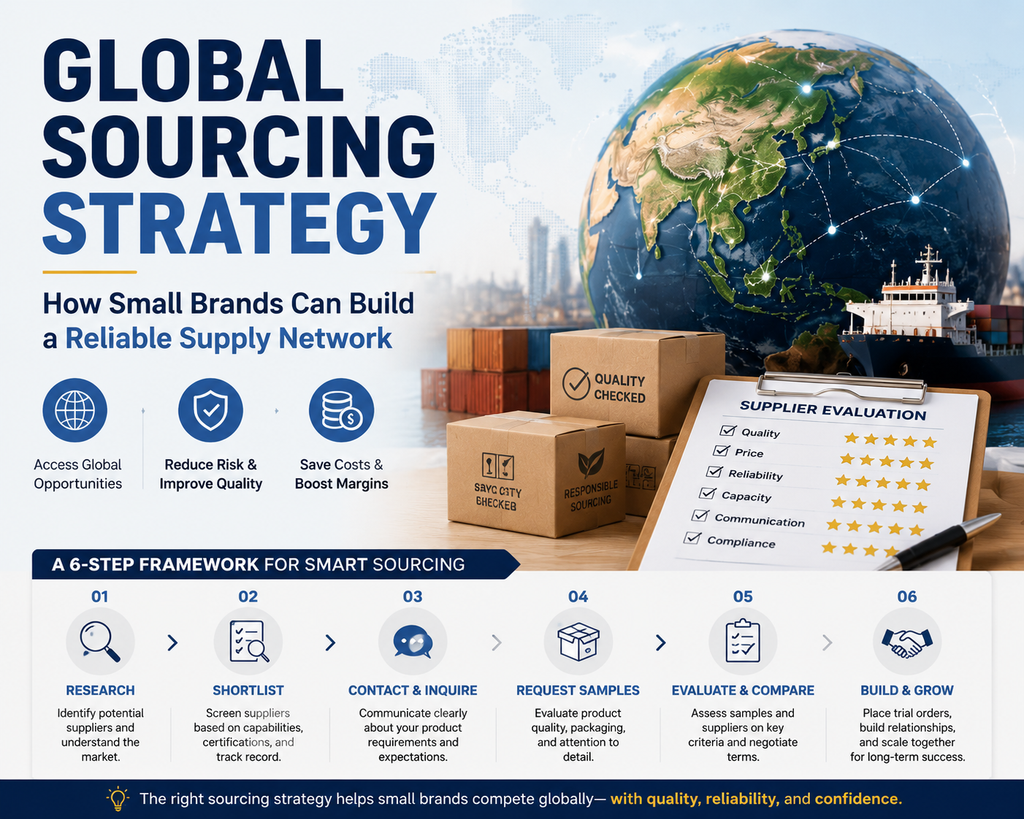
To scale successfully, small brands need to carefully plan, develop key objectives, and execute strategically.
Here’s how SMEs can build a robust strategy.
Identify Sourcing Objectives
First, outline what you need out of a global sourcing strategy. Is it increased production, cheap labor, or the latest technology?
Conduct Risk Assessment
Evaluate potential risks across geopolitical, economic, environmental, and operational regions. Identify high-risk suppliers, regions prone to disruption, and single points of failure in the supply chain.
Identify Potential Suppliers
Do extensive research to find suppliers that fit your criteria and objectives. Avoid dependency on a single country or supplier by strategically sourcing from multiple countries. Diversification increases flexibility and reduces exposure to localized shocks.
Evaluate Supplier Capabilities
After identifying potential suppliers, evaluate their qualifications, including financial stability, production capacity, and quality standards.
Develop Supplier Relationship
Build relationships based on trust, transparency, and performance metrics. Strong relationships with suppliers encourage better communication during crises.
Implement Quality Control Metrics
To ensure products meet quality standards, small brands should implement robust quality control measures, including supplier audits and quality inspections.
Continuously Monitor and Adapt
The key is evolution, so you must continually assess and optimize your business. This includes regularly evaluating suppliers, monitoring market trends and tariff changes, and adjusting sourcing strategies. Use real-time data and periodic reviews to refine the sourcing strategy and stay ahead of emerging risks.
The Bottom Line
Building a reliable global supply network takes strategy, clear quality standards, and the right international partners. By setting strict quality checks, tracking your shipments, and preparing backup plans, you can protect your margins and scale your business with confidence.
Ready to simplify your international procurement? If you are looking to source products from China, book a free consultation or contact eSource Solution today for exceptional products and reliable supply chain support all across China.
FAQS
What is global sourcing?
Global sourcing refers to the process of procuring goods and services from suppliers around the world. The goal is to optimize cost and availability by tapping into global markets.
What are the advantages of a global sourcing strategy?
Global sourcing offers cost savings through competitive international pricing, access to cheap labor, and diversification of supplier risk.
How do you manage risks in global sourcing?
Managing risks in global sourcing requires combining supplier diversification, quality control, and proactive logistics planning to protect your supply chain against disruptions.
How does global sourcing impact cost savings?
Global sourcing can reduce costs through better pricing, cheap labor, and automated processes.