
How do you explain your product idea to a manufacturer so they can produce exactly what you have in mind? The answer is simple: prepare a detailed Product Spec Sheet before requesting quotations or starting production.
A product idea might look clear in your head, but manufacturers cannot work from assumptions. They need exact information about materials, dimensions, colors, construction, finishing, packaging, and quality requirements. Without these details, every factory may interpret your requirements differently. This can lead to inaccurate quotations, poor samples, production delays, and unnecessary costs.
For example, imagine you want to manufacture a cotton T-shirt. You contact three factories and ask for their prices. One quotes $3.50, another quotes $4.20, and the third offers $2.90 per unit. At first, the third supplier looks like the best option.
But there is a problem. You never specified the fabric weight, cotton composition, stitching quality, or printing method. The cheapest factory may have quoted a much thinner fabric and a different construction method.
Now you are comparing three different products rather than three quotations for the same product.
This is exactly why a Product Spec Sheet matters.
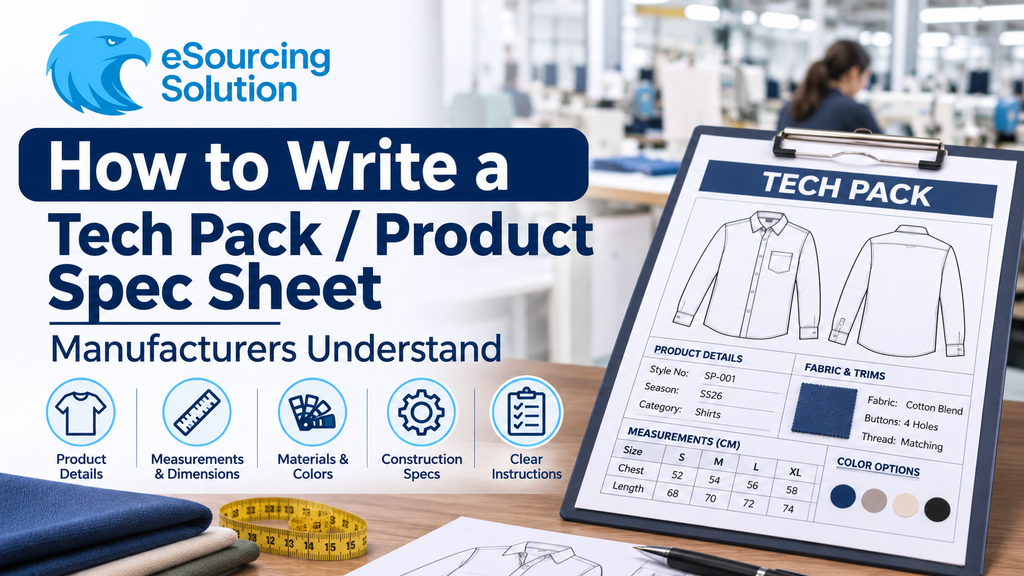
In apparel manufacturing, this document is often part of a larger technical package called a tech pack. It gives manufacturers a clear reference for understanding your design and production requirements.
In this guide, I’ll explain how to create a manufacturer-friendly Product Spec Sheet, what information to include, how a tech pack works, and some common mistakes to avoid when preparing your first manufacturing order.
Table of Contents
What Is a Product Spec Sheet?
A Product Spec Sheet, also called a product specification sheet, is a document that explains the technical and physical requirements of a product.
It tells manufacturers what they need to make, which materials they should use, what dimensions the finished product should have, and what quality standards they need to meet.
Think of it as a blueprint for your product.
A good specification sheet usually includes:
- Product name and description.
- Dimensions, weight, and measurements.
- Material composition and grade.
- Colors and finishing requirements.
- Construction and assembly details.
- Product functionality.
- Logo and branding instructions.
- Packaging and labeling requirements.
- Quality standards and testing requirements.
- Reference images or technical drawings.
The information will depend on the product category.
For example, a clothing manufacturer needs fabric composition, stitching details, garment measurements, and size grading. An electronics manufacturer needs component specifications, electrical requirements, operating conditions, and testing instructions.
The objective is the same: remove guesswork from the manufacturing process.
Product Spec Sheet vs. Tech Pack: What Is the Difference?
These two terms are often used interchangeably, particularly in apparel manufacturing. However, they are not exactly the same.
A Product Spec Sheet focuses on the technical requirements of a product. A tech pack is a more comprehensive document that brings together different production-related details.
For example, a garment spec sheet may contain measurements for a T-shirt, while its tech pack includes technical drawings, fabric details, stitching instructions, colorways, labels, and packaging requirements.
Here is a simple comparison:
| Feature | Product Spec Sheet | Tech Pack |
| Product description | Yes | Yes |
| Dimensions and measurements | Yes | Yes |
| Material details | Yes | Yes |
| Technical drawings | Where needed | Usually included |
| Construction details | Basic to detailed | Detailed |
| Bill of Materials (BOM) | May be included | Usually included |
| Colorways | If relevant | Usually included |
| Packaging instructions | If relevant | Usually included |
| Sample comments | Optional | Usually included |
For general consumer products, a detailed specification sheet may be enough to start discussions with manufacturers.
For apparel, footwear, bags, and other products with several design and construction details, a complete tech pack is usually more appropriate.
Shopify also explains this process in its guide on how to create a tech pack for manufacturers.
What Should a Manufacturer-Friendly Product Spec Sheet Include?
This is where you need to be careful. A document can look professional but still be incomplete.
The important thing is not how many pages it has. It is whether the manufacturer can understand your requirements without repeatedly asking for clarification.
Let’s look at the main sections.
A. Product Overview
Start with basic product information.
Include the product name, model number, product category, and a short description of what you want to manufacture.
For example:
| Field | Example |
| Product Name | Stainless Steel Water Bottle |
| Product Code | WB-001 |
| Product Category | Drinkware |
| Capacity | 750 ml |
| Target Market | USA |
| Order Quantity | 2,000 units |
| Product Type | Double-wall insulated bottle |
This information helps the supplier identify the product and organize its quotation and production records.
If you are developing several products, assign a unique product code to each one. It makes communication much easier when you start working with multiple factories.
B. Technical Drawings and Reference Images
Pictures are extremely useful when explaining a product, especially when you are working with overseas manufacturers.
However, a random product photograph is not always enough.
Try to provide clear technical drawings showing the product from different angles. Depending on the product, these can include:
- Front view.
- Back view.
- Side view.
- Top and bottom views.
- Close-up images of specific components.
- Dimensions and measurement markings.
For apparel, include flat sketches showing the front and back of the garment. If the design has special details such as pockets, collars, zippers, embroidery, or buttons, show them separately.
You do not necessarily need expensive design software to start. Simple technical drawings can be prepared using suitable illustration tools, provided they are clear and dimensionally accurate.
C. Material Specifications
Never assume a manufacturer will automatically understand what you mean by premium or high-quality materials.
These descriptions are subjective.
Instead, mention the exact material, composition, grade, thickness, weight, or other technical properties wherever applicable.
For example:
| Product | Vague Description | Better Specification |
| T-shirt | Premium cotton | 100% cotton, 180 GSM |
| Water bottle | Stainless steel | SUS 304 stainless steel, 750 ml |
| Backpack | Durable fabric | 600D polyester outer fabric |
| Storage container | Food-safe plastic | Food-contact compliant polypropylene, with applicable testing requirements |
These are illustrative specifications, not universal recommendations for every product.
For more complex products, you may also need to specify material suppliers, technical datasheets, test reports, or approved alternatives.
This is important because material changes can affect product performance, durability, weight, and final pricing.
D. Dimensions and Measurements
Measurements are among the most important parts of a Product Spec Sheet.
You should mention the exact dimensions of the finished product and explain how those measurements should be taken.
For example:
| Measurement | Required Specification | Unit |
| Bottle Height | 260 | mm |
| Bottle Diameter | 75 | mm |
| Bottle Capacity | 750 | ml |
| Bottle Weight | 350 | g |
| Lid Diameter | 45 | mm |
For apparel, the table will be slightly different.
You may need chest width, body length, sleeve length, shoulder width, waist, and other points of measurement.
Also, include acceptable tolerances.
A tolerance explains how much variation is acceptable in a measurement.
For example, if a bottle must be 260 mm tall with a tolerance of ±2 mm, the acceptable height range is 258 mm to 262 mm.
Do not leave manufacturers to decide these limits themselves. For critical dimensions, tolerances should be based on product functionality, design requirements, and manufacturing capability.
E. Colors, Finishing, and Branding
Color descriptions such as dark blue, beige, or light grey can be interpreted differently by different suppliers.
For better consistency, provide a Pantone reference or another agreed color standard.
Also mention:
- Surface finish (matte, glossy, brushed, polished).
- Logo placement.
- Printing or embroidery method.
- Artwork dimensions.
- Color combinations.
- Special coatings or treatments.
If your product includes a logo, provide the original artwork file in a suitable format rather than relying only on a low-resolution screenshot.
F. Construction and Assembly Details
This section explains how different parts of the product should be assembled.
For a backpack, you may need to specify zipper types, stitching, reinforcement areas, strap construction, and lining.
For electronics, this section could include component placement, wiring, connectors, assembly instructions, and safety requirements.
For garments, include seam types, stitch details, seam allowances, button placement, and finishing methods.
If a particular component must not be substituted, clearly mention that as well.
G. Packaging and Labeling
Packaging is another detail that importers sometimes forget.
Your manufacturer needs to know whether the product will be shipped in bulk packaging or individual retail boxes.
Include information such as:
- Individual packaging requirements.
- Carton dimensions.
- Packaging material.
- Product labels.
- Barcode placement.
- Country-of-origin marking.
- Care instructions, where applicable.
- Inner and outer carton quantities.
If you sell in regulated markets, check the relevant labeling requirements before approving the final design.
For example, the U.S. Federal Trade Commission’s textile labeling guidance explains requirements concerning fiber content, country of origin, and responsible business identification for covered textile products.
How to Create a Product Spec Sheet Step by Step
You do not need to create a complicated document from the beginning. Start with the information you already have and fill in the technical details before contacting manufacturers.
Here is a practical process.
Step 1: Define Your Product Clearly
Write down exactly what you want to manufacture.
Include its purpose, target customer, main features, expected price range, and any special requirements.
Try to separate essential features from optional ones.
For example, if you are developing a backpack, water resistance may be essential, while an additional external pocket might be optional.
This helps manufacturers understand which requirements cannot be changed.
Step 2: Collect Reference Materials
Gather product photographs, drawings, material samples, competitor references, and design files.
If you are using an existing product as inspiration, explain which features you want to replicate and which ones should be different.
Avoid simply sending an online product link and expecting a factory to figure out every detail.
Step 3: Prepare the Technical Details
Create tables for dimensions, materials, colors, construction, and packaging.
Use specific values wherever possible.
If you are unsure about a technical requirement, consult a product designer or engineer rather than guessing.
Step 4: Add Quality and Testing Requirements
Explain how you will determine whether the finished product meets your expectations.
For example:
- Material verification.
- Dimension checks.
- Functional testing.
- Color consistency.
- Surface finish inspection.
- Packaging inspection.
If your product needs specific certifications or regulatory testing, mention the applicable requirements and ask the manufacturer to confirm its capabilities.
Step 5: Review the Document With Your Manufacturer
Before placing a bulk order, send the specification sheet to your shortlisted suppliers.
Ask them to review the technical details and confirm whether they can meet the requirements.
A manufacturer may suggest a different material or construction method because of cost or production limitations. You can consider these suggestions, but do not approve substitutions without checking how they affect the final product.
Step 6: Update the Sheet After Sampling
The first sample is an opportunity to identify problems before mass production.
Compare the sample against your original specifications.
If the dimensions, materials, or finishing need adjustments, document those changes and issue an updated version.
Keep the approved sample and final specification sheet together as your production reference.
Sample Product Spec Sheet Template for Importers
Here is a simple example of how you can organize a specification sheet for a consumer product.
Product: Stainless Steel Insulated Water Bottle
| Specification | Requirement |
| Product Code | WB-001 |
| Product Type | Insulated Water Bottle |
| Capacity | 750 ml |
| Main Material | SUS 304 Stainless Steel |
| Lid Material | Food-contact compliant PP |
| Height | 260 mm |
| Diameter | 75 mm |
| Body Finish | Matte |
| Color | Pantone reference to be approved |
| Logo | Laser engraved, centered |
| Insulation | Double-wall construction |
| Packaging | Individual retail box |
| Testing | Leak and insulation performance testing |
| Order Quantity | 2,000 units |
Additional instructions:
- No material substitutions without written approval.
- Product dimensions must meet the agreed tolerances.
- Logo artwork must be approved before mass production.
- The manufacturer must submit a pre-production sample.
- Packaging artwork must be approved before printing.
This is a basic example. A real specification sheet should include more detailed drawings, tolerances, testing methods, and material information based on the product.
Common Mistakes to Avoid When Preparing a Product Spec Sheet
Even when importers understand the importance of specifications, they sometimes miss small details that create bigger problems during production.
Here are some common mistakes worth avoiding.
1. Using vague descriptions: Words like strong, premium, durable, and high quality do not tell a manufacturer much. Use measurable technical requirements instead.
2. Leaving out measurements: A product may look correct in a photograph but still have incorrect dimensions. Include all important measurements and tolerances.
3. Not specifying materials: If you do not define the material, the manufacturer may choose an alternative based on availability or cost.
4. Ignoring packaging: Your product may be manufactured correctly but arrive with damaged or unsuitable packaging because the requirements were never discussed.
5. Sending outdated specifications: If you make changes after receiving a sample, update the document. Otherwise, the factory may continue production using an older version.
6. Skipping sample approval: Never assume that a written specification guarantees the manufacturer will get everything right on the first attempt. Review the sample and confirm all important details before mass production.
7. Not attaching the specifications to the purchase agreement: Your final approved specifications should be referenced in the supplier agreement or purchase order. This creates a documented standard for production and quality inspection.
How a Product Spec Sheet Helps With Sourcing and Quality Control
A Product Spec Sheet is not just a document for designers. It also plays an important role in procurement and supplier management.
When you approach several manufacturers with the same specifications, you can compare quotations more accurately.
You can also evaluate whether a supplier has the right production capabilities and whether its proposed materials and processes meet your requirements.
For example, if one manufacturer offers a much lower price, you can check whether it has quoted the same material grade, packaging, dimensions, and testing requirements.
It also becomes easier to conduct quality inspections because the inspection team has a clear reference for what the finished product should look like.
At eSourcing Solution, we consider product specifications an important part of the sourcing process. They help establish clear expectations between buyers and manufacturers before production begins.
If you are still preparing your first order, our guide on the sampling process and how to get product samples from China explains how specifications are used during product development.
You can also explore our supplier sourcing guide to understand how to identify and evaluate suitable manufacturing partners.
Conclusion
Creating a clear Product Spec Sheet is one of the most useful things you can do before approaching manufacturers. It gives suppliers a better understanding of your product, helps them prepare more accurate quotations, and reduces the chances of misunderstandings during sampling and mass production.
The important thing is to include actual technical information rather than relying on general descriptions or product photographs. Define your materials, dimensions, tolerances, construction methods, colors, branding, packaging, and quality requirements.
For apparel and other design-heavy products, a complete tech pack can bring all these details together in one organized document.
Remember, your manufacturer can only produce what it understands. The more clearly you communicate your requirements, the easier it becomes to compare suppliers, review samples, and maintain consistent quality.
If you need help developing product specifications, finding suitable manufacturers, or managing the sourcing process, Book a free consultation with eSourcing Solution. Our team can help you plan your sourcing requirements and move your product from concept to production.
Frequently Asked Questions (FAQs)
1. What is a Product Spec Sheet used for?
A Product Spec Sheet communicates the technical requirements of a product to a manufacturer. It includes materials, dimensions, colors, construction details, packaging, and quality requirements. Manufacturers use it to prepare quotations, develop samples, and guide production.
2. Is a Product Spec Sheet the same as a tech pack?
Not exactly. A Product Spec Sheet focuses on product specifications, while a tech pack is a more comprehensive technical package. In apparel manufacturing, a tech pack usually includes technical drawings, measurements, fabric details, construction instructions, colorways, and packaging information.
3. Can I create a Product Spec Sheet in Excel?
Yes. Excel is suitable for organizing product measurements, materials, quantities, and technical requirements in tables. You can also use Word, Google Sheets, or specialized product development software. The format matters less than the accuracy and clarity of the information.
4. Do manufacturers require a Product Spec Sheet before giving a quotation?
Not every manufacturer requires a formal document, but providing one is strongly recommended. It helps suppliers understand exactly what you need and prepare quotations based on the same product requirements. Without clear specifications, quotations from different factories may not be directly comparable.
5. Who is responsible for creating a tech pack or Product Spec Sheet?
Usually, product designers, product developers, engineers, or technical designers prepare these documents. However, importers and business owners can also create them if they have the necessary product information. For technically complex products, getting help from an experienced professional is a better option.