
How do you make sure the products you order from an overseas manufacturer meet your quality expectations? The answer is a proper QC inspection process. It helps importers identify manufacturing defects, check product specifications, and make sure suppliers are following the agreed requirements before goods are shipped.
When sourcing products from China, quality control is something you should never leave entirely to the manufacturer. Even if a factory has good reviews, competitive prices, and years of manufacturing experience, there is still a possibility of receiving products that do not match your approved sample.
For example, imagine you order 3,000 customized bags from a Chinese manufacturer. You approve the sample, pay the deposit, and the factory starts production. Everything seems fine until the shipment arrives. You then discover that some bags have incorrect stitching, others have broken zippers, and the colors are slightly different from what you approved.
Now you have a serious problem. Returning the products or asking the manufacturer to fix everything can cost you additional money and time.
This is where QC inspection becomes important.
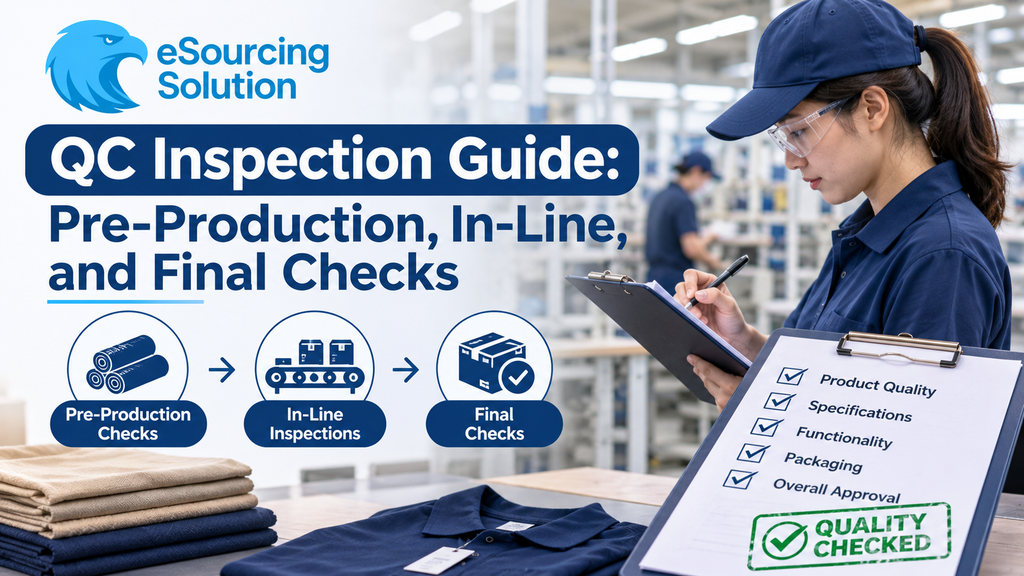
A proper quality control process involves checking products at different manufacturing stages rather than waiting until everything is finished. The three important stages are pre-production inspection, in-line inspection, and final inspection.
In this guide, I’ll explain how each stage works, what inspectors should check, how AQL sampling helps importers, and why quality inspection is an important part of sourcing from China.
Table of Contents
What Is QC Inspection in Manufacturing?
QC inspection, or Quality Control inspection, is the process of checking products, materials, and manufacturing activities to make sure they meet agreed quality standards.
It involves examining products against approved samples, technical specifications, drawings, and other requirements provided by the buyer.
The purpose is not just to identify defective products. It is also to find problems early enough so manufacturers can correct them before they affect the entire order.
For importers, QC inspection helps with:
- Identifying defective materials before production.
- Checking whether manufacturers follow approved specifications.
- Monitoring production quality.
- Finding manufacturing defects before shipment.
- Verifying product quantities and packaging.
- Reducing the risk of customer complaints and returns.
- Maintaining consistent product quality across repeat orders.
Quality inspection can be performed by the manufacturer’s internal quality team, the buyer’s representative, or an independent third-party inspection company.
For overseas buyers, independent inspection is particularly useful because they may not be able to visit the factory themselves.
Three Main Stages of QC Inspection
Quality inspection should not happen only when production is complete. Different checks are needed at different stages because each one serves a different purpose.
Here is a quick overview:
| Inspection Type | When It Happens | Main Purpose |
| Pre-Production Inspection (PPI) | Before mass production | Check materials, samples, and production readiness |
| In-Line Inspection (DUPRO) | During manufacturing | Identify defects while production is running |
| Final Inspection (FQC/PSI) | When production is nearly complete | Verify finished products before shipment |
These stages work together. If you only conduct a final inspection, you might identify defects, but correcting them could be expensive because the entire order has already been manufactured.
Let’s understand each stage in detail.
Pre-Production Inspection: Checking Everything Before Manufacturing Starts
Pre-production inspection takes place before mass manufacturing begins.
This stage focuses on checking whether the factory has everything required to produce the order according to your specifications.
You might have already approved a product sample, but that does not automatically mean the manufacturer is ready for bulk production.
For example, the factory may have sourced a different fabric, changed a component supplier, or misunderstood a particular product requirement.
A pre-production inspection helps identify these problems before they affect hundreds or thousands of units.
What Does Pre-Production Inspection Include?
1. Raw Material Inspection
The inspector checks whether the materials match the buyer’s requirements.
For example, if you are manufacturing cotton clothing, the inspector may verify fabric composition, GSM, color, and material quality.
For electronics, the focus may be on components, wiring, connectors, and other technical specifications.
2. Approved Sample Verification
The manufacturer should have a reference sample before starting mass production.
The inspector compares the available materials and production setup against the approved sample and technical specifications.
3. Production Equipment and Factory Readiness
The inspection may also cover machinery, production lines, tools, and the availability of required components.
This helps confirm whether the factory can start production as planned.
4. Packaging and Labeling Review
Packaging should also be discussed before manufacturing begins.
Check whether the factory has the correct boxes, labels, barcodes, printing artwork, and other packaging materials.
5. Production Schedule
Confirm the production timeline, order quantity, and expected completion date.
This is particularly important when you are working with a factory during a busy manufacturing season.
Why Is Pre-Production Inspection Important?
It is much easier to correct a material or design problem before mass production than after the factory has completed the order.
Imagine discovering that your supplier has purchased the wrong material for 5,000 products. If you catch this before production starts, the manufacturer may still be able to replace it.
If you discover the same issue after manufacturing, the situation becomes much more complicated.
For this reason, pre-production inspection is particularly useful for:
- First-time orders with new manufacturers.
- Customized products.
- Products requiring special materials.
- Large manufacturing orders.
- Products with complex technical specifications.
In-Line Inspection: Checking Product Quality During Production
In-line inspection, also called During Production Inspection (DUPRO), takes place while the factory is manufacturing your products.
Unlike pre-production inspection, which focuses on readiness, in-line inspection checks the actual production output.
This is one of the most useful QC inspection stages because it allows importers to identify problems before the factory completes the entire order.
According to QIMA’s inspection guidance, a typical during-production inspection can be conducted once around 20% of the order has been produced. The exact timing depends on the product, production schedule, and inspection plan.
What Does In-Line Inspection Check?
1. Product Quality and Workmanship
Inspectors examine products coming off the production line.
They look for issues such as:
- Uneven stitching.
- Scratches and dents.
- Incorrect assembly.
- Poor finishing.
- Loose components.
- Incorrect dimensions.
- Color differences.
2. Production Consistency
One of the biggest concerns during manufacturing is consistency.
A sample may look perfect, but can the factory maintain the same quality across 1,000 or 5,000 units?
In-line inspection helps compare products from different production batches and identify changes in quality.
3. Product Specifications
The inspector checks whether the factory is following the approved product specifications.
This may include dimensions, weight, materials, colors, design, and functionality.
4. Production Progress
In-line inspection is not limited to product quality.
It also helps buyers understand how much of the order has been completed and whether the factory is following the agreed production schedule.
5. Corrective Actions
If defects are identified, the factory should investigate the cause and take corrective action.
For example, if several bags have loose stitching, the manufacturer may need to adjust the sewing process or retrain workers.
The important thing is to correct the issue before the same defect appears in the remaining units.
Why Should Importers Arrange In-Line Inspection?
Let’s say you are importing 4,000 plastic storage containers.
During production, the inspector discovers that the lids are not fitting properly because the manufacturer has used an incorrect mold setting.
Without an in-line inspection, the factory might complete all 4,000 units before anyone notices the problem.
With an inspection, the manufacturer can adjust the process and correct the remaining production.
This is why in-line inspection is especially useful for large orders, customized products, and manufacturers you have not worked with before.
You can learn more about this process through QIMA’s guide to during-production inspections.
Final Inspection: Checking Products Before Shipment
Final inspection is one of the most important stages of the QC inspection process.
It usually takes place when most of the production order is complete and the products are ready for packing or shipment.
A common industry practice is to arrange a pre-shipment inspection when at least 80% of the order is finished and packed or available for inspection. This gives buyers enough time to identify problems and request corrections before shipping.
Unlike in-line inspection, which focuses on products during manufacturing, final inspection examines finished goods.
What Does Final Inspection Include?
1. Visual Inspection
The inspector checks the overall appearance of the products.
This includes identifying scratches, stains, cracks, dents, poor finishing, and other visible defects.
2. Dimensional and Weight Checks
Products are measured against the approved specifications.
For example, if you are importing furniture, inspectors may check length, width, height, and other important measurements.
3. Functional Testing
If your product has moving parts or electronic components, its functionality should be tested.
Examples include:
- Checking zippers on bags.
- Testing buttons and switches.
- Checking electronic devices.
- Testing kitchen appliances.
- Verifying product assembly and operation.
4. Quantity Verification
The inspector checks whether the factory has completed the correct order quantity.
This helps identify shortages, incorrect product variations, and missing items.
5. Packaging and Labeling
Packaging is also checked before shipment.
Inspectors may verify:
- Individual product packaging.
- Inner and outer cartons.
- Shipping marks.
- Barcode placement.
- Product labels.
- Carton dimensions and weight.
- Packaging condition.
6. Comparison With Approved Samples
The finished products should match the approved sample and specifications.
Any unauthorized changes in materials, colors, dimensions, or construction should be reported.
For a more detailed breakdown, refer to QIMA’s pre-shipment inspection guide.
What Is AQL in QC Inspection?
If you are importing products in large quantities, you will probably come across the term AQL.
AQL stands for Acceptance Quality Limit. It is an index used in statistical acceptance sampling to determine sample sizes and acceptance criteria when inspecting a production lot.
In simple terms, instead of checking every single product, an inspector randomly selects a specific number of units from the order and examines them for defects.
The results are then compared with the agreed sampling plan.
For example, if you order 5,000 products, inspecting every unit may take too much time. An AQL-based inspection allows you to examine a representative sample according to an established statistical plan.
Common Defect Categories
During QC inspection, defects are generally divided into three categories.
| Defect Type | Meaning | Example |
| Critical | A defect that creates a safety or regulatory risk | Exposed electrical wiring or a dangerous sharp edge |
| Major | A defect that affects product functionality or makes the product unsuitable for normal use | Broken zipper or incorrect product assembly |
| Minor | A defect that does not significantly affect functionality but affects appearance or finishing | Small scratches or minor cosmetic imperfections |
The buyer and supplier should agree on the defect classifications and acceptance criteria before production.
How Does AQL Sampling Work?
Let’s say you have placed an order for 5,000 units.
Your inspection plan will determine:
- How many products need to be randomly selected.
- Which defects should be checked.
- How defects should be classified.
- How many defects are acceptable under the selected sampling plan.
- When the lot should pass or fail inspection.
For example, an importer may specify AQL levels of 0 for critical defects, 2.5 for major defects, and 4.0 for minor defects.
These are illustrative values commonly seen in consumer-product inspection plans, not universal requirements. The appropriate levels depend on the product, its risks, and the buyer’s requirements.
One important clarification: AQL 2.5 does not simply mean that 2.5% of the entire shipment is guaranteed to be acceptable or that the lot contains exactly 2.5% defects. It is a statistical sampling index used to select an acceptance sampling plan.
The ISO 2859-1 standard provides sampling schemes indexed by AQL for lot-by-lot inspection.
For importers, it is important to agree on the sampling standard and acceptance criteria before the inspection takes place.
Pre-Production vs. In-Line vs. Final Inspection: Which One Do You Need?
All three inspection stages serve different purposes. Choosing the right combination depends on your order size, product complexity, supplier experience, and quality risks.
Here is a comparison:
| Factor | Pre-Production | In-Line | Final Inspection |
| Timing | Before mass production | During production | Near completion |
| Main focus | Materials and readiness | Production quality | Finished goods |
| Checks raw materials | Yes | Where relevant | Limited |
| Checks workmanship | Sample/setup | Actual production | Finished products |
| Checks quantity | Production planning | Progress monitoring | Full order verification |
| Identifies problems | Before production | During manufacturing | Before shipment |
| Best for | New and customized orders | Large or complex orders | Most commercial orders |
For a new supplier or customized product, I would recommend considering all three stages.
For a small and simple repeat order from a reliable factory, you may be able to use a more focused inspection plan based on the product’s risk and previous inspection results.
However, skipping inspections simply to save a small amount of money can become expensive if the shipment arrives with serious defects.
Common QC Inspection Mistakes Importers Should Avoid
Even businesses with years of importing experience sometimes make mistakes when managing quality control.
Here are some common problems worth avoiding.
1. Relying Only on the Manufacturer’s Internal QC
A factory’s quality team works for the manufacturer. It is still important to have independent checks, especially when dealing with new suppliers or high-value orders.
2. Skipping Pre-Production Checks
Starting production without confirming materials, specifications, and approved samples can create problems that affect the entire order.
3. Waiting Until the Final Inspection
Final inspection is important, but it cannot always prevent expensive rework. If you identify a manufacturing problem earlier, the factory has more time to correct it.
4. Not Providing Clear Product Specifications
Inspectors need a reference to determine whether a product is acceptable.
Provide approved samples, technical drawings, dimensions, material details, and quality requirements before arranging an inspection.
5. Using an Unclear AQL Plan
Simply telling an inspection company to follow AQL is not enough. Specify the sampling standard, inspection level, defect classifications, and acceptance criteria.
6. Ignoring Inspection Reports
An inspection report should not just be stored in your email. Review the photographs, defect descriptions, measurements, and overall results.
If an inspection fails, discuss corrective actions with the supplier before approving shipment.
How to Prepare for a QC Inspection in China
Before arranging an inspection, make sure the inspector has all the information needed to evaluate your products.
Here is a simple checklist:
- Approved product specification sheet.
- Golden sample or approved reference sample.
- Product drawings and dimensions.
- Material and component requirements.
- Defect classification and acceptance criteria.
- Agreed AQL sampling plan, where applicable.
- Packaging and labeling instructions.
- Functional testing requirements.
- Purchase order and order quantity.
- Factory contact details and production schedule.
Once the inspection is completed, request a detailed report with photographs and findings.
If the inspection identifies problems, ask the supplier for a corrective action plan. Depending on the findings, you may need rework, replacement, sorting, or another inspection before shipment.
Also, remember that final inspection and container loading inspection are different. A final inspection checks product quality, while a container loading check verifies that the correct goods and quantities are loaded safely.
How eSourcing Solution Helps With QC Inspection
Managing product quality from another country can be challenging, especially when you are working with multiple suppliers or placing large manufacturing orders.
At eSourcing Solution, quality control is part of the wider sourcing process. Our inspection support helps importers check product quality at different stages of manufacturing.
Our Quality Control and Inspection Services cover several important areas:
- Pre-production inspection: Checking materials, approved samples, and production readiness.
- In-line inspection: Monitoring production and identifying defects while manufacturing is underway.
- Final inspection: Checking finished products, workmanship, functionality, and packaging before shipment.
- Incoming material inspection: Verifying raw materials and components before they enter production.
- Factory and supplier checks: Evaluating manufacturing capabilities and quality processes.
We also help buyers understand inspection findings and communicate quality requirements to manufacturers.
The goal is to identify problems early, reduce avoidable production issues, and help importers make more informed decisions before their products leave the factory.
Conclusion
QC inspection is an important part of importing, especially when you are working with overseas manufacturers. A product looking good in a sample does not guarantee that every unit in a bulk order will meet the same standard.
Pre-production inspection helps you verify materials and manufacturing readiness. In-line inspection identifies problems while production is still running, and final inspection checks finished goods before shipment.
Together, these three stages give importers better visibility into the manufacturing process and help reduce the risk of receiving defective or incorrect products.
My recommendation is to establish your quality requirements before production starts, keep an approved sample, and agree on an inspection plan with your supplier. Do not wait until the shipment reaches your warehouse to discover that something went wrong.
At eSourcing Solution, we help businesses manage supplier relationships, production quality, and sourcing challenges in China. If you want to protect your next manufacturing order with proper quality checks, Book a free consultation and discuss your sourcing and QC requirements with our team.
Frequently Asked Questions (FAQs)
1. What are the three main types of QC inspection?
The three main stages are pre-production inspection, in-line inspection, and final inspection. Pre-production checks materials and factory readiness, in-line inspection monitors quality during manufacturing, and final inspection verifies finished products before shipment.
2. When should a QC inspection be conducted?
QC inspection should be conducted at different stages depending on the product and order requirements. Pre-production checks happen before mass manufacturing, in-line checks take place while production is running, and final inspections are generally arranged when at least 80% of the order is completed.
3. What is the difference between in-line inspection and final inspection?
In-line inspection takes place during manufacturing to identify problems before production is complete. Final inspection takes place near the end of production and checks finished goods for defects, dimensions, functionality, quantity, and packaging before shipment.
4. What does AQL mean in quality control?
AQL stands for Acceptance Quality Limit. It is an index used in statistical sampling plans to determine how many products should be inspected and the acceptance or rejection criteria for a production lot. It is commonly used during final product inspections.
5. Is third-party QC inspection necessary when importing from China?
Third-party inspection is not legally required for every import order, but it is highly useful for buyers who cannot visit factories themselves. An independent inspector can check products against approved specifications and provide photographs and inspection reports before shipment. It is particularly recommended for new suppliers, customized products, and large manufacturing orders.