
B/L in Shipping guide-Shipping documents can feel overwhelming.
You’ve got invoices, packing lists, certificates of origin, and a dozen other papers. One of the most important? The B/L. You can’t ship internationally without it, and if you mess it up, your cargo sits at the port racking up storage fees.
Here’s what B/L means, why it matters, what types exist, and how to use them correctly.
Table of Contents
| # | Section | Key Points Covered |
| 1 | What Does B/L Mean in Shipping? | Definition, purpose, legal significance |
| 2 | Why B/L Matters in Shipping | Functions, importance, consequences |
| 3 | Key Information in a B/L | Essential data fields and details |
| 4 | B/L Template and Format | Sample structure and components |
| 5 | Ocean Bill of Lading | Most common type, when to use |
| 6 | Sea Waybill | Non-negotiable alternative |
| 7 | Telex Release B/L | Digital release process |
| 8 | Straight Bill of Lading | Non-negotiable consignment |
| 9 | Order Bill of Lading | Negotiable and transferable |
| 10 | Through Bill of Lading | Multi-modal transport |
| 11 | Master and House B/L | Freight forwarder arrangements |
| 12 | Charter Party Bill of Lading | Chartered vessel shipments |
| 13 | How to Get Your B/L | Process and timeline |
| 14 | Common B/L Mistakes | Errors that cause delays |
| 15 | B/L vs Other Shipping Documents | Comparison with similar docs |
| 16 | Final Thoughts on B/L | Summary and next steps |
What Does B/L Mean in Shipping?
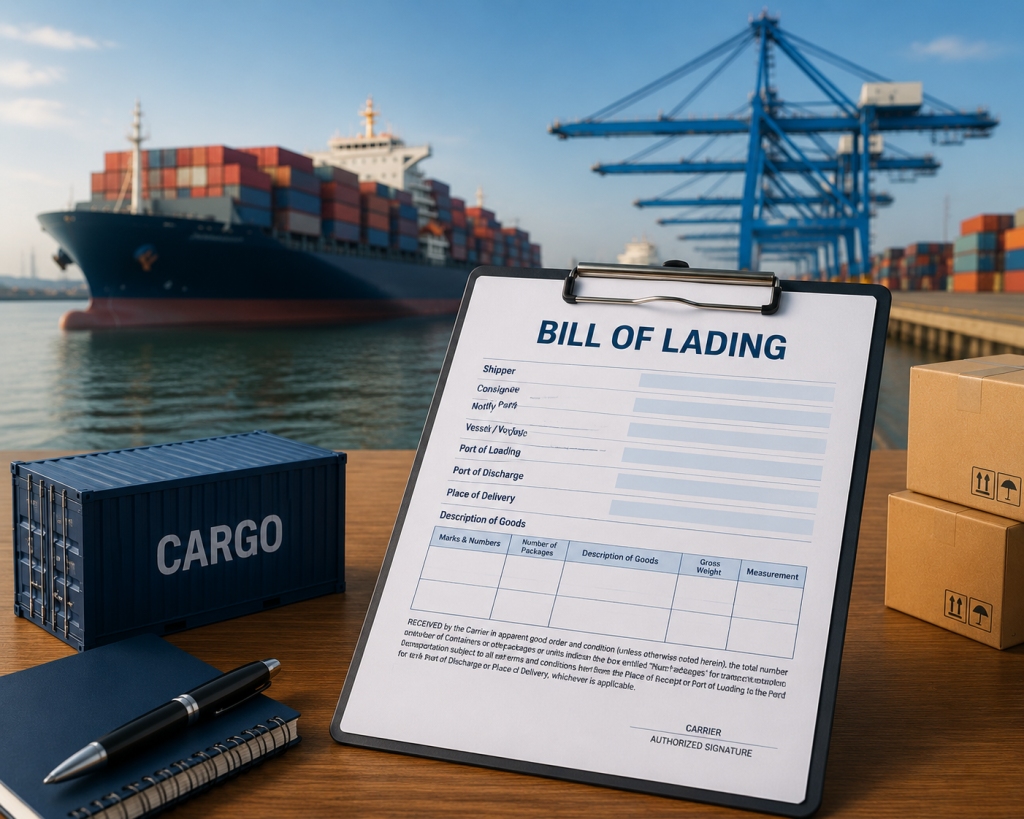
B/L stands for Bill of Lading. It’s the most important document in international shipping.
A bill of lading serves three purposes:
- Receipt – Proof the carrier received your goods
- Contract – Legal agreement between shipper and carrier
- Title document – Proof of ownership for the cargo
Without a B/L, you can’t claim your goods at the destination port. The carrier won’t release the shipment until someone presents the original B/L or an authorized release.
Think of it like a car title. The person holding the B/L owns the cargo. That’s why banks hold onto B/Ls in letter of credit transactions—it gives them security until payment clears.
If you’re doing bulk product sourcing from China or working with a China sourcing agent, understanding B/L types matters. The wrong type can delay customs clearance or create payment issues.
Why B/L Matters in Shipping
The B/L protects everyone in the transaction.
For the shipper (exporter):
It proves they handed goods to the carrier. If something goes wrong in transit, the B/L shows what condition the cargo was in when it left.
For the carrier:
It’s a contract. The shipper agrees to pay freight charges. The carrier agrees to transport goods to the destination. Both parties have legal obligations spelled out in the B/L.
For the consignee (importer):
It’s proof of ownership. Without the B/L, you can’t collect your shipment. Customs won’t release it. The port won’t hand it over.
For banks:
In letter of credit deals, banks hold the B/L as collateral. They release it to the buyer only after payment conditions are met. This protects sellers from non-payment and buyers from non-delivery.
Mess up the B/L and you create problems. Wrong details? Customs delays. Lost B/L? Expensive bond process to release cargo. Late B/L? Demurrage fees pile up while you wait for documents.
If you’re using global sourcing services, make sure your provider understands B/L requirements. One mistake here costs time and money.
Key Information in a B/L
Every B/L contains specific information. Here’s what you’ll see:
Shipper Details:
Name and address of the company sending goods. Usually your supplier.
Consignee Details:
Name and address of who receives goods. That’s you, your company, or sometimes “To Order” for negotiable B/Ls.
Notify Party:
Who gets notified when the shipment arrives. Often the same as consignee, but could be your customs broker or freight forwarder.
Vessel Name and Voyage Number:
Which ship carries your cargo and which voyage.
Port of Loading:
Where goods were loaded onto the vessel.
Port of Discharge:
Where goods will be unloaded.
Place of Delivery:
Final destination (might be different from port of discharge if using inland transport).
Container Number and Seal Number:
Identifies which container holds your goods and the security seal number.
Number of Packages:
How many cartons, pallets, or units.
Description of Goods:
What’s in the shipment. Not super detailed, but specific enough for customs and cargo identification.
Weight and Volume:
Gross weight and cubic measurement (CBM).
Freight Terms:
Who pays freight—Prepaid (shipper pays) or Collect (consignee pays).
Date of Issue:
When the B/L was created.
Number of Originals:
Usually 3 original B/Ls issued. Any one of them can be used to claim cargo.
Getting any of this wrong creates headaches. If the consignee name doesn’t match your company registration exactly, customs might reject it. If weights are off, you might pay incorrect freight charges.
B/L Template and Format
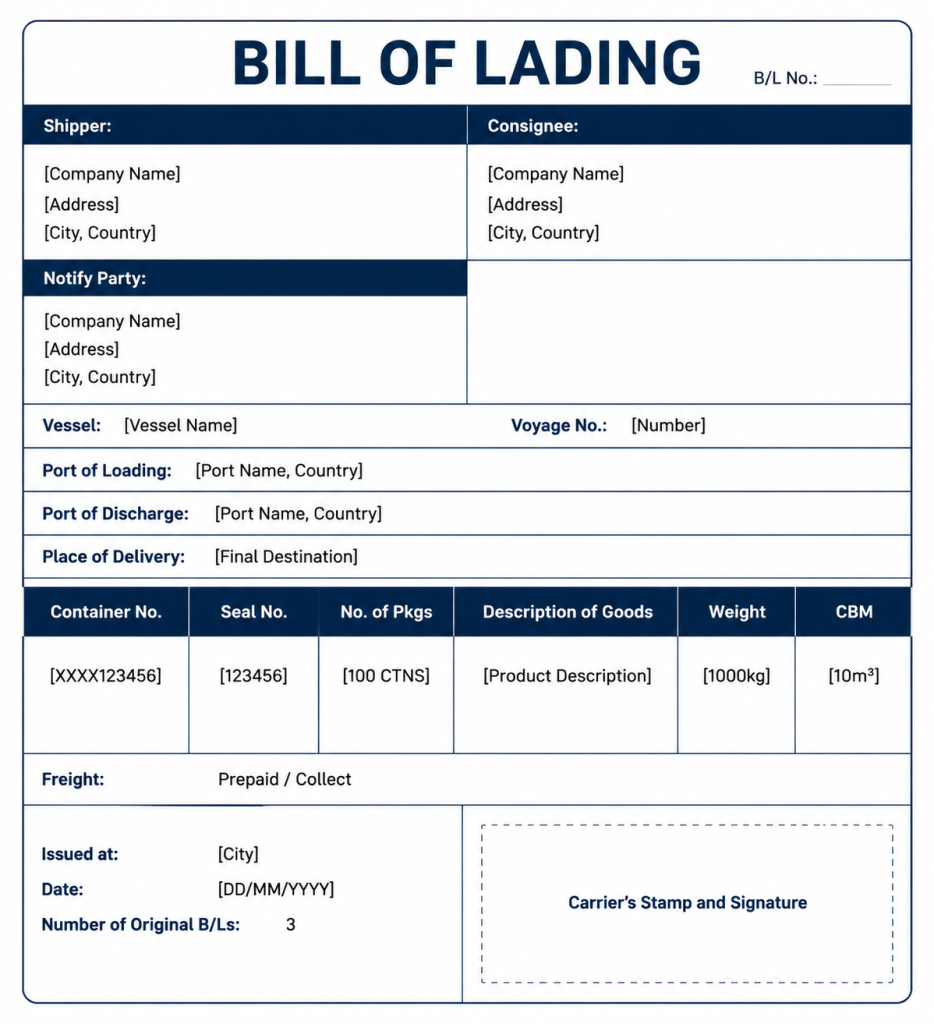
Most carriers use their own templates, but all include these basic elements. Some add more fields like HS codes, letter of credit references, or special handling instructions.
If you need a B/L template for product sourcing, your freight forwarder provides it. Don’t try to create your own—carriers won’t accept unofficial formats.
Ocean Bill of Lading
This is the standard B/L for sea freight. Most common type you’ll encounter.
What it is:
A negotiable document issued by the ocean carrier. Proves ownership of cargo. Can be transferred to another party by endorsement.
When to use it:
- Standard sea freight shipments
- Letter of credit transactions
- When you need proof of ownership
- Any situation requiring a negotiable document
How it works:
The carrier issues 3 original B/Ls. All have equal legal standing. Whoever presents one original B/L at the destination can claim the cargo. Once cargo is released, the other originals become void.
Pros:
- Legally recognized worldwide
- Works with letters of credit
- Provides strong proof of ownership
- Standard industry practice
Cons:
- Takes time to courier originals to destination
- Risk of loss or delay
- More paperwork than electronic alternatives
Ocean B/L is default for most bulk product sourcing from China. Banks accept it. Customs recognizes it. No complications.
Sea Waybill
A sea waybill is a non-negotiable transport document. Faster and simpler than a traditional B/L.
What it is:
Proof that the carrier received goods, but not a title document. The named consignee can claim cargo without presenting the original document.
When to use it:
- Shipments between related companies
- When you trust the buyer completely
- Short transit times where B/L might not arrive in time
- No letter of credit involved
How it works:
Carrier releases cargo directly to the named consignee at destination. No need to present original documents. Consignee just shows ID and proof they’re the named party.
Pros:
- Faster than traditional B/L
- No risk of lost documents
- Lower admin costs
- Simpler process
Cons:
- Not negotiable—can’t transfer ownership
- Doesn’t work with letters of credit
- Less security for sellers
- Can’t hold goods as collateral
Sea waybills work well for established relationships where payment isn’t an issue. If you’re shipping to your own warehouse or a trusted partner, it speeds things up. But don’t use it with new buyers or risky markets.
Telex Release B/L
Telex release combines benefits of traditional B/L with speed of digital communication.
What it is:
Original B/L is surrendered at origin port. Carrier sends electronic message (telex) to destination port authorizing cargo release to the named consignee.
When to use it:
- Short transit times (Asia to West Coast US, for example)
- When original B/L won’t arrive before cargo
- Established buyer-seller relationships
- Want security of B/L but need speed
How it works:
- Carrier issues original B/L at origin
- Shipper returns all originals to carrier at origin port
- Carrier “releases” the B/L and sends telex to destination
- Consignee collects cargo at destination with ID and telex reference
Pros:
- Faster than couriering original B/L
- Cheaper than express courier fees
- Still maintains some security features
- Widely accepted
Cons:
- Requires trust—can’t recall once released
- Some countries or ports don’t accept telex release
- Less secure than holding original B/L
- Might not satisfy letter of credit terms
Telex release is popular for global sourcing when transit times are 10-15 days. Gives you security during production and payment, but speeds up delivery at destination.
Straight Bill of Lading
Straight B/L names a specific consignee and isn’t negotiable.
What it is:
A B/L made out directly to a named consignee. Can’t be transferred or endorsed to another party.
When to use it:
- Shipments to your own company
- Related party transactions
- When you don’t need negotiability
- Domestic shipments within same corporate structure
How it works:
Carrier releases cargo only to the named consignee. Even if someone else gets the B/L document, they can’t claim the cargo. Only the named party can take delivery.
Pros:
- Prevents cargo being claimed by wrong party
- Simpler than negotiable B/L
- Good for internal transfers
- Reduces fraud risk
Cons:
- Can’t transfer ownership
- Doesn’t work with letters of credit
- Less flexible
- Limited use cases
Straight B/L makes sense when shipping between your own facilities or to wholly-owned subsidiaries. But it’s too restrictive for most commercial transactions.
Order Bill of Lading
Order B/L is negotiable and can be transferred by endorsement.
What it is:
A B/L consigned “To Order” or “To Order of [Bank Name]”. Holder can transfer ownership by endorsing it to another party.
When to use it:
- Letter of credit transactions
- When goods might be sold in transit
- Trading companies buying and reselling
- Maximum security needed
How it works:
The shipper endorses the B/L (signs the back). Whoever holds the endorsed B/L owns the cargo. Can be endorsed multiple times, transferring ownership each time.
Pros:
- Maximum negotiability
- Banks accept it for letters of credit
- Can sell goods while in transit
- Flexible ownership transfer
Cons:
- More complex handling
- Risk if B/L is lost or stolen
- Requires secure courier
- More expensive to manage
Order B/L is standard for letter of credit deals. Banks hold it until payment clears, then release it to you. This protects both buyer and seller.
If you’re working with procurement outsourcing services, they’ll handle the endorsement process. But understand what you’re signing—endorsing a B/L transfers ownership.
Through Bill of Lading
Through B/L covers shipments using multiple modes of transport.
What it is:
A single B/L covering the entire journey, even if goods transfer between ship, truck, and rail.
When to use it:
- Goods need inland transport at origin or destination
- Multi-modal shipments
- Door-to-door service
- Want single contract for entire journey
How it works:
One carrier (or freight forwarder) takes responsibility for the entire trip. Issues one B/L covering all legs. You deal with one party instead of separate carriers for ocean, truck, and rail.
Pros:
- Simpler documentation
- Single point of contact
- Clear liability chain
- Easier claims process if something goes wrong
Cons:
- More expensive than handling each leg separately
- Less control over individual segments
- Might not be available for all routes
Through B/L works well when you want simplicity. Instead of juggling multiple documents and carriers, you have one contract covering everything from factory to your warehouse.
Master and House B/L
When using a freight forwarder, you get two B/Ls—Master and House.
What they are:
Master B/L (MBL):
Issued by the ocean carrier to the freight forwarder. Shows forwarder as shipper.
House B/L (HBL):
Issued by freight forwarder to you. Shows actual shipper and consignee details.
When used:
- Consolidated shipments (LCL)
- When using freight forwarder services
- Multiple shippers sharing container space
How it works:
Your freight forwarder books space with the carrier. Carrier issues MBL to forwarder. Forwarder issues HBL to you. At destination, forwarder uses MBL to claim cargo, then distributes to individual shippers using HBLs.
Pros:
- Allows LCL shipping
- Forwarder handles carrier relationship
- Better rates through forwarder’s volume
- Simplified process for small shippers
Cons:
- Extra step in document chain
- Slightly longer release process
- Need to coordinate with forwarder for delivery
Most small to mid-size importers use House B/Ls because they ship LCL. If you’re doing bulk product sourcing but not filling containers, you’ll get a House B/L from your forwarder.
Charter Party Bill of Lading
Charter Party B/L is for chartered vessels. Rare for most importers.
What it is:
A B/L issued when you charter an entire ship (or significant space). References the charter party agreement.
When to use it:
- Bulk commodity shipments
- Very large volume shipments
- Oil, grain, minerals, etc.
- When you need entire vessel
How it works:
You sign a charter party agreement (contract to rent the ship). The B/L references that agreement and is subject to its terms.
Pros:
- Flexible terms negotiated directly
- Cost-effective for very large volumes
- Control over timing and routing
Cons:
- Only practical for massive shipments
- Complex legal agreements
- Banks might not accept for letters of credit
- Higher risk and responsibility
Unless you’re moving thousands of tons of cargo, you won’t encounter Charter Party B/L. It’s specialized for commodity trading and bulk shipping.
How to Get Your B/L
The process for obtaining B/L depends on who handles your shipping.
If using freight forwarder:
- Forwarder books space with carrier
- Goods are loaded at origin port
- Carrier issues B/L to forwarder (or forwarder issues House B/L to you)
- Forwarder couriers original B/L to you, or arranges telex release
- You receive documents 3-7 days after vessel departure
If dealing directly with carrier:
- You book directly with shipping line
- Goods loaded at origin
- Carrier issues B/L
- Original documents sent via courier
- You receive 5-10 days after departure
Timeline:
- Ocean B/L: 5-10 days for originals to arrive
- Telex Release: 1-2 days after surrender
- Sea Waybill: No waiting—consignee can claim immediately upon arrival
Plan ahead. If your cargo reaches destination before B/L documents arrive, you pay storage fees while waiting. Telex release solves this but requires trust and isn’t always appropriate.
If you’re managing procurement intelligence, track B/L issuance as part of your logistics KPIs. Late B/Ls cost money.
Common B/L Mistakes
These errors cause the most problems:
1. Wrong Consignee Name
Company name must match exactly. “ABC Ltd” isn’t the same as “ABC Limited” to customs. One letter off? Delays.
2. Incorrect HS Codes
Some B/Ls include HS codes. Wrong code means wrong duty calculation and customs flags.
3. Misdeclared Weight or Volume
Freight charges based on weight/volume. Misdeclare and carrier issues revised invoice or customs questions accuracy.
4. Missing “Freight Prepaid” or “Freight Collect”
Carrier won’t release cargo until freight is paid. If terms unclear, creates confusion at destination.
5. Lost Original B/L
Losing original B/L is expensive. You need to post a bond (usually 200% of cargo value) and wait for court approval to release cargo. Takes weeks and costs thousands.
6. Wrong Notify Party
If customs broker isn’t listed as notify party, they might not know cargo arrived. Creates delays in customs clearance.
7. Inconsistent Documents
B/L doesn’t match commercial invoice or packing list? Customs rejects it. All documents must align.
8. Late Document Arrival
Original B/L arrives after cargo. You pay demurrage and storage while waiting for documents.
Working with a quality control partner? Have them verify B/L details before shipment leaves. Catching errors early saves money.
B/L vs Other Shipping Documents
People confuse B/L with similar documents. Here’s the difference:
B/L vs Commercial Invoice:
- B/L: Transport document, proof of shipment, title to goods
- Commercial Invoice: Payment document, shows transaction value, used for customs
B/L vs Packing List:
- B/L: Legal document for cargo ownership
- Packing List: Detail of what’s in each box/pallet, no legal standing
B/L vs Certificate of Origin:
- B/L: Shows transport details and ownership
- COO: Proves where goods were manufactured, needed for preferential duty rates
B/L vs Air Waybill:
- B/L: Ocean freight, negotiable (can be), proves ownership
- Air Waybill: Air freight, non-negotiable, not a title document
B/L vs Sea Waybill:
- B/L: Negotiable, transferable, title document
- Sea Waybill: Non-negotiable, faster, not transferable
You need multiple documents for international shipping. B/L is just one piece. But it’s the most important for claiming cargo at destination.
Final Thoughts on B/L
Understanding bill of lading types prevents expensive mistakes. Wrong B/L type delays cargo release, creates payment issues, or complicates customs clearance.
Most importers use Ocean B/L or Telex Release for standard shipments. Sea Waybills work for trusted partners. Order B/Ls handle letter of credit deals. House B/Ls come with freight forwarder services.
Know which type fits your situation. Verify details before shipment departs. Keep originals secure. Plan for document transit time.
Need help managing B/L requirements or coordinating with suppliers? Get in touch and we’ll walk through your specific situation. Want to streamline your import documentation? Book a consultation and let’s discuss end-to-end logistics support.
Understanding B/L in shipping is fundamental to successful importing. Get it right and shipments flow smoothly. Get it wrong and you pay the price in delays, fees, and frustration.