
I got a call from a client in 2021 that still makes me wince. They’d manufactured 12,000 units of an electronic product, shipped the entire order to Germany, and had the whole shipment held at customs. The reason? Missing CE marking documentation. Not the physical mark on the product. They had that. The problem was they couldn’t produce the technical file proving their CE mark was legitimate. Twelve thousand units sitting in a warehouse. Customers waiting. Cash flow bleeding. All because they treated CE marking as a logo to print rather than a compliance process to complete.
That experience taught me something I now tell every client who asks about selling products in Europe. CE marking is not a sticker. It’s a legal declaration. And getting it wrong costs far more than getting it right.
Table of Contents
- What Does CE Marking Actually Mean
- CE Marking vs CE Mark: Is There a Difference
- Which Products Need CE Marking
- The CE Marking Process Step by Step
- CE Marking in the UK After Brexit
- Common Mistakes That Get Products Rejected
- How Much Does CE Marking Cost
- Questions Exporters Ask Me Regularly
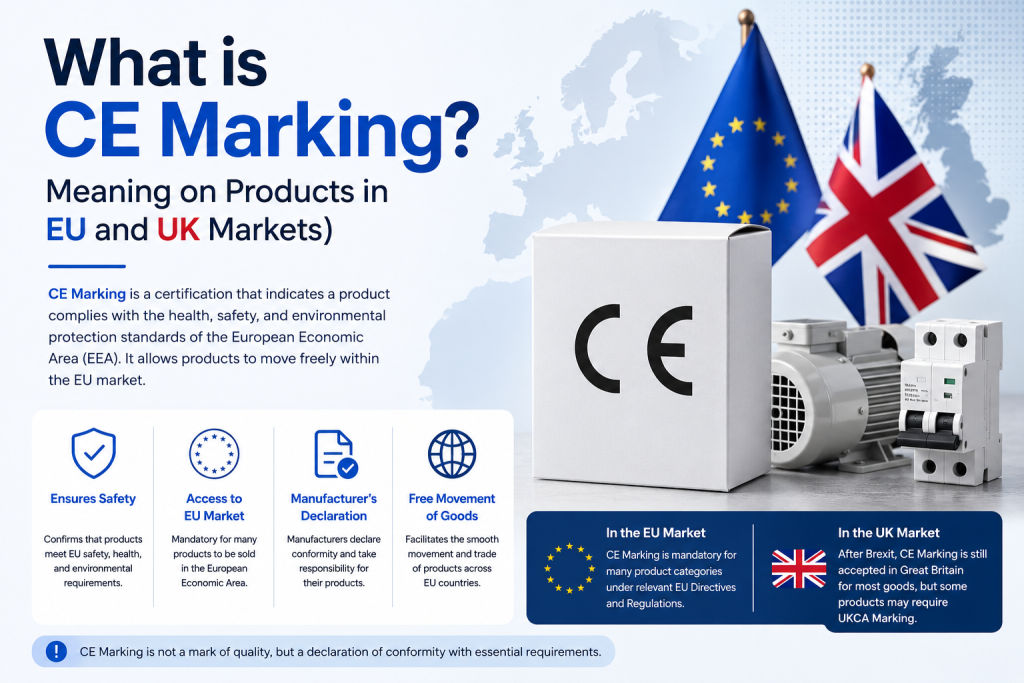
1. What Does CE Marking Actually Mean
CE stands for “Conformite Europeenne” which translates from French as “European Conformity.” When you see the CE mark on a product, it means the manufacturer declares that the product meets all relevant EU health, safety, and environmental protection requirements.
Here’s what most people get wrong. The CE mark is not a quality mark. It’s not a certification that some authority tested your product and approved it. In most cases, nobody from the EU tests your product at all. The manufacturer self-declares conformity. You’re putting your name and reputation behind a legal statement that says “this product meets every applicable EU directive and regulation.”
That legal responsibility is what makes CE marking serious. If your product causes harm and your CE marking documentation doesn’t hold up, you face product recalls, fines, criminal liability, and permanent market access loss. The European Commission makes this responsibility structure explicitly clear in their guidance documents.
The CE mark gives your product a passport to move freely across all 27 EU member states plus Iceland, Liechtenstein, and Norway (the European Economic Area). Without it, your product legally cannot be sold, imported, or distributed in these markets. Customs authorities check for it. Market surveillance authorities enforce it. Retailers require it.
2. CE Marking vs CE Mark: Is There a Difference
People use “CE marking” and “CE mark” interchangeably in conversation. Technically, there’s a subtle distinction worth knowing.
“CE marking” refers to the entire process. The assessment, testing, documentation, declaration of conformity, and physical application of the symbol. It’s the complete compliance journey from identifying which directives apply to your product through to placing the symbol on the finished item.
“CE mark” refers specifically to the physical symbol itself. The distinctive letters “CE” in a specific geometric proportion that gets printed, engraved, or attached to the product. The official CE mark design has precise proportional requirements. Each letter must be at least 5mm tall. The proportions must follow the official grid. You can’t just type “CE” in any font and call it done.
For practical purposes in business conversations, both terms mean the same thing. But in regulatory documents and when communicating with notified bodies or customs authorities, using “CE marking” to describe the process and “CE mark” to describe the physical symbol shows you understand the system properly.
3. Which Products Need CE Marking
Not every product sold in the EU needs CE marking. Only products covered by specific EU directives and regulations require it. If no directive applies to your product, you actually cannot legally put a CE mark on it. Marking a product CE when no directive requires it is itself a violation.
Product categories that require CE marking include:
Electrical and electronic equipment falls under the Low Voltage Directive (LVD) and Electromagnetic Compatibility (EMC) Directive. Anything that plugs in, uses batteries, or emits electromagnetic energy needs CE marking. Computers, chargers, LED lights, kitchen appliances, power tools, audio equipment.
Machinery falls under the Machinery Directive 2006/42/EC. Industrial equipment, power tools, construction machinery, agricultural equipment, and automated systems all require CE marking with specific risk assessment documentation.
Toys fall under the Toy Safety Directive 2009/48/EC. Every toy sold in the EU needs CE marking with testing by an accredited laboratory for mechanical, chemical, and electrical safety.
Medical devices fall under the Medical Device Regulation (MDR) 2017/745. From bandages to MRI machines, medical devices require CE marking with involvement of a Notified Body for most device classifications.
Personal protective equipment (PPE) falls under Regulation 2016/425. Safety helmets, protective gloves, high-visibility clothing, respiratory protection, and fall protection equipment all need CE marking.
Construction products fall under the Construction Products Regulation 305/2011. Building materials, structural components, and construction accessories require CE marking based on harmonized European standards.
Radio equipment falls under the Radio Equipment Directive 2014/53/EU. Bluetooth devices, WiFi products, cellular equipment, and anything that transmits or receives radio signals needs CE marking.
Products that typically don’t need CE marking include furniture (unless it has electrical components), clothing (unless it’s PPE), food products, cosmetics, chemicals (covered by REACH but not CE marked), and pharmaceuticals.
For manufacturers unsure which directives apply to their specific product, a compliance assessment specialist can identify applicable requirements before production begins, preventing costly mistakes downstream.
4. The CE Marking Process Step by Step
The CE marking process follows a logical sequence. Skip steps or do them out of order and you create gaps that customs authorities and market surveillance bodies will find.
Step one: Identify applicable directives. Determine which EU directives and regulations apply to your specific product. Many products fall under multiple directives simultaneously. A Bluetooth speaker, for example, needs compliance with the Radio Equipment Directive, Low Voltage Directive, EMC Directive, and RoHS Directive. Missing even one applicable directive invalidates your CE marking.
Step two: Identify applicable harmonized standards. Each directive references specific European harmonized standards (EN standards) that provide the technical requirements your product must meet. Following harmonized standards creates a “presumption of conformity” with the directive. You can use alternative methods to demonstrate compliance, but harmonized standards are the clearest path.
Step three: Determine conformity assessment procedure. Some products allow manufacturer self-assessment (internal production control). Others require third-party testing by an accredited laboratory. Higher-risk products require involvement of a Notified Body (an organization designated by an EU member state to assess conformity). The applicable directive specifies which assessment modules apply to your product category.
Step four: Test the product. Conduct or commission the required testing against applicable standards. This might include electrical safety testing, EMC testing, chemical analysis, mechanical testing, or performance testing depending on your product type. Keep all test reports as part of your technical file.
Step five: Compile the technical file. Create comprehensive documentation including product description, design drawings, test reports, risk assessments, manufacturing quality procedures, and any other evidence demonstrating compliance. This file must be available to authorities on request for ten years after the last product is placed on the market.
Step six: Draft the EU Declaration of Conformity (DoC). This is the formal legal document where you (the manufacturer or authorized representative) declare that your product meets all applicable requirements. It must include your identity, product identification, applicable directives, harmonized standards used, and your signature. The official DoC requirements are specified in EU Decision 768/2008.
Step seven: Affix the CE mark. Place the CE symbol on the product itself, its packaging, or accompanying documents (depending on what’s practical for the product type). The mark must be visible, legible, and permanent.
For companies managing this process across multiple product lines while coordinating with overseas manufacturers, having a sourcing partner who understands EU compliance requirements prevents communication gaps between design intent and manufacturing reality.
5. CE Marking in the UK After Brexit
Brexit changed everything for products entering the UK market. Since January 1, 2021, the UK has its own marking system called UKCA (UK Conformity Assessed). But the transition has been messy, extended multiple times, and confused manufacturers worldwide.
Here’s the current situation as of 2025. The UK government has extended recognition of CE marking for most product categories indefinitely for goods sold in Great Britain (England, Scotland, Wales). This means products with valid CE marking can still be sold in Great Britain without additional UKCA marking for most product types.
However, Northern Ireland follows different rules under the Windsor Framework. Products sold in Northern Ireland still require CE marking (following EU rules) or can use the UK(NI) marking.
The practical implication for exporters: if you already have CE marking for the EU market, your products can currently enter the UK market without separate UKCA certification for most categories. But this policy could change. The UK government retains the right to require UKCA marking in the future.
My recommendation to clients: get your CE marking right for the EU market first. That currently covers both EU and UK access. Monitor UK government announcements for any changes to CE mark recognition timelines. Don’t invest in separate UKCA certification unless your products fall into categories where it’s already mandatory or unless your UK volumes justify the insurance of having both marks.
6. Common Mistakes That Get Products Rejected
After helping dozens of clients navigate CE marking over the years, I see the same mistakes repeatedly. Each one is entirely preventable.
Treating CE marking as a label rather than a process. The most common and most dangerous mistake. Printing “CE” on your product without completing the actual conformity assessment process is illegal. It’s called fraudulent CE marking. Penalties include product seizure, fines up to hundreds of thousands of euros, and criminal prosecution in some member states.
Missing applicable directives. Products often fall under multiple directives. Manufacturers identify one or two but miss others. A product that complies with the EMC Directive but ignores the Low Voltage Directive isn’t properly CE marked even though it has the symbol on it.
Inadequate technical file. The technical file is your proof. Without it, your CE mark is just ink on plastic. Customs authorities and market surveillance bodies request technical files during inspections. If you can’t produce comprehensive documentation within a reasonable timeframe, your products get pulled from the market.
Using outdated standards. Harmonized standards get revised and replaced. Testing against a withdrawn standard doesn’t provide presumption of conformity even if your product passes the tests. Always verify you’re working with current, listed harmonized standards.
Incorrect CE mark proportions. The CE symbol has specific geometric requirements. Using incorrect proportions, wrong fonts, or marks that are too small (under 5mm) technically constitutes non-compliance. Market surveillance authorities do check this.
No authorized representative in the EU. Non-EU manufacturers must have an authorized representative established within the EU who takes responsibility for compliance documentation. Without this representative, your product cannot legally carry CE marking regardless of its actual compliance status.
7. How Much Does CE Marking Cost
Cost varies enormously depending on product complexity, applicable directives, and whether third-party testing is required. Here are realistic ranges based on what I’ve seen clients pay.
Simple products (single directive, self-assessment): $2,000 to $5,000 total. This covers standard identification, testing against harmonized standards, technical file compilation, and declaration of conformity drafting. A basic electronic accessory or simple mechanical product falls here.
Moderate complexity (multiple directives, lab testing required): $5,000 to $15,000. Products requiring EMC testing, safety testing, and possibly radio testing across multiple standards. Most consumer electronics fall in this range.
High complexity (Notified Body involvement required): $15,000 to $50,000+. Medical devices, certain machinery, pressure equipment, and other high-risk products requiring third-party assessment by a Notified Body. Timelines extend to months rather than weeks.
Ongoing costs: Annual surveillance audits (if required by your conformity assessment module), standard updates requiring retesting, and technical file maintenance add recurring costs. Budget 10 to 20 percent of initial certification costs annually for maintenance.
These costs feel significant until you compare them against the cost of non-compliance. My client with 12,000 units held at customs? The storage fees, shipping delays, emergency compliance work, and lost customer relationships cost over $80,000. The proper CE marking process would have cost $8,000 upfront.
For manufacturers looking to manage certification costs effectively while maintaining compliance, working with a product development team experienced in regulatory requirements from the design stage prevents expensive redesigns after production.
Questions Exporters Ask Me Regularly
Can I self-certify CE marking or do I need a third party?
Depends entirely on your product category and the applicable directive. Many product types allow manufacturer self-assessment (Module A in EU terminology). You conduct or commission testing, compile documentation, and declare conformity yourself. Higher-risk products (certain machinery, medical devices, gas appliances, pressure equipment) require Notified Body involvement. Check the specific directive applicable to your product to determine which assessment modules are available.
How long does CE marking take?
Simple products with self-assessment: 4 to 8 weeks from starting the process to having complete documentation. Moderate complexity with lab testing: 8 to 16 weeks depending on laboratory availability and testing scope. High complexity with Notified Body: 3 to 12 months depending on product type and body workload.
Does CE marking expire?
The CE mark itself doesn’t have an expiration date. However, your conformity assessment becomes invalid if applicable standards change, if you modify the product design, or if the regulatory framework updates. You’re responsible for monitoring changes and updating your compliance documentation accordingly. Practically, plan to review your technical file annually.
What happens if my product fails testing?
You redesign, modify, or adjust the product to meet requirements, then retest. This is why involving compliance considerations early in product development saves money. Discovering a fundamental design problem after manufacturing 12,000 units is exponentially more expensive than identifying it during prototyping.
Is CE marking the same as being “approved” by the EU?
No. The EU doesn’t approve products (with limited exceptions involving Notified Bodies). CE marking is the manufacturer’s declaration of conformity. You’re stating that your product meets requirements. The EU provides the framework, standards, and enforcement. But the responsibility and declaration come from you. This distinction matters legally because it means liability sits with the manufacturer, not with any government body.
Do I need CE marking for products sold on Amazon EU?
Yes. Amazon requires CE marking documentation for applicable product categories sold on their EU marketplaces. They actively enforce this requirement and will remove listings that lack proper compliance documentation. Amazon’s compliance requirements specify what documentation sellers must provide.
Final Thought
CE marking isn’t optional, isn’t decorative, and isn’t something you figure out after production. It’s a legal requirement that determines whether your product enters the world’s largest single market or sits in a customs warehouse costing you money every day it’s stuck there.
Get it right from the start. Build compliance into your product development process rather than bolting it on at the end. The investment in proper CE marking pays for itself the first time your shipment clears customs without a single question asked.
For manufacturers navigating CE marking requirements while managing overseas production, having a compliance-aware sourcing partner ensures your products meet EU requirements before they leave the factory floor rather than discovering problems at the border.