
A car accessories brand owner called me from his warehouse in Texas last September. He’d just received 8,000 car covers from his factory in Zhejiang province. The covers looked fine in the box. Nice packaging. Clean stitching. Professional appearance. He shipped 2,000 units to Amazon FBA within the first week.
Six weeks later, his listing was drowning in one-star reviews. “Ripped after one windstorm.” “Water pools on top and leaks through.” “Smells like chemicals, stained my paint.” “Fell apart at the seams after two months outside.”
His factory had quoted him “waterproof polyester car cover fabric.” He’d accepted that description without asking a single follow-up question. No fabric weight specification. No coating type. No UV stabilizer requirement. No tensile strength minimum. No breathability rating. Just “waterproof polyester.”
What he received was 90 GSM polyester taffeta with a thin single-pass PU coating. Technically polyester. Technically waterproof (for about three weeks before the coating degraded under UV exposure). But completely inadequate as a fabric for car cover applications facing real outdoor conditions. The fabric was too light to resist wind stress. The coating was too thin to maintain waterproofing beyond initial use. And the lack of UV stabilizers meant the polyester itself began degrading within weeks of sun exposure.
His total loss: $47,000 in product cost, shipping, Amazon fees, and refund processing. Plus a destroyed listing with reviews he can never remove.
Choosing the right fabric for car cover products isn’t a casual decision you make by accepting whatever your factory suggests. It’s a technical specification decision that determines whether your product protects vehicles for years or fails within weeks. And the difference between those outcomes often comes down to details that cost pennies per unit but save thousands in avoided returns and reputation damage.
Table of Contents
| # | Section |
| 1 | Why Fabric Choice Makes or Breaks a Car Cover Business |
| 2 | What Makes a Good Fabric for Car Cover Applications |
| 3 | Fabric #1: Polyester Oxford (The Industry Workhorse) |
| 4 | Fabric #2: Nylon Taffeta (Lightweight Indoor Champion) |
| 5 | Fabric #3: Polypropylene Non-Woven (Budget Outdoor Option) |
| 6 | Fabric #4: PEVA/EVA Composite (Waterproof Budget Layer) |
| 7 | Fabric #5: Solution-Dyed Acrylic (Premium Outdoor Performer) |
| 8 | Fabric #6: Polyester Microfiber (Soft Indoor Specialist) |
| 9 | Fabric #7: PVC-Coated Polyester (Heavy-Duty Industrial) |
| 10 | Fabric #8: Tyvek (Breathable Barrier Technology) |
| 11 | Fabric #9: Multi-Layer Composite Fabric (Engineered Performance) |
| 12 | Fabric for Car Cover: Complete Comparison Chart |
| 13 | How Climate Should Drive Your Fabric Selection |
| 14 | Coatings and Treatments That Determine Real-World Performance |
| 15 | How Factories Cut Corners on Car Cover Fabric |
| 16 | How to Specify Car Cover Fabric in Your Production Orders |
| 17 | FAQ |
What Makes a Good Fabric for Car Cover Applications
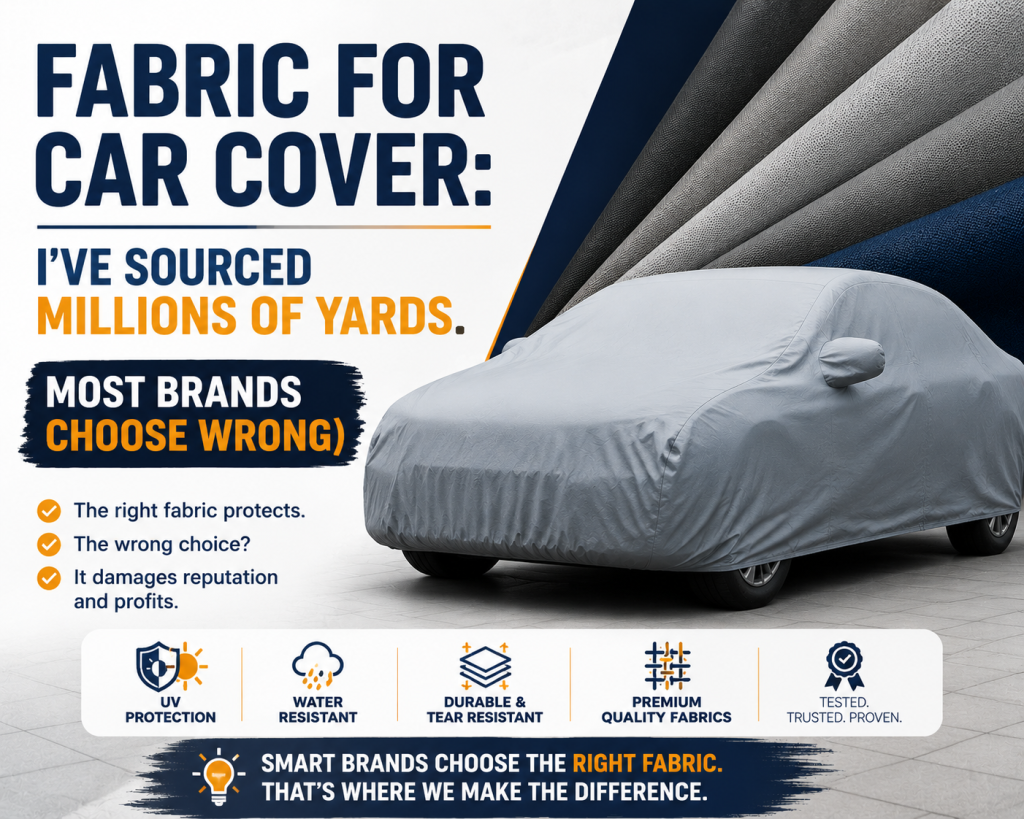
Before comparing specific materials, you need to understand what a car cover fabric actually needs to do. The requirements are more complex than most people realize because a car cover faces simultaneous opposing demands.
It must block water but allow moisture to escape. A completely waterproof barrier (like a plastic sheet) traps condensation between the cover and the paint surface. Trapped moisture causes water spots, promotes mold growth, and can damage paint finishes over time. The fabric needs to prevent rain from reaching the car while allowing water vapor (from ground moisture, temperature differentials, and residual dampness) to pass through and evaporate. This balance between water resistance and breathability is the central engineering challenge of car cover fabric design.
It must resist UV radiation without degrading. Sunlight destroys most synthetic fabrics over time. UV radiation breaks polymer chains, causing the fabric to become brittle, lose strength, fade in color, and eventually disintegrate. A car cover fabric needs UV stabilizers that extend its outdoor life from weeks to years. The level of UV protection needed depends on the target market’s climate. A cover sold in Arizona needs dramatically more UV resistance than one sold in Seattle.
It must resist physical stress without tearing. Wind is the primary mechanical stress on car covers. Wind creates lift forces that pull the cover away from the vehicle, stress concentration at tie-down points, and flapping that causes abrasion against the paint surface. The fabric needs adequate tensile strength and tear resistance to survive wind events without ripping. It also needs enough weight and drape to stay in position without excessive flapping.
It must be soft enough to not scratch paint. The inner surface of a car cover contacts the vehicle’s paint directly. Any roughness, grit, or abrasive texture on the fabric’s inner face will scratch the paint surface, especially when wind causes the cover to shift and rub. The inner layer needs to be soft, smooth, and non-abrasive. This is why many quality car covers use a different material for the inner layer than the outer layer.
It must fold to a manageable size. Car owners store their covers in trunks, garages, or storage bags. Extremely thick or rigid fabrics that don’t fold compactly become inconvenient to use, which means customers stop using them, which means they stop buying replacements or recommending the product. Practical packability matters for customer satisfaction and repeat purchases.
It must resist mold and mildew. A damp car cover stored in a trunk or garage bag becomes a mold breeding ground. Mold damages the fabric, creates unpleasant odors, and can transfer to the vehicle’s paint surface. The fabric needs inherent mold resistance or antimicrobial treatment to prevent biological growth during storage.
These competing requirements explain why no single fabric is perfect for all car cover applications. Every material involves trade-offs. Understanding those trade-offs helps you select the right fabric for your specific product positioning, target market, and price point.
Fabric #1: Polyester Oxford (The Industry Workhorse)
Polyester Oxford fabric dominates the car cover market for good reason. It offers the best balance of performance, durability, and cost for outdoor car cover applications. If you’re launching a car cover product line and need one fabric to start with, polyester Oxford in the right weight and coating specification covers the widest market.
What it is: Oxford weave is a specific weave pattern (basketweave variant) that creates a textured, durable fabric with good tear resistance. When woven from polyester yarns and coated with polyurethane (PU) or polyacrylic, it becomes an effective car cover material that balances water resistance, breathability, UV resistance, and mechanical strength.
Weight options and their applications:
150D Oxford (approximately 110-130 GSM): Lightweight option suitable for indoor covers or mild-climate outdoor use. Folds compactly. Lower tear resistance limits wind performance. Appropriate for budget-positioned products or indoor/garage use.
190T Oxford (approximately 80-100 GSM): Ultra-light taffeta variant sometimes marketed as Oxford. Inadequate for serious outdoor use. This is what budget factories default to when you don’t specify weight. Avoid for any product making outdoor durability claims.
210D Oxford (approximately 140-160 GSM): Mid-weight option offering reasonable outdoor performance at moderate cost. Adequate for seasonal outdoor use in mild climates. The minimum acceptable weight for products marketed as outdoor car covers.
300D Oxford (approximately 180-220 GSM): The sweet spot for most outdoor car cover applications. Good tear resistance, adequate weight to resist wind lift, durable enough for multi-year outdoor use with proper coating. This is what quality car cover brands typically specify.
420D Oxford (approximately 240-280 GSM): Heavy-duty option for premium outdoor covers or harsh-climate applications. Excellent tear resistance and wind performance. Heavier fold weight and higher cost limit it to premium product positioning.
600D Oxford (approximately 300-350 GSM): Maximum durability for extreme conditions. Used in commercial vehicle covers, boat covers, and heavy-duty applications. Too heavy and bulky for standard passenger car covers unless targeting the premium/commercial segment.
Coating options:
PU (Polyurethane) coating: The standard waterproofing treatment for polyester Oxford car covers. Applied to the back side of the fabric in liquid form, then cured. Available in different thicknesses measured in millimeters of water column resistance (mm H2O). A single PU coat provides 1000-3000 mm water column. Double PU coat provides 3000-5000 mm. For car covers, 2000-3000 mm water column is adequate for rain protection.
PA (Polyacrylic) coating: Less expensive than PU. Provides water resistance but less durable under UV exposure and repeated flexing. Adequate for budget products but degrades faster than PU in outdoor conditions.
Silver coating: Reflective aluminum-based coating applied to the outer surface. Reflects UV radiation and heat, reducing under-cover temperature and extending fabric life. Adds $0.30-0.60 per yard to fabric cost but significantly improves UV performance and heat reduction. Highly recommended for products targeting hot-climate markets.
PVC coating: Creates a completely waterproof barrier but eliminates breathability entirely. Used for heavy-duty industrial covers where breathability isn’t required. Not recommended for standard car covers because trapped moisture damages paint.
Wholesale cost (2026): $1.80-4.50 per yard depending on denier, coating type, and order volume. 300D with PU coating from Zhejiang mills runs $2.20-3.00 per yard at 3000+ yard orders. Silver-coated 300D runs $2.80-3.60 per yard.
Sourcing notes: Polyester Oxford is produced at massive scale in China (primarily Zhejiang and Jiangsu provinces), making supply abundant and lead times reasonable (4-6 weeks for stock fabrics, 6-8 weeks for custom colors or specifications). MOQs typically start at 2000-3000 yards for stock colors, 5000+ yards for custom specifications. A sourcing partner with textile mill relationships can negotiate lower MOQs for emerging brands.
Fabric #2: Nylon Taffeta (Lightweight Indoor Champion)
Nylon taffeta offers superior softness and drape compared to polyester, making it the preferred choice for indoor car covers where paint protection and gentle contact matter more than weather resistance.
What it is: Taffeta is a plain-weave fabric with a smooth, slightly crisp hand feel. When woven from nylon (polyamide) yarns, it produces a lightweight, strong, and exceptionally smooth fabric that glides over paint surfaces without scratching.
Why nylon for indoor covers: Nylon’s natural properties align perfectly with indoor cover requirements. It’s inherently softer than polyester against paint surfaces. It has higher abrasion resistance (meaning it doesn’t generate lint or fiber particles that could scratch paint). It drapes closely to vehicle contours, creating a fitted appearance. And it’s lightweight enough to fold into a compact storage bag that fits in a glove compartment.
Weight options:
170T Nylon Taffeta (approximately 55-65 GSM): Ultra-lightweight. Excellent for indoor dust covers on show cars, collector vehicles, and garage-stored daily drivers. Folds to the size of a paperback book. Minimal wind resistance makes it unsuitable for any outdoor use.
190T Nylon Taffeta (approximately 65-80 GSM): Standard indoor cover weight. Good balance of coverage, softness, and packability. The most common specification for quality indoor car covers.
210T Nylon Taffeta (approximately 80-95 GSM): Slightly heavier for added durability. Appropriate for indoor covers that see frequent use (daily covering and uncovering) where the additional fabric weight extends service life.
Performance characteristics:
Water resistance: Minimal without coating. Nylon taffeta is not a waterproof fabric. It provides splash resistance at best. Not appropriate for outdoor use in any climate where rain occurs.
UV resistance: Poor. Nylon degrades rapidly under UV exposure. Outdoor use causes the fabric to become brittle and disintegrate within months. Strictly an indoor material.
Softness: Excellent. The smoothest common car cover fabric available. Zero risk of paint scratching under normal use.
Static: Nylon generates static electricity, which actually helps indoor covers attract and hold dust particles away from the paint surface rather than letting them settle. This is a feature, not a bug, for indoor dust protection.
Breathability: Excellent. Uncoated nylon taffeta allows complete air circulation, preventing any moisture buildup between cover and paint.
Wholesale cost (2026): $1.20-2.50 per yard. Less expensive than polyester Oxford because no coating is required for indoor applications. 190T nylon taffeta from Chinese mills runs $1.40-1.80 per yard at 3000+ yard orders.
Sourcing notes: Widely available from the same Zhejiang and Jiangsu textile regions that produce polyester Oxford. Often available from the same mills, simplifying sourcing if you’re developing both indoor and outdoor cover lines. Lead times similar to polyester: 4-6 weeks stock, 6-8 weeks custom.
Fabric #3: Polypropylene Non-Woven (Budget Outdoor Option)
Polypropylene non-woven fabric occupies the budget end of the outdoor car cover market. It’s the material used in most disposable or semi-disposable car covers sold at auto parts stores for under $30 retail.
What it is: Non-woven polypropylene is made by bonding polypropylene fibers together through heat, chemical, or mechanical processes rather than weaving them on a loom. The result is a fabric-like material that’s inexpensive to produce, naturally water-resistant, and lightweight.
Why it exists in the car cover market: Cost. Polypropylene non-woven fabric costs a fraction of woven polyester or nylon. For brands competing on price in the sub-$30 retail segment, polypropylene non-woven is often the only material that allows profitable pricing at that level.
Performance characteristics:
Water resistance: Moderate. Polypropylene is naturally hydrophobic (repels water). Non-woven construction provides some barrier effect. However, the porous structure allows water penetration under sustained rain or pooling. Adequate for light rain and morning dew. Inadequate for heavy or prolonged rainfall.
UV resistance: Poor to moderate. Polypropylene degrades under UV exposure faster than polyester. Without UV stabilizers, non-woven PP covers become brittle and tear within 3-6 months of continuous outdoor exposure. With UV stabilizers added during manufacturing, lifespan extends to 12-18 months.
Tear resistance: Low. Non-woven construction means no interlocking yarn structure to distribute stress. Once a tear initiates, it propagates easily. Wind stress at tie-down points and edges causes premature failure.
Breathability: Good. The porous non-woven structure allows air and moisture vapor to pass through, preventing condensation buildup.
Softness: Moderate. Smoother than raw polyester Oxford but rougher than nylon taffeta. Acceptable for most vehicles but not ideal for show cars with delicate paint finishes.
Weight options:
60 GSM: Ultra-budget. Barely adequate for single-use or very short-term protection. Tears easily in any wind.
80 GSM: Standard budget cover weight. Provides basic protection for 3-6 months of outdoor use in mild conditions.
100 GSM: Better durability. Extends useful life to 6-12 months with UV stabilizers. The minimum acceptable weight for any product making durability claims.
120+ GSM: Premium non-woven. Approaches woven fabric performance at lower cost. 12-18 month outdoor life with proper UV stabilization.
Wholesale cost (2026): $0.60-1.80 per yard. The lowest cost car cover fabric available. 80 GSM PP non-woven from Chinese mills runs $0.70-1.00 per yard at 5000+ yard orders. UV-stabilized versions add $0.15-0.30 per yard.
Sourcing notes: Produced at enormous scale in China for multiple industries (agriculture, construction, medical, automotive). MOQs are typically higher (5000-10000 yards) because production runs are set up for high volume. Lead times are short (3-5 weeks) due to abundant production capacity. Available from mills in Zhejiang, Guangdong, and Shandong provinces.
Honest assessment: Polypropylene non-woven is appropriate for disposable or semi-disposable car covers positioned at the lowest price point. It’s not appropriate for any product making claims about long-term protection, durability, or premium quality. If your brand positioning is above budget, skip this material entirely. The customer complaints and returns from premature failure cost more than the fabric savings.
Fabric #4: PEVA/EVA Composite (Waterproof Budget Layer)
PEVA (Polyethylene Vinyl Acetate) is a chlorine-free alternative to PVC that provides complete waterproofing at low cost. It’s commonly used as a waterproof layer in budget to mid-range car covers, either alone or laminated to a fabric backing.
What it is: PEVA is a thermoplastic material produced as a thin film (similar to a heavy-duty plastic sheet) that’s completely waterproof. For car cover applications, it’s typically laminated to a non-woven backing (for structure and softness) or used as a middle layer in multi-layer constructions.
Performance characteristics:
Water resistance: Complete. PEVA is 100% waterproof as a film. No water penetrates regardless of rain intensity or duration. This sounds ideal until you consider the breathability trade-off.
Breathability: Zero. PEVA film allows no moisture vapor transmission. This means condensation forms between the cover and the car surface, especially during temperature changes (cool nights after warm days). This trapped moisture can damage paint over time, promote mold growth, and leave water spots.
UV resistance: Moderate. PEVA resists UV degradation better than standard polyethylene but still becomes brittle after 12-24 months of continuous sun exposure. UV-stabilized formulations extend this to 24-36 months.
Tear resistance: Low to moderate. PEVA film tears relatively easily once punctured. The non-woven backing in composite constructions improves tear resistance significantly.
Temperature performance: PEVA remains flexible in cold temperatures (down to approximately -20°C/-4°F) unlike PVC which becomes stiff and brittle in cold weather. This makes PEVA suitable for cold-climate markets where PVC covers crack during winter use.
Softness: The PEVA film itself is smooth and non-abrasive. When laminated with a soft non-woven inner layer (cotton or polyester fleece), the inner surface is gentle on paint.
Common constructions:
PEVA film alone (single layer): Cheapest option. Provides waterproofing only. No structural strength. Tears easily. Used in the cheapest disposable covers.
PEVA + non-woven PP backing: Standard budget construction. The PP backing provides structure and tear resistance while PEVA provides waterproofing. Most sub-$25 retail car covers use this construction.
PEVA + cotton fleece inner layer: Mid-range construction. Cotton fleece provides soft paint contact while PEVA provides waterproofing. Better paint protection than PP-backed versions.
PEVA as middle layer in three-layer composite: The PEVA film sits between an outer fabric layer (polyester Oxford) and an inner soft layer (cotton or microfiber). This construction provides waterproofing without sacrificing outer durability or inner softness. Used in mid-range to premium covers.
Wholesale cost (2026): $0.80-2.20 per yard for composite constructions. PEVA/PP non-woven composite runs $0.90-1.30 per yard. PEVA/cotton fleece composite runs $1.50-2.20 per yard. Pure PEVA film runs $0.50-0.80 per yard but is rarely used alone for car covers.
The breathability problem: The complete lack of breathability is PEVA’s fundamental limitation for car cover applications. For vehicles stored outdoors long-term, trapped moisture causes more damage than the rain the cover prevents. PEVA covers work best for short-term protection (overnight parking, weekend storage) or in dry climates where condensation is minimal. For long-term outdoor storage in humid climates, breathable fabrics (polyester Oxford with PU coating, solution-dyed acrylic) perform better despite allowing some moisture through during heavy rain.
Fabric #5: Solution-Dyed Acrylic (Premium Outdoor Performer)
Solution-dyed acrylic represents the premium end of car cover fabrics. It’s the material used by high-end cover brands charging $200-500+ retail for custom-fit covers. The performance justifies the price for customers who own vehicles worth protecting with the best available material.
What it is: Acrylic fibers that are dyed during the fiber manufacturing process (before spinning into yarn) rather than after fabric construction. This “solution dyeing” process means the color penetrates the entire fiber cross-section rather than sitting on the surface. The result is exceptional color fastness and UV resistance because the dye molecules are protected within the fiber structure rather than exposed on the surface where UV radiation can break them down.
Performance characteristics:
UV resistance: Superior. The best UV resistance of any common car cover fabric. Solution-dyed acrylic maintains color and structural integrity for 5-10 years of continuous outdoor exposure in harsh sun environments. The fiber itself resists UV degradation, and the solution-dyed color doesn’t fade because the pigment is protected within the fiber.
Water resistance: Good (not waterproof). Acrylic fibers are naturally water-repellent. Tightly woven acrylic fabric sheds light to moderate rain effectively. Heavy sustained rain will eventually penetrate. This is actually a feature: the fabric breathes while providing adequate rain protection for most conditions.
Breathability: Excellent. The woven construction allows moisture vapor to escape, preventing condensation buildup. This makes solution-dyed acrylic ideal for long-term outdoor storage where breathability prevents more damage than complete waterproofing.
Softness: Good. Acrylic fibers are naturally soft and non-abrasive. Safe for direct contact with all paint finishes including clear coats, matte finishes, and ceramic coatings.
Mold resistance: Excellent. Acrylic fibers are inherently resistant to mold and mildew growth. The fabric doesn’t retain moisture in its fiber structure, denying mold the damp environment it needs to grow.
Tear resistance: Good to excellent depending on weave density and yarn weight. Premium solution-dyed acrylic car cover fabrics use tight weave constructions that resist tearing under wind stress.
Color options: Extensive. Because the dyeing happens at the fiber level, virtually any color is achievable with guaranteed long-term color stability. Custom colors are available at reasonable MOQs (typically 3000-5000 yards).
The brand name factor: Sunbrella (by Glen Raven) is the most recognized solution-dyed acrylic brand in the market. Many premium car cover brands use Sunbrella fabric or equivalent solution-dyed acrylics. Using a recognized fabric brand name in your product marketing adds perceived value and customer confidence. However, Sunbrella fabric costs significantly more than generic solution-dyed acrylics from Chinese or Taiwanese mills that offer comparable performance.
Wholesale cost (2026): $5.00-12.00 per yard. Sunbrella and equivalent branded fabrics run $8.00-12.00 per yard. Generic solution-dyed acrylic from Asian mills runs $5.00-7.00 per yard with similar performance characteristics. The price premium over polyester Oxford is substantial (3-5x) but justified for premium product positioning.
Sourcing notes: Solution-dyed acrylic production is more concentrated than polyester. Major producers include Glen Raven (USA), Dickson (France), Recasens (Spain), and several Taiwanese and Chinese mills. Chinese production of quality solution-dyed acrylic has improved significantly in recent years, offering 70-80% of branded fabric performance at 50-60% of the cost. Lead times are longer than polyester (8-12 weeks) due to the fiber-level dyeing process. MOQs are typically higher (5000+ yards) for custom colors. Procurement intelligence helps identify which mills produce solution-dyed acrylic at quality levels appropriate for your product positioning.
Fabric #6: Polyester Microfiber (Soft Indoor Specialist)
Polyester microfiber uses extremely fine polyester fibers (typically 0.5-1.0 denier per filament, compared to 1.5-3.0 denier in standard polyester) to create an ultra-soft fabric with exceptional paint-safe properties.
What it is: Microfiber refers to fiber diameter, not fiber type. Polyester microfiber uses the same polyester polymer as standard polyester but spun into much finer filaments. These fine filaments create a fabric with dramatically more surface area per unit weight, resulting in superior softness, dust-trapping ability, and paint-safe contact properties.
Performance characteristics:
Softness: Superior. The softest car cover fabric available. Finer than nylon taffeta against paint surfaces. Zero risk of scratching even on the most delicate finishes (matte paint, ceramic coatings, fresh clear coat).
Dust trapping: Excellent. The high surface area of microfiber filaments attracts and holds dust particles through electrostatic and mechanical trapping. The cover actively removes dust from the paint surface rather than just preventing new dust from settling.
Breathability: Excellent. Uncoated microfiber allows complete air circulation.
Water resistance: Minimal. Not appropriate for outdoor use without waterproof coating (which would negate the softness advantage for indoor use).
UV resistance: Poor. Standard polyester microfiber degrades under UV exposure. Indoor use only.
Static generation: Moderate to high. Generates static that aids dust trapping but can attract lint to the cover surface. Antistatic treatments reduce this if it’s problematic.
Best applications: Show cars, collector vehicles, concours competition cars, vehicles with fresh paint or ceramic coatings, and any application where paint surface protection is the absolute priority. Premium indoor covers for luxury and exotic vehicles.
Wholesale cost (2026): $2.50-5.00 per yard. More expensive than nylon taffeta due to the finer fiber production process. 180 GSM polyester microfiber from Chinese mills runs $2.80-3.50 per yard at 3000+ yard orders.
Fabric #7: PVC-Coated Polyester (Heavy-Duty Industrial)
PVC-coated polyester is the heaviest, most waterproof, and most durable car cover fabric available.
It’s also the least appropriate for standard passenger car applications due to weight, breathability, and paint safety concerns.
What it is: A woven polyester base fabric (typically 300D-1000D Oxford weave) coated on one or both sides with polyvinyl chloride (PVC) compound. The PVC coating creates a completely waterproof, highly durable, and chemically resistant surface. This is the same material used in truck tarps, industrial equipment covers, and marine applications.
Performance characteristics:
Water resistance: Complete. PVC coating is 100% waterproof regardless of rain intensity or duration. No water penetrates under any conditions.
Breathability: Zero. PVC-coated fabric allows no moisture vapor transmission whatsoever. Condensation is guaranteed under temperature fluctuation conditions.
UV resistance: Good. PVC resists UV degradation reasonably well, maintaining integrity for 3-7 years of outdoor exposure depending on formulation and UV stabilizer content.
Tear resistance: Excellent. The combination of heavy woven polyester base and PVC coating creates extremely high tear and puncture resistance. Wind damage is virtually impossible with properly secured PVC covers.
Weight: Very heavy. 500-900 GSM depending on base fabric weight and coating thickness. A full-size sedan cover in PVC-coated polyester weighs 8-15 kg (18-33 lbs). This weight makes handling difficult and storage bulky.
Chemical resistance: Excellent. PVC resists most chemicals, oils, bird droppings, tree sap, and industrial fallout without degradation.
Paint safety: Poor without inner liner. PVC surfaces are rough and can trap grit particles that scratch paint. PVC also releases plasticizers in heat that can transfer to paint surfaces, causing staining. Always requires a soft inner liner (fleece or microfiber) between PVC and paint.
Cold weather performance: Poor. PVC becomes stiff and brittle below -10°C (14°F). Folding or handling PVC covers in cold weather can crack the coating. Not suitable for cold-climate markets without cold-weather plasticizer formulations.
Best applications: Commercial vehicle covers, fleet vehicle storage, construction equipment covers, boat covers, and industrial applications where maximum weather protection matters more than paint delicacy, weight, or breathability. For passenger cars, appropriate only for long-term outdoor storage of non-show vehicles where the owner prioritizes weather exclusion over all other factors.
Wholesale cost (2026): $2.50-6.00 per yard depending on base fabric weight and PVC coating thickness. 500D base with standard PVC coating runs $3.00-4.00 per yard. 1000D heavy-duty runs $4.50-6.00 per yard.
Sourcing notes: PVC-coated polyester is produced at massive scale in China for the tarpaulin and industrial cover industries. Abundant supply, short lead times (3-5 weeks), and low MOQs (1000-2000 yards) make it easy to source. However, environmental regulations around PVC production are tightening in some Chinese provinces, which may affect future availability and pricing. Some European markets restrict PVC content in consumer products due to environmental concerns. Check your target market’s regulations before committing to PVC-based products.
Fabric #8: Tyvek (Breathable Barrier Technology)
Tyvek is DuPont’s branded high-density polyethylene (HDPE) material that offers a unique combination of water resistance and breathability not achievable with conventional fabrics or films.
What it is: Tyvek is made from flash-spun high-density polyethylene fibers bonded together under heat and pressure. The result is a material that looks and feels like paper or lightweight fabric but has properties unlike either. The fiber structure creates millions of microscopic pathways that block liquid water while allowing water vapor (moisture) to pass through.
Performance characteristics:
Water resistance: Very good. Tyvek blocks liquid water effectively under normal rain conditions. Not rated for sustained high-pressure water contact (fire hose, pressure washer) but handles natural rainfall without penetration.
Breathability: Excellent. The key differentiator. Tyvek allows moisture vapor to escape at rates comparable to uncoated woven fabrics while maintaining water barrier properties. This solves the fundamental condensation problem that plagues PEVA and PVC covers.
UV resistance: Moderate. Standard Tyvek degrades under prolonged UV exposure (becomes brittle within 4-6 months of continuous sun). UV-stabilized Tyvek formulations extend outdoor life to 12-24 months. Not a long-term outdoor material without UV treatment.
Tear resistance: Moderate. Tyvek resists tearing in one direction but can tear relatively easily once initiated. The material doesn’t fray (no woven structure to unravel) but punctures and tears propagate under stress.
Weight: Very light. 50-80 GSM for car cover applications. Extremely compact when folded. A full sedan cover in Tyvek weighs under 1 kg (2.2 lbs).
Softness: Moderate. Tyvek has a slightly papery feel that’s smoother than polyester Oxford but not as soft as nylon taffeta or microfiber. Acceptable for most paint finishes but not ideal for show cars with delicate surfaces.
Dust protection: Good. The tight fiber structure blocks fine particles effectively.
Mold resistance: Excellent. HDPE is inherently resistant to biological growth.
The brand licensing consideration: Tyvek is a DuPont (now Dupont de Nemours) trademarked material. Using the Tyvek name in your product marketing requires licensing or purchasing genuine Tyvek material from authorized distributors. Generic HDPE flash-spun materials exist from Chinese manufacturers but cannot legally be called “Tyvek.” The brand recognition of Tyvek adds marketing value but also adds cost and supply chain complexity.
Wholesale cost (2026): $3.00-6.00 per yard for genuine Tyvek material. Generic HDPE flash-spun alternatives from Chinese mills run $1.50-3.00 per yard with similar (though not identical) performance characteristics. The genuine Tyvek premium reflects both material quality and brand licensing value.
Best applications: Mid-range to premium car covers positioned on the breathability advantage. Ideal for humid climates where condensation is a primary concern. Good for customers who store vehicles outdoors in variable weather and need protection without moisture trapping. Also excellent for transport covers (protecting vehicles during shipping) where breathability prevents transit moisture damage.
Sourcing notes: Genuine Tyvek is distributed through DuPont’s authorized channel partners. Supply is reliable but pricing is fixed with minimal negotiation room. Generic alternatives are available from Chinese HDPE material producers in Guangdong and Zhejiang provinces. If using generic alternatives, don’t market them as “Tyvek” — use descriptive terms like “breathable HDPE barrier fabric” instead. Product specification documents should clearly state whether genuine Tyvek or generic HDPE is being used.
Fabric #9: Multi-Layer Composite Fabric (Engineered Performance)
Multi-layer composite fabrics combine different materials in laminated or bonded constructions to achieve performance characteristics impossible with any single material. This is where car cover fabric engineering gets sophisticated.
What it is: Two, three, four, or even five distinct material layers bonded together to create a single fabric that combines the best properties of each layer. Each layer serves a specific function. The composite performs better than any individual layer could alone.
Common multi-layer constructions:
Three-layer outdoor (most common premium construction):
- Outer layer: Solution-dyed polyester or acrylic (UV resistance, color, abrasion resistance)
- Middle layer: Microporous membrane (waterproof yet breathable barrier)
- Inner layer: Soft polyester fleece or microfiber (paint protection, dust trapping)
Four-layer premium outdoor:
- Outer layer: Solution-dyed acrylic (maximum UV resistance)
- Second layer: Spunbond polypropylene (structural support, additional UV barrier)
- Third layer: Microporous polyurethane membrane (waterproof/breathable barrier)
- Inner layer: Cotton flannel or polyester microfiber (maximum paint softness)
Two-layer budget outdoor:
- Outer layer: Polyester Oxford with PU coating (water resistance, structure)
- Inner layer: Non-woven polypropylene or cotton (softness, scratch prevention)
Performance characteristics (three-layer premium):
Water resistance: Excellent. The microporous membrane blocks liquid water while the outer layer provides first-line rain shedding.
Breathability: Very good. The microporous membrane allows water vapor transmission (typically 2000-5000 g/m²/24hr MVTR) while blocking liquid water. This prevents condensation buildup during temperature changes.
UV resistance: Excellent (with solution-dyed outer layer). The outer layer absorbs UV radiation before it reaches the membrane or inner layers, extending total fabric life.
Softness: Excellent (with fleece or microfiber inner layer). The inner layer contacts the paint surface with zero scratch risk regardless of outer layer roughness.
Tear resistance: Good to excellent. Multiple layers distribute stress across different materials, improving overall tear resistance compared to any single layer.
Weight: Moderate. 200-400 GSM depending on layer composition. Heavier than single-layer fabrics but lighter than PVC-coated options.
The engineering advantage: Multi-layer construction eliminates the trade-offs inherent in single-material covers. You don’t have to choose between waterproof and breathable. You don’t have to choose between UV-resistant outer surface and soft inner surface. You don’t have to choose between structural strength and paint safety. Each layer handles its specific function without compromising the others.
Wholesale cost (2026): $4.00-12.00 per yard depending on layer composition and membrane quality. Three-layer polyester/membrane/fleece runs $4.50-6.50 per yard. Premium four-layer with solution-dyed acrylic outer runs $8.00-12.00 per yard. The cost reflects both material expense and the lamination process that bonds layers together.
Sourcing notes: Multi-layer composite fabric production requires lamination equipment and expertise beyond basic weaving. Not all textile mills can produce quality laminates. The lamination bond quality determines whether layers stay together or delaminate during use (a common failure mode in cheap multi-layer covers). Specify lamination bond strength testing in your quality control requirements. Peel strength testing (measuring the force required to separate layers) should be mandatory for every production batch. Minimum acceptable peel strength for car cover applications is typically 2-3 N/cm. Anything below 1.5 N/cm will delaminate during normal use.
Fabric for Car Cover: Complete Comparison Chart
| Fabric Type | Water Resistance | Breathability | UV Life | Softness | Tear Strength | Weight (GSM) | Cost/Yard | Best Use |
| Polyester Oxford 300D | Good (with PU coat) | Moderate | 2-4 years | Moderate | Good | 180-220 | $2.20-3.00 | All-purpose outdoor |
| Nylon Taffeta 190T | Poor | Excellent | Indoor only | Excellent | Moderate | 65-80 | $1.40-1.80 | Indoor/garage |
| PP Non-Woven 100GSM | Moderate | Good | 6-18 months | Moderate | Low | 80-120 | $0.70-1.00 | Budget outdoor |
| PEVA Composite | Complete | Zero | 12-24 months | Good (with liner) | Low-Mod | 120-180 | $0.90-1.30 | Budget waterproof |
| Solution-Dyed Acrylic | Good | Excellent | 5-10 years | Good | Good-Excellent | 200-300 | $5.00-7.00 | Premium outdoor |
| Polyester Microfiber | Poor | Excellent | Indoor only | Superior | Moderate | 150-200 | $2.80-3.50 | Show cars/collectors |
| PVC-Coated Polyester | Complete | Zero | 3-7 years | Poor (needs liner) | Excellent | 500-900 | $3.00-4.00 | Industrial/commercial |
| Tyvek (HDPE) | Very Good | Excellent | 12-24 months | Moderate | Moderate | 50-80 | $3.00-6.00 | Breathable protection |
| Multi-Layer Composite | Excellent | Very Good | 3-8 years | Excellent | Good-Excellent | 200-400 | $4.50-12.00 | Premium all-weather |
How Climate Should Drive Your Fabric Selection
The single biggest mistake car cover brands make is selling one fabric type across all markets. A cover that performs perfectly in Phoenix fails miserably in Miami. A cover designed for Seattle conditions is overkill for a garage in Minnesota. Climate determines which fabric properties matter most, and your product line should reflect this reality.
Hot and dry climates (Arizona, Nevada, inland California, Middle East, Australia):
Primary threats: UV radiation, extreme heat, dust, occasional sandstorms.
Priority properties: UV resistance (most critical), heat reflection, dust exclusion, breathability (to prevent heat buildup under cover).
Best fabrics: Solution-dyed acrylic (maximum UV life), silver-coated polyester Oxford (heat reflection at lower cost), multi-layer with UV-resistant outer layer.
Avoid: PEVA (heat accelerates plasticizer migration), PVC (becomes soft and sticky in extreme heat), uncoated nylon (UV destruction within weeks).
Hot and humid climates (Florida, Gulf Coast, Southeast Asia, coastal tropics):
Primary threats: UV radiation, heavy rain, high humidity, mold growth, salt air (coastal areas).
Priority properties: Breathability (most critical to prevent mold), UV resistance, water shedding (not necessarily waterproof), mold resistance.
Best fabrics: Solution-dyed acrylic (breathable, UV-resistant, mold-resistant), multi-layer with breathable membrane, Tyvek for mid-range.
Avoid: PEVA (zero breathability guarantees mold), PVC (same problem plus heat issues), any fabric without antimicrobial treatment.
Cold climates (Northern US, Canada, Scandinavia, Northern Europe):
Primary threats: Snow load, ice, freeze-thaw cycles, road salt (if driven), cold-temperature fabric brittleness.
Priority properties: Cold flexibility (fabric must remain pliable below freezing), snow shedding, water resistance, tear resistance (ice and snow add weight stress).
Best fabrics: Polyester Oxford with PU coating (remains flexible in cold), multi-layer composites with polyester outer (cold-stable), Tyvek (HDPE remains flexible to -70°C).
Avoid: PVC (becomes brittle and cracks below -10°C), PEVA (stiffens in cold, tears when handled), thin non-woven PP (tears under snow weight).
Temperate with heavy rain (Pacific Northwest, UK, Northern Europe, Japan):
Primary threats: Prolonged rain, persistent dampness, moderate UV, wind, moss/algae growth.
Priority properties: Water shedding, breathability (critical due to constant dampness), mold/algae resistance, wind resistance.
Best fabrics: Multi-layer with breathable membrane (best rain/breathability balance), solution-dyed acrylic (breathable rain shedding), heavy polyester Oxford with quality PU coating.
Avoid: Non-woven PP (inadequate rain protection), uncoated fabrics (saturate and stay wet), PEVA (traps the constant moisture).
Coastal/marine environments (any coastal area):
Primary threats: Salt air, salt spray, UV, wind, humidity, accelerated corrosion of metal components (grommets, buckles).
Priority properties: Salt resistance, UV resistance, corrosion-resistant hardware, breathability, mold resistance.
Best fabrics: Solution-dyed acrylic (resists salt degradation), marine-grade polyester with fluorocarbon treatment, multi-layer with salt-resistant outer layer.
Avoid: Untreated polyester (salt accelerates degradation), any fabric with steel grommets or hardware (corrode rapidly in salt air — specify stainless steel or plastic hardware).
Understanding your target market’s climate conditions should drive fabric selection during product development. If you’re selling nationally or internationally across multiple climate zones, consider offering climate-specific product variants rather than one universal cover that compromises in every environment.
Coatings and Treatments That Determine Real-World Performance
The base fabric is only half the story. Coatings and chemical treatments applied during or after fabric production dramatically affect how the finished car cover performs in real-world conditions. Two covers made from identical base fabric can perform completely differently based on their coating and treatment specifications.
Polyurethane (PU) Coating:
Function: Waterproofing. Applied to the back side of woven fabrics (polyester Oxford, nylon) as a liquid that cures into a flexible waterproof film.
Performance metric: Water column resistance measured in millimeters (mm H2O). Higher numbers mean more waterproof. 1000 mm = light rain protection. 3000 mm = moderate rain protection. 5000+ mm = heavy rain protection.
Breathability impact: PU coating reduces breathability proportional to coating thickness. Thin single-pass PU (1000-2000 mm) maintains moderate breathability. Thick double-pass PU (3000-5000 mm) significantly reduces breathability. Microporous PU coatings maintain breathability while providing waterproofing (more expensive, used in premium products).
Durability: Standard PU coating degrades under UV exposure and repeated flexing. Outdoor life of PU coating is typically 2-4 years before waterproofing performance declines noticeably. UV-stabilized PU formulations extend this to 3-5 years.
Cost addition: $0.30-0.80 per yard depending on coating weight and number of passes.
Fluorocarbon (DWR) Treatment:
Function: Durable Water Repellency. A chemical treatment applied to the outer fabric surface that causes water to bead up and roll off rather than soaking into the fabric.
How it works: Fluorocarbon molecules bond to fiber surfaces and reduce surface energy, making the fabric hydrophobic. Water droplets form beads and roll off instead of spreading and soaking in.
Performance metric: Spray rating per AATCC 22 test method. Rating of 100 = complete water beading. Rating of 90 = slight wetting. Rating of 80 = partial wetting. New DWR-treated fabric should achieve 90-100 rating.
Durability: DWR treatment wears off over time through abrasion, UV exposure, and contamination (dirt, oils). Typical outdoor life is 6-18 months before retreatment is needed. Some premium DWR formulations last 2-3 years.
Environmental note: Traditional fluorocarbon (C8) DWR treatments contain PFAS chemicals facing increasing regulatory restriction worldwide. Newer C6 and non-fluorinated DWR alternatives are available with slightly lower performance but better environmental compliance. Check your target market’s PFAS regulations before specifying fluorocarbon treatments.
Cost addition: $0.20-0.50 per yard.
Silver/Aluminum Reflective Coating:
Function: UV reflection and heat reduction. A metallic coating (typically aluminum particles in a binder) applied to the outer fabric surface that reflects solar radiation rather than absorbing it.
Performance: Reflects 60-80% of solar radiation depending on coating quality and thickness. Reduces under-cover temperature by 10-20°C (18-36°F) compared to non-reflective covers in direct sun. Significantly extends fabric UV life by reducing the UV dose reaching the fabric structure.
Appearance: Silver/metallic appearance on the outer surface. Some customers find this aesthetically acceptable. Others prefer colored fabric. Silver coating limits color options to metallic silver/grey.
Durability: Silver coating can flake or wear off over time, especially at fold lines and abrasion points. Quality coatings last 2-4 years before visible degradation. Budget coatings may flake within months.
Cost addition: $0.30-0.60 per yard.
UV Stabilizer Additives:
Function: Extend fabric life under UV exposure by absorbing or blocking UV radiation before it damages polymer chains.
Types: HALS (Hindered Amine Light Stabilizers) are the most effective for polyester and polypropylene fabrics. UV absorbers (benzotriazole type) provide additional protection. Best results come from combining both types.
Performance: UV stabilizers can extend fabric outdoor life by 2-5x compared to unstabilized fabric. Unstabilized polyester Oxford lasts 12-18 months outdoors. Properly stabilized polyester Oxford lasts 3-5 years.
Application: Added during fiber production (most effective, distributed throughout the fiber) or applied as a topical treatment after fabric production (less effective, surface-only protection).
Cost addition: $0.10-0.30 per yard when added during fiber production. Negligible cost relative to the lifespan extension provided.
Antimicrobial/Anti-Mold Treatment:
Function: Prevents mold, mildew, and bacterial growth on the fabric during storage and use.
Types: Silver-ion based treatments (effective, durable, expensive). Zinc pyrithione treatments (effective, moderate cost). Quaternary ammonium treatments (less durable but inexpensive).
Importance: Critical for products sold into humid markets. A car cover that develops mold odor after storage becomes unusable and generates returns regardless of its other performance qualities.
Durability: Silver-ion treatments last the life of the fabric. Chemical treatments may diminish after 12-24 months or after washing.
Cost addition: $0.15-0.40 per yard depending on treatment type.
How Factories Cut Corners on Car Cover Fabric (And What It Costs Your Brand)
I’ve audited car cover production across dozens of factories in Zhejiang, Jiangsu, and Guangdong provinces. The shortcuts are predictable and consistent. Knowing what to watch for during quality inspection prevents the exact failures that generate one-star reviews.
Shortcut #1: Substituting lighter fabric weight.
You specify 300D polyester Oxford. The factory uses 210D or even 190T and hopes you won’t notice. The finished cover looks similar. The color matches. The stitching is identical. But the lighter fabric tears more easily in wind, provides less UV protection (thinner material = less UV absorption), and wears out faster.
How to catch it: Weigh finished covers on a scale. A full-size sedan cover in 300D Oxford should weigh approximately 2.5-3.5 kg depending on vehicle size. The same cover in 190T weighs 1.2-1.8 kg. The weight difference is immediately obvious. Specify minimum finished product weight in your product specifications alongside fabric specifications.
Shortcut #2: Reducing coating thickness or skipping coating passes.
You specify double-pass PU coating (3000+ mm water column). The factory applies single-pass (1500 mm) or thin single-pass (800-1000 mm). The cover feels coated. It even repels water initially. But the thinner coating fails faster under UV exposure and provides inadequate protection during heavy rain.
How to catch it: Water column testing (hydrostatic head test per AATCC 127). This test measures the water pressure required to force water through the fabric. Specify minimum water column rating and require test reports from every production batch. Any factory that can’t provide hydrostatic head test results is likely not meeting coating specifications.
Shortcut #3: Omitting UV stabilizers.
UV stabilizers are invisible. You cannot see, feel, or smell whether they’re present in the fabric. They add cost to the fabric production process. Factories that buy fabric from the cheapest available source often receive unstabilized material because the fabric mill cut costs by omitting stabilizers.
How to catch it: Accelerated UV aging tests (per SAE J2527 or equivalent). These tests expose fabric samples to concentrated UV radiation for specified hours and measure strength retention. Properly stabilized polyester retains 70%+ of its tensile strength after 500 hours of accelerated UV exposure. Unstabilized polyester retains less than 40%. Require UV aging test certificates from the fabric mill for every fabric lot used in your production.
Shortcut #4: Using recycled or off-spec fabric.
Textile mills produce off-specification fabric (wrong color, uneven coating, weaving defects) that they sell at deep discounts to secondary markets. Some car cover factories purchase this off-spec fabric and use it for production orders, pocketing the cost difference between the off-spec price and the price they quoted you for first-quality material.
How to catch it: Visual inspection of fabric rolls before cutting. Off-spec fabric often shows subtle color variation between rolls, uneven coating appearance, or visible weaving irregularities. Require fabric inspection before production begins, not just finished product inspection after sewing.
Shortcut #5: Skipping or faking seam sealing.
Seams are the weakest point in any car cover’s waterproofing. Needle holes from stitching create water entry points. Quality covers seal seams with heat-applied tape or liquid sealant that covers the stitch holes. This seam sealing step adds time and material cost to production.
Factories skip seam sealing entirely (relying on the customer not noticing until rain leaks through at seams) or apply sealing tape with inadequate heat/pressure so it peels off after a few weeks of use.
How to catch it: Water spray test on finished covers, specifically targeting seam areas. Spray water directly at major seams for 60 seconds and check for penetration on the inside. Also physically inspect seam tape adhesion by attempting to peel tape edges. Properly applied tape requires significant force to remove. Poorly applied tape peels easily with fingernail pressure.
How to Specify Car Cover Fabric in Your Production Orders
Your purchase order and product specification sheet for car covers should include every parameter below. Ambiguity in fabric specifications always resolves in the factory’s favor (meaning the cheapest interpretation).
Fabric specifications:
- Fabric type: State explicitly (e.g., “Polyester Oxford, plain weave” or “Solution-dyed acrylic, twill weave”)
- Yarn denier: Specify exactly (e.g., “300D polyester” not just “polyester”)
- Fabric weight: State minimum GSM (e.g., “Minimum 190 GSM finished weight including coating”)
- Weave density: Specify thread count if relevant (e.g., “68 x 68 threads per inch minimum”)
- Color: Provide Pantone reference or physical sample. State acceptable color tolerance (Delta E value)
- Coating type: Specify exactly (e.g., “Double-pass polyurethane coating, back side only”)
- Coating performance: State minimum water column rating (e.g., “Minimum 3000 mm hydrostatic head per AATCC 127”)
- UV stabilization: Require explicitly (e.g., “HALS UV stabilizer added during fiber production. Minimum 70% tensile strength retention after 500 hours accelerated UV per SAE J2527”)
- DWR treatment: If required, specify (e.g., “C6 fluorocarbon DWR treatment, outer surface. Minimum spray rating 90 per AATCC 22 initial”)
- Antimicrobial treatment: If required, specify type and standard
- Breathability: If relevant, specify minimum MVTR (e.g., “Minimum 2000 g/m²/24hr moisture vapor transmission rate”)
Construction specifications:
- Number of layers: State explicitly for multi-layer constructions
- Layer composition: Describe each layer’s material and function
- Lamination method: Specify bonding method (adhesive lamination, flame lamination, ultrasonic bonding)
- Lamination bond strength: Specify minimum peel strength (e.g., “Minimum 2.5 N/cm peel strength between all layers”)
- Seam type: Specify stitch type and seam allowance
- Seam sealing: Specify method (heat-applied tape, liquid sealant, or both) and coverage (all seams, exposed seams only)
- Thread type: Specify UV-resistant thread for outdoor covers (standard polyester thread degrades under UV, causing seam failure even when fabric remains intact)
- Hardware: Specify material for grommets, buckles, and elastic components (stainless steel, brass, or engineering plastic for outdoor covers — never plain steel)
Testing requirements:
- Tensile strength: Minimum breaking force per ASTM D5034 or equivalent
- Tear resistance: Minimum tear force per ASTM D1424 (Elmendorf) or ASTM D2261 (tongue tear)
- Burst strength: Minimum per ASTM D3786 (relevant for covers that experience inflation under wind)
- Colorfastness to light: Minimum rating per AATCC 16 (UV exposure colorfastness)
- Colorfastness to water: Minimum rating per AATCC 107 (prevents color bleeding onto vehicle paint)
- Dimensional stability: Maximum shrinkage percentage after exposure to heat and moisture
- Abrasion resistance: Minimum cycles per ASTM D4966 (Martindale) for inner surface (paint contact layer)
Providing these specifications eliminates factory discretion on material quality. The factory knows exactly what you expect, and your quality inspection team knows exactly what to test against. Without these specifications, you’re relying on the factory’s definition of “good enough,” which rarely aligns with your customers’ expectations.
Choosing the right fabric for car cover products requires matching material properties to your target market’s climate conditions, your brand’s quality positioning, and your price point constraints. The nine fabric types covered here span the full range from budget disposable covers to premium multi-year protection systems. Each has legitimate applications when specified correctly and sourced from quality mills.
The common thread across every failed car cover product I’ve encountered in fifteen years of sourcing is the same: inadequate specification. The brand owner wrote “waterproof car cover fabric” on a purchase order and expected the factory to interpret that as quality material with proper coatings, UV stabilization, and appropriate weight. The factory interpreted it as the cheapest material that could technically be called waterproof.
Close that gap with detailed specifications. Verify compliance with testing. And choose your fabric based on what your customers’ cars will actually face outdoors, not based on what looks good in a product photo.
If you’re developing a car cover product line and need help with fabric specification, supplier identification, or quality protocols that catch fabric shortcuts before they become customer complaints, schedule a conversation or reach out directly. Getting the fabric right during development costs a fraction of what returns and reputation damage cost after launch.
FAQ
What is the best fabric for car cover used outdoors year-round?
For year-round outdoor use across variable weather conditions, multi-layer composite fabric with a breathable membrane provides the best overall performance. The outer layer (solution-dyed polyester or acrylic) handles UV exposure and physical abrasion. The middle membrane layer provides waterproofing while allowing moisture vapor to escape, preventing the condensation damage that plagues non-breathable covers. The inner layer (polyester fleece or microfiber) protects the paint surface from scratching. This construction handles rain, sun, wind, dust, and temperature fluctuations without the compromises inherent in single-layer fabrics. For brands that need a single-fabric solution at a lower price point, 300D polyester Oxford with quality PU coating and UV stabilization offers the best value for year-round outdoor use. It won’t match multi-layer composite performance in breathability or paint softness, but it provides reliable protection at roughly half the fabric cost. The key for either option is proper UV stabilization and adequate coating specification. Without these, even the best base fabric degrades within a year of outdoor exposure.
How long does car cover fabric last outdoors before needing replacement?
Fabric outdoor lifespan varies dramatically by material type, coating quality, UV stabilizer content, and climate severity. Solution-dyed acrylic lasts 5-10 years in most climates, making it the longest-lasting option. Quality multi-layer composites with UV-stabilized outer layers last 3-8 years. Properly specified 300D polyester Oxford with UV stabilizers and quality PU coating lasts 2-4 years. Tyvek and HDPE materials last 12-24 months with UV treatment. Polypropylene non-woven lasts 6-18 months depending on weight and UV stabilization. PEVA composites last 12-24 months before becoming brittle. These timelines assume the fabric was properly specified with UV stabilizers from the start. Without UV stabilization, cut all timelines by 50-70%. Climate multipliers also apply: covers in Arizona or the Middle East (extreme UV) degrade 2-3x faster than covers in the Pacific Northwest or Northern Europe moderate UV.