
Look, I learned about hat fabrics the hard way. About eight months back, a customer of mine wanted 5,000 straw sun hats for her Amazon store. Seemed straightforward. Then I asked what kind of straw she wanted and she just… stared at me through the Zoom screen. Had no idea there were options.
She thought straw was straw. One material. One type. Done.
Nope. There are at least six different natural fibers that factories call “straw” when they’re making hats. Each one looks different in person. Feels different in your hands. Costs different on the invoice. And holds up completely differently when a customer actually wears it to the beach for a week.
She nearly ordered paper straw hats thinking she was getting natural raffia. Would’ve cost her around $8,000 and a flood of angry reviews from customers who expected something premium and got something that fell apart in light rain.
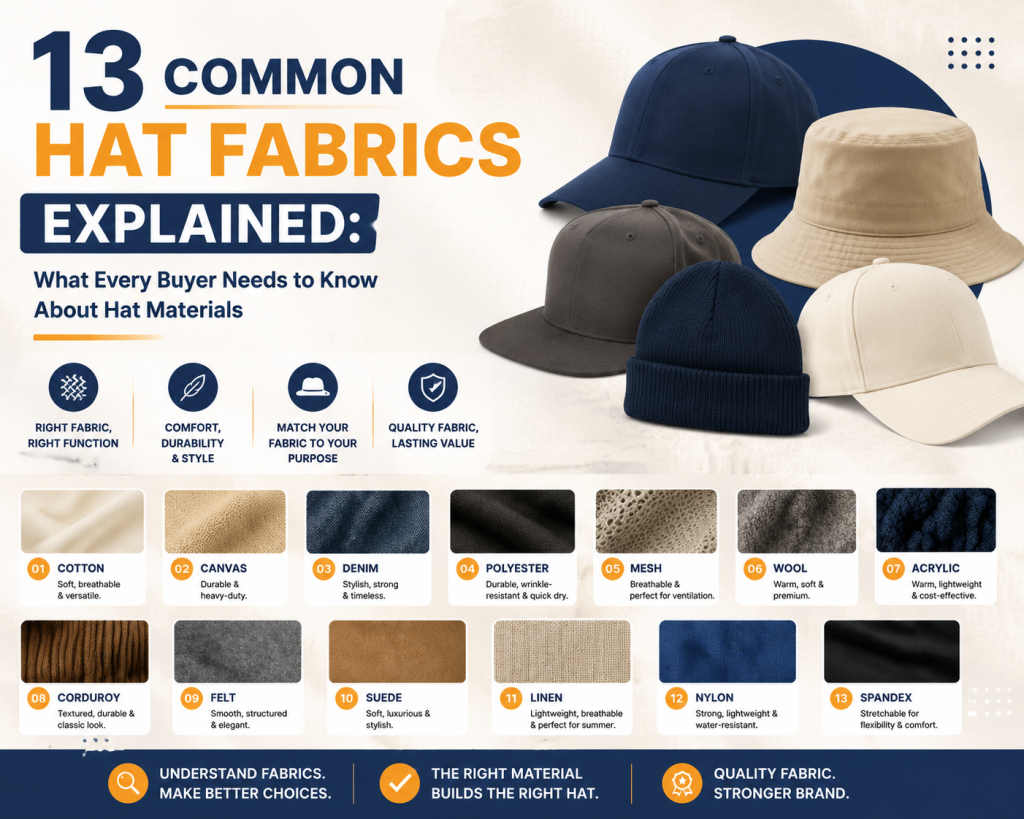
That experience pushed me to put this guide together. Thirteen hat fabrics. Everything you’ll run into when you’re sourcing hats, building a brand, or just trying to figure out what the hell you’re actually buying from a factory listing that says “straw material” with zero additional detail.
Let me walk you through all of them.
Table of Contents
- Natural Straw Hat Fabrics and Fibers
- Woven Natural Hat Fabrics Beyond Straw
- Cotton and Cotton Blend Hat Fabrics
- Wool and Felt Hat Fabrics
- Synthetic and Performance Hat Fabrics
- Specialty and Luxury Hat Fabrics
- How to Choose the Right Hat Fabric for Your Product Line
- Sourcing Hat Fabrics in Bulk: What You Need to Know
1. Natural Straw Hat Fabrics and Fibers
So here’s where all the confusion lives. Someone types “what are straw sun hats made from” into Google expecting a one-line answer. But straw is a whole category of materials, not one single thing. Let me break down the main types you’ll actually encounter when you’re buying or selling sun hats.
Toquilla Straw (Panama Hat Fiber)
You’ve heard of Panama hats. Funny thing is, they come from Ecuador, not Panama. They’re woven from young leaves of the toquilla palm. Locals call the plant Carludovica palmata. This is the top shelf of straw hat fabrics. A real hand-woven Panama hat can take anywhere from a couple days to several months to finish depending on how fine the weave is.
Here’s what matters if you’re sourcing these. Authentic toquilla straw costs serious money even at factory level. We’re talking $15 to $200+ per hat based on weave grade. The ultra-fine “Montecristi” grade? Those are luxury goods. Most of the Panama-style hats you see on Amazon are actually paper straw or toyo straw shaped to look like the real thing. Different product entirely, different price point entirely.
Word of caution on your listings. Calling a paper straw hat a “Panama hat” when it’s not toquilla straw will get you burned. Informed customers know the difference. And marketplace policies around misleading material claims are getting stricter every year.
Raffia
This stuff comes from raffia palm leaves, mostly grown in Madagascar. Got a slightly rough, organic texture to it. The kind of look that screams beach vacation and resort wear. Natural color runs tan to light brown, but it takes dye pretty well if you need custom colors.
What I like about raffia from a product standpoint is how it photographs. That handmade, natural look pops in ecommerce listings. Lightweight, breathable, biodegradable. Checks all the boxes for the eco-conscious customer.
The tradeoff? Structure. Raffia hats are floppy by nature. Works beautifully for wide-brim sun hats. Not so much for a structured fedora or boater style. If your customer wants something that holds a crisp shape, raffia isn’t your material.
Factory pricing lands between $3 and $12 per unit. Depends on size, design complexity, and whether the weaving is hand-done or machine-assisted. Raffia is one of those hat fabrics where the handmade element genuinely matters to end consumers. They notice. And they’ll pay more for it.
Paper Straw
Alright, this is the workhorse. The material that dominates the affordable sun hat market worldwide. And here’s the thing most people don’t realize. Paper straw isn’t straw at all. It’s wood pulp processed into thin strips or tubes, then woven or braided into hat shapes. Sometimes blended with polyester thread so it doesn’t fall apart quite as fast.
Why does paper straw own the mass market? Simple. Cost. You can produce a paper straw sun hat for $1.50 to $4 at factory level when you’re ordering volume. It’s light, takes color beautifully, and can be molded into basically any hat style you can dream up.
The catch? Durability. Paper straw and water don’t get along. Soak one in rain and it’s done. Shape gone permanently. They also tend to crack along fold lines after a season or two of regular wear. Not a forever product. More of a seasonal accessory.
For sellers targeting that $15 to $35 retail sweet spot, paper straw is probably where most of your revenue comes from. Just be straight with customers about what they’re getting. People who know they bought a paper straw hat at a paper straw price are perfectly happy. People who thought they were getting natural fiber and received processed wood pulp? Those are your one-star reviews.
Seagrass
Woven from dried seagrass, harvested mostly in coastal Vietnam and China. Has this distinctive flat, ribbon-like look with natural color variations. Some pieces lean green-gold. Others go deep tan. No two hats come out exactly identical, which some brands spin as a selling point.
Seagrass sits in the middle of the pricing spectrum. Factory costs typically run $2.50 to $7 per unit. More durable than paper straw. Handles light moisture better. Still not waterproof though, so don’t market it that way.
That natural variation I mentioned? It’s worth thinking about for your brand. If you’re the type of seller who wants every unit looking identical on the shelf, seagrass might frustrate you. If you can lean into the “each piece is unique” angle in your marketing, it becomes an advantage instead of a headache.
Wheat Straw
The real deal. Actual straw from actual wheat plants. This is what your grandparents picture when someone says “straw hat.” Been used for hat-making across Europe and Asia for literally centuries. The stalks get braided into flat strips, then sewn together in a spiral pattern to form the crown and brim.
Wheat straw hats are sturdy. They hold shape well. Got that classic golden color that makes people think of summer fields and farmers markets. Heavier than paper straw but way more durable. Factory pricing sits between $2 and $6 depending on quality grade and construction method.
Here’s something I learned the hard way about sourcing wheat straw. Quality varies enormously based on when the wheat was harvested and how the straw was processed afterward. Late-harvest straw gets brittle. Cracks easily. Properly harvested and treated wheat straw stays flexible for years. If you’re ordering volume, ask your supplier specifically about their straw sourcing and processing timeline. This is the kind of detail that separates a product with 4.5-star reviews from one that gets returned constantly because it’s cracking after three wears.
Toyo Straw
Think of toyo as paper straw’s fancier sibling. It’s a smooth, shiny material made from shellacked or lacquered paper fiber. Originally developed in the Philippines. Has a polished, refined appearance that looks more upscale than raw natural straw.
Toyo works great for structured hat styles. Fedoras, trilbies, dress hats. Holds shape better than most natural fibers because of that lacquer coating. The coating also gives it some water resistance, though calling it waterproof would be a stretch.
Factory costs run $2 to $5 per unit. If you’re positioning hats in the “smart casual” or “dress hat” space rather than pure beach wear, toyo gives you that elevated look without the price tag of genuine natural straw.
2. Woven Natural Hat Fabrics Beyond Straw
Not everything natural falls under the straw umbrella. These next two fibers serve different purposes and attract different customers.
Jute
Jute is a vegetable fiber. Comes primarily from Bangladesh and India. Coarse, strong, and has this intentionally rustic look that either works for your brand or doesn’t. Shows up in casual bucket hats, boho sun hats, and accessories targeting the festival and beach crowd.
From a sourcing angle, jute is dirt cheap. Among the lowest raw material costs of any natural fiber you’ll find. But jute hats occupy a very specific aesthetic lane. They look rough on purpose. Earthy. Unrefined. That resonates with certain demographics and completely misses others.
One practical problem with jute. It wrinkles badly and doesn’t bounce back once crushed. If your hats are shipping in poly bags without structure support, they’ll arrive looking like garbage. Customers won’t bother trying to reshape them before snapping a photo for their negative review. Invest in proper packaging that protects the hat shape during transit. Spend the extra $0.30 per unit on a hat form or rigid insert. Trust me on this one.
Hemp
I’m genuinely surprised more hat brands aren’t using hemp. It’s naturally UV-resistant. Antimicrobial. Gets softer with every wear without losing structural integrity. Has a linen-like appearance with subtle texture that looks premium in person.
The sustainability story is strong too. Hemp grows fast, barely needs water, doesn’t require pesticides. For brands building their identity around eco-consciousness, hemp hats practically sell themselves to the right audience. Factory pricing runs higher than conventional materials. Typically $4 to $10 per unit. But the retail markup potential is real because sustainability-focused consumers accept and even expect premium pricing.
Challenge I’ve run into with hemp sourcing? Color consistency between production batches. Natural hemp ranges from cream to light grey-green depending on how it was processed. If your brand needs exact color matching across every order, specify Pantone references in your product spec sheet and demand production samples before you approve any bulk run. Don’t skip this step. I’ve seen batches come back looking like two completely different products sitting next to each other.
3. Cotton and Cotton Blend Hat Fabrics
Cotton is everywhere in the hat world. Baseball caps, bucket hats, sun hats, beanies, newsboy caps. It shows up across every category because it’s comfortable, affordable, versatile, and factories know how to work with it in their sleep.
Cotton Twill
This is the standard fabric for structured baseball caps and dad hats. Got a diagonal weave pattern that gives it durability and a slightly textured surface. Holds embroidery well. Takes screen printing cleanly. Available in literally every color you could want.
For bulk sourcing, cotton twill caps are commodity products. Margins are thin unless you differentiate through design, branding, or niche targeting. Factory costs for a basic 6-panel cotton twill cap run $1.50 to $3.50 depending on construction details, closure type, and whatever decoration you’re putting on it.
The quality variable that actually matters here? Thread count and cotton grade. Cheap twill uses short-staple cotton that pills up and fades after a few washes. Better twill uses combed, ring-spun cotton that stays smooth and holds color through dozens of wash cycles. Price difference at factory level? Maybe $0.40 per hat. Review difference? Night and day. Spend the extra forty cents.
Cotton Canvas
Heavier than twill. Plain-weave cotton that’s thick, durable, and holds structure on its own without needing internal stiffeners. Canvas works well for bucket hats, safari hats, and outdoor styles where ruggedness matters more than softness against skin.
Here’s where canvas gets interesting. It accepts wax treatments beautifully. Waxed cotton canvas hats have this heritage outdoor aesthetic that commands premium retail prices. Think British countryside. Fishing trips. Hiking in the rain. That whole world. Factory costs for waxed canvas hats run $4 to $9 because the waxing process adds labor and material expense. But retail prices of $45 to $80 are completely normal in this category. Margins are healthy.
Cotton-Polyester Blends
Mix cotton with polyester and you get wrinkle resistance, better color retention, and faster drying while keeping some of cotton’s breathability and soft feel. Common ratios are 60/40 or 65/35 cotton-poly.
Most promotional hats and corporate branded caps use these blends. They hold printed logos better over time. Maintain shape through shipping and storage. Don’t look wrinkled when someone pulls them out of a box at a trade show. If you’re sourcing hats for corporate clients or promotional giveaways, cotton-poly blends should be your default recommendation. Consistent performance. Lower cost than pure cotton at equivalent quality.
4. Wool and Felt Hat Fabrics
Now we’re moving into cooler weather territory. Wool and felt hat fabrics own the fall and winter market, plus year-round dress hat categories where structure and formality matter.
Wool Felt
Here’s something people don’t always realize. Felt isn’t woven. It’s made by matting, condensing, and pressing wool fibers together using heat, moisture, and mechanical pressure until they lock into a dense, smooth sheet. No thread. No weave pattern. Just compressed fiber.
The result is a material that holds shape beautifully. Blocks wind. Can be steamed and reshaped over and over without damage. Wool felt is the foundation of classic hat styles. Fedoras, cloches, western hats, bowlers. Pretty much any structured dress hat with that smooth, clean surface is probably wool felt underneath.
Quality grades range from “fashion felt” at the bottom (lower wool content, mixed with synthetic fibers, less durable) to “pure fur felt” at the top (made from rabbit or beaver fur, extremely premium, extremely expensive).
For sourcing, know that wool felt hat bodies are typically purchased as pre-formed blanks from specialized felt mills. Then a separate hat manufacturer shapes, trims, and finishes them. This two-stage supply chain means you might deal with different suppliers for the raw felt versus the finished hat. Or you find a vertically integrated factory that handles both stages in-house. The second option simplifies your procurement process considerably and usually gives you better quality control.
Factory pricing for finished wool felt hats varies wildly. Fashion-grade felt runs $5 to $15. Pure wool felt runs $12 to $30. Fur felt starts at $25 and climbs from there based on animal type and processing quality.
Melton Wool
Heavyweight, tightly woven wool with a smooth, slightly felted surface. Shows up in newsboy caps, flat caps, military-style hats, and cold-weather accessories. Dense enough to block wind and light rain without needing any waterproof treatment.
Melton wool hat fabrics have a tailored, classic appearance. Works for both men’s and women’s styles. The weight and density make these hats feel substantial when you pick them up. Customers notice that. It signals quality before they even put it on their head.
Factory costs for melton wool caps run $4 to $8 depending on wool content percentage and construction complexity.
5. Synthetic and Performance Hat Fabrics
This is the fastest-growing segment of the hat market right now. Synthetic hat fabrics dominate athletic, outdoor, and performance categories where moisture management, UV protection, and durability outweigh any preference for natural materials.
Polyester
Most common synthetic hat fabric by sheer volume produced globally. Cheap to manufacture. Durable. Wrinkle-resistant. Holds color like nothing else. Dries fast. And here’s the big one for sellers: polyester accepts sublimation printing. That means full-color, photographic, all-over designs without the limitations of screen printing or embroidery.
Performance polyester hat fabrics include moisture-wicking mesh for athletic caps, ripstop polyester for outdoor adventure hats, and microfiber polyester for lightweight packable sun hats. Different variants for different use cases, but all sharing the same base material.
For Amazon sellers in outdoor and athletic categories, polyester performance hats offer strong margins. Raw material costs are low. Perceived value gets driven by features and branding rather than material prestige. A polyester hiking hat with UPF 50+ rating, moisture-wicking sweatband, and packable design can retail for $25 to $40 with factory costs sitting under $3. Those are healthy numbers.
Nylon
Stronger than polyester. Better abrasion resistance. Nylon hat fabrics show up in outdoor adventure hats, rain hats, and military-style boonie hats. Takes DWR (durable water repellent) coatings really well, making it the default choice for anything marketed as water-resistant.
Main downside versus polyester? Price. Nylon runs 20 to 40 percent more expensive at the fabric level. For most hat applications, polyester honestly does the job fine. Nylon makes sense when you’re specifically building your marketing around durability or water resistance as primary selling points and your retail price supports the higher material cost.
6. Specialty and Luxury Hat Fabrics
These materials serve smaller markets but command premium prices and attract customers who care deeply about craftsmanship and material quality.
Leather
Full-grain leather, suede, and faux leather all show up in hat making. Leather hats range from rugged outback styles to fashion-forward bucket hats and berets. Real leather develops patina over time. Enthusiasts love that. It makes the hat look better with age rather than worse.
Sourcing leather hats means paying attention to leather grade, tanning method, and origin. Chrome-tanned leather gives you more uniformity and water resistance. Vegetable-tanned leather is more environmentally friendly and develops richer character over time. Factory costs for genuine leather hats start around $8 and climb quickly based on leather quality and construction complexity.
Faux leather (PU leather) gives you the aesthetic at a fraction of the cost. Factory prices for PU leather hats run $2 to $5. But here’s the thing. The quality gap between cheap PU and good PU is absolutely massive. Bottom-tier PU peels and cracks within months. Quality PU lasts years and is nearly indistinguishable from real leather to casual observation. Specify PU thickness and backing material in your sourcing documents. Don’t leave it to the factory’s discretion or you’ll get whatever’s cheapest in their warehouse that week.
Silk
Rare in modern hat production but still present in high-end millinery, hat linings, and decorative elements. Silk hat fabrics have an unmistakable luster and drape that nothing synthetic quite replicates. Delicate, expensive, and primarily used in women’s formal hats and fascinators for events like weddings and horse races.
For most commercial hat sourcing, silk appears as a lining material or trim rather than the primary hat fabric. A silk lining inside a wool felt hat signals luxury to the customer. They feel it when they put the hat on. Factory cost addition for silk lining versus standard polyester lining is roughly $1.50 to $3 per hat. Small investment. Significant perceived value upgrade. Worth considering if you’re positioning in the premium tier.
7. How to Choose the Right Hat Fabric for Your Product Line
Alright, you’ve now got the full picture on all 13 hat fabrics. The real question is which ones belong in your business. That depends on who you’re selling to, what price points you’re targeting, and where you’re selling.
Selling beach and resort wear? Paper straw, raffia, and seagrass should be your core materials. Wide-brim sun hats in these fibers sell consistently March through September with peak demand in June and July. Raffia commands higher prices per unit. Paper straw moves higher volume. Seagrass gives you a middle ground.
Playing in the athletic and outdoor space? Polyester and nylon performance fabrics with UPF ratings, moisture-wicking features, and packable designs. This category is less seasonal than straw. More feature-driven. Your listing copy and product photography matter more than material name because customers are buying function, not fiber prestige.
Targeting fashion and lifestyle? Cotton twill, wool felt, and leather give you year-round coverage across multiple hat styles. Cotton for spring and summer casual. Wool felt for fall and winter dress occasions. Leather for year-round statement pieces that attract a loyal niche audience.
Building around sustainability? Hemp, organic cotton, and natural straw fibers let you create a coherent eco-friendly product line. Higher factory costs but higher retail prices and stronger customer loyalty. The sustainability market rewards brands that commit fully rather than dabbling.
Whatever direction you pick, make sure your product development process accounts for material-specific requirements. Straw hats need different packaging than felt hats. Performance fabrics need different quality testing than natural fibers. Getting these details sorted before you place a bulk order saves you from expensive corrections after the fact.
8. Sourcing Hat Fabrics in Bulk: What You Need to Know
Let me close with practical sourcing guidance because knowing hat fabrics is only half the battle. You need to actually buy them correctly at scale without getting burned.
China dominates global hat manufacturing. Yiwu region handles fashion hats. Shenzhen area does caps. Various coastal provinces produce straw hats. Vietnam is growing as an alternative, especially for woven natural fiber styles. Bangladesh handles some cotton cap production at very aggressive pricing.
Material verification is non-negotiable. I’ve personally seen suppliers label paper straw as “natural straw” and polyester felt as “wool felt” on their product listings. Sometimes it’s intentional deception. Sometimes it’s sloppy translation. Either way, the result is the same for you. A product that doesn’t match what you promised your customers. Always request material composition certificates. Always verify through quality inspection before approving any shipment for release.
MOQs swing wildly depending on hat fabric type. Paper straw and polyester hats often have minimums as low as 300 to 500 pieces because materials are standardized and readily available. Natural straw like raffia or toquilla might require 1,000+ pieces because raw material sourcing is seasonal and less predictable. Wool felt hats from specialized manufacturers sometimes accept 200 to 300 pieces per style because unit values are higher and they’re used to smaller batch production.
Timing matters more than people realize. Natural straw materials get harvested seasonally. Planning a summer hat launch? Place orders 4 to 6 months ahead. Factories get slammed with straw hat orders from January through March for summer delivery windows. Wait until April and you’re looking at longer lead times, higher prices, or both. Sometimes neither option is available and you’re simply too late for that season.
Color matching on natural materials is inherently imperfect. Natural fibers like raffia, seagrass, wheat straw, and hemp have built-in color variation. Every batch looks slightly different. If your brand demands exact color consistency across every single unit, synthetic materials or heavily dyed natural fibers are your safer path. If you can embrace slight variation as part of the natural aesthetic, communicate that clearly in your product listings so customers know what they’re getting before it arrives.
Always test before committing volume. Order samples in every hat fabric you’re considering. Wear them around for a week. Wash the ones that claim to be washable. Crush them in a bag and see if they recover. Leave them in direct sunlight for several days. See how they actually perform in real conditions before you order 3,000 units based on a factory photo and a spec sheet. We help clients with this evaluation as part of our sourcing process, but even if you’re handling it solo, never skip testing. A $50 sample order can save you from a $15,000 disaster.
Final Thoughts
Hat fabrics aren’t rocket science once you know what each material actually is and what it does well. The problem most buyers face isn’t intelligence. It’s specific knowledge about a product category they haven’t worked in before. And that gap between general understanding and specific expertise is exactly where expensive sourcing mistakes happen.
Now you know what straw sun hats are actually made from. You know the difference between paper straw and raffia. Between wool felt and melton. Between performance polyester and basic polyester. You know which hat fabrics serve which markets and which price points make sense for each.
Next step is deciding which materials fit your business, finding suppliers who deliver what they promise without games, and building a product line your customers actually trust and come back to.
If you want help with any part of that process, whether it’s finding the right factory, verifying material claims, or managing quality across your hat product line, reach out to our team or book a quick conversation. We source hats and accessories regularly for clients selling on Amazon, Shopify, and wholesale channels. Happy to share what we’ve learned.