
So let me tell you about something that happened last quarter. I’m sitting in a conference room with a procurement manager from a mid-size ecommerce brand. She pulls up a spreadsheet. Twenty-three suppliers. Four countries. Annual revenue around $4 million. And this woman looks like she hasn’t slept properly in months.
I asked her a simple question. “How many of these suppliers could you call right now and get someone on the phone within an hour?” She laughed. Said maybe four. The rest? She’d be lucky to get a reply within three days.
That’s the reality of supplier sprawl. And it’s way more common than people admit.
We spent the next six months helping her cut that list from 23 down to 9. Not overnight. Not recklessly. Methodically. And here’s what happened. Freight costs dropped 18 percent. Defect rates fell by a third. She stopped working weekends chasing shipments from factories she’d only ordered from once or twice.
That’s supplier consolidation doing what it’s supposed to do. Not some abstract business school concept. A practical strategy that puts money back in your pocket when you execute it properly.
Let me break the whole thing down for you.
Table of Contents
- What Does Supplier Consolidation Mean?
- Why Supplier Consolidation Matters for Your Business
- The Real Benefits of Supplier Consolidation
- Four Steps for Effective Supplier Consolidation
- How eSourcingSolution Helps You Get Diverse Supplier Solutions
- Frequently Asked Questions About Supplier Consolidation
1. What Does Supplier Consolidation Mean?
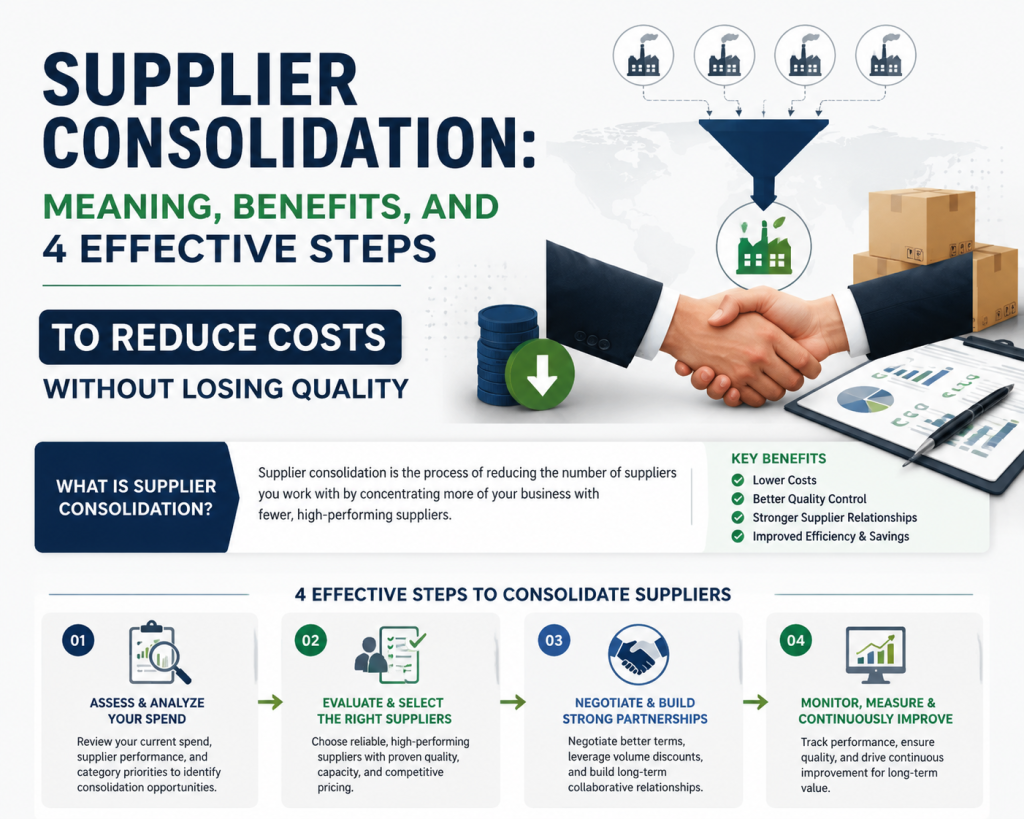
Here’s the plain English version. Supplier consolidation means you stop spreading your orders across too many factories and start concentrating your purchasing volume with fewer, better vendors.
Say you’re buying kitchen gadgets from one factory, your product packaging from a second factory, and your shipping labels from a third. Supplier consolidation asks a pretty obvious question. Can one of these guys handle two or three of those things? Can you combine orders, simplify your logistics, and stop managing relationships that aren’t earning their keep?
Usually the answer is yes. Not always. But way more often than most business owners think.
Now let me clear something up because people get this wrong all the time. Supplier consolidation does NOT mean putting everything with one single vendor and crossing your fingers. That’s called single sourcing, and it’s risky as hell. Smart consolidation still keeps backup options in place. Still maintains diversity where it genuinely matters. The goal is cutting unnecessary complexity out of your supply chain. Not building a house of cards.
For most small and mid-size businesses I work with, the sweet spot lands somewhere between 3 and 8 core suppliers handling the bulk of their volume. Maybe a couple secondary vendors for specialized items or emergency backup. That’s the zone where you get efficiency without dangerous concentration.
2. Why Supplier Consolidation Matters for Your Business
Nobody wakes up one morning and decides to work with 20 suppliers. It creeps up on you. You find a factory for your first product. Then you need a different material for product number two, so you add another vendor. Six months later, someone on your team finds a “better deal” somewhere and splits an order. A year passes. Suddenly you’ve got 15 suppliers and you can’t remember why half of them are on your vendor list.
I call this supplier creep. And it creates problems that get worse the longer you ignore them.
Your buying power gets watered down. Think about it from the supplier’s perspective. Would you bend over backwards for a customer who sends you $5,000 a year? Or for one who sends $50,000? When your spend is scattered across too many vendors, you’re a small fish everywhere instead of a big fish somewhere. Small fish get slow replies, higher prices, and last priority when production schedules get tight.
Your logistics turn into a juggling act. More suppliers means more shipments arriving at different times from different places. More customs entries. More receiving appointments. More chances for something to get lost, delayed, or damaged. Every additional supplier adds coordination work that somebody on your team has to handle. And that somebody probably has better things to do.
Quality gets inconsistent. Different factories run different equipment with different standards and different levels of care. When you’re managing 15 vendor relationships, you physically cannot maintain deep quality oversight with all of them. Corners get cut. Inspections get skipped. And eventually a batch of defective product lands on your doorstep. I’ve watched it happen dozens of times.
Your negotiating position gets weak. A supplier who receives a meaningful chunk of your annual business treats you like a partner. One who gets pocket change treats you like a transaction. Consolidation concentrates your spend, which gives you actual leverage when it’s time to negotiate better pricing and terms.
3. The Real Benefits of Supplier Consolidation
I’ve walked dozens of businesses through this process over the years. The benefits show up in obvious places and in places that surprise people. Let me lay out what actually changes when you consolidate your supplier base the right way.
Your unit costs go down because volume talks. This one’s straightforward but worth putting numbers on. When you shift from ordering 2,000 units split across three suppliers to ordering 6,000 units from one supplier, your per-unit price drops. How much depends on the product and how close you were to the supplier’s volume price breaks before. But I typically see 5 to 15 percent savings on unit cost alone. On a $200,000 annual spend, that’s $10,000 to $30,000 back in your business.
Shipping costs shrink because fewer shipments means fewer bills. Fewer suppliers means fewer separate freight bookings. Fewer customs entries. Fewer receiving headaches at your warehouse. You can also combine multiple product orders into single containers instead of paying LCL rates from five different origins. That consolidation at the logistics level is one of the biggest hidden savings in global sourcing that people consistently overlook.
Your supplier relationships actually mean something. When a factory sees you as a top-ten customer, the whole dynamic shifts. They pick up the phone when you call. They prioritize your production run over someone else’s. They’re willing to hold safety stock, extend payment terms, or accommodate a last-minute design change. You stop being “just another PO” and start being someone they genuinely want to keep happy.
Quality control gets tighter because your attention isn’t scattered. Managing quality across 3 suppliers is a completely different job than managing it across 15. With fewer vendors, you can invest more deeply in each relationship. Visit factories more often. Establish detailed standards and actually enforce them. Your quality control process gets sharper because you’re not spreading your oversight across too many places to be effective anywhere.
Administrative work drops dramatically. Every supplier relationship comes with purchase orders, invoices, payment processing, emails, phone calls, issue resolution, and performance tracking. Multiply that by 20 vendors and you need a full-time person just keeping the paperwork straight. Cut to 7 vendors and suddenly your team has bandwidth to work on things that actually grow the business.
You can actually forecast demand and manage inventory. When orders flow through fewer suppliers, you get clearer visibility into your supply chain. Lead times become predictable. You can plan inventory with confidence because you’re not juggling delivery schedules from a dozen sources with a dozen different timelines and a dozen different definitions of “on time.”
Problems get fixed fast because you matter. When something goes sideways with a supplier who handles significant volume for you, they jump on it. Because losing your account would actually hurt them. Compare that to a supplier who barely registers your $3,000 annual spend. Which one do you think responds to a quality complaint on a Friday afternoon?
4. Four Steps for Effective Supplier Consolidation
Alright. Here’s the part you actually came for. How do you pull this off without blowing up your operations or creating new risks you didn’t have before? I’ll walk through the exact four steps we use with clients at eSourcingSolution when we help them restructure their vendor base.
Step 1: Map Everything You’ve Got Right Now
You can’t consolidate what you can’t see. So before you cut anything or change anything, pull together a complete picture of every supplier you’re currently working with.
For each vendor, write down what products or materials they supply you. How much you spend with them annually. How reliable their delivery has been. What their defect rates look like. What payment terms they give you. Where they’re located. How fast they respond when you reach out. And whether they have capability to handle additional product categories beyond what you currently buy from them.
Here’s what I’ve found. Most businesses have never actually done this exercise in one place. The information exists in fragments. Some in spreadsheets. Some in email threads. Some in the head of that one employee who’s been there since the beginning. Getting it all consolidated into a single view is step one, and it’s almost always eye-opening.
You’ll probably discover suppliers you forgot existed. You’ll notice overlapping capabilities you never connected. You’ll see that maybe 60 percent of your spend already sits with 3 or 4 vendors while the remaining 40 percent is sprinkled across 12 others who barely matter.
This mapping work is basically procurement intelligence turned inward. You’re gathering data about your own supply base so you can make decisions based on facts instead of feelings.
Step 2: Score and Rank Every Supplier Honestly
Now that you can see the full picture, it’s time to get ruthless about ranking. Not every supplier deserves a spot going forward. And the ones you keep won’t all play the same role.
Score each vendor on these things: quality consistency over time, pricing competitiveness versus market rates, delivery reliability (percentage of on-time shipments), communication quality and responsiveness, financial stability, capacity to grow with you, willingness to collaborate on improvements, and any geographic or logistical advantages they offer.
Be brutally honest here. That supplier who gives you rock-bottom pricing but delivers late on every third order? They’re costing you more than you realize in expedited shipping, stockouts, and angry customers. The slightly pricier supplier who hasn’t missed a deadline in two years and calls you proactively when there’s a potential delay? They might actually be your cheapest option when you factor in total cost of doing business with them.
After scoring, sort your suppliers into three buckets. Strategic partners you want to grow with and invest in. Acceptable vendors you’ll keep for specific needs but won’t expand. And suppliers you’re going to phase out over the next few months.
Step 3: Shift Volume and Renegotiate
This is where the money shows up. Take the purchasing volume you’re pulling away from phased-out suppliers and redirect it toward your strategic partners. Then have a real conversation with those partners about what this increased commitment means for pricing, terms, and service levels.
You’re not just asking for a discount. You’re offering something genuinely valuable in return. More volume. More predictability. A longer-term relationship. That gives your supplier confidence to invest in your account. To hold raw materials. To reserve production capacity. To sharpen their pencil on pricing because they know the volume justifies it.
The conversation goes something like this: “We’ve been evaluating our supply base and we want to consolidate more volume with you because your quality and reliability have been strong. Here’s what our projected annual spend looks like if we move these three product lines to you. Based on that commitment, what can you offer on unit pricing, payment terms, and lead times?”
Nine times out of ten, suppliers respond well to this conversation. They’d rather have a bigger piece of a committed customer’s business than fight for scraps from someone who spreads orders across 20 factories. Smart supplier negotiation at this stage typically pulls 8 to 20 percent off your unit costs depending on how much additional volume you’re bringing to the table.
Step 4: Transition Gradually and Watch the Numbers
Don’t do this overnight. Seriously. Consolidation works best as a phased rollout over 3 to 6 months. Here’s why rushing it backfires.
If you immediately cut a supplier and dump all their volume onto someone else, you’re gambling. What if the receiving supplier can’t actually handle the capacity increase? What if their quality dips because they’re scaling production too fast? What if something goes wrong and you’ve already burned the bridge with your backup?
Instead, transition in stages. Start by moving 30 to 50 percent of the volume from a phased-out supplier to your strategic partner. Watch quality metrics, delivery times, and communication responsiveness for 60 to 90 days. If everything holds steady or improves, shift the rest. If problems pop up, you still have your backup supplier active while you sort things out.
Set clear performance indicators for your consolidated suppliers. On-time delivery percentage. Defect rate per shipment. Average response time to inquiries. Cost per unit tracked quarterly. Review these numbers regularly. Supplier consolidation isn’t something you do once and forget about. It’s an ongoing discipline that needs attention and occasional adjustment as your business evolves.
5. How eSourcingSolution Helps You Get Diverse Supplier Solutions
Let me be straight about what we do here and why it matters if you’re considering this process for your business.
Supplier consolidation sounds simple when you read about it. In practice, it demands deep knowledge of supplier capabilities, realistic market pricing, manufacturing processes across different product categories, and logistics optimization. Most business owners and procurement managers don’t have spare hours in their week to do this work properly while also running daily operations.
That’s the gap we fill.
We assess and benchmark your current suppliers. Are you getting competitive pricing or overpaying? Is quality where it should be or are you accepting mediocre because you don’t know what good looks like in that category? Could another supplier handle multiple product lines you’re currently splitting across three vendors? We bring procurement intelligence to answer these questions with real data and market comparisons.
We find consolidation opportunities you’d miss on your own. Our team knows which factories can handle broader product ranges. A manufacturer that produces both your primary product and your packaging components? That’s a consolidation win most people would never discover through Alibaba searches. We find those matches because we’ve spent years building relationships and understanding what factories actually do versus what they claim on their website.
We support your negotiations with real market data. When you sit down to renegotiate with consolidated suppliers, we bring competitive quotes, material cost benchmarks, and volume projections to the conversation. This isn’t about beating suppliers into submission. It’s about structuring deals that work for both sides. More volume for them, better pricing for you. Our cost optimization work focuses on building sustainable partnerships that last, not squeezing short-term wins that poison relationships.
We tighten quality management across your consolidated base. Fewer suppliers means we can go deeper with each one. More rigorous inspections. Clearer standards documentation. Faster feedback when issues arise. Your quality control improves because attention gets concentrated instead of diluted.
We manage the ongoing relationship so you don’t have to. Markets shift. Suppliers change ownership. Your product line grows. We provide procurement outsourcing that keeps your supplier base optimized continuously, not just at the moment you first consolidate.
We balance efficiency with smart risk management. And this part matters a lot. Consolidation doesn’t mean reckless concentration. We help you find the right balance between fewer suppliers (efficiency) and maintained backup options (resilience). For anything critical to your business, we always recommend keeping at least one qualified secondary supplier handling 15 to 20 percent of volume. That way, if your primary vendor hits a capacity wall or quality issue, you’ve got a tested alternative ready to absorb the overflow.
The benefits we deliver come from combining consolidation efficiency with strategic diversification. Fewer suppliers overall. But the right suppliers in the right roles with appropriate coverage for when things don’t go according to plan.
When Consolidation Might Not Be Your Best Move
I want to be upfront about this because I’m not going to pretend consolidation is always the answer. There are situations where maintaining a broader supplier base makes more sense.
If you’re operating in a volatile market where raw material prices swing wildly or supply disruptions happen regularly, having multiple qualified suppliers gives you flexibility to shift volume based on who can deliver and at what price. Consolidating too aggressively in unstable markets leaves you exposed when your primary supplier can’t perform.
If your products require highly specialized manufacturing that only certain factories can do, consolidation opportunities might be limited. You can’t force a plastics injection molder to also handle your metal stamping work just because you want fewer vendors on your list.
If your best supplier simply doesn’t have capacity to absorb more volume, pushing too hard creates problems. Quality drops. Deliveries slip. The relationship that was working well starts breaking under pressure it wasn’t built to handle.
And if geographic diversification matters for your risk profile, maintaining suppliers in different regions provides insurance against localized disruptions. Earthquakes, port closures, political instability, pandemic lockdowns. We’ve seen all of these disrupt supply chains in recent years. Having all your eggs in one geographic basket is a real risk.
The point isn’t that consolidation is always right or always wrong. The point is making deliberate choices about your supplier base instead of letting it grow randomly through years of unplanned decisions.
The Real Cost of Ignoring This
One more story before I wrap up. Talked to a retailer last year running 31 active supplier relationships. Two-person procurement team. They estimated about 70 percent of their working hours went to pure administration. Chasing invoices. Following up on late shipments. Resolving quality disputes. Coordinating deliveries from multiple origins arriving on different days.
Zero time for strategic work. Zero time finding better suppliers. Zero time developing new products. Zero time negotiating better deals.
Their per-unit costs ran 12 to 15 percent higher than competitors who had consolidated. Defect rates nearly double the category average. Cash flow suffered because deposits and payments were scattered across 31 different accounts with 31 different schedules.
Working harder. Spending more. Getting worse results. All because nobody had stopped to ask whether 31 suppliers was actually necessary or just the result of years of accumulated decisions that nobody ever revisited.
If any of that sounds familiar, maybe it’s worth a conversation. You can reach out to our team here or grab a time on our calendar to talk through your situation. No sales pitch. No obligation. Just a straightforward discussion about whether consolidation makes sense for where your business is right now and what the potential upside might look like.
Frequently Asked Questions About Supplier Consolidation
What is the difference between supplier consolidation and single sourcing?
People mix these up constantly so let me make it clear. Supplier consolidation means reducing your total vendor count while still keeping multiple suppliers for risk coverage. You might go from 20 vendors down to 7 or 8. You still have options. You still have backups. You’ve just eliminated the dead weight and concentrated your spend where it creates the most value.
Single sourcing is different. That means using one and only one supplier for a particular product or component. Maximum cost efficiency because all your volume goes to one place. But maximum risk too, because if that one supplier fails, you’ve got nothing. No backup. No alternative. Just a gap in your supply chain and customers waiting for products you can’t deliver.
Most experienced procurement professionals recommend consolidation over single sourcing for anything that’s critical to your operations. The small premium you pay for maintaining a secondary supplier is cheap insurance against disruption.
How long does supplier consolidation typically take from start to finish?
For most small to mid-size businesses, plan on 3 to 6 months from first assessment to full implementation. Month one is mapping and data gathering. Getting visibility into who you’re working with, what you’re spending, and how each supplier performs. Month two is evaluation and strategy. Scoring suppliers, identifying consolidation opportunities, deciding who stays and who goes. Months three through six are execution. Renegotiating with retained suppliers, transitioning volume away from phased-out vendors, monitoring performance of the new structure, and making adjustments as needed.
Can you do it faster? Sometimes. If your supplier base is smaller or your product line is simpler, you might compress the timeline to 8 or 10 weeks. Can it take longer? Also yes. Complex businesses with many product categories, multiple geographies, and regulatory requirements might need 9 to 12 months to do it properly.
Rushing creates risk. Dragging your feet leaves savings on the table. The 3 to 6 month window hits the right balance for most situations I’ve worked on.