
If you buy products from Asia, you have heard “China is getting expensive” for about ten years. Yet most buyers still keep at least one supplier there. So is China still cheaper than Vietnam, India, or Bangladesh in 2026?
The short answer is no on wages, but it is not that simple once you add tariffs, tooling, and lead time. Let’s walk through it with real numbers.
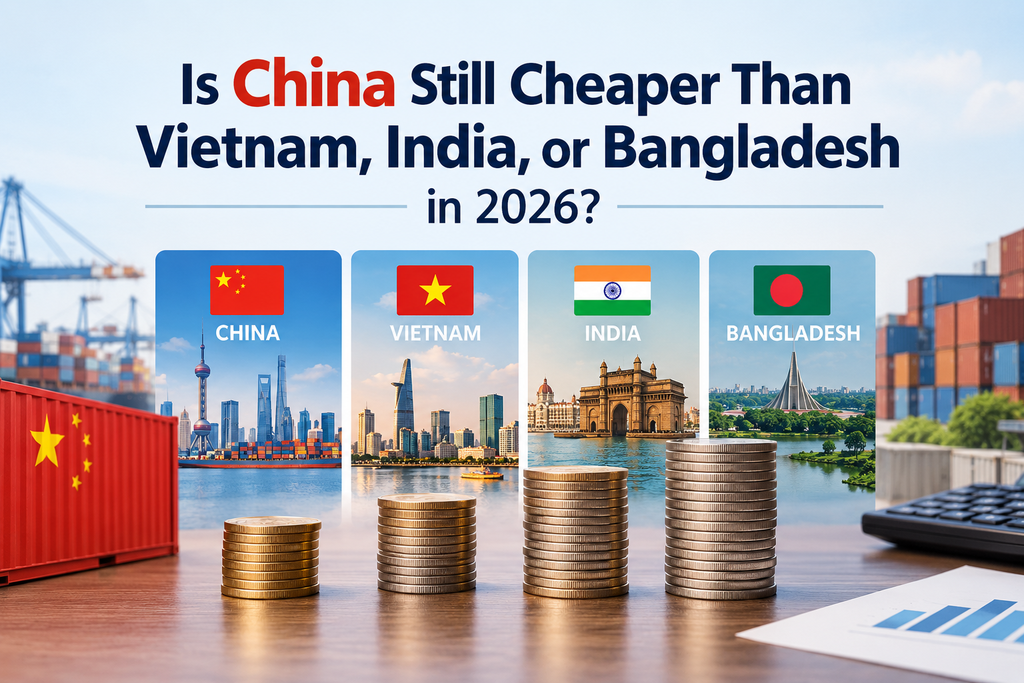
Is China Cheaper Than Vietnam, India, or Bangladesh? The Short Answer
China is no longer the cheapest place to make most things. Pay is much higher than in the other three countries. But labor is only one slice of your final cost. China still wins in some categories because of its factory clusters, tooling, and speed.
Put simply: China is rarely the lowest on the quote, but sometimes it is the lowest on the total bill.
China vs Vietnam, India, or Bangladesh: Labor Cost Compared
Wages show the clearest gap. One 2026 garment comparison from Milky Fashions puts monthly minimum pay at about $113 to $130 in Bangladesh, $180 to $220 in Vietnam, and $400 to $500 or more in Shanghai.
For industrial work, a Zetwerk cost study lists a coastal China assembly operator at $4.50 to $6.00 per hour, while India’s Tier-1 cities run $1.20 to $1.80 and Tier-2 cities $0.80 to $1.20.
| Country | Typical factory labor cost (approx.) | Main trade edge | Best for |
| China | $400 to $500+ per month (coastal) | Largest supplier base, fast tooling | Electronics, moulds, complex parts |
| Vietnam | $180 to $220 per month | Lower US tariffs than China | Furniture, footwear, assembly |
| India | $212 to $354 per month (fully loaded) | Huge labor pool, local incentives | Engineering goods, textiles, auto parts |
| Bangladesh | $105 to $130 per month | Duty-free EU access | Cotton knitwear, basic apparel |
In Bangladesh, the garment minimum wage is 12,500 BDT per month, roughly $104, and it was set in the November 2023 wage gazette per MyPi HR. Unions want it higher, so watch that number.
Why China Can Still Be Cheaper Than Vietnam, India, or Bangladesh on Total Cost
A low wage does not always mean a low price. Chinese factories make up for higher pay with scale and automation. According to Vinasources, big clusters in Guangdong and Zhejiang can cut the cost of a standard T-shirt by 5 to 10 percent versus Vietnam or Bangladesh because fixed costs are spread over huge volumes.
Tooling is another strong point. Zetwerk reports that a Class A injection mould costing $8,000 to $15,000 in China costs $12,000 to $22,000 in India. If you launch new products often, that gap adds up.
China is also still huge in apparel. Wikipedia notes that China held 31.7% of global clothing exports in 2022, with Bangladesh rising to second place.
Tariffs Change the Answer for US and EU Buyers
For US buyers, tariffs are the big swing factor. A WeDoImport guide runs a simple test: a $5.00 factory cost in China with a 25% Section 301 tariff lands at about $7.05, while a $5.50 factory cost in Vietnam with a 5% duty lands at about $6.68.
So Vietnam is 50 cents more at the factory door, yet cheaper at your warehouse. Tariff rules move fast, so rerun the numbers with current duty rates before you place an order.
EU buyers see a similar pattern with Bangladesh. Milky Fashions says Bangladesh gets 0% EU duty against 12% on Chinese goods, and the landed cost advantage over China can reach 20 to 35 percent for simpler garments.
Vietnam vs India vs Bangladesh: Quick Country Notes
China
- Largest supplier network, so almost any component is within a short drive
- Fast sampling and strong tooling
- Highest labor cost of the four
- Tariff exposure on US-bound goods
Vietnam
- Wages 40 to 60 percent below China, per the WeDoImport guide
- Lower tariff burden into the US
- Close to China: a 1,450 km border and 2 to 3-day trucking from Shenzhen, according to Beacon Filing. Many Vietnamese factories still import Chinese parts
- Wages keep climbing
India
- Very large workforce and government support for manufacturers
- Beacon Filing lists manufacturing labor at $2.00 to $3.50 per hour in India against $2.80 to $4.00 in Vietnam
- Ports and roads can slow shipments
- One Zetwerk model shows a landed cost of $450,000 in India against $654,000 in China. It is a vendor’s model, so use it as a guide, not a promise
Bangladesh
- Lowest labor cost among major Asian producers
- Strong in cotton knits, polos, T-shirts, and basic denim, backed by an integrated knit base per OneAim Apparel
- About 3,500 factories and 4 million workers, per a Fox News report
- Narrow range outside textiles, and unrest can affect lead times
Hidden Costs When Moving From China to Vietnam, India, or Bangladesh
Many buyers stop at the unit price. That is where surprises start. Check these before you move any order:
- Material sourcing: If the new country imports fabric or parts from China anyway, you pay for that trip too.
- Minimum order quantities: Smaller supplier bases may ask for bigger MOQs.
- Lead time: A cheaper unit means little if production takes three weeks longer.
- Quality control: New factories need more inspections at the start.
- Power and logistics: Vietnam’s power is a bit cheaper at $0.07 to $0.09 per kWh versus $0.08 to $0.12 in India, while Indian ports can be a bottleneck.
- Compliance: Audits, certificates, and labor standards vary a lot by factory.
Which Is Cheaper for Your Product: Vietnam, India, or Bangladesh?
A rule of thumb we use with buyers:
- Cotton T-shirts, polos, basic knitwear: Bangladesh first, Vietnam second
- Footwear, furniture, mid-range assembly: Vietnam
- Engineering parts, castings, textiles at volume: India
- Electronics, plastics with new moulds, fast-changing products: China
- Mixed orders: Split them. Keep tooling-heavy items in China and move simple, high-volume items elsewhere
You do not need to leave China fully. Many smart buyers run a “China plus one” setup so one tariff change or port delay does not stop the whole business.
Conclusion
So, is China still cheaper than Vietnam, India, or Bangladesh in 2026? On wages, no. All three come in lower, and Bangladesh leads by a wide margin. On total landed cost, it depends. Tariffs favor Vietnam for US buyers and Bangladesh for EU buyers, while China holds its ground where tooling, speed, and supplier choice matter most.
The smart move is not to pick one winner country. Match each product to the right country and compare full landed cost, not just the factory price. That takes real supplier knowledge on the ground, and a quote sheet alone will not give you that.
If you want help comparing factories across China, Vietnam, India, and Bangladesh, the team at eSourcingSolution can vet suppliers, run landed cost numbers, and manage quality for you.
Note: Wage and tariff data change often. The figures above come from the linked 2026 industry sources and vary by region and factory, so confirm current numbers before you commit to an order.
Frequently Asked Questions
Is China still cheaper than Vietnam, India, or Bangladesh for manufacturing?
Not on labor. Wages in China are well above all three. China can still give better total value on complex products thanks to its supplier network, tooling, and scale.
Which is cheaper, Vietnam or India?
Most 2026 comparisons put India slightly lower on labor. Vietnam can win on shipping time to the US and East Asia, and on tariffs for US-bound goods.
Why is Bangladesh so popular for garments?
Low wages, a strong knit supply base, and duty-free access to the EU. It works best for cotton basics at volume, and less well for technical or complex products.
Should I move all production out of China?
Usually no. Many buyers shift simple, high-volume items and keep tooling-heavy products in China. Moving everything at once can raise both risk and cost.
How do I compare real costs between countries?
Use landed cost: factory price plus tariffs, freight, MOQs, quality control, and lead time. A lower unit price can turn into a higher total bill.