
China manufacturing costs in 2026 depend on what you are making, the materials used, order quantity, factory location, and the quality you expect. A simple plastic item can be relatively inexpensive to produce in bulk, while a customized electronic product may cost much more because of its components, tooling, testing, and assembly. So, there is no single price that applies to every product.
For importers, the bigger question is what the factory price actually includes. You might receive a quotation that looks very attractive, but after adding packaging, quality inspection, freight, customs duties, and other charges, the final cost can be quite different.
China is still a major manufacturing destination because businesses can source many materials and components from established industrial clusters.
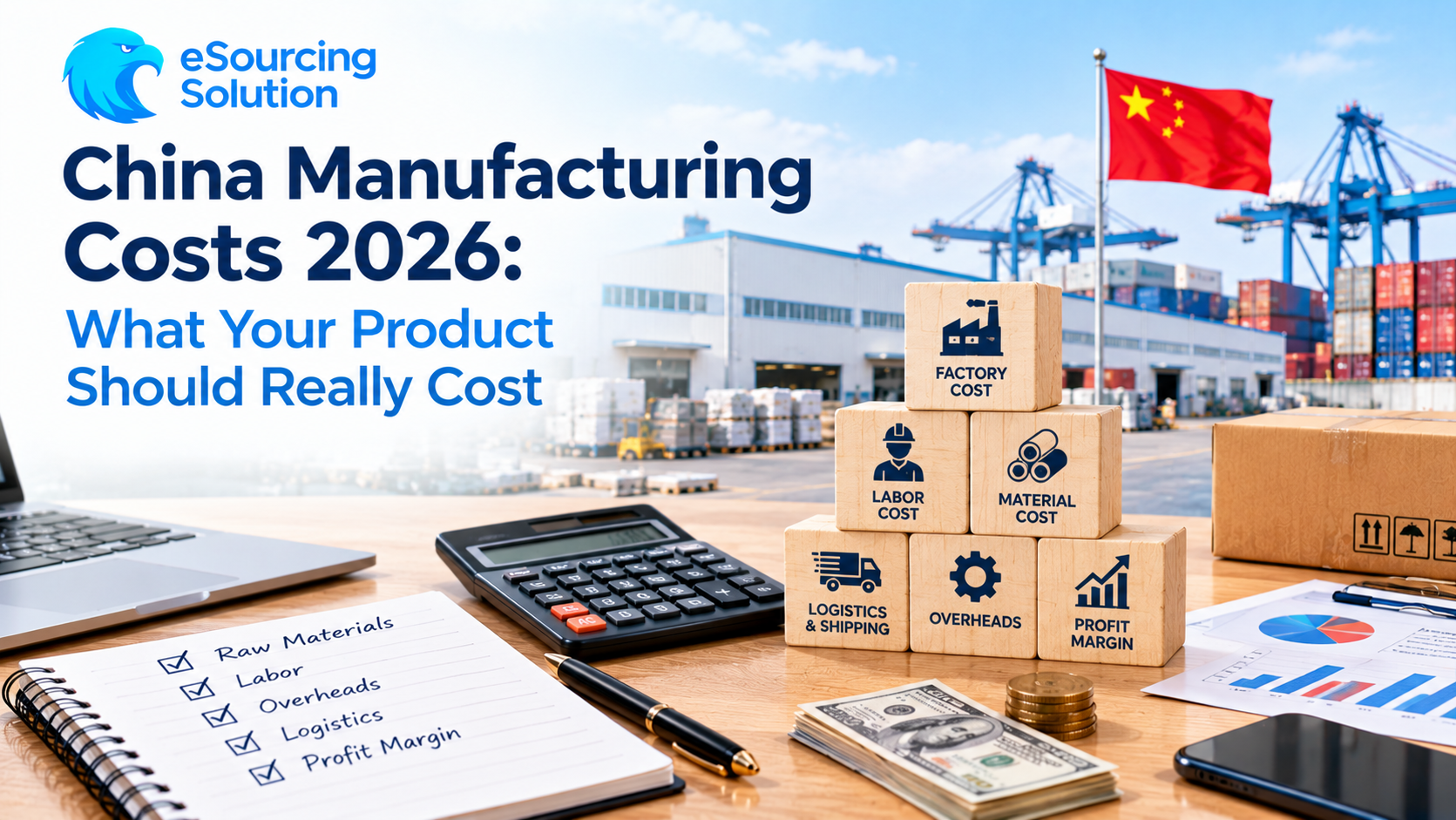
According to China’s National Bureau of Statistics, the country’s manufacturing sector covers a wide range of industries, from basic consumer products to advanced electronics. Its wage statistics also show that manufacturing costs need to be considered as part of a wider production system, rather than only looking at the worker’s salary.
A 2026 manufacturing cost guide from China Policy Guide estimates that China produces around 30% of global manufacturing output. This gives buyers an idea of the scale of its manufacturing base, although the exact cost advantage depends on the product and destination market.
In this article, we will look at the main China manufacturing costs in 2026, common expenses buyers miss, and how you can calculate what your product should really cost before placing an order.
Table of Contents
China Manufacturing Costs by Region
| Region | Worker Base Salary | Social Insurance | Total Cost/Month | Annual Cost |
| Shanghai | ¥5,500-8,000 | ¥2,000-2,900 | ¥7,500-10,900 | ¥90K-131K |
| Shenzhen | ¥5,000-7,500 | ¥1,500-2,200 | ¥6,500-9,700 | ¥78K-116K |
| Dongguan | ¥4,000-6,000 | ¥1,400-2,100 | ¥5,400-8,100 | ¥65K-97K |
| Suzhou | ¥4,500-6,500 | ¥1,600-2,300 | ¥6,100-8,800 | ¥73K-106K |
| Chengdu | ¥3,500-5,500 | ¥1,200-1,800 | ¥4,700-7,300 | ¥56K-88K |
| Chongqing | ¥3,500-5,000 | ¥1,200-1,700 | ¥4,700-6,700 | ¥56K-80K |
| Wuhan | ¥3,500-5,500 | ¥1,200-1,800 | ¥4,700-7,300 | ¥56K-88K |
| Zhengzhou | ¥3,000-4,500 | ¥1,000-1,500 | ¥4,000-6,000 | ¥48K-72K |
What Makes Up China Manufacturing Costs?
When a Chinese factory sends you a quotation, the price is usually based on several things. Some are easy to understand, while others are not always explained clearly unless you ask.
Raw Materials and Components
Materials are often one of the biggest expenses in product manufacturing. For plastic products, the price of resin matters. For metal products, steel and aluminum prices can affect the quotation. Garments depend on fabric, stitching, buttons, zippers, and other accessories.
For most physical products, raw materials account for around 40% to 70% of total factory costs. Understanding these costs helps buyers check supplier quotations and find ways to save money.
- Metals: In late 2025, hot-rolled steel cost around RMB 3,500 to 4,000 per tonne, while aluminium profiles cost RMB 18,000 to 22,000 per tonne. Prices can change with market conditions.
- Plastics: ABS resin costs around RMB 12,000 to 15,000 per tonne, while PP costs RMB 8,000 to 10,000. Injection mould tooling may add RMB 8,000 to 30,000 or more.
- Textiles and Foam: Polyester upholstery fabric costs around RMB 15 to 45 per metre, while high-density foam costs RMB 8,000 to 12,000 per cubic metre.
- Electronic Components: Chips, circuit boards, and batteries can change in price due to supply and demand. For products like IoT devices, component costs may fluctuate by 15% to 25% over a year.
The material itself is not the only thing that matters. Its grade, thickness, durability, and availability can also change the price.
For example, two suppliers may quote for the same plastic storage box, but one uses thicker plastic while the other uses a cheaper material. The second supplier may look more affordable, but the product might not last as long.
This is why buyers should share clear product specifications with every supplier. Otherwise, you may end up comparing two different products without realizing it.
Labor Costs
Labor is another part of China manufacturing costs, especially for garments, furniture, packaging, and products that need manual assembly.
As a general budgeting guide, basic manufacturing workers in many Chinese industrial areas may have monthly base wages of around RMB 2,300 to RMB 4,500, while skilled technicians and specialized workers can earn more. The total cost to the employer may be higher after adding social insurance, overtime, training, and other employment-related expenses.
China’s labor costs vary by region and job type. Skilled technicians working on precision equipment usually cost more than workers doing basic assembly. Employer expenses can also include social insurance, training, overtime, and other employment-related costs.
However, a factory with higher labor costs is not automatically more expensive overall. Its workers may be more experienced, production may be faster, and the factory may have fewer defects. These factors can help reduce the cost per usable product.
Factory Overhead and Profit
Factories also need to pay for electricity, equipment maintenance, rent, production management, and quality control. These expenses are usually included in the factory price, even if they are not shown as separate charges.
The supplier also needs to make a profit. A very low quotation may mean the factory has better production efficiency, but it could also mean that some requirements have been left out.
If a price seems unusually low compared with other suppliers, ask how the quotation was calculated. It is better to understand the difference before production starts than to discover a problem after receiving the goods.
China Factory Rent Costs
| City | Standard Factory (¥/sqm/mo) | Grade A Factory (¥/sqm/mo) | Industrial Land (¥/mu) |
| Shanghai | 30-50 | 50-80 | 800K-1.5M |
| Shenzhen | 25-45 | 45-70 | 700K-1.2M |
| Dongguan | 18-30 | 30-45 | 400K-700K |
| Suzhou | 20-35 | 35-55 | 500K-900K |
| Chengdu | 15-25 | 25-40 | 300K-500K |
| Chongqing | 12-22 | 22-35 | 250K-450K |
China Manufacturing Costs by Product Category
The cost of manufacturing changes considerably from one product category to another. A basic item with a simple design is not priced in the same way as a product that needs specialized components or detailed testing.
Here is a practical comparison of the main cost factors.
| Product category | Main cost factors | Expenses to check |
| Plastic products | Resin, mold design, production volume | Mold charges, material grade, color changes |
| Clothing and textiles | Fabric, stitching, accessories, labor | Labels, samples, sizing, packaging |
| Furniture | Wood, metal, foam, upholstery | Finishing, carton size, shipping volume |
| Electronics | Chips, batteries, circuit boards, assembly | Testing, certification, component availability |
| Metal products | Steel, aluminum, machining | Tooling, surface treatment, tolerances |
| Kitchenware | Materials, molding, finishing | Food-contact requirements, packaging |
| Industrial machinery | Components, engineering, assembly | Installation, testing, spare parts, warranty |
These are cost categories, not fixed price ranges. The actual quotation will depend on your product design and order requirements.
For example, a furniture buyer ordering 500 chairs may receive a different unit price from someone ordering 5,000 chairs. The larger order may spread setup and production costs across more units. However, it also requires more storage space and working capital.
Before accepting a quote, ask the supplier to confirm the product specifications, minimum order quantity, packaging, and any additional charges.
Does the Manufacturing Location Affect the Price?
Yes, the location can affect both production costs and delivery expenses. China has different manufacturing clusters, and many factories specialize in particular industries.
| Location | Common manufacturing strengths | What buyers should consider |
| Shenzhen | Electronics, hardware, product development | Specialized components and technical expertise |
| Dongguan | Electronics assembly, consumer products | Supplier networks and production capacity |
| Foshan | Furniture, ceramics, home appliances | Finishing and bulky shipments |
| Ningbo | Machinery, hardware, industrial components | Engineering requirements and component sourcing |
| Suzhou | Precision manufacturing and industrial equipment | Skilled labor and technical standards |
| Inland regions | Various industries, including automotive and electronics | Transport to ports and supplier availability |
These are general industry associations, and suitable suppliers can be found in other locations too.
A factory in an inland region may have lower rent or labor expenses than one in a coastal industrial city. But if it needs to bring components from another province or transport finished goods a long distance to the port, those savings may become smaller.
So, do not choose a factory just because its city is known for lower costs. Look at the complete production and delivery arrangement.
Read more on Alibaba Shipping Cost and Time: Small vs Bulk Orders
Hidden Expenses That Increase Your Final Cost
One common mistake is treating the factory quotation as the final amount you will spend. In reality, several other expenses may need to be included.
Tooling, Molds, and Samples
If you are ordering a customized product, the factory may need to create molds, dies, fixtures, or prototypes before mass production.
Ask whether these charges are included in the unit price or billed separately. You should also clarify who owns the tooling and whether you can use it if you move production to another factory.
Samples can cost more per unit than mass-produced goods because they require additional setup and manual work. This is normal, but you should confirm the sample fee and whether it will be credited against a future order.
Quality Inspection and Testing
Quality checks add to the budget, but they can help prevent expensive problems later.
Depending on the product, you may need a factory audit, a production inspection, a pre-shipment inspection, or laboratory testing. Some products also require specific compliance documents before they can be sold in your target market.
For example, electronic products may need to meet applicable safety or electromagnetic compatibility requirements. The exact requirements depend on the product and destination country.
Do not assume that a certificate shown by a supplier covers every model it sells. Check the document with the relevant issuing body and confirm that it applies to your product.
Packaging and Shipping
Packaging can have a noticeable effect on costs, especially for fragile or bulky goods. Branded boxes, protective inserts, manuals, labels, and export cartons all need to be considered.
Then comes international freight. Charges depend on shipment size, weight, transport method, destination, and market conditions. Customs clearance, insurance, duties, and final delivery may also be your responsibility.
The International Chamber of Commerce’s Incoterms rules help buyers and suppliers agree on who pays for transport and when risk transfers from one party to the other.
Make sure you know whether a quotation is EXW, FOB, CIF, or based on another delivery term. Two prices cannot be compared fairly if they cover different services.
How to Calculate the Real Cost of Your Product
For importers, the most useful figure is often the landed cost per unit. This is the cost of getting the product to the required destination, divided by the number of usable units received.
A basic formula is:
Landed cost per unit = Total order and import costs ÷ Number of usable units
Depending on the order, the total cost may include:
- Factory production price.
- Tooling and setup charges.
- Packaging and labeling.
- Quality inspection and testing.
- Inland transport and export handling.
- International freight and insurance.
- Customs duties and clearance.
- Final delivery to your warehouse.
- Expected costs from defects or damaged goods.
Let’s take a simple example.
A business orders 2,000 units from a Chinese factory. The following numbers are hypothetical and only show how the calculation works.
| Cost item | Example cost |
| Factory order, 2,000 units at $5 each | $10,000 |
| Tooling and setup | $600 |
| Inspection and testing | $300 |
| Freight and insurance | $1,200 |
| Customs, duties, and clearance | $900 |
| Final delivery | $400 |
| Total estimated cost | $13,400 |
The total cost is $13,400. Divide this by 2,000 units, and the estimated landed cost is $6.70 per unit.
At first, the product looked like a $5 item. But once the other expenses are included, it costs $6.70 to bring each unit to the warehouse.
This is why calculating the landed cost matters before setting your selling price. If you only use the factory price to calculate your profit margin, you may find that your actual profit is much lower than expected.
Remember that this example does not include every possible expense, such as storage, financing, or losses from defective units. You should use your own shipment details when preparing a purchasing budget.
Why the Cheapest Supplier Is Not Always the Best Choice
It is natural to look for a lower price, especially when you are buying in bulk. But the cheapest quotation is not always the most economical option.
Imagine two factories are offering similar products. Supplier A quotes $4.80 per unit, while Supplier B quotes $5.20. At first, Supplier A looks like the better choice.
But what if Supplier A uses thinner material, has inconsistent quality, or charges extra for packaging? What if Supplier B provides better quality control and delivers the order on time?
The higher quotation may turn out to be better value.
When comparing suppliers, check:
- Product specifications and material quality.
- Production capacity and lead time.
- Minimum order quantity.
- Tooling and setup fees.
- Quality inspection arrangements.
- Packaging and shipping terms.
- Warranty and after-sales support.
- Ability to maintain quality across repeat orders.
A low price is not necessarily a warning sign. Some factories have better production systems or source materials at lower rates. The important thing is to understand why the prices are different.
How to Reduce China Manufacturing Costs Without Reducing Quality
You do not always need to pressure the factory for a discount. There are other ways to control costs while keeping the product suitable for your customers.
- Send clear specifications. Give every supplier the same product details, including materials, dimensions, colors, packaging, and quality requirements. This reduces misunderstandings and makes quotations easier to compare.
- Ask for volume-based pricing. Request prices for different order quantities. A larger order may reduce the unit price, but only increase your quantity if you can sell the stock without creating a cash flow problem.
- Review product design. Sometimes a small design change can reduce production time or material waste. Ask the factory whether there are practical alternatives that maintain the required performance and appearance.
- Plan production early. Last-minute orders can leave you with fewer shipping choices and less time to compare suppliers. Planning ahead gives you more room to negotiate and arrange inspections.
- Build a working relationship with the factory. Clear forecasts and regular orders may help the supplier plan production more efficiently. Still, continue checking quality and reviewing prices when needed.
- Compare total cost, not just unit price. Include freight, duties, packaging, inspection, and expected defects in your calculations. This gives you a more realistic view of the money your business will spend.
What Is Changing in China Manufacturing Costs in 2026?
China manufacturing costs are affected by more than wages. Raw material prices, exchange rates, energy expenses, automation, and trade policies can all change the final quotation.
For example, electronics manufacturers may face changes in component prices or availability. Metal and plastic products can be affected by changes in commodity prices. Tariffs can also influence the final cost of goods entering a particular market.
Automation is another factor. A factory that invests in efficient machinery may reduce the labor needed for each unit. However, automated production can require higher setup costs, so it may not be suitable for small orders.
China also has an established network of component suppliers, logistics providers, and specialized manufacturers. For products that require many parts, being close to these suppliers can save time and simplify production.
For buyers, the practical approach is to request updated quotations rather than relying on prices received many months ago. Confirm the material costs, delivery schedule, shipping terms, and applicable import duties before placing an order.
Conclusion
China manufacturing costs in 2026 depend on several factors, and the factory price is only one part of the calculation. Materials, labor, tooling, packaging, inspection, freight, and import duties can all affect what your product really costs.
Before placing an order, compare suppliers using the same specifications and calculate the landed cost for your shipment. A slightly higher quotation may be worth paying if it gives you better quality, fewer defects, and more reliable delivery.
If you need help with supplier sourcing, quotation comparison, or quality checks, book a free consultation to learn more about sourcing support for your business.
Frequently Asked Questions
How much does it cost to manufacture a product in China in 2026?
There is no standard price for every product. Costs depend on materials, design, order quantity, tooling, labor, and quality requirements. Request quotations from several suppliers using the same specifications to get a realistic estimate.
Is manufacturing in China still cheaper than in other countries?
It can be, especially for products supported by established supplier networks and specialized manufacturing clusters. However, the answer depends on the product, shipping costs, tariffs, and quality requirements. Compare the full landed cost before making a decision.
What is the difference between factory price and landed cost?
The factory price covers the product under the agreed quotation terms. Landed cost includes additional expenses such as freight, customs duties, clearance, insurance, and delivery to your destination. It gives you a better idea of the actual cost per unit.
How can I check whether a Chinese factory’s quotation is reasonable?
Compare at least three quotations based on the same specifications. Check the material quality, packaging, tooling, inspection, delivery terms, and payment conditions. If one quotation is much lower than the others, ask the supplier to explain the difference.
How can I reduce manufacturing costs without affecting product quality?
You can reduce costs by improving product design, planning orders early, negotiating quantity-based prices, comparing suppliers, and avoiding unnecessary packaging or customization. Keep essential quality and compliance requirements in place while making changes.