
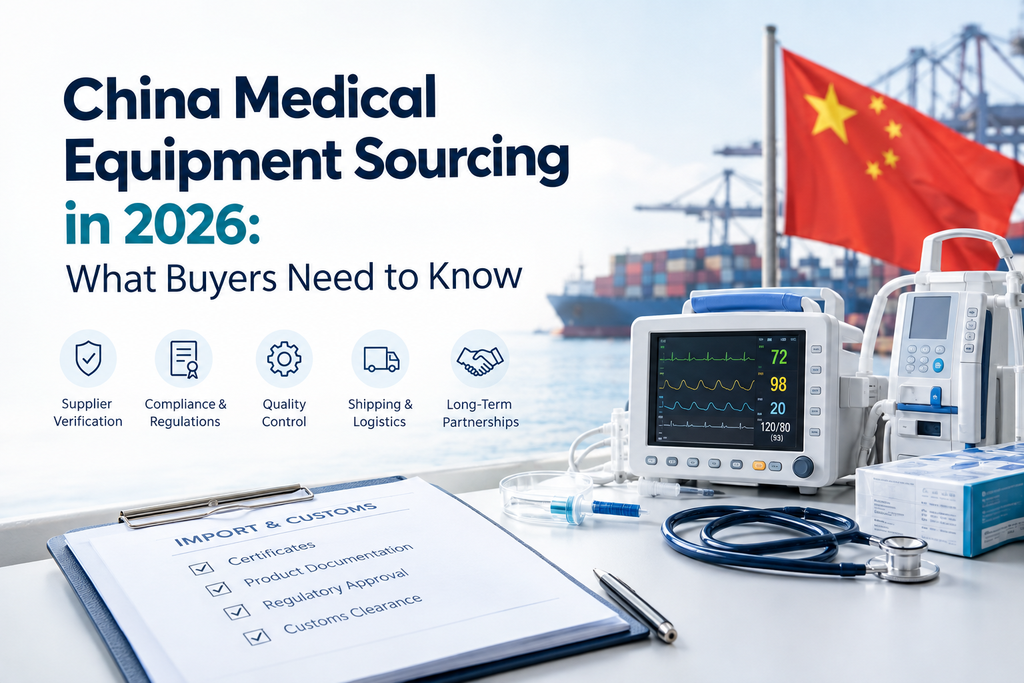
China is renowned globally for its state-of-the-art production and has now become a leading manufacturing hub for medical devices and technology. China medical equipment sourcing has been on the rise, thanks to China’s efficient and cost-effective production. From surgical instruments to imaging systems, China has positioned itself as a reliable sourcing hub for MedTech.
However, sourcing from China is not just a matter of affordability. You have to make sure you are trusting a genuine, reliable supplier who can deliver on your demands, such as product specifications, quality, and regulations. Since the matter is the medical industry, you have to be careful with whom you are trusting your business to.
This blog covers China medical equipment sourcing in detail, highlighting common challenges, risks, and keys to finding the right China sourcing agent for medical equipment.
Table of Contents
Why Source Medical Equipment from China?
MedTech market is growing rapidly every year. According to research, it was valued at USD 745.25 billion in 2025 and is projected to reach USD 797.19 billion in 2026. It is expected to grow to approximately USD 1.36 trillion by 2034, representing a compound annual growth rate of 6.97% from 2026 to 2034.
It’s worth noting that China places heavy emphasis on regulatory compliance when it comes to medical device manufacturing. According to China’s National Medical Products Administration (NMPA), manufacturers must comply with applicable laws, regulations, mandatory standards, and Good Manufacturing Practice requirements. These requirements vary according to device classification.
Types of China Medical Equipment Sourcing
The medical industry is huge, and China offers mass production of various medical components and equipment.
- Medical consumables
- Surgical instruments
- Patient-care products
- Infection-control products
- Diagnostic devices
- Imaging equipment
- Cardiovascular technologies
- Hospital equipment
- Rehabilitation equipment
How to Source Medical Equipment from China?
Medical equipment has to meet regulatory compliance standards so it has to be trusted with the right supplier. Here’s how you can find the right sourcing agent.
1: Define the Product Requirements
Before you begin searching for suppliers, you have to outline what kind of product you need to source. This includes:
- Product name
- Intended use
- User or healthcare setting
- Technical specifications
- Required standards
- Target market
- Required certifications
- Packaging requirements
- Initial order quantity
- Target price range
For more advanced medical devices, the specifications may be a bit more comprehensive.
For example, sourcing an angiography system is fundamentally different from sourcing a disposable medical consumable. The buyer may need to consider clinical applications, imaging capabilities, infrastructure requirements, software, installation, training, maintenance, and lifecycle support. The more precisely the requirement is defined, the easier it becomes to identify an appropriate supplier.
2. Find the Right Type of Supplier
Once your product requirements are set, begin with supplier search. You can do this by:
- Searching for suppliers on Alibaba.com, a Chinese e-commerce company that directly connects manufacturers in China to buyers all over the world. A reliable manufacturer’s Alibaba profile should include details about the company, such as the company’s production capacity, trade capacity, quality management process, photos of the facilities and equipment, and more.
- You should then contact these companies to ask for more information about their products as well as scans of their certifications, licenses, and other relevant documents.
- Sometimes, you may find certain suppliers trustworthy online, but they may divulge fraudulent information. So, you should connect with a representative in China who can visit the manufacturing sites and verify the Chinese supplier’s claims in person.
- The representative should conduct an in-depth assessment including the whereabouts of the supplier, manufacturing equipment and facilities, warehouse, products, annual revenue, regulatory certifications, and past experience with exporting to international customers. The results of this assessment should determine whether the supplier is the most suitable for your particular medical product.
Supplier Checklist
When reviewing potential suppliers, buyers should look at:
| Area to review | Key questions to consider |
| Business legitimacy | Is the supplier legally registered and operating within the stated industry? |
| Product specialization | Does its core production match the sports equipment you need? |
| Factory resources | What production facilities, machinery, and output capacity does it have? |
| Quality management | What processes are in place to maintain consistent product quality? |
| Compliance records | Can the supplier provide the certifications and test reports required for your target market? |
| International sales | Does the manufacturer have experience supplying overseas customers? |
| Product development | Can it handle design changes, OEM/ODM work, or custom specifications? |
| Order volume | What minimum quantity must you purchase for an initial order? |
| Production schedule | How long will manufacturing take from order confirmation to completion? |
| Supplier communication | Are responses timely, clear, and technically accurate? |
| Post-sale support | What support is available for defects, replacements, repairs, or spare parts? |
| Business conditions | What are the prices, payment arrangements, shipping options, and other terms? |
Documentation Checklist
The documents needed can vary depending on the type of medical device, how it will be used, and the country where it will be sold. Having a certificate does not automatically mean the product meets the requirements of every market.
- Quality and management certificates
- Product approval documents
- Laboratory or safety test results
- Technical product files
- Compliance statements
- Required registration records
- Product details and specifications
- Label and marking requirements
- User manuals and instructions
- Packaging details
- Sterilization records, if needed
- Information about materials used
- Clinical or product performance evidence, when required
Target Market Checklist
A medical device manufactured and sourced from China is not automatically ready for every region. Different countries have differing compliance and product requirements. The buyer should check the product requirements of each region before marketing it. For instance, the product requirements in the US may differ from those in Europe, etc.
Based on that, the regulatory requirements may affect:
- Product classification
- Labeling
- Registration
- Technical documentation
- Clinical evidence
Therefore, you should carefully select a supplier by considering the market entry requirements too.
Supplier Quality Control Evaluation
Certificates are important, but they should not be the only thing checked when choosing a supplier. Buyers should also look at how the factory manages materials, production, testing, packaging, storage, and product tracking. It is also important to check how they deal with customer complaints, quality problems, product changes, recalls, and after-sales support.
China’s revised medical-device GMP, effective from November 1, 2026, puts more focus on quality risks, proper quality control, validation, outsourced production, and managing quality throughout the product lifecycle. For international buyers, checking the supplier’s overall quality system is therefore becoming an important part of supplier selection.
3. Sign a Contract with the Supplier
When working with Chinese suppliers, face-to-face communication can help avoid misunderstandings. A local sourcing representative can visit factories, confirm product details, negotiate terms, and ensure both sides clearly understand the agreement. Buyers should also keep key requirements in writing, as some details may need to be reconfirmed during production.
Buyers should research market prices and compare several supplier quotes before negotiating. A high price may leave room for negotiation, while an unusually low quote can signal quality concerns. It is also important to confirm that pricing will remain stable for future orders.
Using multiple suppliers can make sense when products require different skills or materials. However, concentrating related products with fewer suppliers can simplify management and give buyers more negotiating power through larger order volumes.
4. Request Samples Before Placing an Order
This step is extremely important, and you should not miss it. Always request samples from your potential supplier to check the quality of their products. Sometimes, Chinese suppliers may send already-existing samples that may not meet your product requirements. They may tell you that they will tailor the final product once a large order is placed, but there’s a risk involved as they may fail to deliver the product you desire.
You must insist that the samples meet your product requirements to avoid time waste and quality disputes. Once you receive the samples, evaluate
- Materials
- Dimensions
- Packaging
- Build Quality
- Ergonomics
- Regulatory compliance
5. Placing an Order with the Supplier
Once the supplier has been checked and all product, quality, pricing, and regulatory requirements are confirmed, the buyer can proceed with placing the order. Before making the payment, prepare a clear purchase order that includes the product name, specifications, quantity, agreed price, packaging requirements, delivery time, payment terms, and shipping details.
The supplier should review the order and confirm that all information is correct. If the products are customized, attach the approved designs, samples, labels, or technical specifications to avoid confusion during production. Keep copies of the purchase order, invoices, agreements, and supplier communications as a record.
For a first order, it is also useful to agree on how quality will be checked before shipment. A pre-shipment inspection can help confirm that the products match the approved specifications and quantity. Once everything is confirmed, make the agreed payment and stay in regular contact with the supplier until production and delivery are completed.
6. Getting Medical Equipment Ready for Import
After placing the first order, buyers should work with the supplier to make sure all documents and product details meet the import rules of the destination country. Small mistakes in this stage can cause delays, so every document and requirement should be checked carefully before production and shipment.
For logos, labels, colors, and packaging, buyers should provide clear instructions and ask the supplier to send a design proof. Check the proof carefully and approve it only after all details are correct. It is also a good idea to check the finished packaging because printing mistakes can still happen, such as incorrect product information, addresses, or colors.
Import and customs documents should also be reviewed before the goods are shipped. Make sure all required information is complete, accurate, and matches the product and other documents. Some suppliers may not have staff who specialize in regulatory paperwork, so they may need guidance or several corrections. Taking time to review these forms properly can help prevent customs problems and unnecessary delays.
Mistakes to Avoid When Sourcing Medical Equipment from China
If you are sourcing medical devices for the first time, you may focus on getting the lowest price. This and the following mistakes should be avoided to get the best deal.
- A certificate doesn’t mean the product is market-ready. You must determine whether the product meets the regulatory requirements of the intended destination.
- Not every supplier is a manufacturer. Some companies are trading companies, export companies, or intermediaries.
- Always outline the product specifications before placing an order. Otherwise, you may not be satisfied with the final outcome.
- Don’t ignore after-sales support. This is particularly important for equipment requiring installation, maintenance, software updates, training, or spare parts.
- Don’t rely solely on online information like websites; rather, check the ground reality.
Final Thoughts
China medical equipment sourcing can give businesses access to a wide range of products, competitive pricing, and experienced manufacturers. However, successful sourcing is not simply about finding the lowest price. Buyers need to vet suppliers carefully, confirm product quality, review regulatory documents, and ensure all requirements are clearly agreed upon before production begins.
The key takeaway is that the right supplier is not necessarily the one offering the cheapest quote, but the one that can consistently meet your quality, compliance, delivery, and communication requirements. Taking the time to verify a supplier before placing an order can prevent costly problems later and help build a dependable supply chain for the long term.
If you’re planning to source medical equipment from China and want to know what approach makes sense for your business, talk to our team. We’ll look at your specific requirements and help you make the right sourcing decisions.
Frequently Asked Questions
1. Why should I use a sourcing agent for medical equipment in China?
A sourcing agent can help you find suitable suppliers, check factories, negotiate prices, inspect products, and manage communication with manufacturers.
2. How do I choose a reliable medical equipment supplier in China?
Check the supplier’s manufacturing experience, quality systems, certifications, product documentation, export history, and ability to meet your specific requirements.
3. What documents are needed when importing medical equipment from China?
Requirements depend on the product and destination country. They may include product certificates, test reports, technical documents, registration records, labeling information, and customs documents.
4. Can a sourcing agent inspect medical equipment before shipping?
Yes. A sourcing agent can arrange factory visits and pre-shipment inspections to check product quality, quantity, packaging, and compliance with the agreed specifications.
5. How can I avoid quality problems when sourcing medical equipment from China?
Work with a verified supplier, clearly document your requirements, approve samples and packaging designs, conduct quality inspections, and review all important documents before shipment.