
Getting products from factory to customer isn’t simple.
Inventory sits in warehouses. Orders come in. Someone needs to pick, pack, and ship those orders. Track everything. Handle returns. Keep costs down while delivering fast. That’s distribution management.
Mess it up and you’ve got angry customers, blown budgets, and products sitting in the wrong places. Get it right and your business runs smoothly while competitors struggle.
Here’s what you need to know about distribution management, stripped down to the essentials.
Table of Contents
| # | Topic | What You’ll Learn |
| 1 | What is Distribution Management? | Definition and core concepts |
| 2 | Why Distribution Management Matters | Business impact and benefits |
| 3 | Key Components | Essential elements that make it work |
| 4 | Distribution Channels | Direct, indirect, and hybrid options |
| 5 | Distribution Strategies | Intensive, selective, and exclusive approaches |
| 6 | Technology and Tools | Systems that streamline operations |
| 7 | Common Challenges | Problems you’ll face and how to handle them |
| 8 | Best Practices | What actually works in real operations |
| 9 | Getting Started | First steps for beginners |
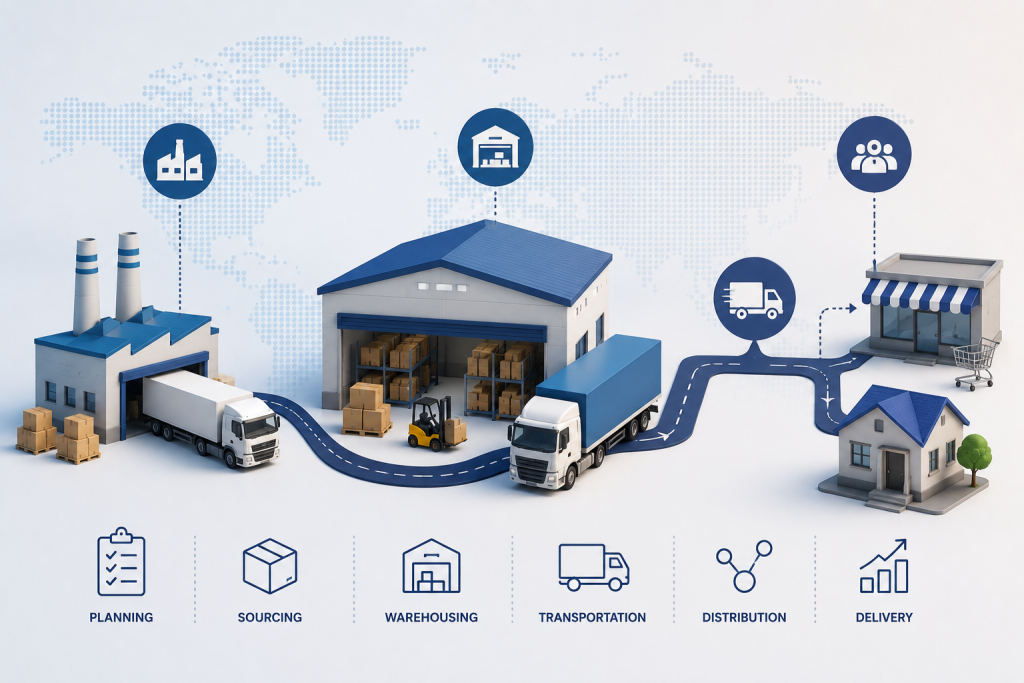
What is Distribution Management?
Distribution management is how you move products from manufacturer to end customer. The entire process of getting stuff where it needs to go, when it needs to be there.
What it includes:
Warehousing and storage. Order processing and fulfillment. Inventory management. Transportation and shipping. Returns handling. Tracking and reporting.
Not just logistics:
People confuse distribution management with logistics. Logistics is part of it (the physical movement), but distribution management is bigger. It’s the planning, coordination, and control of the entire distribution process.
The goal:
Get the right products to the right place at the right time, in the right condition, at the lowest possible cost. Sounds simple. Isn’t.
According to the Council of Supply Chain Management Professionals, effective distribution management can reduce operating costs by 15-30% while improving customer satisfaction.
If you’re doing bulk product sourcing from China, distribution management starts the moment containers leave the factory.
Why Distribution Management Matters
Bad distribution kills businesses. Good distribution gives you an edge.
Cost control:
Distribution costs can eat 10-30% of your revenue. Efficient management cuts those costs significantly. Better warehouse layouts, optimized routes, smarter inventory levels all save money.
Customer satisfaction:
People expect fast, accurate delivery now. Amazon trained everyone to expect 2-day shipping. Your distribution system needs to deliver or customers go elsewhere.
Competitive advantage:
If you can deliver faster and cheaper than competitors, you win business. Distribution becomes a differentiator, not just a cost center.
Cash flow:
Better inventory management means less money tied up in stock. Faster order processing means faster payment collection. Distribution efficiency impacts your cash position.
Scalability:
Solid distribution systems let you grow without chaos. Add products, enter new markets, increase volume without everything breaking.
Risk management:
Good distribution spreads risk. Multiple warehouses mean one location going down doesn’t kill your business. Diversified carriers mean one shipping partner having problems doesn’t stop deliveries.
Companies with strong distribution management grow faster and survive downturns better. It’s not sexy, but it’s essential.
Key Components
Distribution management has several moving parts:
1. Warehouse Management
Where you store inventory. Location matters. Layout matters. Systems for receiving, storing, picking matter. Poor warehouse management creates bottlenecks that slow everything down.
2. Inventory Control
Knowing what you have, where it is, how much you need. Too much inventory ties up cash. Too little means stockouts and lost sales. Balance is everything.
3. Order Processing
Taking customer orders and turning them into shipments. Speed and accuracy matter here. Manual processes create errors. Automated systems scale better.
4. Transportation Management
Moving products from point A to B. Choosing carriers. Planning routes. Tracking shipments. Managing costs. This is where freight expenses live.
5. Packaging and Handling
How products are packed affects shipping costs, damage rates, customer experience. Good packaging protects products without adding unnecessary weight or bulk.
6. Returns Management (Reverse Logistics)
Handling products coming back. Defects, wrong items, customer changes of mind. Returns can cost 1.5-3x the original shipping cost if not managed well.
7. Information Systems
Software tying everything together. Warehouse management systems (WMS), transportation management systems (TMS), order management systems. Data visibility across the supply chain.
Each component affects the others. Weak link in any area drags down the whole system. Working with procurement outsourcing partners helps coordinate these components without building everything yourself.
Distribution Channels
How products flow from manufacturer to customer. Several options exist:
Direct Distribution:
Manufacturer ships directly to end customer. No middlemen. You control the experience. Keep all margins. But you handle all logistics, customer service, returns.
Common with: Online stores, D2C brands, B2B sales.
Indirect Distribution:
Products go through intermediaries. Wholesalers, distributors, retailers. You lose some control and margin. But gain reach, reduced logistics burden, faster market entry.
Common with: Traditional retail, mass market products, international sales.
Hybrid Distribution:
Mix of direct and indirect. Sell direct online while also working with retailers. Own some distribution while partnering for other channels.
Common with: Established brands expanding channels, companies testing new markets.
Single-level:
One intermediary between you and customer. Example: You → Retailer → Customer.
Multi-level:
Multiple intermediaries. Example: You → Distributor → Wholesaler → Retailer → Customer. More complex but necessary for broad market coverage in some industries.
Choosing the right channel:
Depends on your product, market, resources, control needs. Direct gives control but requires infrastructure. Indirect gives reach but reduces margins. Most businesses eventually use multiple channels.
Distribution Strategies
Beyond channels, you need a strategy for market coverage:
Intensive Distribution:
Sell through as many outlets as possible. Maximize availability. Think Coca-Cola in every convenience store, vending machine, restaurant.
Good for: Convenience products, impulse purchases, low-margin items needing volume.
Selective Distribution:
Choose specific retailers or distributors. Balance between intensive and exclusive. You’re in multiple outlets but not everywhere.
Good for: Specialty products, items needing some sales support, mid-market brands.
Exclusive Distribution:
Limit to very few outlets, sometimes just one per market. Creates prestige. Gives retailers incentive to push your product.
Good for: Luxury goods, high-end products, items requiring significant retailer investment.
Pull vs Push:
Pull strategy: Create consumer demand that “pulls” products through distribution. Marketing and branding focused.
Push strategy: Push products into distribution channels through promotions, incentives to distributors and retailers.
Most successful companies use both. Create consumer demand (pull) while incentivizing channel partners (push).
For global sourcing operations, your distribution strategy affects which markets you enter and how you enter them.
Technology and Tools
Modern distribution management runs on software:
Warehouse Management System (WMS):
Manages warehouse operations. Receiving, putaway, picking, packing, shipping. Tracks inventory location. Optimizes picking routes. Essential for any serious operation.
Transportation Management System (TMS):
Handles shipping. Selects carriers. Plans routes. Tracks shipments. Manages freight costs. Audits freight bills. Bigger operations need this.
Order Management System (OMS):
Processes customer orders across channels. Routes orders to appropriate fulfillment location. Manages order status. Coordinates between sales and fulfillment.
Inventory Management Software:
Tracks stock levels. Calculates reorder points. Forecasts demand. Prevents stockouts and overstock. Can be standalone or part of WMS.
Enterprise Resource Planning (ERP):
Integrates everything. Accounting, purchasing, inventory, sales, distribution. Big investment but creates single source of truth.
Barcode and RFID Systems:
Track inventory movement. Scanning speeds up receiving and shipping. Reduces errors. RFID enables automatic tracking without manual scanning.
According to Gartner, companies using integrated distribution management technology reduce order processing time by 50-70% and cut distribution costs by 20-35%.
Small operations can start with basic tools and upgrade as they grow. Don’t overbuild technology before you need it.
Common Challenges
Real problems you’ll face:
Inventory accuracy:
System says you have 100 units. Physical count shows 87. Discrepancies cause stockouts even when system thinks you have inventory. Regular cycle counting and audits help.
Rising transportation costs:
Freight rates fluctuate. Fuel surcharges change. Capacity tightens during peak seasons. Hard to budget. Solution: Multiple carrier relationships, flexible routing, some contract rates locked in.
Demand forecasting:
Predicting what you’ll sell is tough. Too optimistic? Excess inventory. Too conservative? Lost sales. Use data, but expect to be wrong sometimes.
Last-mile delivery:
Final delivery to customer is expensive and complex. Residential delivery costs way more than commercial. Urban vs rural creates cost differences. Customer expectations keep rising.
Returns volume:
Ecommerce return rates hit 20-30% for some categories. Each return costs money. Some are legitimate. Some are return fraud. Need efficient returns process without making customers jump through hoops.
Seasonal spikes:
Holiday seasons, promotions, market events create volume spikes. Your distribution system needs capacity for peak without being too expensive during slow periods. Flexible labor, scalable warehouse space help.
Coordination across locations:
Multiple warehouses mean complexity. Which location fulfills which order? How to balance inventory across locations? When to transfer stock between facilities?
Technology integration:
Your WMS needs to talk to your OMS and TMS and accounting system. Integration is expensive and breaks easily. APIs and data synchronization require ongoing maintenance.
Working with quality control services catches problems before products enter distribution, preventing downstream headaches.
Best Practices
What actually works:
Start with data:
Track everything. Order cycle time. Inventory turns. Shipping costs per order. Accuracy rates. You can’t improve what you don’t measure.
Optimize warehouse layout:
Fast-moving items near packing stations. Slow movers farther away. Reduce picker travel distance. Small layout changes can increase throughput 20-30%.
Implement quality checks:
Verify orders before shipping. Catch errors early. Costs less to fix before it ships than to handle a return.
Build carrier relationships:
Don’t rely on one carrier. Negotiate rates. Understand each carrier’s strengths. UPS might be best for ground. FedEx for overnight. Regional carriers for specific areas.
Use safety stock wisely:
Buffer inventory prevents stockouts. But too much ties up cash. Calculate safety stock based on lead time variability and demand uncertainty.
Cross-train employees:
People who can do multiple roles give you flexibility. When receiving is slammed but packing is slow, people can shift.
Plan for peaks:
Know your busy seasons. Line up temp labor early. Build inventory ahead. Negotiate carrier capacity in advance.
Automate where it makes sense:
Manual data entry creates errors. Barcode scanning is cheap and effective. Full warehouse automation is expensive and only makes sense at scale.
Focus on customer experience:
Fast, accurate shipping with good tracking builds loyalty. Communicate delays proactively. Make returns easy (but track abuse).
Review regularly:
Distribution that worked at 100 orders/day breaks at 500 orders/day. Regularly assess your processes and systems. Upgrade before pain points become crises.
For supplier negotiation and cost optimization, distribution costs should be part of your total landed cost analysis.
Getting Started
New to distribution management? Here’s your roadmap:
Step 1: Understand your current state
Map out how products move now. Where are bottlenecks? What costs the most? What breaks most often? Document everything.
Step 2: Set clear goals
Reduce shipping costs by X%. Cut order processing time by Y%. Improve inventory accuracy to Z%. Specific goals drive specific improvements.
Step 3: Start with basics
Good warehouse organization. Barcode scanning. Clear processes. Don’t jump to expensive software before fundamentals are solid.
Step 4: Implement systems gradually
Start with simple inventory tracking. Add shipping software. Eventually WMS. Build capability as you grow. Don’t try to implement everything at once.
Step 5: Train your team
Best systems fail if people don’t use them right. Invest in training. Create documented procedures. Review regularly.
Step 6: Measure and adjust
Track KPIs weekly. Review monthly. Look for trends. Small adjustments compound over time.
Step 7: Scale strategically
Add warehouse space or locations when current capacity hits 80%. Add technology when manual processes can’t keep up. Add carriers when shipping volume justifies negotiated rates.
Step 8: Consider outsourcing
Third-party logistics (3PL) providers handle distribution for you. Makes sense when you’re small (don’t have volume for efficiency) or very large (want to focus on core business). Middle stages often best to handle yourself.
The Supply Chain Management Review recommends starting with one distribution channel and mastering it before expanding. Complexity kills execution.
Need help setting up distribution systems? Contact us to discuss your situation. Want to improve existing distribution operations? Book a consultation and we’ll identify opportunities.
Final Thoughts on Distribution Management
Distribution management isn’t glamorous. Nobody dreams of optimizing warehouse layouts or negotiating freight rates. But it’s the difference between businesses that scale smoothly and those that choke on their own growth.
Good distribution management means:
Customers get orders fast and accurate. Costs stay under control as you grow. You can enter new markets without chaos. Cash doesn’t get trapped in excess inventory. Returns get handled efficiently.
Bad distribution management means:
Stockouts losing sales. Slow shipping losing customers. High costs killing margins. Growth creating chaos instead of profit.
Start simple. Build fundamentals. Add complexity only when needed. Measure everything. Adjust constantly.
Distribution management is a competitive advantage hiding in plain sight. Most companies accept mediocre distribution. Do it well and you’ll stand out.