
Last March, I sat across from a woman who’d spent $47,000 developing her lingerie line. Forty-seven thousand dollars. Samples looked stunning. Photography was done. Website was live. Pre-orders were rolling in.
She handed me a production sample and asked me to wear-test it. I put it on in the factory bathroom in Shantou. Within maybe two hours, I knew she had a problem. The band kept creeping up my back. Straps stretched so much I had to readjust three times before lunch. And the lace on the cups? Beautiful lace, genuinely pretty. But it was scratching against my skin because whoever cut it didn’t finish the edges properly.
Forty-seven thousand dollars, and nobody had thought carefully enough about bra materials.
This happens more than you’d think. Founders obsess over design, color palettes, brand identity, packaging. All important stuff. But the actual fabrics and components that make a bra function as a garment on a human body? That part gets rushed. Someone picks materials from a supplier catalog based on how they look in a swatch book, and then wonders why customers complain about comfort six weeks after launch.
I’ve been sourcing intimate apparel from factories in Shantou, Shenzhen, and Dongguan for a while now. These cities make most of the world’s bras. Not some. Most. And the factory engineers I work with understand fabric mechanics at a level that would surprise people outside the industry. They know exactly which material belongs where on a bra and, more importantly, which materials will cause problems in which positions.
So let me walk through every single component. What works. What doesn’t. And what I’ve personally seen go wrong.
Table of Contents
| 1 | Why Bra Materials Determine Everything About Fit and Comfort |
| 2 | Bra Cup Materials |
| 3 | Bra Padding Materials |
| 4 | Bra Lining Materials |
| 5 | Bra Band Materials |
| 6 | Bra Strap and Adjuster Materials |
| 7 | Bra Hooks and Eyes (Closure) Materials |
| 8 | Bra Underwire Materials |
| 9 | Bra Embellishment Materials |
| 10 | How Material Choices Affect Your Brand |
| 11 | FAQ |
1. Bra Cup Materials
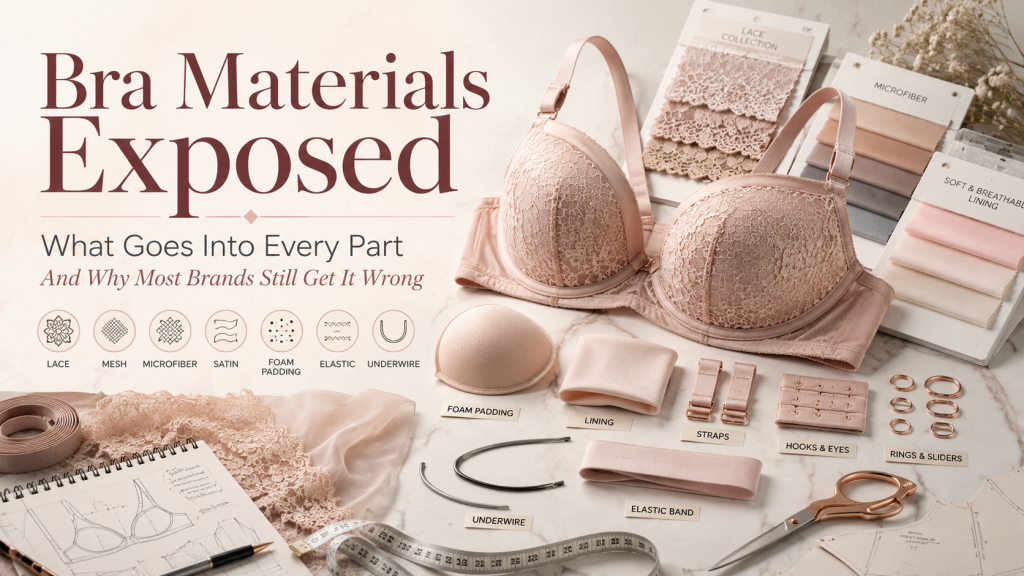
Cups are tricky because they need to do several things at once that kind of contradict each other. They need to look good (obviously). They need to feel soft because they’re sitting against some of the most sensitive skin on the body. They need structure so they hold shape throughout a full day. They need to breathe so the wearer doesn’t feel like she’s got a heating pad strapped to her chest. And they need to survive being thrown in a washing machine over and over without falling apart.
No single fabric does all of that perfectly. Which is why most cups are actually multiple layers working together.
Lace
I could write a whole separate post just about bra lace. The range of quality is enormous. On one end, you’ve got French Leavers lace woven on machines that are literally antiques, some of them over a hundred years old, producing fabric that costs $12-18 per meter. On the other end, basic Raschel lace from a high-speed warp knitting machine in Chaoyang district, maybe $0.40 per meter. Both get called “lace” on a product tag. They are not the same thing.
For bra cups specifically, you want stretch lace. Somewhere between 10-20% spandex content woven into the structure. This lets the lace conform to breast shape without creating gaps or wrinkles. Rigid lace (no stretch) requires extremely precise sizing and darting to fit properly, which drives up construction costs and limits your size range.
One thing I always check on lace cup samples: the scalloped edges. Run your fingertip along them. If they feel rough or scratchy at all on a fresh sample, they’ll be worse after five washes when the finishing softens and raw-cut threads start poking out. I’ve rejected samples from three different factories over this exact issue in the past year alone.
Mesh and Tulle
The sheer bra trend isn’t slowing down. Mesh cups give that “barely wearing anything” feeling that a lot of women prefer, especially in warmer months. The fabric is usually nylon or polyester, sometimes with a small percentage of spandex for stretch.
There’s a big difference between power mesh and fine tulle though. Power mesh is heavier, has strong elastic recovery, and actually provides some support on its own. Fine tulle is delicate and pretty but structurally it’s doing almost nothing. A tulle cup bra needs underwire, seaming, or side boning to provide any real support. The tulle is decorative, not functional.
I personally think mesh cups are underrated for everyday wear. They breathe better than anything else. In Guangdong summers when factory visits mean walking through un-air-conditioned warehouses, I reach for mesh cup bras every single time.
Microfiber
This is your t-shirt bra fabric. Ultra-fine synthetic fibers (we’re talking under 1 denier per filament) woven into a fabric so smooth it practically disappears under fitted clothing. No texture. No seam lines showing through. Just a smooth silhouette.
Most molded cup bras stretch microfiber over a foam form. The microfiber handles the aesthetics and skin feel. The foam underneath handles the shape. Together they create that perfectly round, smooth cup that dominates the everyday bra market.
Quality microfiber feels almost silky. Cheap microfiber feels plasticky and doesn’t breathe well. The difference is fiber quality and weave density, and you can feel it immediately when you touch both side by side.
Cotton
Cotton cups show up in bralettes, nursing bras, teen bras, and anything marketed as “natural” or “gentle.” And cotton genuinely is gentle on skin. It breathes. It absorbs moisture. People with synthetic sensitivities can wear it without reactions.
But cotton has a structural problem. It stretches out during wear and doesn’t bounce back. A cotton cup that fits perfectly at 8 AM is saggy by 3 PM. It wrinkles. It shows sweat stains. For structured bras that need to maintain shape all day, pure cotton doesn’t work.
Cotton-spandex blends (around 92% cotton, 8% spandex) solve most of these issues while keeping the skin-friendly properties. That small percentage of spandex gives the fabric enough memory to recover its shape between wears.
2. Bra Padding Materials
Padding does different jobs depending on the bra style. Sometimes it’s about adding volume. Sometimes it’s about creating a specific shape. Sometimes it’s just about nipple coverage so the wearer feels comfortable in a thin top. The material you choose determines which of these jobs gets done well.
Molded Foam
Polyurethane foam, heat-pressed into cup shapes on specialized molding machines. This is the backbone of the t-shirt bra industry. Different densities create different effects. Thin, flexible foam (maybe 3-5mm) gives light shaping without adding size. Thick, firm foam (8-12mm+) creates push-up effects and can add a full cup size visually.
I’ve visited foam suppliers in Dongguan who showed me their density range. The difference between their cheapest and most expensive foam was startling. Cheap foam had a chemical smell straight off the roll, felt stiff, and the factory rep admitted it would yellow within six months. Their premium foam ( OEKO-TEX certified, properly cured for 72+ hours) was odorless, flexible, and they had wash-test data showing shape retention through 100 cycles.
Foam’s biggest weakness is heat. It traps warmth against the body. Perforated foam (with small holes punched through the material) helps with airflow but doesn’t fully solve the problem. If your target market lives in hot climates, foam-heavy designs will generate comfort complaints during summer months. Guaranteed.
Fiberfill
Loose polyester fibers sandwiched between fabric layers. Feels softer and more natural than rigid foam. Moves with the body rather than holding a fixed shape. Breathes better because air passes between the fibers.
The downside? Fiberfill migrates. After repeated washing, the fibers shift and clump, creating uneven padding. Some spots get thicker while others thin out. For bralettes and soft-cup styles where perfect symmetry isn’t critical, fiberfill works great. For structured bras where both cups need to look identical after six months of wear, foam is more reliable.
Silicone Gel
Push-up bras going for maximum cleavage effect often use silicone gel inserts at the bottom or inner edge of cups. The gel has weight and movement similar to actual breast tissue, which creates a more natural look than foam alone.
Manufacturing challenge: gel inserts need perfect sealing. I saw a batch rejection at a factory in Shenzhen where the heat-seal on gel pads was inconsistent. Some pads leaked during compression testing. Imagine a customer bending over and feeling warm gel oozing out of her bra cup. That’s a brand-ending customer experience. Always verify seal integrity during quality inspection.
Air and Water Chambers
Niche products. Sealed pouches filled with air or water create very natural movement and feel. Air pads are lightweight but can puncture. Water pads feel remarkably natural but add noticeable weight that straps and bands need to support. Manufacturing complexity is higher, defect rates run higher, and per-unit costs reflect that. I’ve only sourced these for two clients, both positioning at luxury price points where the novelty justified the cost.
3. Bra Lining Materials
Nobody sees the lining except the person wearing the bra. But ask any woman which part of her bra she notices most during a long day, and it’s usually whatever fabric is touching her skin directly. Lining choice is a comfort decision that affects reviews, returns, and repeat purchases more than most founders realize.
Cotton Jersey
My default recommendation for any bra where comfort is a priority. Cotton jersey against breast skin just feels right. It breathes. It absorbs light perspiration without feeling wet. It doesn’t stick or slide. There’s a reason hospitals use cotton for patient gowns. It’s simply the most skin-friendly widely available fabric.
For bras with lace or synthetic cup exteriors, cotton jersey lining gives you the best of both worlds. Pretty on the outside, comfortable on the inside.
Microfiber Lining
Better choice for molded cup bras where you need the lining to lay perfectly flat inside the cup without bunching or wrinkling. Microfiber is smoother than cotton jersey, which means it slides into position inside a foam cup and stays put. It also dries faster than cotton after perspiration or washing.
Tradeoff: microfiber doesn’t absorb moisture. It wicks it (moves it along the surface) but doesn’t absorb it into the fiber the way cotton does. During heavy sweating, microfiber lining can feel slippery or clammy against skin. For everyday office wear, not an issue. For active wear or hot climates, cotton might be the better call.
Power Mesh Lining
When you need the lining itself to do structural work. Power mesh lining adds elastic compression that helps hold cup shape and provides support independent of the underwire. Common in full-coverage styles, minimizer bras, and plus-size designs where every layer needs to contribute to the support system.
Power mesh lining doesn’t feel as soft as cotton or microfiber against skin. It’s functional, not luxurious. Brands targeting comfort-first positioning should think carefully before using it.
Bamboo Viscose and Modal
The premium lining choice for brands that want to charge more and justify it with hand feel. Bamboo viscose (made from bamboo pulp processed into rayon) and modal (beech tree cellulose) both feel noticeably silkier than cotton. They wick moisture effectively and have natural temperature-regulating properties.
Cost is 30-50% higher than equivalent cotton lining. Whether that’s worth it depends on your retail price point and whether your customer will actually notice the difference. At $25 retail, probably not worth it. At $55+ retail, it becomes a differentiator that justifies the price gap.
4. Bra Band Materials
I need to say this clearly because it’s the most misunderstood thing about bras: the band does roughly 80% of the support work. Not the straps. The band. A well-fitted bra should provide almost all its support from the band wrapping around the ribcage, with straps just keeping the cups in position.
This means band materials need to be seriously engineered. They need strong elastic recovery (stretch out and snap back, thousands of times, without losing tension). They need to grip skin enough to stay in place without riding up. And they need to do all this while remaining comfortable enough to wear for 12-16 hours straight.
Woven and Knitted Elastic
The foundation. Every bra band contains elastic in some form. Woven elastic is firmer, more structured, and provides more consistent tension. Knitted elastic is softer, more flexible, and conforms to body curves more naturally.
The quality spectrum here is wide. I’ve tested elastic from suppliers where brand-new samples already felt tired and limp. And I’ve tested elastic from other suppliers where the recovery force was so consistent that samples still snapped back perfectly after being stretched on a testing jig for 48 hours straight.
What separates good elastic from bad? Rubber content, yarn quality, and manufacturing tension during production. Cheap elastic uses less rubber and lower-grade yarns. It feels fine when new but loses recovery within 2-3 months of regular wear. Quality elastic maintains its performance for a year or more.
When writing your product spec, specify elongation percentage (how far it stretches) and recovery percentage (how completely it returns to original length). Good band elastic stretches 50-80% and recovers to within 5% of its resting length. ASTM testing standards define exactly how to measure this. Ask your factory for test data. If they can’t provide it, they haven’t tested it.
Powernet
A firm mesh fabric with built-in elastic properties. Powernet shows up in bands that need maximum support without excessive thickness. It’s especially common in plus-size and full-bust bras (think 34G, 38H, and above) where the band needs to handle significantly more tension than a standard 34B.
Powernet breathes better than solid elastic because of its mesh structure. Air passes through. This matters because bands sit tight against skin in a warm area of the body (under the bust, around the ribcage). A band that doesn’t breathe creates a sweaty, uncomfortable stripe around the torso.
Microfiber Band Fabric
For seamless-look bras that need to disappear under clothing. Microfiber bonded to elastic creates a smooth, flat band without visible elastic edges. These bands feel less like traditional lingerie and more like a second layer of skin. The smooth surface also reduces friction against outer clothing, which prevents that annoying bunching and riding-up that textured bands sometimes cause.
Cotton-Spandex
Soft. Breathable. Comfortable. And honestly, not very supportive compared to proper elastic or powernet. Cotton-spandex bands work for sleep bras, light bralettes, nursing bras, and any situation where comfort matters more than firm support. For everyday structured bras that need to hold position through a full workday? Cotton-spandex bands don’t have enough recovery force. They stretch out by afternoon.
5. Bra Strap and Adjuster Materials
Straps get blamed for support problems that are actually band problems. But straps still matter. They keep cups positioned correctly on the body, they handle 10-20% of the total support load, and they’re one of the most visible parts of the bra (peeking out from tank tops, visible through sheer fabrics, on display in racerback styles).
Elastic Straps
Woven or knitted elastic in widths from about 8mm (delicate, decorative) up to 25mm or wider (full-bust support). The key feature to look for: plush backing. This means the skin-facing side of the strap has a soft, brushed texture while the outer side stays smooth. Plush backing prevents the strap from digging into shoulder skin and reduces slipping.
Strap elastic needs to be firm enough to maintain tension without the wearer constantly readjusting, but not so firm that it creates pressure marks on the shoulders. Finding that balance is partly material choice and partly width choice. Wider straps distribute force across more skin area, reducing pressure per square centimeter.
Adjusters: Sliders and Rings
Small components, big impact. These little hardware pieces let the wearer customize strap length. They come in two main materials:
Metal (usually nickel-plated steel or brass): Stronger. Grips strap elastic better under tension. Maintains position without slipping. But metal conducts temperature (cold in winter), can trigger nickel allergies in roughly 10-15% of women, and adds slight weight.
Plastic (nylon or acetal resin): Lighter. No allergy concerns. Won’t set off metal detectors (relevant for frequent travelers). But plastic adjusters can slip under high tension, especially with silky strap materials. They also crack if the plastic quality is poor.
For brands selling into the EU market, nickel-free hardware isn’t optional. It’s essentially required by consumer expectation even where regulations allow trace amounts. I always specify nickel-free or nylon-coated metal for any intimate apparel project.
Convertible Strap Hardware
J-hooks, clear straps, detachable clips, multi-way attachment points. These let one bra work with different necklines (racerback, halter, strapless, one-shoulder). The hardware needs to handle strap tension at unusual angles without the connection point failing.
I’ve seen cheap J-hooks that bent open under normal wear tension. The strap detaches. The cup drops. The customer is furious. This is not a component to cheap out on. Specify the load rating and test it during pre-production inspection.
6. Bra Hooks and Eyes (Closure) Materials
That little strip of hooks at the back of a bra takes more abuse per square centimeter than any other component. Every breath expands the ribcage. Every twist, bend, and reach pulls on those hooks. They need to stay connected under constant dynamic load, release cleanly when the wearer intentionally unhooks them, and resist corrosion from years of sweat exposure and machine washing.
Metal Wire Hooks and Eyes
Industry standard. Steel wire bent into hook and eye shapes, then coated for protection. Two main coating options:
Nickel plating: Thin, smooth, less visible under clothing. But nickel touches skin and can cause reactions. Increasingly avoided for intimate apparel.
Nylon coating: Thicker coating that eliminates skin contact with metal entirely. Feels smoother. No allergy risk. Slightly more visible under thin fabrics due to the coating thickness. My recommendation for any brand that doesn’t want allergy complaints.
The fabric tape that hooks and eyes mount on matters too. It needs to be firm enough that individual hooks don’t shift position (which would make them harder to fasten) but flexible enough to curve with the body at center back. Woven nylon tape is standard. Width and row count depend on the support level needed.
Configuration by support level:
1 column, 2 rows: Bralettes, light support, teen bras
2 columns, 3 rows: Standard everyday bras, A-D cups
3 columns, 3 rows: Full-bust bras, plus-size bands
4 columns, 4 rows: Maximum support, post-surgical, specialty
More hooks spread the closure force across a wider area. Each individual hook handles less stress, which means less chance of accidental unhooking during movement.
Front-Close Mechanisms
Front-closure bras use completely different hardware. Plastic snaps (convenient but can pop open under tension during movement). Magnetic closures (easy one-handed fastening, great for people with limited mobility, but magnets concern some pacemaker users). Metal clasps (secure and durable but bulkier, can show through fitted clothing).
Front closures are growing in popularity partly because of the adaptive clothing movement. People with arthritis, shoulder injuries, or limited arm mobility find back closures difficult or impossible. Front-close hardware that’s both secure AND easy to operate is a genuine engineering challenge that most factories handle with varying degrees of success.
7. Bra Underwire Materials
The underwire is a structural element that most wearers never see but definitely feel. It sits inside a fabric channel (called the casing) running along the bottom and sides of each cup. Its job: define cup shape, provide lift, and keep breast tissue separated and positioned.
When underwire works well, you forget it’s there. When it fails, you feel a metal point stabbing into your ribcage or armpit. There’s very little middle ground.
Carbon Steel Wire
Most common. Affordable. Strong enough to hold shape under the weight of breast tissue pulling down on it all day. Can be formed into precise curves matching different cup sizes (each size needs a different wire shape and length).
Weakness: rust. If the fabric casing wears thin from friction or washing, moisture reaches the steel and corrosion starts. I’ve seen bras where rust stains bled through the casing fabric onto the cup exterior. Not a good look. Not a good customer experience.
Stainless Steel Wire
Corrosion-resistant alternative. Costs more than carbon steel but eliminates the rust problem entirely. Slightly harder to form into tight curves (relevant for smaller cup sizes where the wire radius is small), but modern forming equipment handles it fine.
For brands positioning as premium or long-lasting, stainless steel wire is worth the cost difference. It’s maybe $0.15-0.30 more per pair of wires at manufacturing level. Tiny cost for eliminating a failure mode.
Wire Tips
This is where most underwire complaints originate. The tip of the wire (where it ends, usually near the armpit area) pokes through its casing and stabs the wearer. It’s the number one reason women say they “hate underwire bras.”
Quality factories address this by: dipping wire tips in plastic coating, capping them with small protective covers, or folding the wire end back on itself to create a blunt termination. During quality inspection, I always check wire tip finishing by pressing my thumb firmly against each tip through the casing. If I can feel a sharp point, it fails. Period.
Plastic Wire (Nylon or Polycarbonate)
Flexible alternative that bends with body movement rather than holding rigid shape. Lighter than steel. Won’t rust. Won’t set off airport security. Won’t conduct cold against skin in winter.
But plastic wire provides less lift and definition. It flexes under breast weight rather than holding firm. For A-C cups where the weight load is moderate, plastic wire works well and feels more comfortable than steel. For D cups and above, the wire needs to resist deformation under greater load, and plastic often isn’t strong enough. It bends permanently and the cup loses its intended shape.
Memory Wire (Titanium Alloy)
The premium option. Memory wire flexes with movement (bending, twisting, reaching) and then returns to its original engineered shape. It combines steel’s strength with flexibility that standard steel wire doesn’t have.
Cost at manufacturing level: roughly $0.50-2.00 more per bra than standard steel wire. At retail, brands mark this up to $5-15 premium. Whether customers perceive the value depends entirely on how well the brand explains what memory wire actually does differently. “Titanium underwire” sounds impressive on a product page. But if the customer doesn’t understand why it matters, she won’t pay extra for it.
8. Bra Embellishment Materials
Embellishments turn a functional undergarment into something that makes the wearer feel good about putting it on. They add cost, add manufacturing complexity, and add potential quality failure points. But they also add perceived value and emotional connection that plain bras can’t match.
Lace Trim and Appliqué
Decorative lace along edges, between cups, or as overlay panels. Lace appliqué (individual motifs cut from a lace sheet and applied to the bra surface) creates a custom, expensive look without full lace construction. The motifs can be sewn on or heat-bonded depending on the base fabric.
Ribbon and Bows
That little bow between the cups? Almost universal in lingerie. Seems trivial. But ribbon quality matters more than you’d expect. Cheap polyester satin ribbon frays after a few washes. The bow unravels. Loose threads appear. It looks worn out while the rest of the bra is still fine. Quality ribbon (properly heat-cut edges, dense weave) maintains its appearance through the garment’s full lifespan.
Embroidery
Machine embroidery adds texture and perceived luxury. Thread quality determines longevity. Cheap embroidery thread gets fuzzy and loose after washing, making the design look blurred. Quality rayon or polyester embroidery thread maintains crisp definition wash after wash.
Rhinestones and Beads
Heat-set rhinestones are standard for mass production. The adhesive quality is everything. Cheap adhesive fails within 5-10 washes and stones fall off. Quality heat-set application (proper temperature, proper pressure, proper dwell time during application) creates bonds that survive 50+ washes. Always request wash-test data on embellished samples before approving production.
Digital Printing and Sublimation
Printing directly onto bra fabric allows unlimited graphic possibilities without added texture or weight. Sublimation (heat-transferring dye into polyester fabric) creates permanent color that won’t crack, peel, or fade. Only works on polyester-based fabrics though. Cotton and nylon won’t accept sublimation dye.
How Bra Material Choices Ripple Through Your Entire Business
If you’re building a lingerie brand, every material decision connects to something else.
Your margins: Cup lace ranges from $0.40/meter to $15+/meter. That single choice swings per-unit cost by $3-8 per bra. Across a full collection with multiple sizes, material costs determine whether your business model works mathematically or doesn’t.
Your fit consistency: Different fabrics stretch different amounts. A bra that fits perfectly in 34C using one fabric may fit completely wrong in the same marked size using a different fabric with different stretch properties. Your spec sheet needs stretch percentages built into the pattern grading.
Your return rate: Uncomfortable materials generate returns. Elastic that dies in three months generates returns. Underwire tips that poke generate returns. Every material shortcut you take shows up in your return rate six months later.
Your sustainability story: GOTS-certified organic cotton, recycled nylon like ECONYL, recycled polyester, OEKO-TEX certified components. All available. All cost 20-40% more than conventional options. Your pricing needs to absorb that premium or your margins disappear.
Your regulatory compliance: Intimate apparel sits against skin for extended hours. Chemical safety testing (formaldehyde levels, pH, restricted azo dyes, heavy metals) is mandatory in most markets. Cheap materials from uncertified suppliers create regulatory risk. Product recalls destroy brands overnight.
When sourcing bras at volume, demand material certifications, wash testing data, and colorfastness results before committing to production. A pre-production inspection that verifies materials match approved samples prevents the kind of disasters that only surface after 10,000 units have already shipped to customers.
Every single part of a bra needs different material properties. What performs beautifully as a cup exterior fails miserably as a band. What makes a perfect lining stretches too much as a strap. Understanding these differences is what separates brands that women genuinely love wearing from brands that collect one-star reviews and process refunds.
Get the materials right for each component. Test them together as a complete garment on real bodies. Verify they hold up through real-world wear and repeated washing. That’s how you build bras that earn loyalty instead of returns.
Need help sourcing bra materials and components from verified lingerie factories? eSourcingSolution works with intimate apparel manufacturers across Shantou, Shenzhen, and Dongguan. From material sourcing to final quality inspection, we handle the supply chain for brands that refuse to compromise on quality. Start your lingerie project here.
FAQ
What’s the most comfortable bra material for all-day wear?
Microfiber cups with cotton jersey lining. That combination gives you smoothness on the outside (disappears under clothing) and breathability against skin (no clammy feeling by afternoon). For the band, quality elastic with plush backing distributes pressure without leaving red marks. But honestly, comfort comes from getting every component right together. A bra with amazing cups but a terrible band still feels awful. Every layer matters.
Which bra materials work best for sensitive or reactive skin?
Cotton or bamboo viscose lining against skin. Nylon-coated hardware instead of nickel-plated. OEKO-TEX Standard 100 certification on all fabrics (this tests for harmful chemicals at levels safe for prolonged skin contact). If elastic itself causes reactions, look for bras with fabric-covered elastic edges rather than raw elastic touching skin directly. And avoid formaldehyde-finished fabrics, which some cheap suppliers still use as an anti-wrinkle treatment.
How can I tell if bra materials will hold up long-term?
Ask for wash testing data. Specifically: elastic recovery percentage after 50 wash cycles (should maintain 95%+ of original recovery force). Colorfastness rating (4+ on the grey scale means minimal fading). Pilling resistance. Dimensional stability (under 3% shrinkage). If a factory can’t provide these numbers, they haven’t tested. And untested materials are a gamble with your brand reputation.
What bra materials work for plus sizes and full bust (D cup and above)?
Bands need powernet or heavy-duty woven elastic with high recovery force. Underwires must be steel (not plastic) in appropriate gauge for the cup size. Straps need 18-25mm width with plush backing to spread weight across more shoulder area. Cup fabrics need enough body and structure to resist distortion under breast weight. Thin mesh or lightweight microfiber won’t cut it above a DD. The materials need to do real mechanical work at larger sizes.
Are sustainable bra materials worth the higher cost for my brand?
Depends on who you’re selling to and at what price. Recycled nylon costs about 30% more than virgin nylon. Organic cotton runs 20-40% premium. OEKO-TEX testing adds $500-2000 per material per season. If your customer actively seeks sustainable products and will pay $10-20 more per bra, the investment returns through loyalty and premium positioning. If you’re competing at mass-market prices below $25 retail, sustainable materials may make your margins unworkable. Know your customer’s actual purchasing behavior, not just what she says in surveys.