
I got an email last March from a guy named Kevin in Atlanta. He’d ordered 50 pairs of sunglasses from a DHgate seller for his new online store. Paid about $6 per pair. The listing showed sleek polarized aviators with UV400 protection. Photos looked sharp. Reviews were mostly positive. Seller had a decent rating.
When the sunglasses arrived six weeks later, Kevin sent me photos. I wish I was making this up. The frames were crooked. Not slightly crooked. Visibly, obviously, one-lens-higher-than-the-other crooked. The “polarized” lenses weren’t polarized at all. but given everything else, he wasn’t feeling optimistic.
Fifty pairs. $300 plus shipping. Completely unsellable.
Kevin wanted to know: is DHgate safe? Should he try to get a refund? Should he ever use the platform again?
My answer was longer than he expected. Because the real answer to “is DHgate safe” isn’t yes or no. It’s “safe for what, and compared to what, and are you willing to do the work that makes it safer?”
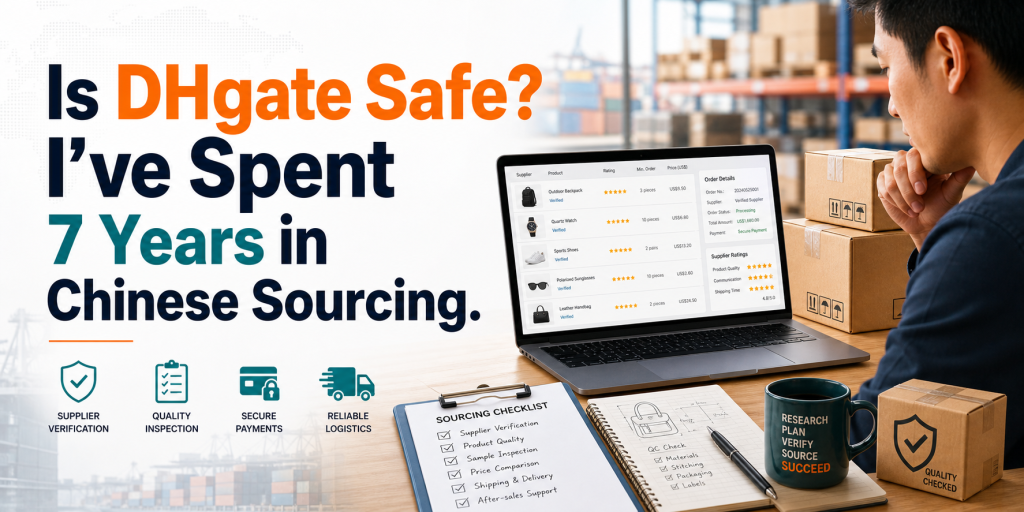
I’ve been in the Chinese sourcing business for over seven years. I’ve helped clients buy from DHgate, recover from bad DHgate purchases, and transition away from DHgate to direct factory relationships. I’ve also placed personal test orders on the platform just to see what shows up. So I have opinions. Strong ones. And they’re more complicated than “DHgate is a scam” or “DHgate is totally fine.”
Let me walk you through all of it.
First, what even is DHgate and how is it different from Alibaba
If you already know this, skip ahead. But I talk to a lot of people who lump all Chinese e-commerce platforms together, and the differences actually matter.
DHgate is a Chinese cross-border e-commerce platform founded in 2004. It connects Chinese sellers (manufacturers, trading companies, and individual resellers) with international buyers. So far that sounds exactly like Alibaba right?
Here’s where they diverge.
Alibaba is primarily a B2B (business-to-business) platform. It’s designed for bulk orders. Minimum order quantities. Factory-direct pricing. The expectation is that you’re a business buying hundreds or thousands of units.
DHgate is more of a B2C and small B2B hybrid. You can buy single items. You can buy 5 pieces. You can buy 500 pieces. The minimum quantities are much lower, sometimes just one unit. This makes DHgate accessible to individual consumers and very small businesses in a way that Alibaba isn’t.
DHgate also handles the full transaction including payment processing and shipping, more like Amazon or eBay than like Alibaba’s more hands-off approach. You browse, you add to cart, you pay, you wait for delivery. The experience feels more like online shopping and less like international trade negotiation.
This accessibility is both DHgate’s biggest strength and its biggest problem. Low barriers to entry mean more buyers can use the platform. But low barriers also mean more sellers can list products, including sellers who have no business selling anything to anyone.
Is DHgate safe from a payment and financial perspective
Let me separate this from product quality because they’re different questions.
From a pure “will my credit card get stolen” standpoint, DHgate is reasonably safe. The platform uses standard encryption for payment processing. They support credit cards, debit cards, and PayPal. Your financial information is handled by the payment processor, not by individual sellers.
DHgate’s Buyer Protection program holds your payment in escrow until you confirm receipt of the goods. The seller doesn’t get paid until you say you’ve received the order. If the order never arrives, you can open a dispute and get a refund. If the order arrives but doesn’t match the description, you can open a dispute for that too.
On paper, this is solid protection. In practice, it’s more complicated.
The dispute process works. I’ve seen it work. But it’s slow. And the burden of proof is on you. You need photos, videos, screenshots of the listing, evidence that what you received doesn’t match what was advertised. If the discrepancy is obvious (wrong product entirely, missing items, clearly broken), disputes usually resolve in the buyer’s favor. If the discrepancy is subjective (“the quality isn’t as good as I expected”), it gets murkier.
And here’s a thing that catches people off guard. DHgate’s buyer protection window has a time limit. You typically have a set number of days after delivery confirmation to open a dispute. If you don’t inspect your order promptly and the window closes, you lose your ability to dispute. I’ve seen this happen to people who ordered products, got busy, didn’t open the package for three weeks, and then discovered problems after the protection window expired.
My advice: the day your DHgate order arrives, open it. Inspect everything. Take photos. If there’s a problem, file the dispute immediately. Don’t wait.
If you want an extra layer of protection, pay with PayPal when DHgate offers it as an option. PayPal’s buyer protection is independent of DHgate’s. If DHgate’s dispute process fails you, PayPal gives you a second avenue for recovery. Credit card chargebacks are a third option, though that should be a last resort.
So is DHgate financially safe? Mostly yes, if you use the platform’s payment system, pay attention to protect windows, and document everything. The risk of outright financial fraud (paying and getting nothing) is low. The risk of paying and getting something disappointing is much higher. Which brings us to the real question.
Is DHgate safe from a product quality perspective
This is where my answer gets less reassuring.
DHgate has a product quality problem. Not a small one. A significant, structural, deeply embedded product quality problem. And it stems from the platform’s fundamental business model.
Because DHgate caters to small-quantity buyers, the sellers on the platform are often not the factories themselves. They’re middlemen. Resellers. Small trading companies. Individual entrepreneurs who buy cheap goods from wholesale markets or 1688 (China’s domestic wholesale platform) and resell them on DHgate at a markup.
These sellers often have no control over product quality because they didn’t make the product. They bought it from whoever was cheapest and they’re flipping it to you. They might not have even seen the product in person. They grabbed photos from a manufacturer’s catalog, wrote a listing, and started selling.
This creates a disconnect between what the listing shows and what you actually receive that is, frankly, worse than on Alibaba. On Alibaba, you’re more likely to be dealing with the actual factory. On DHgate, you’re more likely to be dealing with someone who bought from a factory (or bought from someone who bought from a factory) and is reselling to you.
The result? Product photos that look professional because they were taken by the original manufacturer, attached to products that look nothing like those photos because the reseller sourced the cheapest version they could find.
Kevin’s sunglasses. The listing photos were probably from a legitimate manufacturer who makes decent polarized aviators. The seller sourced the cheapest sunglasses they could find that vaguely resembled those photos. Kevin got the cheap version. The listing showed the good version. Classic DHgate experience.
The counterfeit problem is worse on DHgate than on Alibaba.
I need to be direct about this. DHgate has a reputation as a source for counterfeit goods. Designer handbags, luxury watches, branded sneakers, name-brand electronics. Search for almost any luxury brand on DHgate and you’ll find listings that are obviously selling knockoffs, even if they don’t use the brand name explicitly. They’ll use phrases like “high quality designer style” or show photos that are clearly of a branded product without naming the brand.
Buying counterfeit goods is illegal. Importing them into the US can result in seizure by US Customs. Selling them can result in lawsuits from brand owners. I’m not being preachy here. I’m being practical. The legal risk is real and the financial consequences can be severe.
If you’re looking at a DHgate listing and the product looks like a luxury brand item at 5% of the retail price, it’s counterfeit. There are no secret factory outlets selling real Gucci bags for $30. That’s not how any of this works.
Quality inconsistency is the norm, not the exception.
Even for non-branded, non-counterfeit products, quality on DHgate is wildly inconsistent. The same search for “wireless earbuds” will return results ranging from surprisingly decent to absolute garbage. And you often can’t tell which is which from the listing alone.
Reviews help somewhat. But DHgate reviews have their own problems. Some are fake. Some are from buyers with very low standards (“it arrived!” is not a quality review). Some are from buyers who haven’t used the product long enough to discover durability issues. And the photo reviews, which are the most useful, are sparse on many listings.
The specific risks I’ve seen people run into on DHgate
Let me get concrete. These aren’t hypothetical risks. These are things I’ve personally seen happen to real people.
Product looks nothing like the listing photos.
This is the most common complaint about DHgate by a wide margin. The listing shows a beautifully crafted leather wallet. What arrives is a stiff, plasticky thing that smells like chemicals and has crooked stitching. The listing shows a sleek drone with a 4K camera. What arrives is a toy-grade quadcopter with a 480p camera that produces footage that looks like it was filmed through a dirty window.
The photos on DHgate listings are aspirational. They show what the product could look like if it were made well. What you receive is what the product actually looks like when it’s made as cheaply as possible.
Sizing is completely off.
Clothing from DHgate is notorious for this. Chinese sizing runs smaller than Western sizing. A “Large” from a DHgate clothing seller might fit like a Western “Small.” Some sellers provide size charts. Some of those size charts are accurate. Some are copied from a different product entirely.
I’ve talked to people who ordered wedding party dresses from DHgate based on measurements they submitted, and the dresses arrived two sizes too small. For a wedding. That’s not a minor inconvenience. That’s a crisis.
If you’re ordering clothing from DHgate, order a single piece first. Measure it. Compare it to the size chart. Then decide whether to order more. Do not order 15 bridesmaid dresses based on a size chart you haven’t verified. Please.
Shipping takes forever and tracking is unreliable.
Standard DHgate shipping is slow. We’re talking 2 to 6 weeks for most orders. Sometimes longer. The free or cheap shipping options use economy postal services that provide minimal tracking. Your package enters a black hole somewhere between Shenzhen and your mailbox and you just have to wait and hope.
Expedited shipping options exist but they cost more, sometimes significantly more. For a $10 product, paying $25 for DHL shipping doesn’t make economic sense. So most people choose the slow option and then spend three weeks refreshing a tracking page that hasn’t updated since the package left China.
The tracking numbers DHgate provides often don’t work on standard tracking websites until the package reaches your country. Chinese domestic tracking and international tracking use different systems. Your package might be moving through China perfectly fine but the tracking number won’t show anything useful until it hits a scan point in your country.
Seller communication ranges from excellent to nonexistent.
Some DHgate sellers are responsive, helpful, and genuinely try to resolve problems. Others disappear the moment they have your money. I’ve seen both extremes and everything in between.
The language barrier is real. Most DHgate sellers communicate in English as a second (or third) language, often through translation tools. Nuanced quality complaints get lost in translation. “The stitching is uneven and the material feels cheaper than the listing described” might get translated into something the seller interprets as “the customer is happy but has a small concern.”
If you need to communicate a problem, use photos. Lots of photos. Circle the defects. Compare side by side with the listing photos. Visual evidence transcends language barriers in a way that written complaints don’t.
So when IS DHgate actually worth using
After everything I just said, you might think I’m going to tell you to never use DHgate. I’m not. The platform has legitimate use cases. They’re just narrower than most people think.
Personal purchases where you’re okay with gambling.
You want a phone case for $2. A quirky piece of costume jewelry for $4. A novelty t-shirt for $6. You understand that the quality might be mediocre. You’re not going to be devastated if it’s not perfect. You’re basically buying a lottery ticket where the worst outcome is losing a few bucks and the best outcome is getting something surprisingly decent for almost nothing.
For low-stakes personal purchases, DHgate is fine. Treat it like a dollar store with a 6-week shipping time. Adjust your expectations accordingly.
Testing product ideas before committing to bulk.
This is actually a smart use of DHgate that not enough people talk about. Say you’re thinking about selling phone accessories. You’re not sure which specific products will resonate with your market. You could order small quantities of 10 different phone accessory types from DHgate, test them yourself, see which ones are decent quality, and use that information to guide a larger bulk order from a proper factory through Alibaba or a sourcing agent.
You’re not going to sell the DHgate products. You’re using them as cheap market research samples. The quality might not be representative of what a good factory can produce, but it gives you a starting point for understanding the product category.
Products where quality variation doesn’t matter much.
Some product categories are hard to screw up. Basic silicone molds. Simple plastic organizers. Generic cables and adapters (though be careful with anything electrical). Fabric storage bags. Products where the manufacturing process is so simple that even a mediocre factory produces something functional.
For these categories, DHgate’s low prices and low minimums can work. The product doesn’t need to be amazing. It just needs to be functional. And for truly simple products, functional is almost guaranteed.
When you should absolutely NOT use DHgate
Reselling branded or brand-adjacent products.
If you’re building a business, do not source your inventory from DHgate. The quality inconsistency means you can’t guarantee what your customers will receive. The counterfeit risk means you might unknowingly sell illegal products. The lack of customization options means you can’t differentiate your brand. And the inability to build a direct factory relationship means you can’t improve quality over time.
Serious e-commerce sellers, especially Amazon FBA sellers, need consistent quality, reliable supply, and the ability to customize products with their own branding. DHgate doesn’t provide any of that reliably.
Products that need to meet safety standards.
Children’s products. Electronics. Anything that goes in or on the body. Food contact items. If the product category has safety regulations in your country, DHgate is the wrong source. You have no visibility into manufacturing processes, no ability to request compliance testing, and no way to verify that the product meets the standards required for legal sale.
A $3 children’s toy from DHgate that contains lead paint isn’t a bargain. It’s a liability nightmare.
Anything where consistency matters.
If you need 500 units that all look and function identically, DHgate is not your platform. Even ordering from the same seller twice might get you different products if they’re sourcing from different suppliers each time. The lack of manufacturing control means batch-to-batch consistency is essentially random.
High-value purchases.
Spending $500 or more on a single DHgate order without extensive vetting of the seller is risky. The buyer protection helps, but dispute resolution for large orders is stressful, time-consuming, and not guaranteed to go your way. If the stakes are high, use a platform and process with more safeguards.
DHgate versus Alibaba versus going direct: a realistic comparison
People ask me this constantly so let me lay it out.
DHgate is best for: small personal purchases, product research samples, low-stakes experimentation. It’s the most accessible platform with the lowest minimums but also the lowest quality floor and the least control over what you get.
Alibaba is better for: business purchases, bulk orders, building supplier relationships. Higher minimums but you’re more likely to deal with actual factories, you can negotiate specifications, and the quality ceiling is much higher. Still requires due diligence but the tools for vetting suppliers are better.
Direct factory sourcing (through a sourcing agent or your own relationships) is best for: serious businesses that need consistent quality, custom products, and reliable supply chains. Highest barrier to entry but also the highest quality control and the best long-term economics.
Most people’s journey goes: DHgate for curiosity → Alibaba for first real orders → direct sourcing as the business grows. That progression makes sense. Each step up gives you more control and better quality at the cost of more complexity and higher minimums.
How to make DHgate as safe as possible if you’re going to use it
I’m a realist. Some of you are going to use DHgate regardless of what I say. So here’s how to minimize your risk.
Read reviews obsessively. Especially photo reviews.
Written reviews are somewhat useful. Photo reviews are gold. They show you what the product actually looks like when a real buyer receives it, not what the seller’s professional photos show. If a listing has no photo reviews, that’s a yellow flag. If the photo reviews show a product that looks significantly different from the listing photos, that’s your answer right there.
Check the seller’s history and transaction volume.
A seller with 5,000 transactions and a 97% positive rating is a safer bet than a seller with 12 transactions and no reviews. Not a guarantee. But the odds are better. Established sellers have more to lose from bad behavior.
Start small. Always.
Never make a large first order from a DHgate seller you haven’t bought from before. Order one or two pieces. Evaluate them. If they’re acceptable, order a few more. Build trust incrementally. The sellers who are worth buying from will still be there next month.
Use the messaging system to ask specific questions before ordering.
Ask about materials. Ask about sizing. Ask for real photos (not the listing photos). Ask about shipping times. A seller who responds quickly and thoroughly is more likely to be legitimate than one who gives vague one-word answers or doesn’t respond at all.
Pay with PayPal when possible.
Double layer of buyer protection. DHgate’s escrow plus PayPal’s dispute resolution. If one fails, you have the other.
Document everything from the moment your package arrives.
Open the package on camera if you can. Photograph every item. Compare to listing photos. If you need to file a dispute, this documentation is your evidence. Without it, your dispute is your word against the seller’s.
Never pay outside the DHgate platform.
If a seller asks you to pay via Western Union, direct bank transfer, or any method outside DHgate’s system, walk away. The moment your payment leaves the platform, your buyer protection vanishes. This is the oldest scam in online commerce and it still works because people keep falling for it.
My actual honest bottom line on whether DHgate is safe
Is DHgate safe? Here’s what I tell people who ask me directly.
Your money is reasonably safe. The payment system works. Buyer protection exists and functions, imperfectly but it functions. The risk of paying and receiving literally nothing is low.
Your expectations are not safe. The gap between what DHgate listings show and what DHgate sellers deliver is, on average, larger than on any other major Chinese e-commerce platform. If you go in expecting to receive exactly what the photos show, you will be disappointed more often than not.
Your time is not safe. Between slow shipping, potential disputes, and the research required to find decent sellers, DHgate consumes more time per dollar spent than almost any other sourcing method. For personal purchases of cheap items, that time cost might be acceptable. For business sourcing, it’s usually not.
Your business is not safe on DHgate. If you’re building a brand, selling to customers, or trying to create a reliable supply chain, DHgate is the wrong foundation. The quality inconsistency, the counterfeit risk, the lack of customization, and the inability to build real factory relationships make it unsuitable for serious commerce.
DHgate is a tool. Like any tool, it works well for certain jobs and poorly for others. A screwdriver is great for screws and terrible for nails. DHgate is great for cheap personal purchases and terrible for building a product business.
Use it for what it’s good at. Use something else for everything else.
And if you’re at the point where you need consistent quality, custom branding, and a supply chain you can actually rely on, that’s when you graduate from platforms entirely and start working with factories directly or through a sourcing partner who can get you what you actually need.
Kevin, by the way, got a partial refund through DHgate’s dispute process. About 60% of what he paid. Took five weeks. He never ordered from DHgate again. Last I heard he was working with one of our partner factories on a custom sunglass line with actual polarized lenses and frames that sit straight on a human face. His first bulk order passed inspection on the first try.
Funny how that works.
Done gambling on DHgate quality? The team at eSourcingSolution.comconnects you directly with vetted Chinese factories that actually make the products you want, at the quality level you specify, with inspection before anything ships. Tell us what you need, and let’s build something you can actually sell with confidence.
FAQ
Is DHgate safe to buy from?
DHgate is reasonably safe for payments thanks to its escrow system and buyer protection. However, product quality is inconsistent and the gap between listing photos and actual products is often significant. DHgate is safer for small personal purchases than for business sourcing.
Is DHgate legit or a scam?
DHgate is a legitimate Chinese e-commerce platform, not a scam. However, individual sellers on the platform vary widely in reliability. Some are honest sellers offering decent products. Others sell counterfeit goods or misrepresent product quality. Vetting seller
Why is DHgate so cheap?
DHgate products are cheap because of low Chinese manufacturing costs, direct-from-seller pricing, and thin profit margins. Some products are also cheap because they use inferior materials or are counterfeit versions of branded goods.
Can you get scammed on DHgate?
While outright payment scams are rare due to DHgate’s escrow system, receiving products that don’t match listing descriptions is common. Using buyer protection, paying through the platform, and documenting received products helps protect against losses.
Is DHgate better than AliExpress?
AliExpress generally has better buyer protection, faster shipping options, and more reliable product quality than DHgate. DHgate sometimes offers lower prices, especially for bulk purchases, but with higher quality risk. For most individual buyers, AliExpress is the safer choice.