
Look, my sister panicked. Called me on a Sunday. Mid-cookie-baking with her kids. She’d pulled out her regular roll of bleached parchment paper, and while waiting for the oven to hit 350, she did what none of us should ever do. She googled a health question.
“Is parchment paper safe” she typed. And the internet did what the internet does.
Within twenty minutes she was texting me paragraphs. Chlorine gas. Dioxins. Something about carcinogens leaching into baked goods. One mommy blog had her convinced she’d been feeding her kids poison banana bread for five years. Another one said unbleached was equally toxic. A third said ditch all parchment and switch to silicone mats. Then she found a fourth blog claiming silicone mats cause hormone disruption.
She was spiraling.
I told her to breathe. Put the cookies in. Close the laptop. I’d explain everything when she calmed down.
Here’s why she called me specifically. I’ve worked in product sourcing from China for years. Not parchment paper exclusively, but I’ve been inside paper product factories. Reviewed material safety data sheets. Helped clients develop private-label parchment paper lines and had to learn the manufacturing process inside and out to write proper product specifications. I know more about how parchment paper gets made than any normal person should.
And what I know is this: the internet has turned a boring, safe kitchen product into a terrifying chemical weapon in people’s minds. For no good reason.
Let me undo some of that damage.
Table of contents:
- What Parchment Paper Actually Is
- Bleached Parchment Paper: Is It Actually Safe
- Unbleached Parchment Paper: Is It Safer
- The Temperature Question: When Does Parchment Paper Become Unsafe
- What About PFAS in Parchment Paper
- Parchment Paper vs. the Alternatives: A Safety Comparison
- The Sourcing Angle: What Matters If You’re Selling Parchment Paper
- So Is Parchment Paper Safe? The Short Version
- FAQ
Most people have no clue what parchment paper even is
This is the root of the problem. People don’t understand what they’re using, so when someone throws scary chemical names at them, they have no framework to evaluate whether the fear makes sense.
Parchment paper isn’t just thin paper you bake on. It’s been fundamentally transformed at a molecular level. That sounds dramatic. It’s actually pretty straightforward once you understand it.
Start with wood pulp. Regular paper-making stuff. Fibers get processed into sheets. Nothing unusual yet.
Then comes the step that freaks people out when they first hear about it. The paper goes through a sulfuric acid bath. Or sometimes zinc chloride. I can already hear you going “WHAT.” Yeah. Acid. On your baking paper. Hang on though.
What the acid does is partially dissolve the cellulose fibers and then let them re-form into a tighter, denser structure. Think of it like… okay, imagine you took a loose knit sweater, partially melted the yarn, and let it re-solidify into a tighter weave. The material is the same. The structure is different. Stronger. More resistant to grease and moisture.
And then this is the part the scary blogs conveniently skip the acid gets washed out. Completely. Thoroughly. Multiple rinse stages. What’s left is restructured cellulose. Not acid-soaked paper. The acid was a tool, not an ingredient. It did its job and left.
After that, silicone coating goes on. Food-grade silicone. Same exact category of material that’s in baby bottle nipples, medical implants, silicone baking molds, spatulas. It’s one of the most inert substances we use in food contact. Doesn’t react with anything. Doesn’t break down at baking temperatures. Chemically, it just sits there being slippery. That’s its whole personality.
So your parchment paper is: restructured wood fiber + food-grade silicone coating. That’s it. The acid left. The scary part is over before the product reaches the store shelf.
I explained this to my sister and she said “then why does the internet say it’s toxic?” Good question. Let’s get into that.
The bleached parchment paper panic is based on stuff that happened decades ago
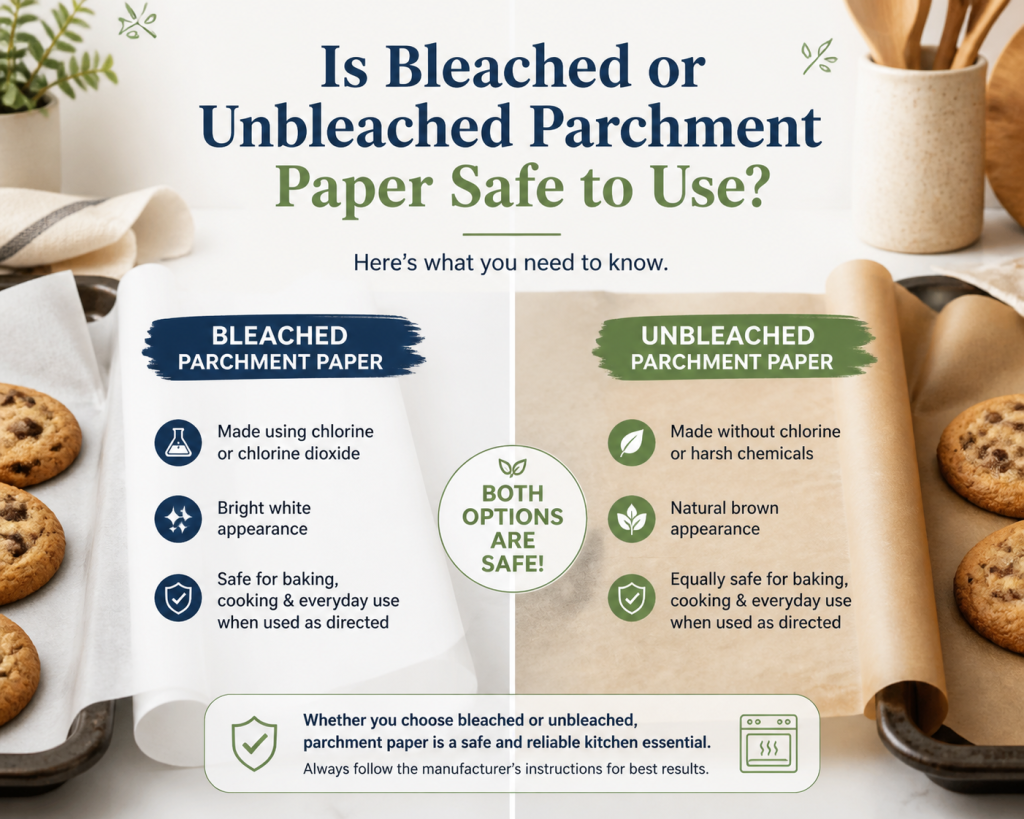
White parchment paper is white because the pulp got bleached before the parchmentization process. Brown parchment paper is brown because it didn’t. That’s the only difference at that stage.
The word “bleached” triggers people. I get it. You think of bleach. Clorox. That harsh chemical smell. Pool water burning your eyes. Your brain makes an association and suddenly you’re imagining chlorine gas infusing your chocolate chip cookies.
But here’s what actually happens in modern paper bleaching. And I want to stress the word modern because this distinction matters enormously.
The old way (mostly dead now): Elemental chlorine gas. Direct application to paper pulp. This method could produce dioxins as a byproduct. Dioxins are legitimately bad. Carcinogenic. Persistent in the environment. The concern about dioxins in bleached paper was valid… in the 1980s. When this method was standard.
It’s not standard anymore. Hasn’t been for food-contact paper in any developed country for a very long time. The blogs screaming about dioxins in your parchment paper are citing a problem that the industry solved before most of their readers were born.
The current way: Elemental chlorine-free bleaching. ECF. Uses chlorine dioxide instead of chlorine gas. Different compound. Different chemistry. Produces essentially zero dioxins. The trace amounts that theoretically could form are so far below any established safety threshold that they’re basically a rounding error.
There’s also TCF totally chlorine-free, which uses hydrogen peroxide or oxygen. No chlorine anything. Some brands use this and charge a premium for it. The Chlorine Free Products Association certifies these products if you want to seek them out.
So what does the FDA say?
Bleached parchment paper that meets FDA food-contact standards is safe. Full stop. The FDA sets limits on chemical migration from food-contact materials into food. Properly manufactured ECF-bleached parchment paper falls so far below those limits that it’s not even a close call.
Could some unregulated factory somewhere still be using old-school chlorine bleaching and not washing their paper properly? I mean, theoretically. Somewhere in the world, probably. Is that what’s sitting on the shelf at your Target or Whole Foods? No. Not a chance. Those products go through regulatory compliance before they reach retail shelves in the US or EU.
The parchment paper fear is like refusing to fly because planes crashed in 1952. The problem was real once. It got fixed. Moving on.
Unbleached parchment paper: marginally different, not meaningfully safer
Unbleached parchment paper skips the bleaching step. The pulp stays its natural brownish color. No bleaching chemicals involved at all.
Is it “safer”? In the most technical, hair-splitting sense… sure. Zero bleaching residue is less than trace bleaching residue. Zero is less than almost-zero. Mathematically true.
Practically meaningful for your health? No. I’m sorry. I know that’s not what the wellness blogs want to hear. But the difference between “no bleaching chemicals” and “bleaching chemicals present at levels thousands of times below any harmful threshold” is not a difference your body can detect or respond to.
Here’s what bugs me about the “always choose unbleached” absolutism. People fixate on the bleaching step and ignore everything else. Unbleached parchment paper still goes through the acid bath. Still gets silicone coated. Still involves industrial processing. The bleaching step is one part of a multi-stage manufacturing process, and it’s not even the part that matters most for safety.
I’ve toured factories. I’ve seen unbleached parchment paper production lines where the overall quality control was sloppy — inconsistent silicone application, inadequate washing after the acid bath, questionable raw material sourcing. And I’ve seen bleached parchment paper lines that were immaculate. Every step monitored. Every batch tested.
The color of your parchment paper tells you whether it was bleached. It tells you nothing about the overall manufacturing quality. And manufacturing quality is what actually determines safety.
Pick unbleached if it makes you feel good. Genuinely, no judgment. But don’t pick it because you think bleached parchment paper is hurting you. That belief isn’t supported by evidence.
The thing that actually makes parchment paper dangerous (and nobody talks about it enough)
You want to know what’s actually risky about parchment paper? It’s not chemicals. It’s temperature.
Every roll of parchment paper has a maximum temperature rating. Usually 420°F to 450°F. Some go to 500°F. It’s printed on the box. Most people never look at it.
Above that temperature, things go wrong. The silicone coating starts degrading. The paper itself can darken, smoke, and eventually catch fire. This isn’t a theoretical concern. This is a “your oven is now on fire” concern.
I know someone — friend of a friend, so take it with appropriate grain of salt — who put parchment paper under the broiler to catch drippings from some chicken thighs. Broilers run at 500°F to 550°F, sometimes higher. The parchment caught fire. Small fire. Contained to the oven. But her kitchen filled with smoke and she had to air out the house for two days.
Other ways people mess this up:
Parchment paper hanging over the edge of a baking sheet, touching the oven’s heating element. Doesn’t matter if your oven is set to 350°F. Direct contact with the element is direct contact with the element. Paper burns.
Pizza ovens. The trendy backyard ones and the serious indoor ones. They run 700°F, 800°F, sometimes over 900°F. Parchment paper in there is kindling. Some pizza people use parchment to transfer the dough onto the stone and then yank the paper out immediately. That works if you’re quick. Leaving it in there does not work.
Reusing parchment paper too many times. Each heat cycle degrades the silicone coating slightly. After several uses, the paper becomes more brittle and more prone to scorching. Most manufacturers say single-use. Some people reuse 2-3 times for cookies and that’s probably fine. But that sheet you’ve used eight times is not performing like it did on round one.
This temperature stuff matters way more than bleached versus unbleached. Way more. And it gets maybe 10% of the online attention. Because “don’t put paper in a 500-degree oven” isn’t as clickable as “YOUR PARCHMENT PAPER IS FULL OF TOXIC CHEMICALS.”
PFAS: the one concern that’s actually worth paying attention to
Okay. So I’ve spent a lot of words telling you that parchment paper fears are overblown. And they mostly are. But there’s one newer issue that deserves genuine attention.
PFAS. Per- and polyfluoroalkyl substances. “Forever chemicals.” You’ve probably seen headlines about these. They’re in a disturbing number of consumer products and they don’t break down in the environment or in your body.
Here’s the deal with PFAS and parchment paper specifically.
Real parchment paper — the kind made through acid treatment and silicone coating — does not use PFAS. The non-stick comes from silicone. The grease resistance comes from the parchmentization process. No fluorinated chemicals needed.
But. And I need you to hear this part.
Not everything sold as “parchment paper” or “baking paper” is actually parchment paper. Some cheaper products skip the real parchmentization process and just coat regular paper with a non-stick surface that may contain PFAS compounds. They look the same in the package. They function similarly in your oven. But the chemistry is different.
This is a real issue. Not a hypothetical one. Studies have found PFAS in some food-contact papers. Not all. Not most. But some.
How do you protect yourself? Look for “silicone-coated” on the packaging. Look for “PFAS-free” claims from brands that back it up with testing. Avoid the absolute cheapest no-name baking papers where you can’t determine what the coating actually is.
For my clients who source parchment paper to sell, this is something I hammer on. Your spec sheet needs to explicitly state silicone coating. Your supplier needs to provide documentation confirming no PFAS. And you need third-party lab testing to verify the claim before you put “PFAS-free” on your packaging. Because if that claim turns out to be false, the regulatory consequences are getting more serious every year.
What about the alternatives? Are they any better?
My sister’s follow-up question after I explained all this: “Okay but should I just use something else instead?”
Depends on what and why.
Silicone baking mats. Safe. Same food-grade silicone that coats parchment paper, just thicker and reusable. Good up to about 480°F usually. No chemical concerns at normal baking temps. Downside: you gotta wash them. They can pick up smells over time. And you can’t wrap a piece of fish in a silicone mat. Try it. Report back. Actually don’t.
Aluminum foil. Mostly fine. Small caveat: acidic foods (tomato sauce, lemon, vinegar marinades) can react with aluminum and cause tiny amounts to transfer into food. The amounts are generally considered safe by health authorities. But if you’re cooking acidic stuff at high heat on foil regularly, maybe don’t. People with kidney problems are sometimes told to limit aluminum exposure specifically.
Wax paper. Not for ovens. At all. Ever. The wax melts. It smokes. It can catch fire. Wax paper is for wrapping sandwiches and lining countertops when you’re dipping strawberries in chocolate. It is not a substitute for parchment paper in any heated application. I bring this up because I’ve met multiple adults who didn’t know the difference. No shame. But now you know.
Just greasing the pan. Works. Butter, oil, spray. Humans baked for millennia without parchment paper. Your grandma probably never used it. The cookies still came out. You just might have to work a little harder to get them off the pan, and some delicate things (looking at you, macarons) really do benefit from parchment’s perfectly flat non-stick surface.
Bare pan, no grease, no nothing. Also works for some things. Crusty bread on a hot baking stone. Pizza on a steel. Some cookies on a well-seasoned sheet pan. Not everything needs a liner. We’ve been conditioned to think every baking project requires parchment paper. It doesn’t.
If you’re sourcing parchment paper to sell: the stuff that actually matters
Switching gears for the business people reading this. If you’re looking to source parchment paper from Chinese manufacturers for a private label brand, the safety conversation takes on a different dimension. You’re not just protecting yourself. You’re responsible for every customer who uses your product.
FDA compliance documentation is not optional. Your supplier must provide it. If they can’t, walk away. I don’t care how good their price is. Selling food-contact products without proper regulatory compliance in the US market exposes you to recalls, fines, lawsuits, and the kind of Amazon listing suspension that’s very hard to recover from.
What to ask for: material safety data sheets, migration testing results (these measure whether anything transfers from paper to food under heat), silicone formulation documentation with food-grade certification, and manufacturing process documentation showing proper washing after acid treatment.
Temperature ratings need independent verification. Whatever the factory says their paper is rated for, test it yourself. Or have it tested. A factory claiming 450°F when the paper actually starts degrading at 400°F is putting your customers at risk and your brand on the line. Print the real number on your packaging. Not the optimistic number.
The bleached vs. unbleached decision is mostly marketing. Both are safe when properly made. But right now, in 2025, “unbleached” sells better to the health-conscious demographic. The brown color reads as “natural” and “clean” even though the safety difference is negligible. If you’re targeting wellness-oriented consumers on Amazon, unbleached is probably your play. If you’re targeting professional bakers or food service, they often prefer white because it shows food contrast better and looks cleaner in a commercial kitchen.
PFAS-free is becoming table stakes. More consumers are asking about it. More retailers are requiring it. Get ahead of this. Source silicone-coated parchment, get it tested for PFAS, and put the claim on your packaging. It’s a differentiator now. In two years it’ll be a minimum expectation.
Working with a sourcing agent who knows food-contact product regulations saves you from learning expensive lessons. The factory knows how to make paper. They don’t necessarily know what the FDA requires for your market. That gap between manufacturing capability and regulatory compliance is where problems hide. Having someone on the ground who can bridge that gap before you commit to a bulk order is worth every penny of their fee.
Bottom line: is parchment paper safe or not
Yeah. It’s safe. Both kinds.
Bleached parchment paper made with modern ECF or TCF processes contains no meaningful level of harmful chemicals. The dioxin thing is a ghost from the 1980s that the internet won’t let die.
Unbleached parchment paper is equally safe with the minor theoretical advantage of zero bleaching residues, which were already at negligible levels anyway.
The actual safety rules for parchment paper are dead simple: stay under the temperature limit on the box, don’t let it touch heating elements, don’t use it under a broiler, don’t reuse it until it’s falling apart, and buy real silicone-coated parchment from brands you recognize rather than mystery paper from the dollar bin.
Do those things and parchment paper is one of the safest, most boring products in your kitchen. Which is exactly what you want from something you put your food on.
My sister? Still baking. Still using her same bleached parchment paper. Her kids are fine. Her banana bread is fine. Everything is fine.
She did stop googling health questions while preheating the oven though. That’s probably the real win here.
Want to source parchment paper or food-contact products from verified Chinese manufacturers?eSourcingSolution handles supplier vetting, compliance documentation, quality inspection, and logistics for food-safe products. Tell us what you’re building.
FAQ
Is bleached parchment paper safe for baking?
Yes. Modern bleached parchment paper uses chlorine-free or elemental chlorine-free processes that leave negligible chemical residues, well below FDA safety limits. It’s safe for all normal baking applications within its stated temperature range.
Is unbleached parchment paper safer than bleached?
The practical safety difference is negligible. Unbleached skips the bleaching step entirely, but properly manufactured bleached parchment paper already contains chemical residues far below any harmful level. Both are safe when made by reputable manufacturers.
What temperature is parchment paper safe to?
Most parchment paper is rated for 420°F to 450°F (215°C to 230°C). Some brands are rated to 500°F. Never use parchment paper under a broiler or in direct contact with heating elements. Check your specific brand’s packaging for its rated limit.
Does parchment paper have PFAS chemicals?
True parchment paper (acid-treated and silicone-coated) should not contain PFAS. However, some cheap baking papers use fluorochemical coatings that may contain PFAS. Look for products labeled “silicone-coated” or “PFAS-free” from reputable brands.
Can parchment paper catch fire in the oven?
Yes, if it exceeds its temperature rating or contacts a heating element directly. At normal baking temperatures (up to 425°F), properly used parchment paper will not catch fire. Keep it on your baking sheet, away from elements, and below its rated temperature.